The easy headline is that Nijō Castle will display the original paintings that once surrounded the shogun's throne. It is also historically wrong in the most interesting way.
The fall exhibition opening September 10 comes from the Ohiroma — the Great Hall — of Ninomaru Palace, the ceremonial core where a Tokugawa shogun normally sat above daimyo and court nobles. But the official 2026 theme is “Murals Adorning the Imperial Seat”. The seat being reconstructed through the paintings is the one prepared for Emperor Go-Mizunoo during the fourth day of his extraordinary September 1626 visit to Nijō Castle.
On that day, the architecture's normal hierarchy was temporarily rewritten. The emperor's seat was set up in the Ohiroma's second room, ordinarily the lower-ranking chamber facing the shogun. His consort sat to his right; his mother, a nyoin, to his left. Retired shogun Tokugawa Hidetada and third shogun Tokugawa Iemitsu watched the Noh program from the third room rather than the first room where a shogun normally took his formal seat.
What will actually be on view
Kyoto City's September 3 announcement identifies three groups of original paintings. From the first room of the Ohiroma come Pine, Bamboo and Golden Pheasants (松竹錦鶏図, Shōchiku Kinkeizu) and Flowers (花卉図, Kakizu). From the second room comes Pine and Peacocks (松孔雀図, Matsu Kujakuzu).
The exhibition runs for 60 days at the Nijō Castle Painting Gallery, formally the 二条城障壁画 展示収蔵館. Gallery admission is ¥100, with a separate castle admission required. The gallery opens at 9:00 AM, with last gallery admission at 4:30 PM and closing at 4:45 PM; the castle's entrance reception closes at 4:00 PM.
Calling these works “murals” is convenient but incomplete. They belonged to a total architectural environment: sliding doors, fixed wall surfaces, spaces above the horizontal beams, the alcove, shelves and the chōdaigamae doorway. They did not hang in a neutral gallery. They helped tell every person entering the room where power sat.
Fall 2026: “Murals Adorning the Imperial Seat”
| Item | Details |
|---|---|
| Dates | September 10–November 8, 2026 (60 days) |
| Venue | Nijō Castle Painting Gallery, inside Former Imperial Villa Nijō Castle |
| Ohiroma First Room | Pine, Bamboo and Golden Pheasants; Flowers |
| Ohiroma Second Room | Pine and Peacocks |
| Gallery hours | 9:00 AM–4:30 PM; closes 4:45 PM |
| Gallery admission | ¥100, separate castle admission required; exemptions apply |
| 2026 annual theme | 400th Anniversary of the Kanei Imperial Visit |
The same room could mean “shogun above” — until one imperial day changed the view
In ordinary Tokugawa ceremonial use, the first and second rooms formed the principal audience chamber of the Ohiroma. The first room was the upper chamber. It contained the defining elements of formal shoin architecture — alcove, staggered shelves, built-in writing desk and chōdaigamae — and the shogun sat there facing south. The second room was the lower chamber, occupied by those who came to face him.
The paintings reinforced that hierarchy. Golden pheasants belonged to the shogun's first room. Peacocks extended through the adjoining spaces. An official Nijō research explanation notes that these exotic birds were associated with rare gifts presented to powerful rulers in Japan and therefore carried an image of authority.
Then came September 9, 1626, the fourth day of Emperor Go-Mizunoo's five-day visit. A Noh stage had been erected south of the Ohiroma. Nijō's 2026 exhibition guide explains that blinds were hung at the corridor and room boundary in the second room. A raised tatami platform and cushion were placed near the blinds to create the emperor's ceremonial seat. The imperial consort sat to his right and his mother to his left.
Behind the emperor was the first room's great alcove. On the surface dominated by a monumental old pine, a triptych attributed to the Southern Song painter-monk Muqi was hung. Above the second room, a peacock painted on the western wall above the beam line appeared to fly over the imperial party.
The shogun did not sit in the shogun's seat
The inversion becomes clearer when the fall exhibition is paired with Nijō's summer show, titled “The Shogun Takes His Seat — Third Room of the Ohiroma.” During the imperial Noh program, Hidetada and Iemitsu sat in the third room. Nijō's own interpretation emphasizes that this was unusual: the shogun normally occupied the first room.
The Ohiroma therefore became a temporary theater grandstand with a political seating plan. The emperor, consort and imperial mother occupied the second room. Hidetada and Iemitsu occupied the third. Attendants and guards extended into other areas. The Noh stage stood outside to the south.
Nijō's entire 2026 painting-gallery program has been designed to reconstruct that event in installments. Spring showed paintings from the Shikidai, behind lower-ranking attendants watching the Noh. Summer moved to the third room where Hidetada and Iemitsu sat. Fall turns to the emperor's position in the first and second rooms. Winter will move into the Kuroshoin, where high-ranking members of the imperial party were entertained.
The annual exhibition is therefore not simply four unrelated displays of Kano-school art. It is a slow walk around one day in 1626.
Why the Tokugawa spent two years rebuilding a castle for one visit
Nijō Castle had been created in 1603 by Tokugawa Ieyasu as a Kyoto residence for the shogun and as a stronghold associated with the protection of the Imperial Palace. The complex visitors know today, however, owes much of its scale and magnificence to the preparations for Go-Mizunoo's visit.
The dynastic background mattered. Tokugawa Hidetada's daughter Masako married Emperor Go-Mizunoo in 1620 and became imperial consort. Kyoto's 2026 exhibition material explicitly describes the marriage as making the Tokugawa shogunal house maternal relatives of the imperial line.
Hidetada, now retired from the shogunate but still politically powerful as the Ōgosho, ordered major work to receive the emperor, his own daughter Masako and the emperor's mother. Construction began in 1624. The castle expanded westward, palaces and associated structures were rebuilt or added, the garden was reworked, and the decorative program was renewed.
The imperial visit began on September 6, 1626 and lasted five days. The schedule included court music, gifts, equestrian viewing, kemari, waka composition, instrumental music and Noh. The emperor climbed the castle keep on the third day and again on the fifth before returning to the palace.
Nijō's official history describes those five days as the castle at its most brilliant. They were also political theater on an enormous scale. Bringing the emperor into a magnificently rebuilt Tokugawa castle allowed the shogunate to display wealth, order and stability while presenting that power in the form of hospitality.
A 24-year-old painter was given the visual center of Tokugawa ceremony
The painter at the center of this project was Kano Tanyū (1602–1674). Kyoto National Museum identifies him as a grandson of the great Momoyama painter Kano Eitoku and says he became a painter to the Tokugawa shogunate at only 16.
At the completion of the 1626 Ninomaru decorative campaign, Tanyū was 24 by modern age reckoning, 25 by traditional Japanese count. Nijō research attributes the first through third rooms of the Ohiroma to him and describes him as the young leader of the broader Kano-school effort.
The assignment mattered because the Ohiroma was not just another palace interior. It was the formal center where Tokugawa power was physically staged. Tanyū's paintings had to operate across architecture measured not in frames but in rooms.
His response helped define a new Edo-period style. The pines are monumental, but they no longer stuff every available surface in the manner associated with some grand Momoyama painting. Large fields of gold remain deliberately empty. Trunks bend and extend horizontally. A 2025 Nijō exhibition guide explicitly contrasts the first three Ohiroma rooms, which use blank space as part of a new pictorial mode, with the fourth room's more densely packed Momoyama inheritance.
Gold did not disappear. Power did not become modest. Instead, emptiness became one of the tools by which power was made elegant.
Golden pheasants and peacocks could identify the rank of a room
Nijō's research goes further than general symbolism. When movable door panels were removed for an audience, parts of the painted program would disappear from view. Yet a pair of golden pheasants on the first room's chōdaigamae remained. Peacocks painted on fixed or upper surfaces remained visible in the second room.
The first room's bird was thus distinct. Peacocks continued through the rooms beyond it. Ceiling decoration also separated the first room from the second and third. Paintings, ceiling and architecture jointly marked the shogun's place as exceptional.
That makes the 1626 transformation especially revealing. The symbols did not change. Their audience did. A peacock ordinarily embedded in a hierarchy centered on the shogun became part of the visual canopy around the emperor's temporary seat.
Japan.co.jp analysis: this is one reason the imperial visit is politically richer than a simple story of “the emperor honored by the shogun.” The Tokugawa did not erase their own symbols of authority. They used the very best of them to host the emperor. The stronger the room's shogunal identity, the more conspicuous the act of temporarily re-centering it on the imperial party.
The same Ohiroma later witnessed the political end of Tokugawa rule
The first and second rooms accumulated another layer of meaning in the 19th century. Tokugawa Yoshinobu's elevation as the 15th shogun was associated with ceremony in this audience suite in late 1866. Roughly ten months later, in October 1867, Yoshinobu announced in the Ninomaru Ohiroma his intention to return governing authority to the imperial court.
The historical symmetry is almost too neat. In 1626, the Tokugawa brought the emperor into a rebuilt castle as a demonstration of a wealthy, stable shogunal order. In 1867, the last shogun used the same palace complex at the moment that order was being surrendered.
The paintings outlasted both political uses. The gold-ground pines and birds were present when Tokugawa authority seemed permanent and when it ceased to be.
The originals are no longer where most visitors think they are
Visitors walking through Ninomaru Palace today see an extraordinarily complete painted environment — but in the Shikidai, Ohiroma, Kuroshoin and Shiroshoin, almost all the wall paintings have been replaced by reproductions.
That substitution is itself part of the heritage story. Nijō retains roughly 3,600 wall paintings, including those from the Kanei period. In 1982, 1,016 were designated Important Cultural Properties as paintings. They had spent centuries in a functioning wooden palace, exposed to fluctuating temperature and humidity, insects, ultraviolet light and other environmental stress. Nijō's conservation reports describe fading, cracking and flaking among the resulting risks.
In 1972, the castle began a long-term copying program. The idea was to preserve the originals permanently in controlled storage while using carefully made copies to maintain the visual integrity of the palace rooms.
This is not a trick in which the visitor is given “fake art.” It is a conservation division of labor. The palace remains legible as an integrated painted building. The vulnerable 17th-century paper and pigments no longer endure constant light and weather fluctuations. And the originals can still be shown for limited periods under controlled conditions.
The Painting Gallery stores a room, not just a picture
The Nijō Castle Painting Gallery opened in October 2005. Its storage method recognizes that a wall painting removed from architecture can lose much of its meaning.
The originals are kept on movable panels that preserve their relative arrangement as installed in the palace. Several times a year, selected panels are moved to a glass-fronted exhibition zone. Nijō says the gallery can display only about 30 paintings on average at one time out of the 1,016 designated works.
The palace and gallery therefore provide two different kinds of authenticity. In Ninomaru Palace, visitors experience scale, room sequence and hierarchy through the reproductions. In the gallery, they can examine the original surface: brushwork, pigment, gold, aging and repair.
For this fall exhibition, that difference matters. The pictures once existed behind and above actual bodies arranged according to rank. The gallery cannot reproduce the entire Noh-viewing ceremony, but it can return viewers to the physical material that was present that day.
In 2026, Nijō is also exhibiting the act of preservation
A companion entrance exhibition, “Protecting and Passing Down the Wall Paintings,” began on August 31. Kyoto City says it includes nine explanatory panels and roughly 20 items such as tools used in copying and repair.
That turns conservation from invisible backstage labor into part of the visit. The originals are compelling precisely because they are old, but age is what threatens them. Every public display therefore sits inside a tension between access and survival.
Nijō's full-scale repair program has been underway since 2011. World Heritage status, National Treasure architecture and Important Cultural Property designation do not mean a monument has reached a finished state. They create a responsibility to keep intervening carefully, generation after generation.
Why the word “throne” causes trouble in English
The Japanese exhibition title uses 玉座, a word that can readily be rendered as “throne.” Nijō's own English listing avoids the trap and calls the fall show “Murals Adorning the Imperial Seat.”
That phrasing is closer to what happened. The emperor was not entering a permanent throne room at Nijō. According to the exhibition guide, his seat in the second room was constructed ceremonially near blinds using raised tatami and a cushion for the Noh viewing.
The room itself ordinarily belonged to a different hierarchy. The shogun's formal place was the first room. The emperor's temporary position in the second room is therefore the historical point, not a defect in the arrangement.
Japan.co.jp has retained the user-specified filename for continuity, but the published English headline corrects the subject. Search-engine shorthand should not turn an emperor into a shogun.
How to look at these paintings: ask who could see what
Once the originals go on view September 10, it will be tempting to focus on iconography: pine, bamboo, flowers, golden pheasant, peacock. A more revealing question is spatial.
What would the shogun normally see from the upper room? Which birds stayed visible when sliding panels were removed? Where did the peacock hover relative to the lower room? During the 1626 Noh, what lay behind Emperor Go-Mizunoo and what lay beyond the blinds in front of him?
Wall paintings in a shoin palace are not pictures before which a neutral observer stands. The observer is inside the architecture. Rank determines viewpoint. Opening a door changes the composition. Removing a panel alters which branch or bird remains. Seating someone in a different place changes what the entire room means.
For one day in 1626, the Tokugawa's premier audience hall became an imperial viewing chamber. More than two centuries later, the hall became part of the story of the shogunate's end. Today, its originals are separated from the architecture so both can survive.
The paintings themselves have barely moved in historical imagination. Everything around them — political power, ceremonial rank, conservation practice and the identity of the viewer — has changed. That is what makes Nijō's fall display much more than a chance to see 17th-century gold and pigment up close.
Sources
- Kyoto City, fall 2026 original wall-painting exhibition announcement — September 3, 2026; dates, venue, admission and official list of works.
- Nijō Castle, 2026 Painting Gallery program: 400th Anniversary of the Kanei Imperial Visit — primary Japanese explanation of the emperor's seat, blinds, raised tatami, cushion, Muqi triptych and peacock placement.
- Nijō Castle, Ninomaru Palace and Garden — normal use of the Ohiroma first and second rooms and the shogun's seat.
- Nijō Castle, History — the five-day 1626 imperial visit and the 1867 restoration-of-rule episode.
- Living History in Kyoto / Nijō Castle, Kanei Imperial Visit — detailed schedule for September 6–10, 1626.
- Nijō Castle, The Historic Ohiroma Audience Suite — golden pheasants, peacocks, authority symbolism, imperial viewing and later political history.
- Nijō Castle research material on Ohiroma decorative hierarchy — how the birds and ceilings distinguished the first room from the second and third.
- Nijō Castle, “Kano Tanyū's Monumental Painting” — Tanyū's age and responsibility for Ohiroma rooms one through three.
- Kyoto National Museum, “420th Anniversary of Kano Tanyū's Birth” — biography and importance of Tanyū's new Kano style.
- Nijō Castle Painting Gallery activity report — roughly 3,600 surviving paintings, 1,016 designated works, deterioration risks, 1972 copying program and 2005 gallery opening.
- Nijō Castle Painting Gallery — storage system, annual exhibition cycle and average number of paintings displayed.
- Kyoto City, “Protecting and Passing Down the Wall Paintings” — 2026 companion exhibition on copying, repair and conservation.
- Nijō Castle, Summary — 1603 foundation, 1626 renovation, 1867 political role and World Heritage status.
- Kyoto City, spring 2026 Painting Gallery press material — Tokugawa Masako's imperial marriage and the dynastic context for Hidetada's rebuilding campaign.
This article was checked against public information available by 6:00 AM JST on September 4, 2026. Japanese primary materials from Kyoto City and Nijō Castle control the official exhibition title, artwork names, readings, room terminology and historical reconstruction. The user-supplied English framing “Shogun’s Throne” is not used as the factual headline because the fall exhibition's “imperial seat” was prepared for Emperor Go-Mizunoo in the Ohiroma second room during the 1626 Noh viewing. The first room was normally the shogun's formal seat. The exhibition opens September 10 and had not opened as of this edition. Kyoto City's September 3 release does not state the exact total number of panels in this particular fall display, so the gallery's general “about 30 paintings on average” figure is not presented as the exhibition count.
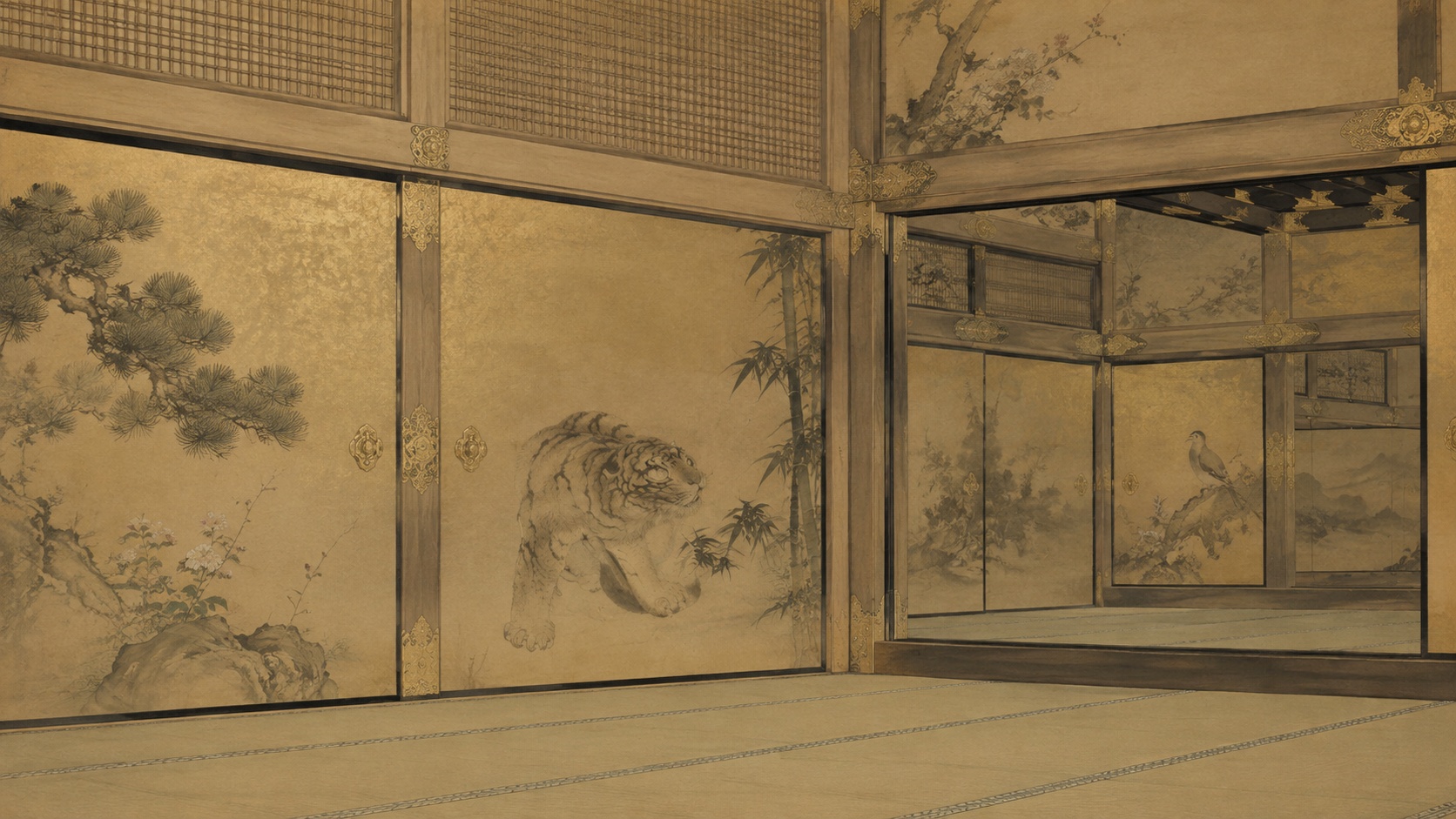
Image rights: © 2026 Japan.co.jp. AI-assisted editorial illustration. Unauthorized republication or reuse is prohibited. The image symbolically evokes a decorated Ninomaru Palace interior; it does not reproduce the featured paintings, the 1626 seating arrangement or an actual Ohiroma view. The tiger visible in the illustration is not among the works in this fall exhibition. For licensing, use the contact page.