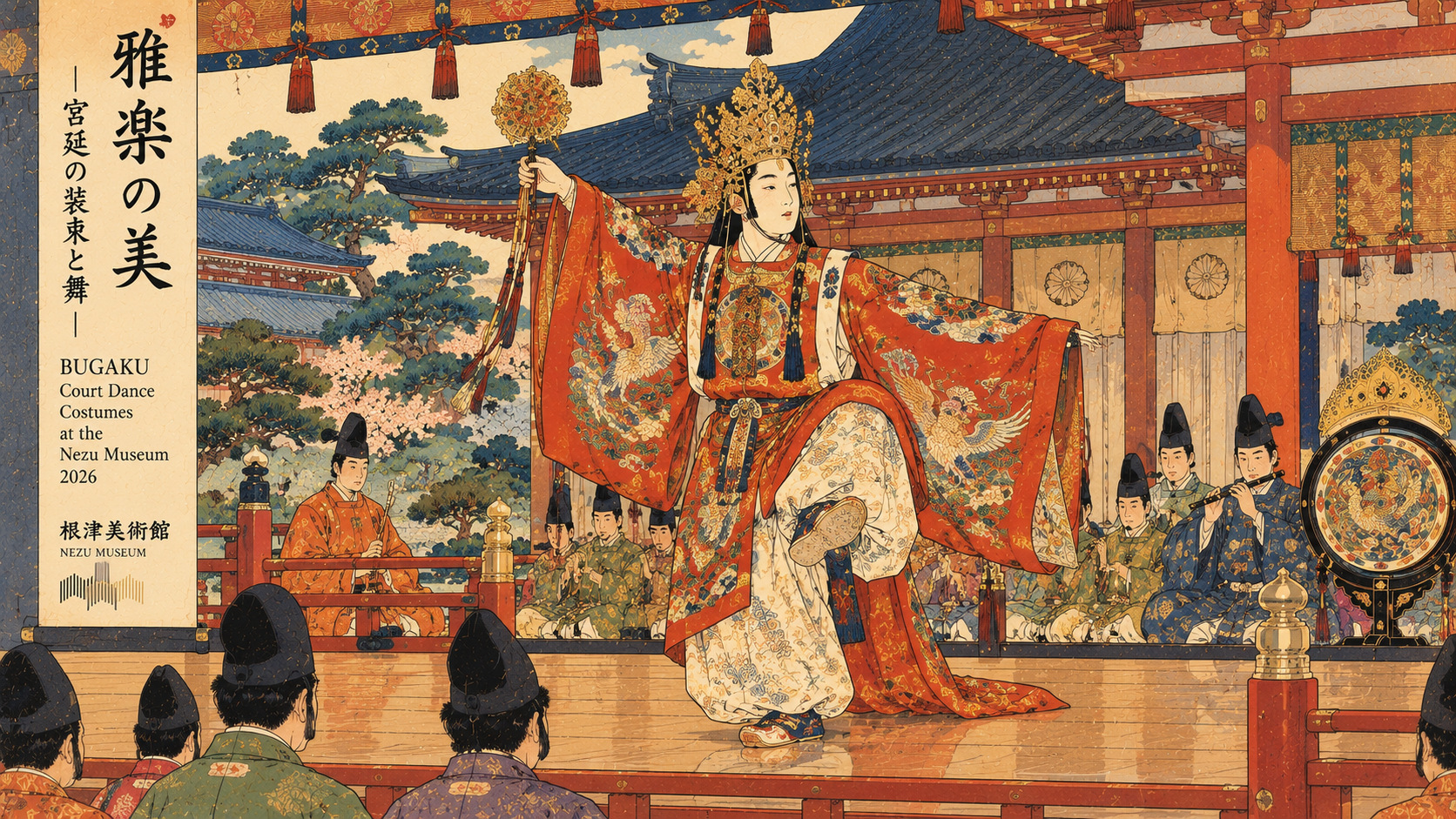
In bugaku, red and blue are more than stage colors. They carry a history of exchange, ritual, loss and renewal.
A dance survives in the cloth
A costume can preserve a performance long after its dancers have left the stage. Tokyo’s Nezu Museum opened Bugaku Costumes: The Enduring Beauty of Textiles on October 24, a display running until November 23, 2026. The museum’s announcement describes approximately fifty objects, including important cultural properties and documents. The exhibition is about more than splendid red and blue silk. Its objects tell of continental exchange, imperial ceremony, regional religious institutions, civil war, powerful patrons and the conservation of fragile garments that were made to move. Visitors can encounter the theatrical language of a tradition many outside Japan have never seen performed.
The difference between gagaku and bugaku
Gagaku is a broad tradition of Japanese court music and associated performances formed through a long history of incorporating influences from mainland Asia. Bugaku refers to its dances. The distinction matters: the museum is presenting garments and related historical records, not promising a live performance. Clothing once seen in motion is encountered at rest, allowing a viewer to study the weave, seams, embroidery, ornament and visual grammar that a dancer’s movement might otherwise obscure. Neither category should be treated as timeless or entirely isolated from the social institutions that sustained it.
Why red and blue matter—but do not tell the whole story
The museum explains the traditional division of dances into sahō, or left-side forms linked broadly to Chinese traditions, and uhō, or right-side forms linked broadly to the Korean Peninsula. Red is associated with the former and blue with the latter. These conventions record the historical organization of repertories; they are not a simple contemporary map of Asian cultures. Nor does every surviving garment obey the pattern without complication. Among the objects from Rinnōji are red and blue robes for Karyōbin, ordinarily classified as a left-side dance. The apparent exception makes the history more interesting, not less.
Imported music and a Japanese performing language
Nezu Museum traces the beginning of continental musical and dance influences arriving in Japan to around the fifth century. That does not mean every choreography on view today can be dated to that century. Music and dance were imported, reorganized, performed and adapted over generations. The museum describes the costumes as having evolved from the uniforms of court military officials into highly decorated dance clothing. Bugaku grew in imperial settings and at powerful temples and shrines, where rituals, patronage and regional practice all shaped its survival.
The gold brocade with a date of 1378
One exceptional object is a ryōtō, a type of overgarment, made from dark-blue gold brocade with scrolling peonies. The important cultural property is held by Tokyo National Museum and carries an inscription dated Eiwa 4, or 1378. The museum identifies it as a donation to the Niū Shrine associated with Mount Kōya’s Amanosha. That written evidence, together with the garment’s notably complete survival, makes it a reference point for studying other medieval dance costumes. A beautiful object becomes stronger historical evidence when its date is not merely guessed from its pattern.
Roses and an arched bridge in 1454
Another important cultural property, a pale-pink suikan from Kongōbuji, bears embroidered roses and an arched bridge. An inscription on an accompanying pair of trousers connects the set with preparations for a scripture ceremony held in 1454. The museum notes that the clothing was prepared for a rehearsal. Such a detail changes how the garment is understood: it was not designed to sit in a display case, but to participate in a carefully organized religious and artistic occasion. Its large embroidered motifs would have looked different once the dancer moved.
When war fractured the tradition
The turmoil beginning with the Ōnin War of 1467–77 brought serious disruption to the institutions of court music. The museum traces subsequent recovery under imperial and political patrons, with costume designs becoming more standardized across the court and major temples and shrines. Continuity did not mean freezing every pattern in an unchanged medieval state. Rebuilding practices, replacing instruments, commissioning garments and regulating performance were active decisions. The surviving costumes show that restoration can become part of tradition itself.
Shitennōji and the reconstruction of Taiheiraku
The Osaka temple Shitennōji has long been associated with performers of the Tennōji musical establishment. Fire and conflict destroyed the temple and its performance equipment in 1576, according to the museum. Contributions from the Toyotomi family subsequently supported restoration. A robe from a set of Taiheiraku costumes recalls that history. The dance remains part of Shōryō-e, ceremonies honoring Prince Shōtoku, and uses an elaborate assembly of armor, weapons and other accessories. To understand the robe merely as luxury clothing would miss its place in an organized ritual performance.
The Rinnōji treasures unseen for about forty years
The museum is also showing costumes from Rinnōji in Tochigi that it says have not been publicly seen for approximately four decades. They were commissioned in 1636 under the third Tokugawa shogun, Iemitsu, for a commemoration of Tokugawa Ieyasu. Especially evocative are robes embroidered with birds and flowers for Karyōbin, a dance associated with children. Red and blue examples survive. Their designs and unusual pairing remind viewers that real objects often complicate tidy explanations of tradition.
What a painted scroll can restore
Garments are not the exhibition’s only witnesses. A fifteenth-century painting of Raryōō, traditionally attributed to Tosa Yukihide, shows a young dancer wearing several parts of a costume together. A 1408 painted handscroll by Abe no Suehide, now in the Asian Art Museum of San Francisco, offers rare dated visual evidence of medieval bugaku attire. Such images are not recordings of an actual performance. They can nonetheless help scholars and viewers understand how surviving textiles once fitted around bodies, how the silhouettes changed during movement, and what historical artists thought important to depict.
Why preservation is not passive
Silk garments carried through centuries are especially vulnerable to light, moisture, insects and handling. Display and conservation can conflict with the purpose for which clothing was created: performance. The exhibition highlights that tension without settling it. Published materials do not document the specific treatment history of every loan, so individual conservation interventions should not be invented. The broader lesson is that preservation involves choices—about access, fragile materials, interpretation and sometimes whether an object can ever safely be worn again.
How to visit
The exhibition is in Galleries 1 and 2 of the Nezu Museum in Minami-Aoyama, Tokyo, from October 24 to November 23. Hours are 10 a.m. to 5 p.m., last admission 4:30 p.m. The museum is generally closed on Mondays during the run but opens on Monday, November 23, a national holiday. Online timed-entry admission is ¥1,600 for adults and ¥700 for students at university level and above. Younger students may enter free with identification under the stated rules; same-day tickets cost an additional ¥200. Confirm current ticket availability and accessibility arrangements with the museum before traveling.
The threads connecting Asia and Japan
Bugaku can easily be labeled a quintessentially Japanese tradition, yet the exhibition reveals how insufficient that phrase is. Its costumes embody artistic traffic across East Asia, court authority, the patronage of temples, recovery from war, and centuries of skilled textile work. A red robe or blue robe is both a designed object and a historical argument about what a community chose to continue. The dancers are absent from the galleries, but the garments give visitors a way to imagine movement—and to question the comforting idea that culture survives without ever changing.
Sources and reporting method
Based on exhibition records from Nezu Museum and published exhibition reporting; no first-hand visit, object examination or curator interview is claimed.