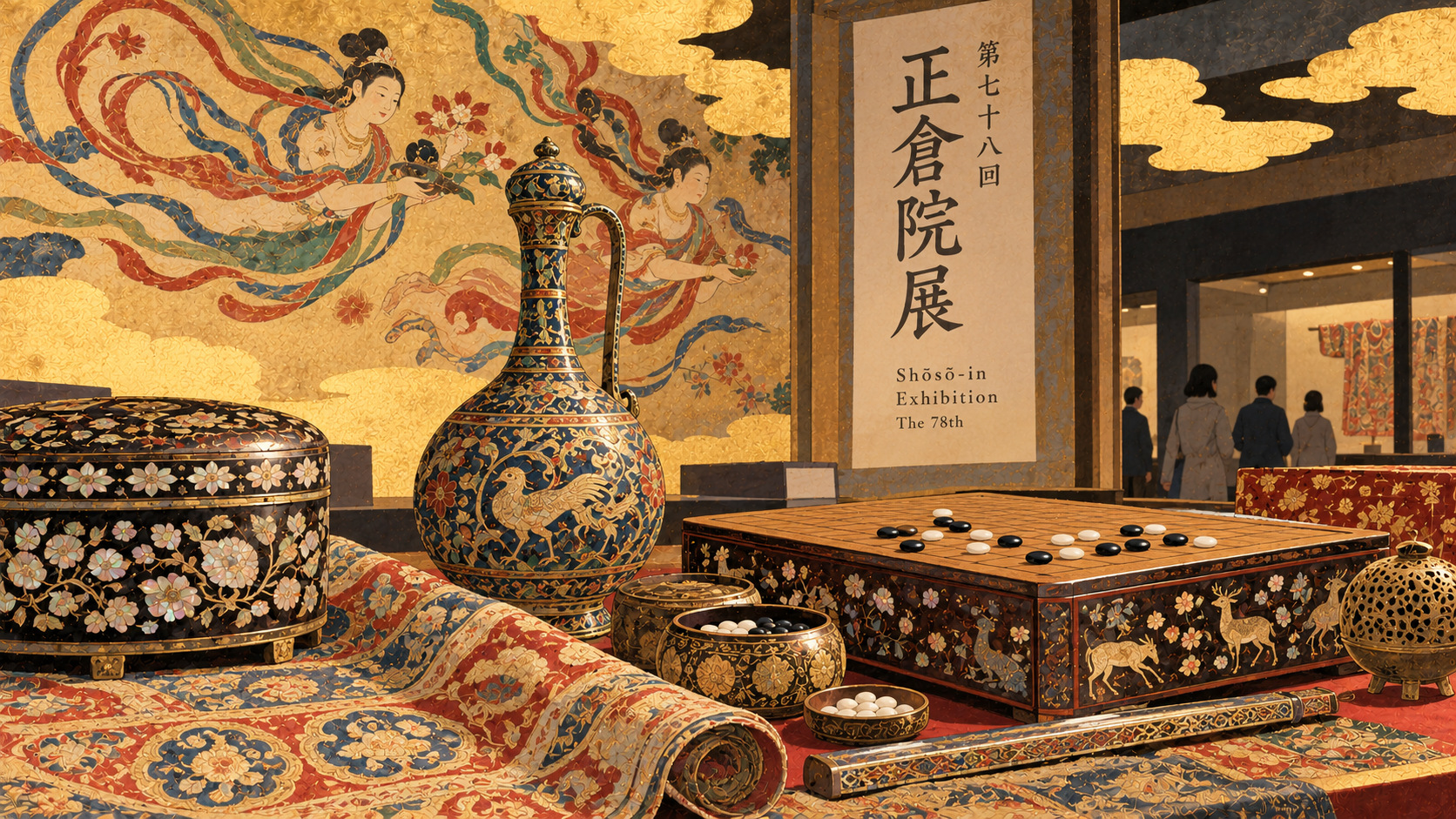
Among the treasures of imperial Japan, one object seems almost impossible to invent: the dried remains of a Japanese marten once understood through the language of dragons. There are also exquisite ivory Go stones, a lacquer ewer shaped by the exchange of ideas across Asia, and documents that speak less of royal splendor than of taxes, work and the running of a capital.
That breadth makes the 78th Annual Exhibition of Shōsō-in Treasures, opening at the Nara National Museum on October 24, more than a showcase of ancient luxury. It is an encounter with a Japan that was already connected to distant worlds—and with the patient research that makes those connections intelligible today.
The gift that helped create a cultural time capsule
In 756, after the death of Emperor Shōmu, Empress Kōmyō began dedicating possessions associated with the emperor to the Great Buddha at Tōdaiji. The inventory called the Kokka chinpōchō, or “List of Rare Treasures of the State,” survives as an extraordinary historical record. Yet the Shōsō-in is not merely the remains of one emperor's wardrobe or treasury. Its holdings also preserve objects used in Buddhist ceremonies, items relating to temple administration and construction, and documents connected with the lives of people outside the court.
The museum describes a corpus of roughly 9,000 treasures. For centuries, access was regulated through an imperial-seal system known as chokufū. Such a collection survives not because it was magically untouched, but through protocols of custody, periodic inspection, research and conservation.
A Persian silhouette, an East Asian workshop
One of the exhibition's finest objects, the Shikkōhei, is a lacquered ewer whose handle and overall form draw on vessel types associated with West Asia. Its dark surface carries elaborate silver-cut patterns of animals, flowering plants and landscapes. The Nara National Museum says the techniques suggest that this particular vessel was likely brought from Tang China.
This is an important distinction. Calling it a “Persian import” might sound romantic, but the object tells a more intricate story: forms migrate; materials and techniques are adapted; artisans in one region reinterpret the visual vocabulary of another. To understand the Silk Road, follow not just where objects traveled but where their designs changed.
An emperor's Go stones—and the artisans behind them
Among the treasures connected with Shōmu are the intricately ornamented red and blue ivory Go pieces, known as Kōge bachiru no kishi and Konge bachiru no kishi. Their decoration turns the ordinary shape of a game piece into a small work of virtuoso craft. An associated silver-decorated lidded container, the Gin heidatsu no gōsu, adds another layer of refinement.
These objects open two routes into history. One leads to recreation and taste at the imperial court. The other leads to the almost invisible work of craft specialists who transformed ivory, pigments and precious metals into something capable of surviving centuries.
The animal called a dragon
Then there is Kōryū, literally “Rainbow Dragon.” The museum identifies the approximately 23-centimeter dried animal as a Japanese marten, probably female, on the basis of anatomical examination. A fifteenth-century account of the taking of fragrant wood known as Ranjatai mentions a “dried dragon,” but the precise relationship between historical references and this specimen deserves care.
Researchers cannot say conclusively how it came to be stored. Did the animal enter on its own and dry naturally? Was it introduced after the fact and interpreted as something marvelous? The science has brought the creature down to earth without exhausting the mystery of its history. That is what makes it such a memorable treasure.
Religion, administration and the people beyond the palace
The painted offering box Mitsuda saie bako is associated with offerings made during the Great Buddha's eye-opening ceremony in 752. A plan of the Tōdaiji temple complex, and documents concerning the administrative life of the capital, direct attention to carpenters, scribes, officials, worshippers and craftspeople. The dazzling court objects matter, but the records of ordinary organization and labor tell us how that world functioned.
For visitors familiar with Japan chiefly through temples, prints or samurai stories, such documents can be unexpectedly powerful. They turn an elegant historical image into a society with budgets, obligations, building plans and people tasked with carrying them out.
Why this exhibition began in 1946
The first annual exhibition of Shōsō-in treasures opened in 1946, in the unsettled first years after Japan's defeat in World War II. With three exceptions when the exhibition was staged in Tokyo, the yearly presentation has been held in Nara. The 2026 show is its 78th iteration and arrives 80 years after that first postwar opening.
The selection changes from year to year; it is not an unrestricted opening of the entire repository. Conservators and curators weigh what can be shown safely and what new research might allow visitors to see with fresh eyes. Material analysis, documentation and historical scholarship continue to reshape what the treasures mean.
Why a label reading “Silk Road” is not enough
Shōsō-in is often described as a monument to Silk Road exchange. That is useful shorthand but imperfect history. A motif inspired by West Asia does not, by itself, establish where an artifact was made. A Tang-era manufacturing technique and a Persian-inspired profile can exist on the same vessel. The museum's careful distinctions about objects such as the ewer are part of the story, not academic footnotes to it.
Nara was not an isolated endpoint to a single route. It was connected to an immense world of merchants, monks, diplomatic exchanges, workshops and cultural intermediaries. The more closely we inspect each object, the more human that network becomes.
How to see the exhibition
The exhibition runs October 24–November 9, 2026, in the Nara National Museum's East and West New Wings, with no closed days during its run. Hours are 8 a.m.–6 p.m., extending to 8 p.m. on Fridays, Saturdays, Sundays and public holidays. Last entry is one hour before closing. Timed-entry arrangements apply; visitors should consult the museum's English-language information for ticketing and access before traveling.
Go to admire the impossible refinement of the court. Stay to wonder at an animal once called a dragon, a vessel made across traditions, and a collection that has kept inviting new questions for more than a millennium.
Primary sources and further reading
Based on material available by October 22, 2026. Official sources report conflicting exhibition totals, so this story avoids stating a final count. No original interviews were conducted.