Gokayama is sold to the world through silence: steep thatched roofs, deep snow and mountain settlements isolated by geography. On September 5, its history arrived as noise.
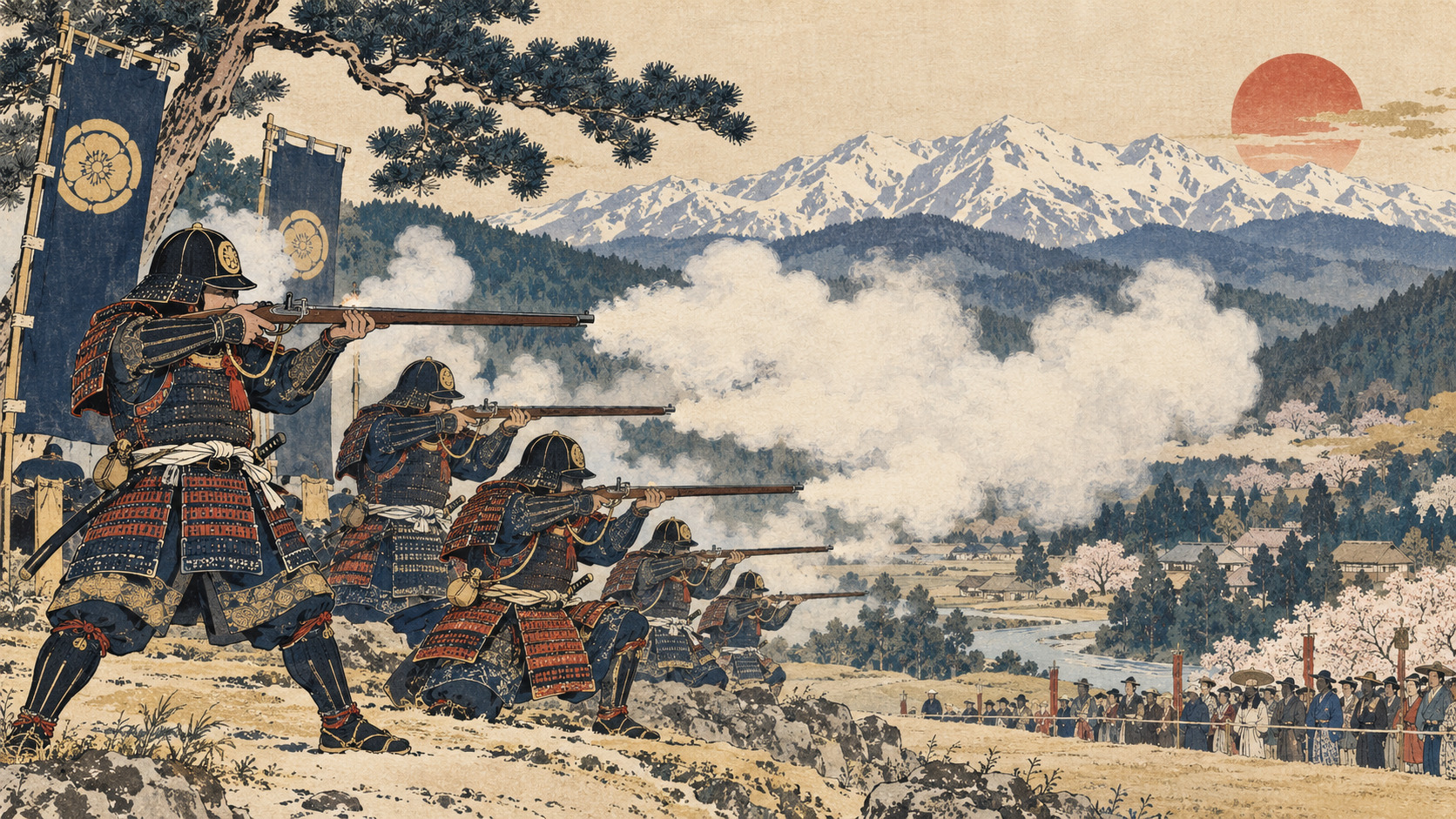
At Roadside Station Taira, part of Gokayama Washi no Sato in Nanto, Toyama Prefecture, members of the Gokayama Enshō Matchlock Corps appeared in jinbaori surcoats. The visiting Shinshu Sanada Matchlock Corps wore armour. They demonstrated the sequence of loading, taking position and firing Edo-period matchlocks. Sparks flashed; a bank of pale smoke formed; the volley cracked across the open ground.
The organiser’s notice listed two demonstrations, at 2 and 3 p.m., with the Gokayama Saltpetre Research Society as host. Japanese television reporting said the guns themselves dated from the Edo period. The event was visually martial, but Gokayama’s claim on this history does not rest on a famous battlefield or castle lord. It rests on an ingredient.
For roughly three centuries, households in these mountains manufactured enshō—saltpetre, or potassium nitrate. Mixed with sulphur and charcoal, it became black powder. The people behind the weapon were not only gunsmiths and samurai. They were farming families tending a slow chemical process below the rooms in which they lived.
A gunpowder history beneath the floorboards
Black powder requires three materials. A history published by Kanazawa City says the Kaga domain drew saltpetre from Gokayama, sulphur from the volcanic Jigokudani area of Tateyama, and charcoal. Saltpetre was the difficult component: Japan did not possess abundant natural deposits of the kind available elsewhere in Asia.
Gokayama developed what researchers call the cultivation method. A pit was dug beneath a house. Soil, mountain grasses, straw and nitrogen-rich waste from silkworm cultivation were layered inside. Families periodically mixed the material and allowed nitrifying bacteria to work over years. The compounds were then leached from the soil with water, concentrated by boiling and processed with wood ash until rough potassium-nitrate crystals formed.
A government multilingual explanation prepared through Japan’s tourism programme says some pits reached two metres deep and the material fermented for about five years. The hearth above helped maintain the environment. Upper floors supported sericulture; the ground floor sheltered family life; the earth below became a chemical workshop.
This changes how a gassho-style house should be seen. The building was not a picturesque shell later assigned heritage value. It was an integrated machine for survival: residence, sericulture loft, workshop, heat source and storage. Its steep roof answered snow. Its internal volume answered labour.
- Mix soil, grasses, straw and silkworm waste in a pit below the house.
- Turn and replenish the material during a multi-year nitrification process.
- Leach the nitrate-bearing earth with water and boil the liquid down.
- Use wood ash in purification and crystallise crude saltpetre.
- Move household product through intermediate and specialist refiners before shipment.
Modern research funded by Japan’s Grants-in-Aid for Scientific Research describes the Gokayama technique as a distinctive biotechnology developed through accumulated experience. That language matters. “Traditional knowledge” can sound soft or decorative; this process controlled microbes, temperature, raw materials, extraction and quality without modern instruments.
From mountain household to domain arsenal
The origin story remains unsettled. Gokayama’s official tourism history notes traditions reaching back toward the Ishiyama Honganji wars of the late 16th century, then explicitly says the beginnings are obscure. A compelling legend is not the same thing as a document.
One firm administrative marker comes in 1605. Nanto City’s cultural archive links a directive issued under Maeda Toshinaga to the point when saltpetre entered the local tax system. From 1637, the official Gokayama history says, most production became omeshi enshō, saltpetre purchased annually by the Kaga domain.
Households produced a crude material called aku enshō. Better-capitalised refining operators, including jōniya, bought and purified it. The finished product travelled over mountain routes to domain storehouses at Tsucchōzu in Kanazawa. What began with bacteria and silkworm waste ended inside an organised fiscal, transport and military system.
That chain complicates the heroic image of the matchlock. A samurai pulled the trigger, but rural labour sustained the supply. A volley represented years of work by people whose names rarely entered chronicles: gathering vegetation, tending silkworms, turning soil, cutting fuel, boiling liquid and carrying product out of the mountains.
The peak came with Perry’s ships
Demand rose in the final years of Tokugawa rule as coastal defence against foreign vessels became urgent. Gokayama’s official history records 5,391 kan—approximately 20 tonnes—of saltpetre production in 1853, the year Commodore Matthew Perry arrived in Japan. The same source cites an Edo-period gunnery text that praised Kaga saltpetre as the country’s finest grade.
Claims of “Japan’s best” need qualification. They draw on period reputation and later scholarship, not a complete modern statistical comparison of every producer. It is sounder to say that official records and research consistently identify Gokayama as one of Japan’s leading saltpetre centres.
The system then collapsed quickly. The abolition of the domains in 1871 removed Kaga’s purchasing structure. Cheap imported Chilean nitrate undercut the labour-intensive local process. A technology refined across generations did not simply become scientifically wrong; it lost the institution and market that had made it viable.
Japan did not receive the matchlock in a single moment
The familiar story dates the firearm’s arrival to Portuguese contact at Tanegashima in 1543. Japan’s National Museum of Japanese History widens the frame: matchlock technology travelled from Europe into East and Southeast Asia, changed there, and then reached Japan. Transfer was a network, not a solitary flash of invention.
Gokayama adds a second correction. Importing a gun is not the same as building a firearms system. Japan required metalworking, gunsmithing, gunnery schools, powder manufacture, raw-material supply and distribution. A weapon’s history becomes intelligible only when all those systems are placed beside it.
That is why the Nanto demonstration is more than a firing drill. Loading and coordinated movement preserve embodied knowledge. The report of the volley directs attention to the object. The name “Gokayama Enshō Matchlock Corps” directs it back to the material economy.
Firing an antique is a form of preservation—and a risk
Japanese news coverage described the matchlocks used on September 5 as genuine Edo-period guns. Age alone does not make a firearm legally unrestricted. The Tokyo Metropolitan Police explains that matchlocks and other antique firearms of artistic or antiquarian value may be registered by prefectural boards of education. A registered object falls within a statutory exception permitting possession.
The publicly available event material does not establish the paperwork or safety plan for each weapon, so this article does not speculate about either. The broader tension is enough: museum preservation normally minimises handling, vibration and heat, while a firing tradition depends on making an old mechanism function.
Practitioners must therefore preserve more than an object. They maintain procedures, inspection habits, spacing, commands and collective discipline. The matchlock survives as material culture because it is treated as both artefact and working machine. The choice to fire it makes the past sensory, but it also creates an obligation that a replica performance would not carry.
The unseen industrial layer of a World Heritage landscape
Ainokura and Suganuma in Gokayama joined Ogimachi in neighbouring Shirakawa-go on the UNESCO World Heritage List in 1995. Visitors recognise the sharply pitched thatched roofs immediately. The less visible achievement is the organisation of production inside them.
The Enshō no Yakata museum in Suganuma has presented tools and staged displays tracing the process from gathering raw materials through boiling, refining and shipment. In 2026, however, the Gokayama NANTO tourism organisation announced that the museum would close temporarily from July 31 for repairs and safety checks. No reopening notice was located by this article’s September 6 cutoff.
That closure gives an outdoor demonstration additional interpretive weight, although a volley cannot replace a museum. Sound conveys force. It does not by itself convey five years of fermentation, the role of family labour, domain control or the fragility of a market dependent on one buyer.
The most responsible heritage work links the experiences. The gun gives the saltpetre a consequence. The farmhouse gives the powder a workplace. The archive gives the spectacle chronology and doubt. Scientific research reveals that empirical household practice was also chemistry.
What does a reenactment choose to remember?
Historical gunnery has two powers. It can transmit embodied technique and make an otherwise distant technology unforgettable. It can also reduce history to armour, banners and martial excitement, allowing the drama of the weapon to obscure the labour and authority behind it.
Gokayama’s local corps carries a partial answer in its name. It is not named for a victorious warlord. It is named for saltpetre. That word redirects the story away from the person who commanded the gun and toward the community that enabled it to fire.
The white smoke at Roadside Station Taira dispersed within seconds. The report of the volley faded into the mountains. Ask why it sounded here, however, and a three-century system appears: a pit beneath a farmhouse, insects in the loft, grass cut from the slopes, refiners and porters, a distant castle town, and finally a global nitrate market that made the system obsolete.
The achievement is not that an old gun can still make a startling noise. It is that the noise can open a path back to the society that made every shot possible.
- TV Asahi, “Edo-period matchlocks thunder in Nanto” — September 5 venue, participating corps and demonstration details.
- Gokayama Information Office, matchlock demonstration notice — time, venue, organiser and participating groups.
- Nanto City, Gokayama Washi no Sato — official facility name, address and component institutions.
- Nanto City Culture and Arts Archives, “Enshō” — cultivation method, 1605 document and domain taxation.
- Official World Heritage Gokayama tourism site, history — annual domain purchases, 1853 output, 1871 decline and uncertain origins.
- Ministry of Land, Infrastructure, Transport and Tourism, Gokayama saltpetre production — fermentation, extraction and shipment.
- Kanazawa City, saltpetre production in the Kaga domain — black-powder ingredients and supply network.
- KAKEN research project on Edo-period saltpetre methods — historical and experimental assessment of Gokayama’s cultivation process.
- National Museum of Japanese History, firearms transmission in Japanese history — the East and Southeast Asian route of matchlock technology.
- Tokyo Metropolitan Police, antique firearms and registration — legal framework for registered matchlocks.
- Gokayama NANTO Tourism Association, temporary closure of Enshō no Yakata — closure from July 31, 2026.
- Agency for Cultural Affairs, World Heritage nomination for Shirakawa-go and Gokayama — cultural landscape and gassho-style settlements.