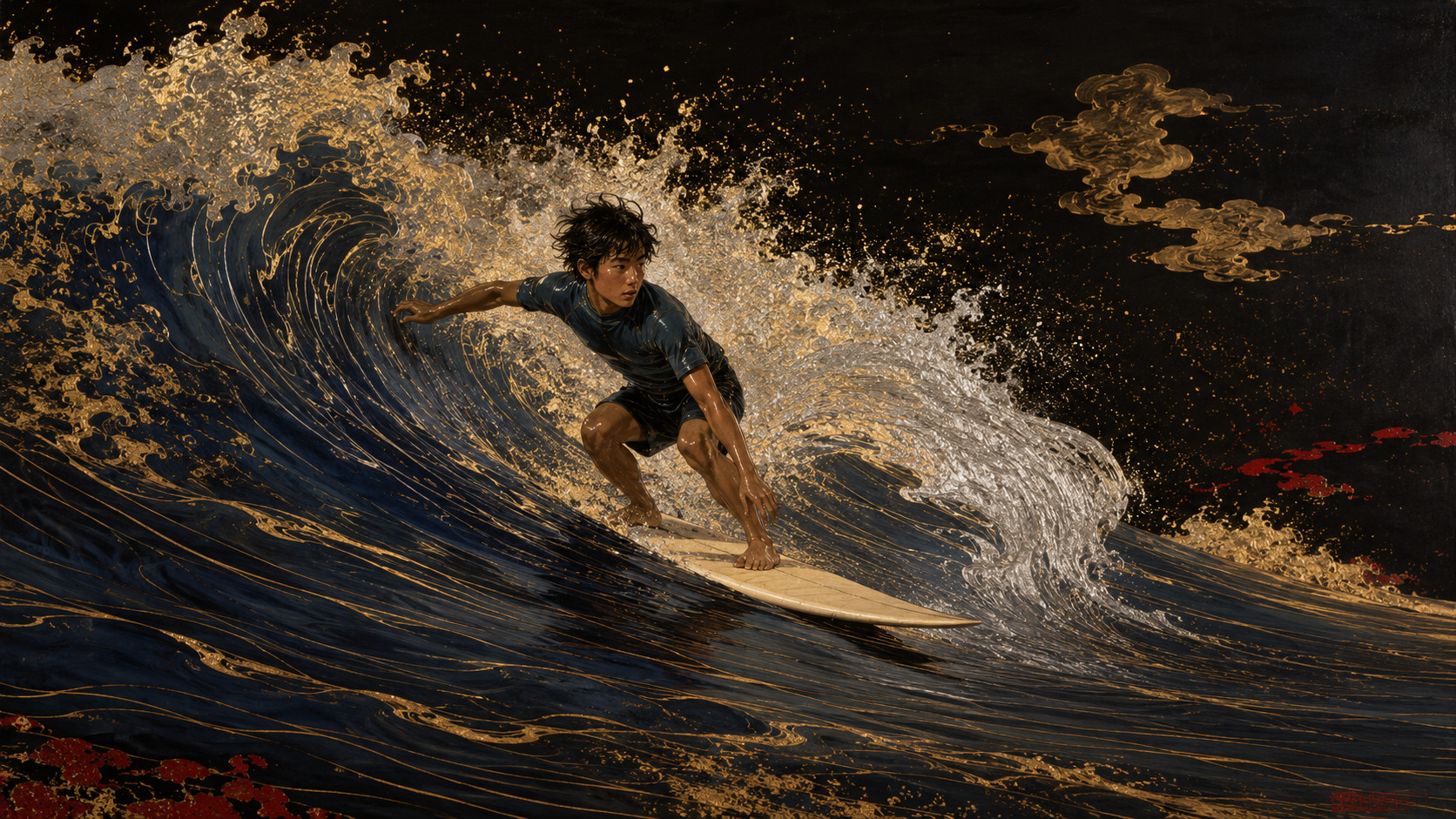
Taichi Ishiyama was behind, and the high-school boys’ final was almost over. Hyuga Fujiya had assembled a 6.67 and a 4.40 for 11.07. With the clock running down, Ishiyama needed more than a routine score and still needed the sea to offer him a usable wave.
The last opportunity came. Ishiyama used the face of the wave and earned 6.77, according to contemporaneous reports from the competition. That was enough to replace his lower counting score and move him into first place before the final signal at Tsurigasaki Beach in Ichinomiya, Chiba Prefecture.
It was a finish peculiar to surfing. A runner controls when to accelerate; a batter knows a pitch is coming. A surfer can position, anticipate and choose, but cannot order one more wave. Ishiyama had to convert the final piece of moving water he received.
One wave remained
The official LiveHeats result places Ishiyama first, Fujiya second, Dai Fujiwara third and Masamune Uno fourth. The score story matters because surfing is not decided by adding every attempt. The Japan Surfing Association’s general competition guide explains that several judges ordinarily score each ride, the high and low marks are removed, and the remaining marks are averaged. A surfer’s two best rides usually form the heat total.
That system rewards quality over accumulation. It also makes the weaker of two counting scores a moving threshold. Ishiyama’s 6.77 did not stand alone: it mattered because it improved his two-wave sum beyond Fujiya’s 11.07. The values reflect comparative judgments about speed, power, difficulty and risk on waves that are never identical.
Event media described the first day, August 29, as cloudy with occasional rain, northeast onshore wind, a broken surface and waves around one meter. On the final day, the face was cleaner and sets occasionally reached roughly 1.5 meters. Those descriptions are observations from competition coverage, not measurements from an official weather station. Better-looking conditions did not make the wave supply equal.
A 9.00 aerial and an 8.83 left
Rio Urayama supplied the event’s most emphatic single ride. In the middle-school boys’ final, he drove above the wave face, completed an aerial and landed it. The 9.00 was the highest single-wave score of the competition, according to the event report. Kaimana Harada finished second, Yusei Iida third and Taisei Tanabe fourth.
Urayama had won the elementary-school boys’ division in 2025. His 2026 victory therefore came immediately after moving into the older bracket. That distinction is important: the result was not a defense of the same title against the same age group, but a successful step into a new division.
The middle- and high-school girls’ final turned on a different kind of ride. Yumi Munemasa selected a left-breaking set wave and linked two strong turns for 8.83. She defeated Yume Kizu, who also competes professionally. Kaina Yamamoto placed third and Riro Nakagawa fourth. Munemasa’s win was a title at this event, not a professional qualification or an Olympic selection result.
Two younger champions completed the program. Mauna Fujimoto won elementary-school boys with 6.77 and 6.67 for 13.44. Konami Oe took elementary-school girls. Centering only the three athletes named in the initial news line would erase two of the five finals, so the complete champion list follows.
| Division | Champion | School | Verified final detail |
|---|---|---|---|
| High-school boys | Taichi Ishiyama | Tokai University Bosei Senior High School | Last-wave 6.77 reversal |
| Middle-school boys | Rio Urayama | Ichinomiya Municipal Ichinomiya Junior High School | 9.00 aerial |
| Middle- and high-school girls | Yumi Munemasa | Yugawara Municipal Yugawara Junior High School | 8.83 left |
| Elementary-school boys | Mauna Fujimoto | Ichinomiya Municipal Torami Elementary School | 6.77 + 6.67 = 13.44 |
| Elementary-school girls | Konami Oe | Ichinomiya Municipal Torami Elementary School | First in official ranking |
A tournament built to show growth
The 2026 results become more revealing when placed beside earlier editions. Ishiyama was runner-up in middle-school boys in 2022 and won that division in 2024. After aging into high-school boys, he reached the top of the older bracket in 2026. The last-wave reversal was dramatic; the longer record shows it was also part of a multi-year climb.
Urayama placed third in elementary-school boys in 2024, won it in 2025, then won middle-school boys in 2026. Munemasa followed another staircase: third in elementary-school girls in 2024, fourth in the combined middle- and high-school girls’ class in 2025, and first in 2026.
These are not controlled measurements of development. The waves, opponents, judging panels and field sizes changed from year to year. A placement cannot isolate the influence of coaching, physical growth or local water time. What the record can show is persistence across divisions: the same athletes returned, met a higher age threshold and changed their place in the order.
| Athlete | 2022 | 2024 | 2025 | 2026 |
|---|---|---|---|---|
| Taichi Ishiyama | 2nd, middle-school boys | 1st, middle-school boys | Moved to high-school division | 1st, high-school boys |
| Rio Urayama | — | 3rd, elementary-school boys | 1st, elementary-school boys | 1st, middle-school boys |
| Yumi Munemasa | — | 3rd, elementary-school girls | 4th, middle/high-school girls | 1st, middle/high-school girls |
From 29 high-schoolers to five divisions
The event began on August 12, 2018, as 2018なみのり甲子園, the first national high-school surfing championship. An official Ichinomiya mayoral diary says the town sports association’s water and marine sports section developed the idea. Twenty-nine high-school surfers from nine prefectures took part, and Sho Matsubara became the first champion.
The name deliberately borrowed the cultural shorthand of Koshien, the national high-school baseball stage. But NAMINORI Koshien is not a school-federation team championship, and its winners are not champions of every Japanese school surfer. It is an independently organized youth competition. That distinction does not diminish the event; it defines the title accurately.
Matsubara won again in 2019. The event was not held in 2020 or 2021 during the COVID-19 pandemic. When the organizing committee announced the third edition for 2022, it expanded eligibility beyond high-school boys to elementary- and middle-school classes and girls’ classes. By 2024, published material used the capitalized NAMINORI styling and showed the five-division structure seen in 2026.
2018 — First edition; 29 high-school surfers from nine prefectures; Sho Matsubara won.
2019 — Matsubara repeated as high-school boys’ champion.
2020–21 — No event during the COVID-19 pandemic.
2022 — Third edition returned with elementary, middle-school and girls’ categories.
2024 — Published records show the NAMINORI styling and five divisions.
2026 — Seventh edition crowned Ishiyama, Urayama, Munemasa, Fujimoto and Oe.
The Olympic beach is part of the test
Tsurigasaki Beach sits at the southern end of the long Kujukuri coast and is widely known in surfing as Shidashita. Ichinomiya calls its coastline a “training ground for wave riding.” In 2021, this was where surfing made its Olympic competition debut at the postponed Tokyo 2020 Games.
An Olympic venue carries symbolic weight, but its practical value is local and daily. Surfers must read tide, wind and the spacing of sets rather than compete on a standardized field. Access to this coastline can create more opportunities to learn those patterns. It does not guarantee a title.
The 2026 results nevertheless show substantial local representation. Urayama and runner-up Harada attend Ichinomiya Junior High School. Fujimoto and Oe, the two elementary champions, attend Torami Elementary School. Those placements are evidence of a local cluster, not proof by themselves that one training system caused the results. Public data on participant numbers, coaching hours, costs and comparable regions would be needed for that conclusion.
Four terms that make the scores legible
- Ride: A surfer’s performance on one wave, ordinarily assessed on a 0–10 scale.
- Best two: The two highest ride scores usually form the heat total, with a maximum of 20.
- Set: A group of larger waves arriving together.
- Left / aerial: A wave ridden left from the surfer’s perspective / a maneuver that leaves the wave face and lands back on it.
What a youth title can—and cannot—measure
Scores of 6.77, 9.00 and 8.83 identify decisive performances in particular heats. They cannot answer the larger development questions on their own: how many entrants return the following year, whether travel costs limit the field, whether girls receive equal competitive opportunity, or how many athletes continue when they move into an older class.
Promotional material presents NAMINORI Koshien as a gateway for young surfers. Sharing a final with an athlete who already competes professionally can certainly create a demanding benchmark. Japan.co.jp found no published rule that turns a victory here automatically into professional status, national-team designation or Olympic qualification. “Gateway” should therefore be understood as the organizer’s developmental ambition, not a guaranteed pathway.
The accessible 2026 organizer material also does not state a total entry count. The current competition rulebook, complete final ride logs and athlete post-final transcripts were not available in the sources reviewed. Those gaps matter. Without participation and retention data, growth is easy to celebrate but difficult to measure.
Japan.co.jp’s analysis is that the event’s most demonstrable development asset is its multi-year record. Ishiyama, Urayama and Munemasa can be followed from earlier placements into older divisions and 2026 titles. Publishing annual entry totals, regional and gender breakdowns, and return rates would make that staircase visible beyond its most successful climbers.
The sea did not repeat itself on August 30. Neither did the champions. Ishiyama waited and reversed a final at the edge of the clock. Urayama went airborne. Munemasa linked two turns on a left. Their scores belong to one weekend; the record of how they arrived there gives the weekend its history.
Sources and documents
- EntryPlus: “Seventh NAMINORI Koshien” and LiveHeats: “Seventh NAMINORI Koshien 2026” (August 29–30 dates, organizer, venue and official rankings in five divisions)
- THE SURF NEWS: “Taichi Ishiyama, Rio Urayama and Yumi Munemasa among the winners”, August 30, 2026 (final conditions, 6.77, 9.00 and 8.83 rides, Fujimoto’s 13.44, full finalists and Japanese name readings)
- NAMIARU event report: “Seventh NAMINORI Koshien 2026” (competition-day conditions, day-one scores, beach clean and organizer reporting)
- Ichinomiya: 2018 mayoral diary on the first Naminori Koshien and Naminori Koshien Organizing Committee: 2022 return (29 entrants from nine prefectures, origin, first champion, pandemic interruption and expanded eligibility)
- Ichinomiya: Tsurigasaki Beach and Japan Surfing Association: How to watch a surfing contest (Shidashita, Tokyo 2020 venue, general heat and judging principles, specialist terminology)
- SURFMEDIA: 2022 results, 2024 results, 2025 results, and Yugawara Municipal Yugawara Junior High School (prior placements and Munemasa’s official school name)
Reporting was checked against Japanese material available by 1:15 AM JST on September 2, 2026. The event title, dates, divisions and rankings were checked against the organizer’s entry page and official LiveHeats results. Japanese name forms and readings, schools and reported final scores were cross-checked against contemporaneous competition coverage and official school sites. A result listing’s malformed “Kanagawa Prefecture Municipal Yugawara Junior High School” was corrected to the school’s official name, Yugawara Municipal Yugawara Junior High School. The accessible sources did not provide a 2026 entry total, a current public event rulebook, every finalist’s complete ride log or primary-source athlete quotations; none has been inferred or reconstructed. The scoring explanation comes from the Japan Surfing Association’s general guide and does not assert this event’s exact heat duration or priority procedure.
Image rights: © 2026 Japan.co.jp. This AI-assisted editorial illustration may not be republished or reused without prior written permission. For licensing, use the contact page.