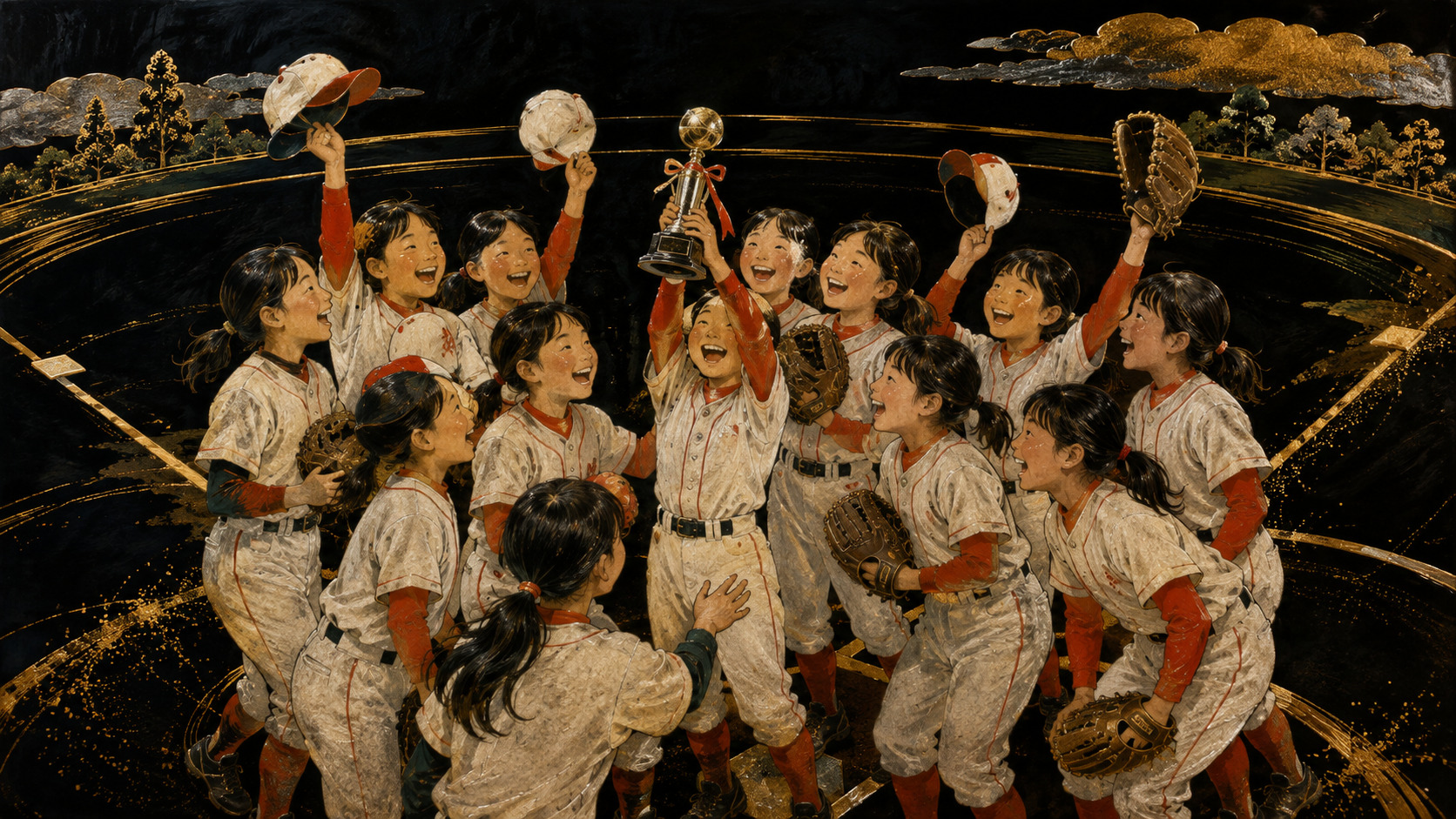
The final began at 8:02 on an August morning in Otsu, Shiga Prefecture. Three innings later, All Oita Girls were behind for the first time in the championship game. Okinawa Girls had converted a hit batter, a steal and a sacrifice into a runner at third, then delivered a single to right for a 1–0 lead.
Oita did not answer by swinging harder. A leadoff walk and an infield single in the bottom of the fourth put two runners aboard. The next batter sacrificed them to second and third. After the cleanup hitter was retired, the No. 5 hitter drove a two-out single through center. Both runners scored. In five plate appearances, Oita had turned a deficit into a 2–1 lead.
The fifth inning supplied distance. Consecutive singles, a flyout to second and another bunt hit loaded the bases with two outs. Oita’s No. 3 hitter, who had laid down the sacrifice an inning earlier, sent a double over the center fielder and cleared them. The same player had traded an out for 90 feet in one inning and delivered three runs with one swing in the next.
The final turned on two disciplined swings
The official scorebook gives the performance a shape that the final score alone cannot. Oita had only one walk and left two runners on base. Its nine starters went a combined 8-for-20, and none struck out. The third baseman, batting second, collected three hits in three at-bats and scored twice. The catcher in the No. 3 spot combined a sacrifice with the three-run double; the No. 5 hitter supplied the two-run single that reversed the game.
On the mound, Oita’s captain worked the first five innings. Okinawa managed two hits against the starter and scored its lone run in the third. The three-hit third baseman then moved to the mound for the sixth. She surrendered consecutive singles to open the inning but retired the next three batters on comebackers to end the championship.
The format mattered. Games in this tournament are scheduled for six innings, so Okinawa’s final opportunity arrived immediately after Oita’s three-run fifth. NPB recorded 1 hour, 6 minutes of playing time, plus a separate 13-minute interruption for hydration and field maintenance. There was no seventh inning waiting for another comeback.
| Team | 1 | 2 | 3 | 4 | 5 | 6 | R | H | E |
|---|---|---|---|---|---|---|---|---|---|
| Okinawa Girls | 0 | 0 | 1 | 0 | 0 | 0 | 1 | 4 | 0 |
| All Oita Girls | 0 | 0 | 0 | 2 | 3 | × | 5 | 8 | 1 |
Six days demanded six different answers
Oita’s route through the bracket was not a six-game version of the final. The prefectural select team opened by shutting out host representative Lake Kids 6–0. It overwhelmed All Aichi Girls 16–2 in the second round. The third round was the escape: Hokkaido Snow White Jr. scored three in the top of the sixth to lead 9–6, only for Oita to draw level and win 10–9 in the bottom half.
A 16–0 quarterfinal against Kagoshima Jr. Girls followed. Then came Osaka Best Girls, the champions in both 2024 and 2025. Osaka scored first in the semifinal; Oita replied with two in the bottom of the opening inning and won 6–1. Okinawa also scored first the following morning. Again, Oita answered.
| Date | Round | Opponent | Score | Game character |
|---|---|---|---|---|
| Aug. 22 | First round | Lake Kids | 6–0 | Opened with a shutout |
| Aug. 23 | Second round | All Aichi Girls | 16–2 | Ended after four innings on time |
| Aug. 24 | Third round | Hokkaido Snow White Jr. | 10–9 | Sixth-inning walk-off |
| Aug. 25 | Quarterfinal | Kagoshima Jr. Girls | 16–0 | Ended after five innings on time |
| Aug. 26 | Semifinal | Osaka Best Girls | 6–1 | Beat the two-time defending champion |
| Aug. 27 | Final | Okinawa Girls | 5–1 | Two runs in the fourth, three in the fifth |
Adding NPB’s finalized scores produces 59 runs for Oita and 13 against, a differential of 46. The arithmetic is impressive but incomplete. It compresses a one-run elimination game, two contests in which Oita fell behind and the pressure of playing on six straight days into a single dominant-looking figure. The title required both abundance and recovery.
The first win came only a year earlier
Before the 2025 tournament, Oita’s team profile stated a modest, specific objective: finally earn its “memorable first win.” The team did so, beating Kagawa Olive Girls 5–4. A 3–2 loss to the Yamanashi select team followed in the second round, but the program had moved from participation to proof.
Four fifth-graders on that 2025 roster returned as sixth-graders in 2026. One became captain and started the championship game. Their presence did not make the two seasons identical; it gave the new group players who had already experienced both the program’s first national victory and the narrow defeat that ended the previous run.
The 2026 roster contained 16 players—15 sixth-graders and one fifth-grader—drawn from local teams around Oita Prefecture. NPB’s official profile says full-squad practices are limited and describes the team as a place for girls from across the prefecture to connect. This was not a school club repeating a daily routine. It was a select side asked to establish responsibilities, trust and communication in comparatively little time.
The published goal changed accordingly. In 2026, the team wanted to enjoy the tournament more and keep advancing. That language should not be mistaken for lowered competitive ambition. The six-game record suggests that enjoyment and execution were not alternatives: the team could survive a 10–9 game, produce two shutouts and manufacture runs in a final.
From 30 teams to a record 48
NPB and the Baseball Federation of Japan launched the girls’ national elementary-school rubber-ball tournament in 2013. The stated purpose was to give girls—often playing in environments where boys formed the majority—a national competitive opportunity, raise the standard of play, expand participation and support the formation of girls’ teams.
The inaugural field had 30 teams, with All Aichi Girls taking the first title. Participation grew to 36 teams in 2014. The scheduled eighth tournament was not held in 2020 because of the COVID-19 pandemic, and competition resumed in 2021. Osaka Best Girls entered 2026 after back-to-back championships.
The 2026 edition was the 14th tournament and the first held in Shiga Prefecture. NPB reported 48 teams and 837 registered players, both record totals, representing 46 prefectures; the field included an NPB-recommended team and an additional host representative. Every game was streamed online.
It also carried a new distinction. For the first time, the event received the Minister of Education, Culture, Sports, Science and Technology Cup. Its full Japanese title became 文部科学大臣杯 NPBガールズトーナメント2026 全日本女子学童軟式野球大会. Oita won the first edition played under that title. A comparison of NPB’s official list of past champions also makes Oita the first champion representing a Kyushu prefecture.
2013 The first tournament brings together 30 teams; All Aichi Girls win.
2014 The field expands to 36 teams.
2020 The eighth tournament is not held during the COVID-19 pandemic.
2021 Competition resumes; Tochigi Super Girls take the title.
2024–25 Osaka Best Girls win consecutive championships.
2026 A record 48 teams and 837 players compete; Oita wins the first minister’s cup.
The rules treat recovery as part of competition
A tournament that asks elementary-school players to compete on consecutive summer days cannot treat health as an afterthought. The 2026 rules limited a pitcher to 70 pitches in one day and 210 in one week. For players in fourth grade or younger, the limits were 60 and 180. Tournament officials, not individual teams, were responsible for tracking the totals.
Games were six innings. Once 1 hour, 30 minutes had elapsed, no new inning could begin. The rules required hydration breaks of at least five minutes after the second and fourth innings. They also allowed a player removed from a game to re-enter once under specified conditions, a system intended to reduce heat and fatigue risk while broadening opportunities to play.
Oita distributed important innings across several pitchers. Three appeared in the quarterfinal, two in the semifinal and two in the final. Public game pages identify those appearances, but NPB does not provide one consolidated, uniform table of every player’s pitch count across the six games. This report therefore does not claim to audit Oita’s individual weekly totals against the 210-pitch limit.
Health and participation rules in 2026
- Pitching: 70 pitches per day and 210 per week; 60 and 180 for fourth-graders and younger.
- Game length: Six innings, with no new inning after 1 hour, 30 minutes.
- Hydration: A break of at least five minutes after the second and fourth innings.
- Re-entry: One conditional return after removal, supporting health and opportunities to participate.
The title matters after the trophy leaves
Fifteen of Oita’s 16 registered players were sixth-graders. Elementary-school champions do not return the following year in substantially the same form: most age into junior-high baseball, and the prefectural select team must be assembled again. A title can therefore be both a culmination and a test of the system around it.
The national tournament supplies something a local mixed-gender team may not always provide—a visible destination where girls meet peers with similar experiences and compete in a girls’ representative uniform. It does not, by itself, establish how many girls play baseball in Oita, how far families travel to selection practices or how many graduates can find a suitable team in junior high school.
Japan.co.jp’s analysis is that the durable measures come next: participation among elementary-school girls, travel and equipment costs, retention into the teenage years, the availability of school and community teams, and a coaching structure that includes women. These are not outcomes claimed by NPB or by All Oita Girls. They are the evidence needed to distinguish a memorable championship from a lasting expansion of opportunity.
Oita scored 59 runs to reach the final out, but the future of girls’ baseball will not be settled on one scoreboard. The first championship will have its greatest value if the players who watched it can find an entry point—and if the players who won it can still find a field after elementary school ends.
Sources and documents
- Nippon Professional Baseball: All Oita Girls win their first championship, August 27, 2026 (Japanese; official event title, final venue, opponent, 5–1 score and first title)
- NPB: Final play-by-play and final box score (Japanese; every plate appearance, innings, pitching, hits, runs batted in, strikeouts, start time and game duration)
- NPB: Oita Prefecture—All Oita Girls team profile (Japanese; coaches, 16-player roster, captain, school years, goals and practice circumstances)
- NPB: 2026 schedule and results, 2025 schedule and results, and Oita’s 2025 roster (Japanese; finalized scores, the program’s first win and four returning players)
- NPB: 2026 tournament information and tournament rules (Japanese; organizers, dates, 48 teams, 46 prefectures, eligibility, six-inning format, pitch limits, hydration and re-entry)
- NPB: Minister’s cup granted to the 2026 tournament, NPB: Introduction to the 2014 tournament, and Baseball Federation of Japan: 2026 results (Japanese; 14th edition, 837 players, founding purpose, 30-team inaugural field and final placings)
Reporting was checked against Japanese primary material published by Nippon Professional Baseball and the Baseball Federation of Japan and available by 11:45 PM JST on September 1, 2026. Official Japanese forms for the players, coaches, teams and tournament, specialist baseball terms, scoring and game sequence were checked against the roster and box scores. NPB’s roster does not supply readings for player names, so this English edition avoids unverified given-name romanizations. The totals of 59 runs scored and 13 allowed, Oita’s status as the first champion from a Kyushu prefecture, and the four returning players are Japan.co.jp calculations or comparisons using official scores, champion lists and rosters. No primary-source postgame transcript was found; no reaction quotation has been reconstructed.
Image rights: © 2026 Japan.co.jp. This AI-assisted editorial illustration may not be republished or reused without prior written permission. For licensing, use the contact page.