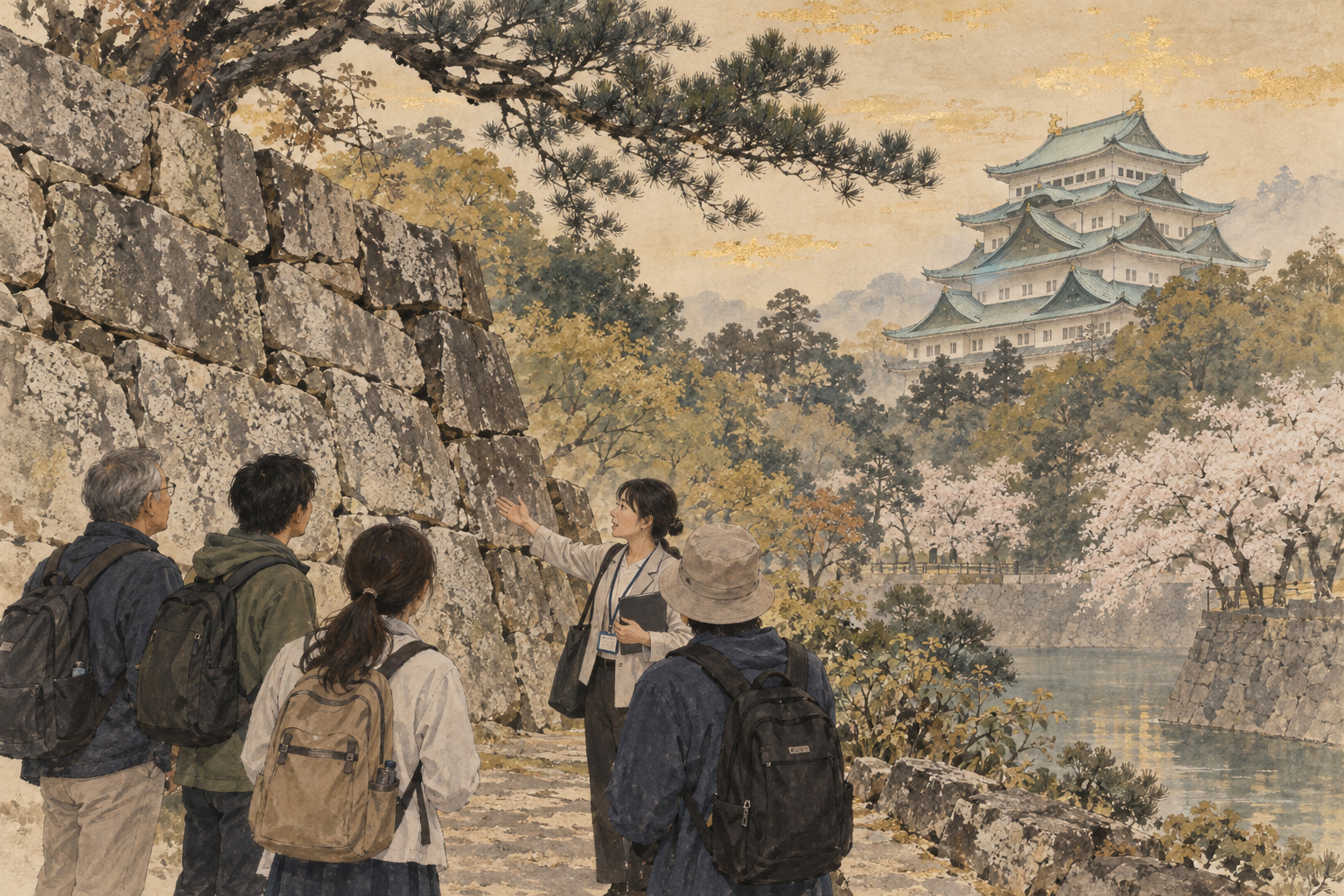
A brick wall, a regimental memorial and a reconstructed castle tell different kinds of wartime history. One records the use of land. Another records an act of commemoration. The third records what a city chose to rebuild. Around Nagoya Castle, learning to distinguish them is part of learning to see the city.
A curator-led walk announced by Aichi Prefecture on September 11 will offer that opportunity on November 7. Participants will begin at the Aichi–Nagoya War Museum—officially 愛知・名古屋 戦争に関する資料館—before exploring nearby war-related sites. The event turns attention from the castle’s commanding silhouette to the evidence around it, and to the people who make that evidence intelligible. [1]
The archaeologist’s eye
The guide is Atsushi Ito (伊藤厚史), a curator at Nagoya’s Miharashidai Archaeological Museum and an adviser to the war museum. His official biography traces his interest in war remains to an investigation of an anti-aircraft gun emplacement at the Miharashidai archaeological site. The advertised route includes the Third Division’s brick wall and monuments associated with military animals and a field-artillery regiment. [2]
These are not interchangeable “scars.” A surviving boundary can explain how military authority occupied space; a memorial asks whose service was honored and by whom. Neither should automatically be read as a bomb-damaged object. The value of expert interpretation lies partly in resisting an easy story when the evidence calls for a more exact one.
For visitors, that changes the questions worth asking. When was an object made? Has it moved? What does its inscription actually say? Does a building’s familiar outline conceal a much later construction date? A walk can make those questions concrete in ways that a distant photograph cannot.
A castle with several modern lives
The military landscape developed long before the air raids of 1945. Nagoya Castle’s official history records an army garrison in its main enclosure in 1872. The keep served as temporary barracks and the Hommaru Palace as headquarters. New military facilities accompanied the removal of older buildings, including the Ninomaru Palace. Parts of the complex subsequently became an imperial detached palace in 1893; transfer to the city came in 1930, followed by public opening the next year. [4]
That sequence matters because “the castle” can suggest a single place with a single function. Its enclosures had different histories. To describe the whole precinct simply as a military base, or simply as a civilian monument, erases those changes.
It also narrows the meaning of wartime remembrance. Understanding what bombing did to Nagoya belongs alongside understanding how military institutions became part of its landscape. Memorial inscriptions are historical evidence of the values of their makers, not instructions for how a reader today must judge the past. Preserving them and examining them critically are compatible tasks.
May 14, seen at the scale of a household
On the morning of May 14, 1945, American B-29 bombers attacked Nagoya. The castle’s keeps and Hommaru Palace burned. Other structures survived, including corner turrets and gates. The official history documents both the destruction and the exceptions—a necessary distinction in a place where original fabric and later rebuilding coexist. [5]
A much smaller object in the war museum’s online collection brings the same date into domestic focus. A disaster certificate was issued in the name of the head of Kita Police Station after a home was completely destroyed in that raid. The museum explains that it enabled access to emergency supplies and free transport. [6]
The burning keep represents the loss of a city’s emblem. The certificate records the administrative bridge between losing a home and obtaining practical assistance. Read together, they stop urban destruction from becoming merely a dramatic view of ruins. Someone needed food, somewhere to go and evidence of what had happened.
Other catalogued objects include clothing ration coupons, military correspondence and a children’s illustrated storytelling performance adapted to wartime education. [7]They locate war inside ordinary routines: getting dressed, hearing from family, being taught how to understand the world. Beginning the excursion with a museum visit gives the outdoor remains that human context.
The work that made survival possible
The palace’s destruction did not mean the disappearance of everything inside it. Sliding-door and ceiling paintings had been removed and stored elsewhere. Many survived; 1,047 panels are designated Important Cultural Properties and are preserved, managed and exhibited through the castle’s Nishinomaru Okura Johokan. [8]
Here preservation is an action, not a fortunate condition. Someone had to separate vulnerable artworks from a vulnerable building. Later custodians had to keep them available for study. The distinction between a surviving painting and a surviving palace is essential: one can be original even when the other has been reconstructed.
Drawings, photographs and measured architectural records also outlived the building. The castle’s account of the reconstruction identifies records extending from the Edo period into the modern era as its evidential foundation. [9]Documentation gave later generations something stronger than a general impression of what had been lost. It allowed decisions about reconstruction to be checked against surviving information.
The painting-reproduction program, pursued in earnest from 1992, adds another form of patient work. Its published process includes investigating original materials with microscopes and consulting records to reconstruct missing portions. [11]Brilliant color is the visible result; research is part of the less visible labor beneath it. A reproduction can help explain an earlier interior while the original remains a distinct object requiring care.
Rebuilding is history, too
The present keeps date to 1959 and were rebuilt in steel-framed reinforced concrete with help from public contributions. They are closed because of aging and earthquake-resistance concerns. [10]Hommaru Palace’s reconstruction was completed in 2018. [14]Recognizing those dates does not diminish either building. It makes visible a second history: the postwar decision to recover a landmark and the later effort to recreate a lost architectural space.
Recovery also unfolded outside the castle walls. The war museum’s postwar collection includes a repatriation certificate, a Nagoya reconstruction-planning map and a maternal-and-child health handbook from 1950. [12]They offer different measures of rebuilding: establishing a household, reorganizing a city and raising a child. None can be reduced to the moment a skyline looked complete again.
For a visitor, this is also a reason to be cautious about appearances. A discolored stone is not, by itself, proof of an air raid. Repairs, relocation and weathering can complicate what seems obvious. Photographs and survey records help test an interpretation. An honest explanation may sometimes end with a limit to what is known.
What families keep, and museums inherit
The war museum describes its purpose through actual materials contributed by residents and through local experience, encompassing civilian life, military service and the postwar period. [3]That makes households part of the preservation story. A letter’s value is not only its paper and handwriting; it is also the recoverable information about its writer, recipient and circumstances.
The museum invites telephone inquiries about possible donations, with practical restrictions: collection is limited to materials owned by Aichi residents, some offers cannot be accepted because of storage and other constraints, and unsolicited postal submission is not accepted. [13]Those limits point to the responsibility that follows acquisition. Keeping something means being able to care for it after the moment of donation has passed.
The November walk will finish near City Hall. Its longer usefulness may lie in what participants notice afterward: an unfamiliar inscription beside a familiar road, a wall whose purpose needs explaining, a family document that deserves a second look. Preserving Nagoya’s wartime history depends on keeping such evidence accessible—and on continuing to ask what it can, and cannot, tell us.
Joining the walk
| When | Saturday, November 7, 2026, 1–3:30 p.m.; check-in from 12:45 p.m. |
|---|---|
| Meeting point | The war museum, ground floor of the Aichi Prefectural Government Otsubashi Annex. Finish near Nagoya City Hall. |
| Places and cost | 25 participants, selected by lottery; free. |
| Apply by | October 17, 4 p.m., by telephone, email or fax. Consult the official announcement and application form. |
| Weather | Goes ahead in rain; canceled in severe weather. |
The organizer is the museum’s operating council. All times are Japan Standard Time. [1]
- Aichi Prefecture: 2026 walking-event announcement, September 11
- Official flyer and application: route and Atsushi Ito’s biography (PDF)
- Aichi–Nagoya War Museum: mission and collections
- Nagoya Castle: modern history
- Nagoya Castle: the May 14, 1945 air raid and subsequent history
- Museum collection: regional wartime history and disaster certificate
- Museum collection: civilian life during wartime
- Nagoya Castle: 1,047 palace painting panels designated Important Cultural Properties
- Nagoya Castle: records supporting the palace reconstruction
- Nagoya Castle: keep reconstruction and reasons for closure
- Nagoya Castle: research and reproduction of palace paintings
- Museum collection: postwar regional history
- Museum: donation inquiries and collection conditions
- Nagoya Castle official visitor introduction: 2018 palace reconstruction