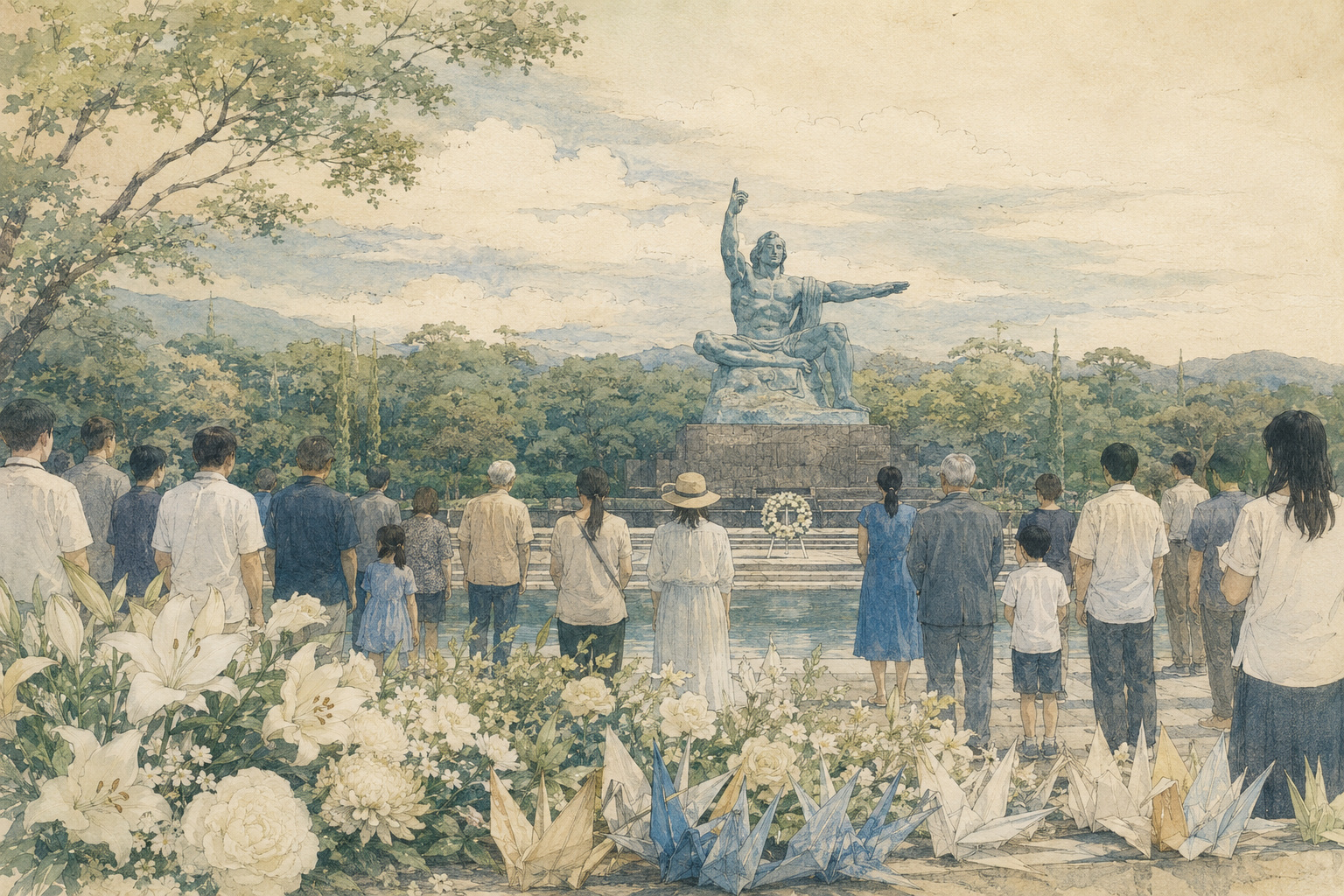
In Nagasaki, 11:02 is more than a time on a clock. People stop in Peace Park. Trams and ships sound their horns. Temple bells and church bells travel across the city’s slopes. The minute of silence does not erase sound; it creates a space in which to imagine the sounds of 81 years ago — the aircraft, the flash, the pressure wave, the cries for water, and then the strange quiet that settled over neighborhoods no longer recognizable as neighborhoods.
On August 9, 2026, Nagasaki is scheduled to hold its 81st Peace Ceremony for atomic-bomb victims from 10:45 to 11:45 a.m. The annual structure is spare and deliberate: the register of the dead is placed in the memorial, water and flowers are offered, the city observes silence at 11:02, the mayor delivers the Nagasaki Peace Declaration, and a survivor gives the Pledge for Peace.
This year the pledge is to be delivered by Chiyoko Motomura, 87. She was six when she was exposed to the bombing in Koego, Fukuda Village, then outside Nagasaki’s municipal boundary. Her presence measures the anniversary in human rather than ceremonial time. The youngest people who can remember 1945 are now old. Childhood memory has become the last living bridge to the day itself.
The numbers make that transition stark. Japan’s health ministry counted 91,105 holders of atomic-bomb survivor health certificates at the end of March 2026. Their average age was 86.66. The central question facing Nagasaki has therefore begun to shift: not simply whether the past will be remembered while survivors can speak, but whether institutions, families and citizens will accept responsibility for memory after they cannot.
Nagasaki was not supposed to be the first target that morning
On the morning of August 9, 1945, the American B-29 bomber Bockscar left Tinian carrying Fat Man, a plutonium-core atomic bomb. Its primary target was Kokura, not Nagasaki. But Kokura was obscured by cloud and smoke, preventing the visual bombing required by the mission orders. With fuel becoming dangerously limited, the aircraft turned for its secondary target.
Nagasaki was also covered by cloud. According to the city’s atomic-bomb records, a break briefly exposed the industrial area. The bomb was released from about 9,600 meters and detonated at 11:02, roughly 500 meters above Matsuyama-machi. Its energy was equivalent to about 21,000 tons of TNT. A cloud opening, fuel calculations and decisions made over minutes destroyed one valley while leaving another city standing.
The mission’s contingencies should not be mistaken for fate. The bombing was not a natural disaster. The United States built the weapon through the Manhattan Project and used it through a military and political chain of command. Japan, meanwhile, had waged aggressive war in Asia and the Pacific, and Nagasaki’s shipyards and arms plants formed part of its war machine. Recognizing the atomic bomb’s indiscriminate human consequences does not require suppressing Japan’s responsibility for the war. The two histories belong together: states turn civilians into instruments of war, and civilians ultimately absorb war’s violence.
The hypocenter was not empty ground. It was Urakami.
Military maps could describe the Urakami Valley as an industrial zone. It was also a community of homes, schools, hospitals and churches. Generations of Catholics had preserved their faith through the Tokugawa government’s prohibition of Christianity. Urakami Cathedral, about 500 meters northeast of the hypocenter, was then one of the largest churches in Asia. It collapsed and burned, leaving fragments of wall and a belfry thrown down a cliff.
Nagasaki City estimates that 15,000 to 16,000 Catholics lived in Urakami and that about 10,000 died in the bombing. The same valley held Nagasaki Medical College, elementary schools, crowded residential districts and Mitsubishi arms factories. At the medical college, 890 faculty members and students were killed, according to the city’s description of the nationally designated bomb ruins. At Shiroyama National School, the reinforced-concrete shell survived while the interior was destroyed and upper floors burned.
The dead were not all Japanese. Koreans and Chinese had been brought into wartime labor under colonial rule and mobilization; Chinese residents and students also lived in the city; Allied prisoners of war, including Dutch prisoners, were held and put to work in the area. A Nagasaki memorial to foreign war victims recalls thousands of Koreans, Chinese workers, overseas Chinese, students and Allied POWs who died in air attacks, the atomic bombing, forced labor and captivity.
Expanding the circle of remembrance is not an exercise in balancing one victimhood against another. It restores the people whom national narratives often leave at their edges. It also requires Japan to remember its own coercion and aggression when it asks the world to remember what happened to Nagasaki.
Flash, blast, heat — and radiation no one could see
Calling the atomic bomb a very large explosion is dangerously incomplete. First came intense light and thermal radiation, burning skin and igniting dark material. The pressure wave crushed wooden houses and drove glass and debris into bodies. Collapsing buildings and simultaneous fires blocked escape. Then ionizing radiation — invisible and without odor — injured people who appeared to have escaped the initial destruction.
Some developed nausea, fever, bleeding and hair loss in the following days and weeks. Later came elevated risks of leukemia and other cancers, cataracts, keloid scarring and effects on children exposed in the womb. Atomic violence did not end when the mushroom cloud dispersed. It changed the horizon of a survivor’s entire life.
The city records that the 20 neighborhoods within one kilometer of the hypocenter were effectively destroyed by heat and blast and then consumed by fire. In more than 20 neighborhoods between one and two kilometers, about 80 percent of homes collapsed and burned. Yet the institutions needed to count the dead had themselves been shattered. People died after fleeing outside the city, radiation illness was poorly understood, and the occupation-era investigation and public record were incomplete.
Nagasaki officially uses a figure of “more than 70,000” deaths, based on postwar population work and a 1950 committee estimate of 73,884 killed and 74,909 injured. The city also emphasizes that an exact death toll has never been established. The precision of the final digits can mislead. The inability to count is itself evidence of the scale of destruction — and of the people missing from surviving records.
- Hypocenter: the point on the ground below the airburst, preserved in today’s Hypocenter Park.
- Combined injuries: blast, heat and radiation acted together, not as separate events.
- Death toll: Nagasaki uses “more than 70,000”; the precise total remains unknowable.
- Hibakusha: the category includes not only people present at the moment of the explosion but some who entered the city afterward for rescue and search work.
A city needed medicine just as its medical system disappeared
Hospitals are supposed to anchor a city in catastrophe. In Nagasaki, the medical network was struck at the very moment nearly everyone needed it. Nagasaki Medical College and its hospital were close to the hypocenter. Doctors, nurses and students were killed or wounded. Survivors began treating patients while injured themselves, with too little water, medicine, gauze, equipment or shelter.
Relief trains moved into districts that were still burning and carried the wounded to hospitals in surrounding towns. Schools, temples, air-raid shelters and stations became improvised aid posts. Medical workers confronted patients who had burns and fractures, but also unfamiliar symptoms for which there was no established diagnosis or treatment. Radiation offered no warning to rescuers entering the devastated area.
The humanitarian consequences extended far beyond the emergency. Survivors required decades of screening and treatment as well as protection from stigma. In the year ending March 2015 — already 70 years after the bombing — the Japanese Red Cross Nagasaki Genbaku Hospital treated 6,030 officially recognized survivors as outpatients and 1,267 as inpatients, the International Committee of the Red Cross reported. For a nuclear weapon, “after use” is not measured in hours. It is measured in lifetimes.
Objects that testify when people no longer can
Eighty-one years is long enough for an ordinary city to rebuild, demolish and forget. Nagasaki has deliberately preserved damaged places whose angles and distances carry information: the former Shiroyama National School building about 500 meters from the hypocenter; the Urakami Cathedral belfry hurled down a slope; a stone gatepost at the former medical college shifted nine centimeters and left tilted; and the second torii of Sanno Shrine, one pillar gone and the other still standing.
These places, together with the hypocenter, were designated the Nagasaki Atomic Bomb Historic Ruins in 2016. They do more than symbolize destruction. The peeled stone, burned wooden blocks and displaced masonry let visitors read the direction of heat and blast. They are physical witnesses subject to measurement.
The great camphor trees at Sanno Shrine also survived with vast wounds in their trunks and later produced new growth. They are often treated as uncomplicated emblems of resilience. But resilience should not become a comforting substitute for loss. Beside every tree that lived were people who did not. The trees offer a harder lesson: recovery does not mean returning to what existed before; it means carrying visible damage into a future that remains possible.
The Peace Statue before which the ceremony is held was created by sculptor Seibo Kitamura and completed in 1955, the tenth anniversary year. The bronze figure stands about 9.7 meters high and weighs roughly 30 tons. Kitamura’s raised right hand signifies the atomic bomb; the left arm extended horizontally signifies peace; the face prays for the dead. Threat and hope occupy the same body. That is why the setting works: Nagasaki’s public memory is both warning and mourning.
How private pain became public testimony
Hibakusha did not emerge from the war into a society ready to hear them. Occupation censorship restricted public reporting about atomic-bomb damage. Radiation effects were poorly understood. Survivors feared discrimination in employment and marriage and were subjected to myths that illness was contagious or that all their children would be harmed. Some remained silent even within their families.
Founded in 1956, Nihon Hidankyo — the Japan Confederation of A- and H-Bomb Sufferers Organizations — joined demands for medical and economic support to a worldwide campaign for abolition. Survivors transformed intensely personal suffering into public evidence. They spoke in schools, legislatures and international forums, insisting that no theory of nuclear strategy be separated from what the weapons do to bodies and cities.
That work received the 2024 Nobel Peace Prize. The Norwegian Nobel Committee credited Nihon Hidankyo with helping establish the nuclear taboo through witness testimony and work for a world without nuclear weapons. The award was international recognition, not a conclusion. The movement’s most urgent problem remains the passage of time.
With 91,105 registered survivors left and an average age of 86.66, preserving video is not enough. Archives require context. Testimony requires listeners who can distinguish memory from inference, correct misinformation and carry the account forward without impersonating the person who lived it. Nagasaki’s family and exchange witnesses, peace volunteers and students are part of that transition from memory held by an individual to memory held responsibly by a society.
Motomura’s history also broadens the mental map of the bombing. She was exposed at age six in Koego, Fukuda Village, not at the hypocenter. The experience did not fit a single ring drawn on a map. Flash, blast, evacuation, hunger, family separation, relief work and later illness created different experiences across distance and time. There was no single hibakusha story.
Japan’s unresolved contradiction
Every year, Nagasaki’s Peace Declaration calls for the abolition of nuclear weapons. The Japanese government, meanwhile, maintains the Three Non-Nuclear Principles — not possessing, not producing and not permitting the introduction of nuclear weapons — while describing extended deterrence provided by the United States, including nuclear capabilities, as essential to national security. Japan has not signed or ratified the Treaty on the Prohibition of Nuclear Weapons.
The government presents the Nuclear Non-Proliferation Treaty, which includes nuclear-armed and non-nuclear states, as the practical center of disarmament. Supporters of the prohibition treaty, including many hibakusha, argue that deterrence necessarily depends on a credible threat to inflict catastrophic harm and is therefore incompatible with the humanitarian lesson of Hiroshima and Nagasaki.
This is not merely a disagreement in diplomatic vocabulary. It is a dispute about risk. Does the threat of retaliation prevent war, or does it preserve the possibility of escalation, miscalculation, accident and unauthorized use? Nagasaki does not provide an easy formula for today’s regional security. It does insist that the physical effects of a nuclear weapon belong inside the calculation, not in a memorial compartment separate from it.
The 2026 anniversary arrives amid renewed domestic argument over the future of the non-nuclear principles. If “a severe security environment” and “the ideal of abolition” are kept in separate boxes, the city’s experience becomes ceremonial language used one day each year. Nagasaki’s deeper challenge is to make the reality of use part of every discussion about deterrence.
| What Nagasaki demonstrates | The question for 2026 |
|---|---|
| One weapon collapsed medical care, administration and ordinary life without meaningful warning. | Can any adequate humanitarian response after nuclear use be assumed? |
| Radiation injury continued long after blast and fire. | Can such a weapon truly separate military from civilian, or present from future? |
| Cloud, fuel and short decisions redirected the mission. | Can deterrence eliminate accident, miscalculation and communication failure? |
| Victims included children, patients, foreign laborers and POWs. | Can the individual ever be contained within a state’s category of “target”? |
Keeping the 81st August 9 from becoming ritual alone
The ceremony repeats a familiar sequence: names are placed in the memorial; water and flowers are offered; heads bow at 11:02. Repetition has a public purpose. Human memory fades on its own, while politics continually selects and rearranges the past. Returning to the same place at the same time is a civic technology against forgetting.
Repetition can also harden into formality. If the lesson ends with “it was tragic” and “peace is important,” Nagasaki is sealed safely in the past. Serious remembrance asks who designed and built the weapon, who ordered its use, why Japan continued the war, who could not be counted, and who remained outside relief and recognition afterward. It then reads current nuclear policy in the same sentence.
Younger generations do not need to speak in the exact language of survivors. The entry points may be film, games, oral-history archives, school dialogue, art or translation. But fidelity to evidence and respect for the person cannot change. In an age when generative technology can synthesize faces and voices, consent, sourcing and a clear boundary between documentary record and reconstruction matter more than ever.
Nagasaki’s hope is not to remain exceptional because of its tragedy. It is to remain the last city ever attacked with a nuclear weapon, until that exceptional status is no longer required to warn anyone. The silence at 11:02 faces backward. What people choose when they raise their heads belongs to a future that has not yet been decided.
August 9, 1945, 11:02 a.m. A plutonium atomic bomb explodes above Matsuyama-machi.
By the end of 1945 Nagasaki adopts an estimate of more than 70,000 dead; no exact total can be established.
1949 The Nagasaki International Culture City Construction Law provides a framework for reconstruction as a peace city.
1955 Seibo Kitamura’s Peace Statue is completed.
1956 Nihon Hidankyo is founded, joining survivor welfare to nuclear abolition.
1996 The present Nagasaki Atomic Bomb Museum opens.
2016 Five sites are nationally designated as the Nagasaki Atomic Bomb Historic Ruins.
2024 Nihon Hidankyo receives the Nobel Peace Prize.
August 9, 2026 Nagasaki marks 81 years and again observes silence at 11:02.
Reporting note and principal sources
This article uses public information verified through 6:00 a.m. JST on August 8, 2026. The ceremony schedule may change because of weather or other circumstances. Historical death totals vary by methodology and period, so figures are identified as estimates and follow Nagasaki City’s own explanation.
- Nagasaki City: The 81st Nagasaki Peace Ceremony
- Nagasaki City: Chiyoko Motomura selected for the Pledge for Peace
- Nagasaki Atomic Bomb Museum: August 9, 1945, at 11:02 a.m.
- Nagasaki Atomic Bomb Museum: The Atomic Bomb Dropped on Nagasaki
- Nagasaki Atomic Bomb Museum: Rescue and Relief Activities
- Nagasaki Atomic Bomb Museum: Nationally Designated Historic Ruins
- Nagasaki City: Peace Park and the Peace Statue
- Nagasaki City: Memorial to Foreign War Victims
- Ministry of Health, Labour and Welfare: Survivor certificate holders and average age
- The Nobel Peace Prize 2024: Nihon Hidankyo
- International Committee of the Red Cross: Long-term survivor care
- Ministry of Foreign Affairs: Three Non-Nuclear Principles
- Ministry of Foreign Affairs: Diplomatic Bluebook on disarmament and extended deterrence
- United Nations Treaty Collection: Treaty on the Prohibition of Nuclear Weapons