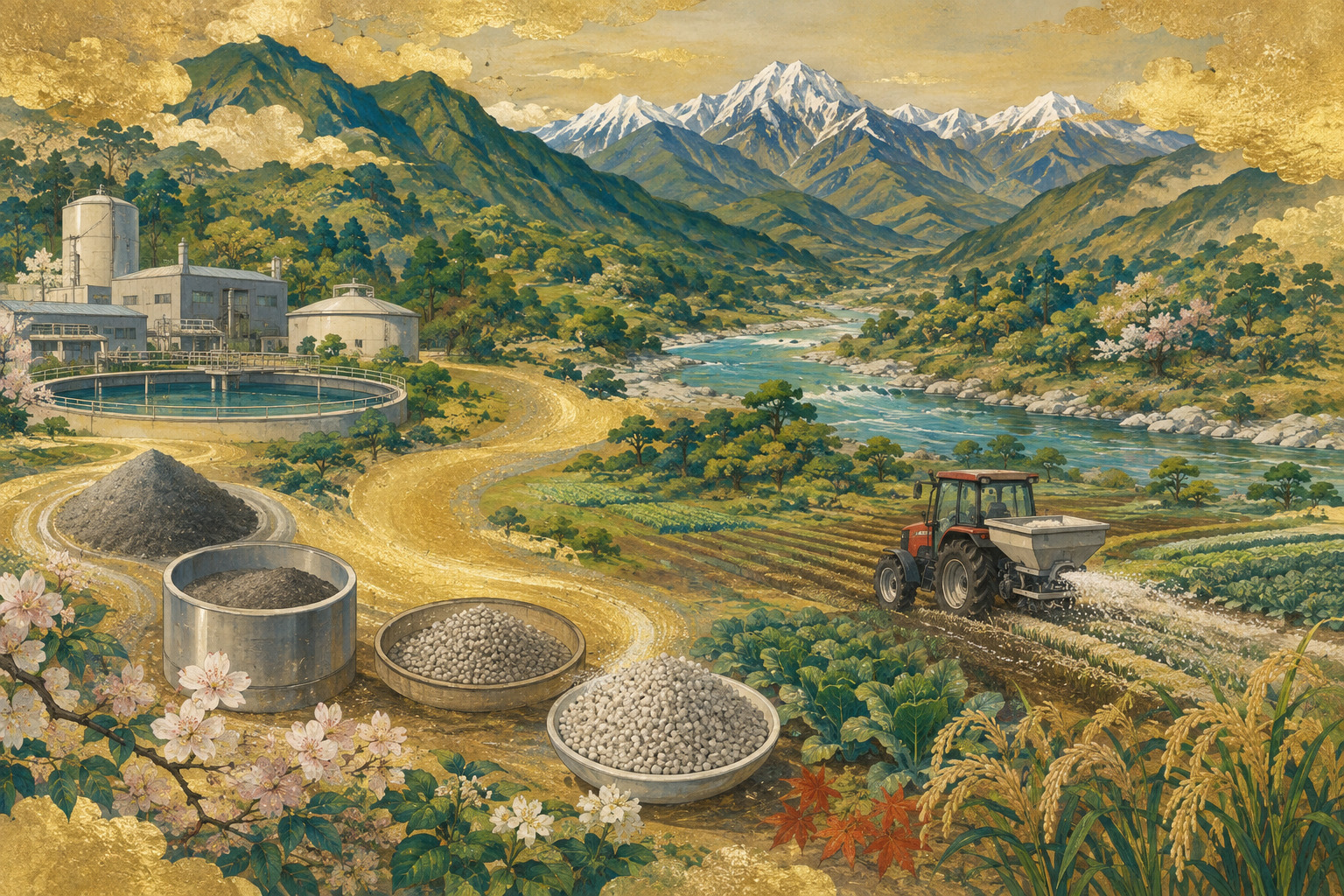
On September 12, visitors to a wastewater treatment plant in southern Nagano City will be offered a small bag containing something that once arrived through sewer pipes. Nagano Prefecture plans to distribute 200 samples, about 200 grams each, of Rinkore 15, a granular phosphate fertilizer made from sewage-sludge combustion ash.
The giveaway will run from 10 a.m. to 2 p.m. during the Aqua Pal Chikuma public open day and will end when the bags are gone. If every sample is handed out, the total is only about 40 kilograms—far too little to alter Japan's fertilizer market.
Its significance lies elsewhere. Phosphorus is essential to crops, yet Japan imports almost all of the raw materials used in its main chemical fertilizers. At the same time, phosphorus eaten in food and used in homes and businesses flows into sewers, where part of it concentrates in sludge. Rinkore 15 tries to connect those two facts: recover an urban nutrient, process it into a regulated product and return it to farming.
This is not a complete N-P-K fertilizer. Nagano says the product contains phosphate only and should be used with other fertilizer. Nor does registration establish one application rate for every crop and soil. The sample is an invitation to examine the system, not a universal agronomic prescription.
From two treatment plants to one granular product
The feedstock comes from Aqua Pal Chikuma and Cleanpia Chikuma, the two terminal treatment plants in the Chikuma River Basin Sewerage System. During wastewater treatment, organic matter and nutrients are transferred from water into sewage sludge. Dewatering and combustion sharply reduce the sludge's volume: much of the organic material is lost, while inorganic material, including phosphorus, remains in the ash.
Nagano's description of Aqua Pal Chikuma says dewatered sludge is combusted by contact with silica sand heated to at least 850 degrees Celsius. The ash has conventionally been taken to private intermediate processors and beneficially used as a cement raw material. Fertilizer therefore represents an additional outlet, not evidence that all ash has ceased going to cement.
The prefecture's Chikuma River Basin Sewerage Office and ONODA CHEMICAL INDUSTRY CO.,LTD. began compositional analysis in fiscal 2023 and signed a memorandum on fertilizer production that October. Ash from the two plants is blended into a product registered in September 2025 under Japan's kintai rinsan hiryo category—a regulated phosphate fertilizer made from microbial biomass. A second product, Rinkore 15, is made by processing that base material to raise the proportion of citrate-soluble phosphate and granulating it. Onoda registered Rinkore 15 as a processed phosphate fertilizer in the same month.
“Citrate-soluble” does not mean simply soluble in water. The official analytical concept uses extraction with a 2 percent citric-acid solution. Phosphate forms that are poorly water-soluble may dissolve gradually through organic acids around plant roots, producing a slower and more sustained response. The engineering objective is therefore not merely to report total phosphorus in ash, but to convert more of it into a form relevant to plant uptake.
Why urban phosphorus has become strategic
Phosphorus is one of agriculture's three primary fertilizer nutrients, alongside nitrogen and potassium. It supports roots, flowering and fruiting. Japan, however, depends almost entirely on imports for such major inputs as urea, ammonium phosphate and potassium chloride. The Land Ministry says China supplied more than 70 percent of Japan's ammonium phosphate imports between July 2021 and June 2022.
That concentration turns distant disruptions into farm costs. From mid-2021, strong grain demand, high energy prices and tighter export inspection in China helped drive fertilizer prices sharply upward. Currency weakness compounds the exposure. Domestic recovery cannot erase imports, but it can add sources and keep a nutrient already inside Japan from being lost.
Japan produces about 2.3 million tonnes of sewage sludge a year, containing an estimated 50,000 tonnes of phosphorus, according to the Land Ministry. Another ministry page describes that as roughly one-fifth of Japan's annual phosphorus demand of about 300,000 tonnes. Those figures represent phosphorus in the sanitation system, not material already recoverable at fertilizer quality. Concentration, treatment technology, contamination, cost and distance to farms differ at every plant.
The national policy direction is nevertheless clear. By 2030, the government wants to double the amount of fertilizer made from sewage-sludge resources and manure, and raise domestic sources to 40 percent of phosphorus used in fertilizer. A 2023 policy notice told sewage operators to prioritize fertilizer use when choosing sludge-treatment routes and, where sludge is combusted, to examine fertilizer use of the ash or phosphorus recovery.
Rinkore 15 is notable because it works downstream of infrastructure Nagano already operates. High-temperature combustion reduces volume and breaks down organic material while concentrating minerals in ash. A process that can make enough of that phosphorus agronomically available may turn a sanitation cost center into a modest domestic source of crop nutrients.
A regulatory change opened a commercial path
Japan has used sewage-derived fertilizer before. The difficulty was variability. Under the older sludge-fertilizer category, producers could not guarantee major nutrient content and could not mix the product with other fertilizers or soil amendments. That made it harder for farmers and compound-fertilizer makers to build the material into predictable nutrient plans.
In October 2023, the Agriculture Ministry created the kintai rinsan hiryo standard. This report describes that Japanese regulatory category as “microbial-biomass phosphate fertilizer”; it is an explanatory rendering, not an official English product label. To qualify, a producer prepares a quality-management plan covering feedstock acceptance, manufacturing, analysis, records and worker training. The plan must receive confirmation from the agriculture minister before product registration; the Food and Agricultural Materials Inspection Center, known as FAMIC, handles applicant consultation and work related to that confirmation process.
The category permits guaranteed nutrient content and mixing with other fertilizer or soil conditioner when its conditions are met. By the end of January 2026, ministerial confirmation procedures had been completed for 39 brands, and 33 of them had obtained registration from prefectural governors, FAMIC reported. The figures show fast adoption of the legal route, not the volume sold or farmers' satisfaction.
Rinkore 15 uses the framework in two stages. The blended ash first becomes a registered microbial-biomass phosphate fertilizer, then a processed phosphate fertilizer with a higher citrate-soluble share and a granular form. In a 2025 announcement about its development program, Onoda stated a target of guaranteeing 15 to 17.5 percent citrate-soluble phosphate and making at least 90 percent of total phosphorus citrate-soluble. It also said then that it planned market supply in the second half of fiscal 2025. Those statements record development targets and an intended timetable; Nagano's September 2026 announcement publishes neither a final guaranteed analysis nor current sales terms. The reviewed sources therefore do not establish that the targets were the finished specification or that general sale occurred as planned.
Edo period — Urban night soil was bought, fermented and returned to farmland; the practice lacked modern sanitation and product standards.
2021–2022 — Import and energy disruptions exposed the cost of Japan's fertilizer dependence.
October 2023 — Japan's new microbial-biomass phosphate-fertilizer standard took effect; Nagano and Onoda also signed their fertilizer-production memorandum.
September 2025 — The base fertilizer and processed Rinkore 15 received fertilizer registrations.
September 2026 — Nagano prepared its first 200 public sample bags for the Aqua Pal Chikuma event.
Not a return to the Edo period
The idea of returning a city's nutrients to farms is old. Japan's Environment Ministry recounts how, during the Edo period, night soil was a traded resource. Farmers acquired it from towns, fermented it in storage pits and used it to grow vegetables. Consumption in the city and production in the countryside were linked by a market for nutrients.
That history should not be romanticized. Raw or poorly treated human waste carried disease and parasite risks, and it offered no guaranteed nutrient analysis. Modern sewerage and chemical fertilizers helped transform urban sanitation and agricultural productivity. They also reinforced a linear system in which nutrients entered cities but were not necessarily returned to food production.
The contemporary project is different. Wastewater treatment, high-temperature combustion, material processing, laboratory analysis, registration and continuing quality control are intended to preserve modern hygiene while recovering a selected nutrient. The circular principle is old; the safeguards and specifications must be modern.
Registration is a beginning, not an agronomic verdict
Registration and a verified quality-management plan create an essential floor for safety and labeling. Sewage-derived inputs require particular attention to cadmium and other potentially harmful metals. The Agriculture Ministry warns that some sludge fertilizers can exceed statutory limits depending on their raw material and calls for continuing process control and testing. Because metals can accumulate in soil, traceable lots and prompt detection of changing feedstock matter after registration as well as before it.
Registration does not prove that a product raises yield in every field. Combustion ash varies with the wastewater catchment and treatment process. Trials summarized by Japan's National Agriculture and Food Research Organization found that sewage-sludge ash can substitute for phosphate fertilizer under defined conditions, but stressed fertilizer registration, compliance with heavy-metal limits and evaluation for the soil and crop involved.
More phosphorus is not automatically better. In soil that already contains enough plant-available phosphorus, additional application may provide little yield benefit. Excess is a wasted resource and cost; if it escapes to water, it can contribute to eutrophication. Soil testing and crop-specific recommendations are therefore not obstacles to recycling. They are what make recycling environmentally credible.
The first practical caution is simpler: Rinkore 15 supplies phosphate, not the whole nutrient program. Nitrogen generally drives leaf and stem growth, while potassium supports plant vigor and stress tolerance. Nagano's instruction to combine this product with other fertilizer reflects that agronomic limit.
Evidence needed for farm-scale adoption
- Quality: guaranteed analysis, heavy-metal results and variability between production lots.
- Use: crop-specific rates tied to soil testing and instructions for combining nutrients.
- Supply: annual production, current sales status, price, package sizes and delivery territory.
- Performance: yield, crop quality and residual effects in Nagano's soils and major crops.
- Environment: energy, chemical use, transport and residual waste compared with existing ash outlets.
Circularity must survive a full accounting
Renaming ash as fertilizer does not by itself close a loop. Moving it to a fertilizer plant, adjusting its chemistry, granulating it and delivering it to farms consume energy, chemicals and money. A serious assessment must compare those burdens with the amount of imported phosphate actually displaced, as well as with transport and management of any remaining residue.
Nagano also faces a choice between two forms of beneficial use. Aqua Pal Chikuma has traditionally sent combustion ash to private processors for use in cement. Diverting some ash to fertilizer can return phosphorus to food production, but the cement producer may then require another input. Which route performs better will depend on travel distance, processing intensity, displaced materials and the stability of demand. The prefecture has not published a comparative life-cycle assessment.
The business chain matters as much as the chemistry. A fertilizer maker needs consistent feedstock and volume. Farmers need a competitive price, easy spreading, compatibility with existing equipment and dependable crop response. The sewerage authority needs a reliable offtake contract. The public needs transparent safety data. A product can be technically registered and still fail if any link is missing.
That makes the September 12 event useful but preliminary. It asks residents to see wastewater treatment as a resource system, not only a disposal service. Yet there is a long distance between distributing 40 kilograms for public engagement and supplying farms season after season.
The next meaningful disclosures would be how much ash Nagano expects to convert each year, how much imported phosphate that output could replace, what the product costs, how it performs on local crops and what its production requires. With those figures, Rinkore 15 could be judged as infrastructure rather than symbolism.
The larger proposition is compelling: return a nutrient collected from the city to farmland safely, at predictable quality and at a price growers can use. Nagano's experiment will matter if it can rebuild that broken nutrient loop without surrendering the sanitary and analytical gains of the modern system.
Primary documents and research
- Nagano Prefecture, “Free distribution of Rinkore 15 fertilizer made from sewage-sludge combustion ash” — September 4, 2026; giveaway details, process and registrations.
- Nagano Prefecture Chikuma River Basin Sewerage Office, “Turning combustion ash into phosphate fertilizer” — participating plants and Onoda partnership.
- Nagano Prefecture, introduction to the Upper Treatment District terminal plant, Aqua Pal Chikuma — combustion process and established cement use.
- Nagano Prefecture, “2026 Sewerage Open Day” — venue and event details.
- Onoda Chemical, announcement of selection for Japan's fiscal 2025 domestic fertilizer-resource expansion subsidy — development targets for processed phosphate fertilizer.
- Land, Infrastructure, Transport and Tourism Ministry, fertilizer use of sewage-sludge resources — import dependence, resource estimates, 2030 targets and policy direction.
- Land Ministry, resource and energy use in sewerage — Japanese phosphorus demand and phosphorus contained in sewage sludge.
- Food and Agricultural Materials Inspection Center, “Putting sludge resources to work: the new kintai rinsan hiryo”, Big Eyes, Small Eyes No. 78 (2025) — the new standard and verification system.
- Food and Agricultural Materials Inspection Center, “About kintai rinsan hiryo” — plans confirmed and brands registered through January 2026.
- Food and Agricultural Materials Inspection Center, “Fertilizer analysis: water-soluble and citrate-soluble phosphate”, Big Eyes, Small Eyes No. 76 (2024) — definition and behavior of citrate-soluble nutrients.
- Agriculture, Forestry and Fisheries Ministry, guide to managing heavy metals in sludge fertilizer — continuing quality-control requirements.
- Environment Ministry, 2008 White Paper on the Environment and the Sound Material-Cycle Society — night-soil trade and agricultural use in the Edo period.
- National Agriculture and Food Research Organization, effects of applying sewage-sludge incineration ash to vegetables as a phosphate-fertilizer substitute — agronomic conditions, registration and heavy-metal compliance.
Reporting note: This report uses public information available through 8:00 a.m. JST on September 5, 2026. Japanese primary sources from Nagano Prefecture, the Land and Agriculture ministries, FAMIC and Onoda Chemical were used to verify names, regulatory categories, facilities, dates, quantities, registration timing and technical terms. Public documents reviewed did not establish annual output, current price and sales channels, the finished product's guaranteed analysis, product-specific heavy-metal results, crop-specific rates or Nagano yield effects; none has been inferred. Onoda's published nutrient figures and market timetable are identified as 2025 development targets and plans. The Japanese and English editions were written independently.
Image rights: © 2026 Japan.co.jp. This AI-assisted editorial illustration may not be reproduced or reused without permission. For licensing, visit the contact page.