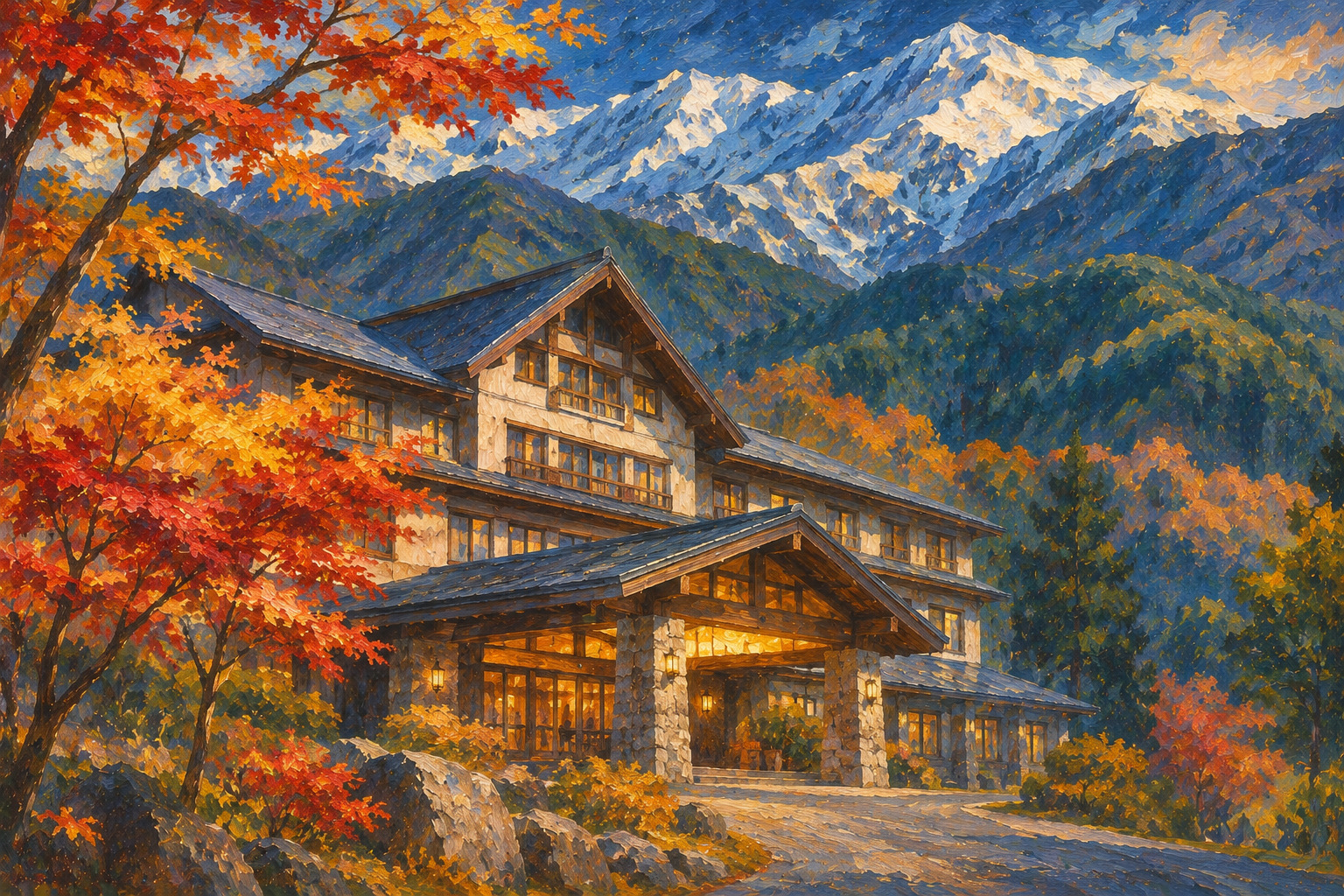
- Can an Alpine hotel change the rhythm of a mountain village?
- A 52-year chapter closes, another begins
- Why the local government wants four seasons
- A small population and a large landscape
- The most interesting feature may be the lobby
- What national certification does—and does not—buy
- From a ski itinerary to a four-season itinerary
- The older story behind Japan’s latest resort investment
- Two milestones should not be confused
- The real test is what happens beyond the hotel doors
Can an Alpine hotel change the rhythm of a mountain village?
In Japan’s Northern Alps, the question is no longer only how to bring skiers to the mountains in January. It is how a small community can support jobs, businesses and public life when the snow has disappeared. A November 12, 2026 decision by Japan’s Ministry of Land, Infrastructure, Transport and Tourism gives that question a newly tangible focus: the planned redevelopment of the former Hakuba Alps Hotel in Otari Village, Nagano Prefecture.
The ministry recognized THE ALPS HOTEL HAKUBA Renovation Plan as an eligible private urban-regeneration improvement project. That recognition can open a route to financing through Japan’s Organization for Promoting Urban Development. It is not a government announcement that the renovation is finished, that new jobs have materialized or that a loan of a specified amount has already been disbursed.
A 52-year chapter closes, another begins
The story starts with an established property rather than a resort built from scratch. In its March 31 notice, the former Hakuba Alps Hotel said that it was closing after the transfer of its operating rights and thanked guests for 52 years of support. The same notice announced a planned December 2026 reopening as THE ALPS HOTEL HAKUBA, under Plan・Do・See.
Plan・Do・See ALPS, part of the hospitality group, is carrying forward the renovation. The project is intended to reshape guest rooms and public spaces while adding reasons to visit beyond the winter sports season. A later industry report lists June 2027 as a completion target for the broader works. A reopening target and construction-completion target may describe different phases, but the precise sequencing remains to be independently confirmed.
Why the local government wants four seasons
Otari’s own urban-regeneration plan provides an unusually direct diagnosis. Ski-resort development beginning around the mid-1960s made tourism a cornerstone of the local economy. The Tsugaike Kogen, Hakuba Norikura Onsen and Hakuba Cortina areas created accommodation, transport and service-sector opportunities along with the obvious draw of winter recreation.
The village now points to long-term changes in domestic skiing participation, diversified travel preferences and demand concentrated in the snow season. International visitors have recovered, it says, but peak-season congestion and off-season demand remain persistent challenges. The aim is not to abandon skiing; it is to create an economy that does not have to wait for the next snowfall to become busy again.
A small population and a large landscape
Otari is not a neighborhood of nearby Hakuba Village, even though the planned hotel’s name uses the internationally recognized Hakuba destination label. It is its own municipality in northern Nagano. The village’s statistical page lists a population of 2,647 and 1,117 households in the 2020 census across 267.91 square kilometers. Those census figures should not be mistaken for a real-time 2026 population count.
In a mountainous community of this scale, the effects of a single large hospitality operation can stretch beyond the front desk. Year-round staffing might sustain local suppliers, maintenance providers, restaurants and transport operators. But such benefits depend on procurement choices, wage levels, housing access and visitors actually spending time and money in the surrounding community. None of these outcomes should be counted as achieved because a redevelopment plan was approved.
The most interesting feature may be the lobby
What distinguishes the approved plan is its treatment of a hotel as a civic asset as well as a commercial one. MLIT says the project will open a renewed lobby and plaza to local residents and visitors who are not staying overnight. Those spaces are meant to encourage movement to nearby attractions rather than trap tourist spending inside a single property.
There is a safety dimension too. The ministry says the lobby is intended to serve as a temporary refuge for people beyond hotel guests during emergencies. The announcement does not establish the capacity, supplies, accessibility or status of that space as an officially designated evacuation shelter. The commitment is worth following precisely because mountain transport interruptions and severe weather can turn an ordinary travel delay into a public-safety challenge.
What national certification does—and does not—buy
Japan’s private urban-regeneration improvement framework is tied to local plans. Otari’s designated Tsugaike Kogen–Hakuba Norikura Onsen–Hakuba Cortina area covers 1,400 hectares and runs under the village’s fiscal 2026–2030 plan. Its priorities include higher-quality year-round stays and closer coordination among mountain destinations. The hotel conversion is among the specifically named projects.
Ministerial recognition makes an eligible project a candidate for financial assistance from the Organization for Promoting Urban Development, whose mechanisms can include mezzanine finance or investment depending on the approved structure. It is not synonymous with a grant award. Nor is the award an investment return, a forecast of tax revenue or a guarantee of profitability. The distinction is important for readers evaluating claims about government-backed regional development.
From a ski itinerary to a four-season itinerary
A village long associated with snow also has spring forests, summer mountain trails and autumn color. The economic opportunity lies in making those assets support longer visits and repeat trips, with local guides, restaurants and businesses participating in the experience. The national announcement specifically emphasizes green-season demand, activity services and encouraging visitors to explore more of the district.
Tourism diversification has costs. More hikers can mean trail and habitat pressure, more cars on mountain roads, and greater demand for water, waste services and energy. An operator that adds guided activities while coordinating conservation and transportation may create more durable value than one that merely sells additional room nights. The project’s environmental and mobility performance cannot yet be quantified from the approval announcement.
The older story behind Japan’s latest resort investment
Japan has long treated tourism infrastructure as a tool for local development. The village’s timeline places Otari’s ski-industry expansion roughly six decades ago, when recreational travel and resort construction reshaped many mountain economies. Today, the policy language is different: renovation instead of perpetual new construction, shared public space instead of purely enclosed resort facilities, and broader regional circuits instead of a single seasonal attraction.
Japan’s urban-regeneration framework allows local governments to prepare area-based plans and link eligible private projects to national financing mechanisms. This makes the Otari project a test of whether older resort infrastructure can perform newer roles. It also highlights an essential policy tension: public objectives can be attached to privately operated spaces, but the real public benefit must be visible in how those spaces work.
Two milestones should not be confused
There are two different dates in the reporting record. The former hotel’s notice announces a December 2026 reopening target. An industry account published following the ministry decision says the broader project is scheduled for completion in June 2027 and reports that work started in April 2026. The same report identifies an approximately 17,684-square-meter project area and an approximately 16,529-square-meter gross floor area. These specific construction details are attributed to that secondary industry report.
We have not independently verified the detailed construction phases or a final opening day, and the ministry’s short announcement does not disclose a definitive project cost or a headcount of new jobs. Treating any of those unknowns as settled would turn a promising development into a promotional story. The more useful reporting question is what can be measured when the hotel actually welcomes visitors.
The real test is what happens beyond the hotel doors
A successful transformation will have several scorecards: occupancy outside the ski season, average length of stay, business generated for village operators, durable local employment, public-space use and practical emergency preparedness. Visitor totals alone will not show whether the village has gained a resilient four-season economy.
The most consequential line in the government’s announcement is its expectation that the renovated site will serve both residents and travelers. For Otari, a former ski hotel becoming a genuine meeting point would represent more than a change of sign over the entrance. November’s certification starts that test. It cannot tell us the outcome.
Sources and methodology
Methodology: Reviewed the November 12 MLIT release, Otari Village’s regeneration and statistical pages, the former hotel’s closure notice, and national financing guidance. Construction schedule and dimensions are attributed to an industry report. No site visit, interview, financial audit or independent employment-impact study was conducted.