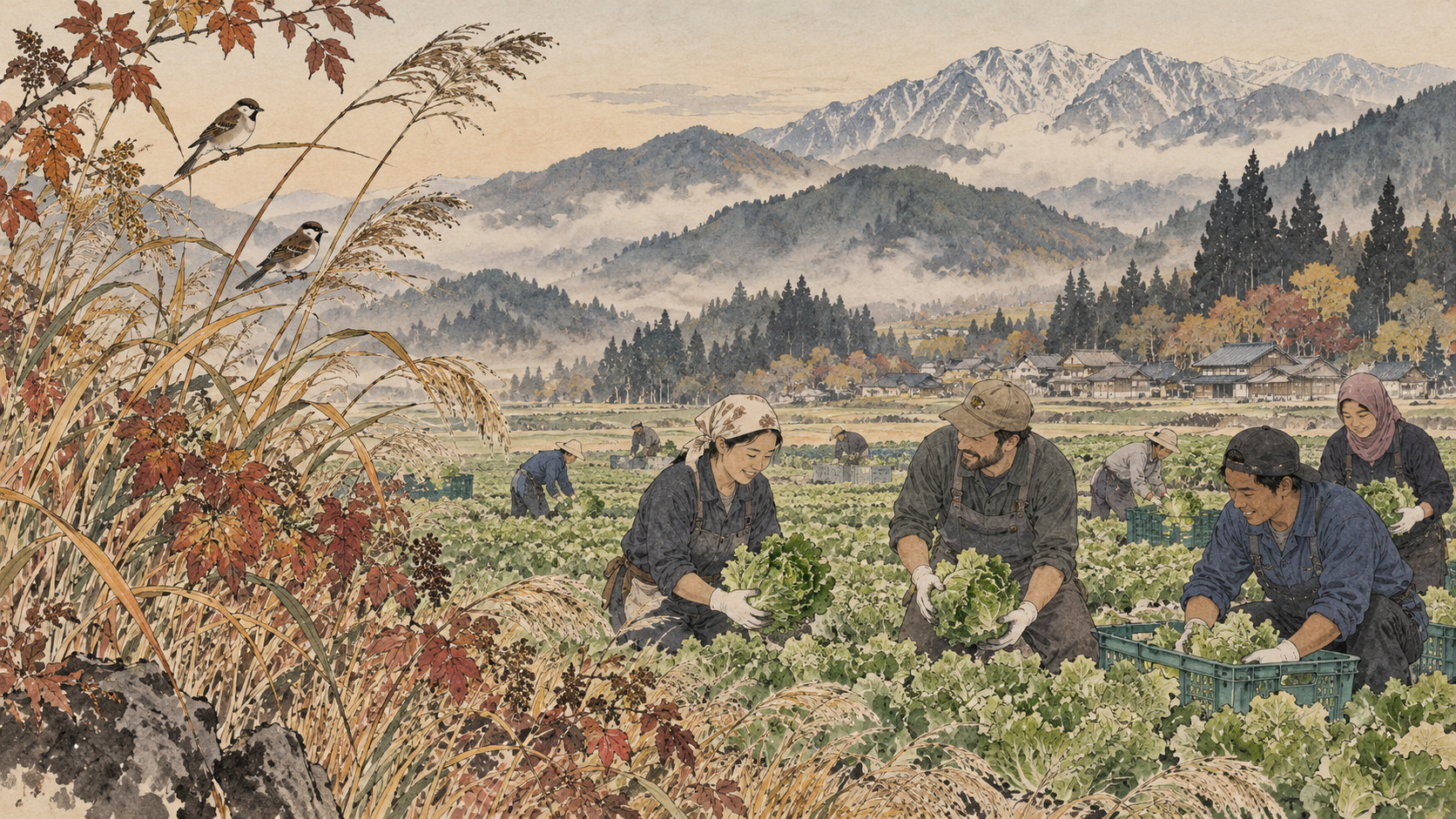
A census surprise in Japan’s lettuce country
Kawakami, a highland village in Nagano Prefecture, is best known as a major producer of lettuce. Now it stands out for another reason: 26.5 percent of its population was classified as foreign nationals in Japan’s 2025 census, the highest proportion reported for any municipality in the country. The figure, reported by Jiji Press on October 13 from released census results, was 19.0 percent in 2020. For readers accustomed to imagining immigration as a story about Tokyo offices and big-city factories, the geography is striking. The deeper story is how food production, mobility and community life intersect in rural Japan.
What the number does—and does not—mean
The census measures nationality, not birthplace, occupation or immigration status. The 26.5 percent should not be translated into a claim that one quarter of residents are foreign-born agricultural workers. People counted may be employed in other sectors, living with family or staying for different periods. Timing also matters. Kawakami’s municipal website lists 4,637 registered residents and 2,525 households as of September 30, 2026, including foreign residents. That is a later figure from the resident registry, not the denominator of the 2025 census. Mixing the two would manufacture an inaccurate current headcount.
A national transformation, seen from one village
According to the Jiji analysis, 132 Japanese municipalities had foreign-national population shares exceeding five percent in the 2025 census, compared with 53 five years earlier. The foreign-national population across Japan reached approximately 3.84 million, or 3.1 percent of the population. Kawakami’s unusually high proportion is therefore an outlier within a much wider transition. Labor shortages have made international recruitment increasingly consequential far beyond metropolitan Japan, especially in places that depend on agriculture, tourism and seasonal demand.
How a mountain village became a food producer
Kawakami did not begin as a lettuce economy. Its official agricultural history traces a shift from subsistence grain growing through commercial Chinese cabbage production beginning in 1934. Rail connections helped farmers reach consumers outside the mountains. Wartime transport disruption set production back, but the postwar agricultural cooperative movement and infrastructure investment supported renewed growth. Experimental lettuce cultivation began in 1950; summer-autumn lettuce received designated production-area status in 1969. The trajectory was one of entrepreneurial adaptation supported by roads, irrigation, distribution networks and favorable cool-season growing conditions.
A supply chain with an international reach
The village records lettuce acreage exceeding 1,000 hectares in 1978. As highways improved, vegetables could be moved more efficiently to distant markets. Kawakami began exports to Taiwan in 2006 and Hong Kong in 2008, according to its historical account. This agricultural system was never economically isolated. Workers and consumers today participate in a network that extends from mountain fields through wholesalers and distribution centers to Japanese kitchens, with ties reaching farther abroad.
The real work behind a head of lettuce
Lettuce cultivation involves nursery preparation, planting, tending, harvesting, grading, packing and loading under sharp seasonal and weather constraints. The availability of labor affects whether growers can keep pace with the harvest window. Foreign-national residents should not, however, be reduced to interchangeable hands. They are individuals whose living arrangements, family situations, career plans and legal rights matter independently of a crop’s output. The census provides no direct measurement of their pay, working hours, recruitment fees, national origins or specific visa categories.
A labor system about to change
Japan is approaching a major regulatory transition. Legislation enacted in June 2024 established the Employment for Skill Development framework, known in Japanese as ikusei shūrō, to replace the Technical Intern Training Program. The new system is scheduled to begin April 1, 2027. Immigration Services Agency guidance describes a system aimed more explicitly at skills development and securing workers, while revising conditions for changing employers and supervision. The specifics will vary by field and circumstance. It would be premature to claim that the law has already resolved problems in recruitment or employment—or to assert that all foreign workers in Kawakami are on technical-intern visas.
A village must work as a community, too
The same demographic shift that supplies farms can raise challenges for rural public services: housing quality, transportation, medical interpretation, multilingual disaster warnings, access to advice and, for longer-term residents, schooling and childcare. These are questions, not findings of misconduct in Kawakami. A responsible investigation would ask residents and officials what services exist and whether they function well in practice. Rural integration can be especially demanding where workplaces are dispersed and public transport is limited.
The perspective of growers—and workers
A farm unable to recruit people for a narrow harvest period risks lost produce and financial strain. A worker facing unreasonable hours or unsafe accommodation faces a different, no less serious risk. Japan’s choices should not be framed as a contest between saving farms and respecting workers. Productivity improvements, mechanization, fair contracts, grievance systems and reliable employment pathways can be examined together. Whether those systems are effective in Kawakami requires local evidence rather than assumptions.
Questions the census cannot answer
How many foreign-national residents remain year-round? How many expect to settle? Which countries are represented, and how do residents evaluate working and living conditions? How much does food production depend on different employment arrangements? The figures reported this week cannot answer those questions. Japan.co.jp has not presented interviews with named villagers or personal testimony that has not been obtained. Those voices would transform a significant demographic finding into a more complete portrait.
Japan’s rural future is already international
Kawakami used climate, infrastructure and the market to build a nationally important agricultural business. Today it must also navigate the human side of that success. Having the country’s highest reported share of foreign nationals is not a scorecard of success or failure. The lasting measure will be whether a productive farming village can also be a safe, fair and welcoming place to live. That question extends well beyond Kawakami, wherever Japan relies on people arriving from abroad to sustain essential work.
Sources and further reading
- Statistics Bureau / e-Stat: 2025 Census tables
- Jiji Press: 132 municipalities exceed 5%, Oct. 13, 2026
- Kawakami Village: agricultural history and statistics
- Kawakami Village: population register, September 2026
- Immigration Services Agency: Employment for Skill Development framework
- Immigration Services Agency: official FAQ
Based on public materials available by October 15, 2026. No original interviews with villagers are represented in this report.