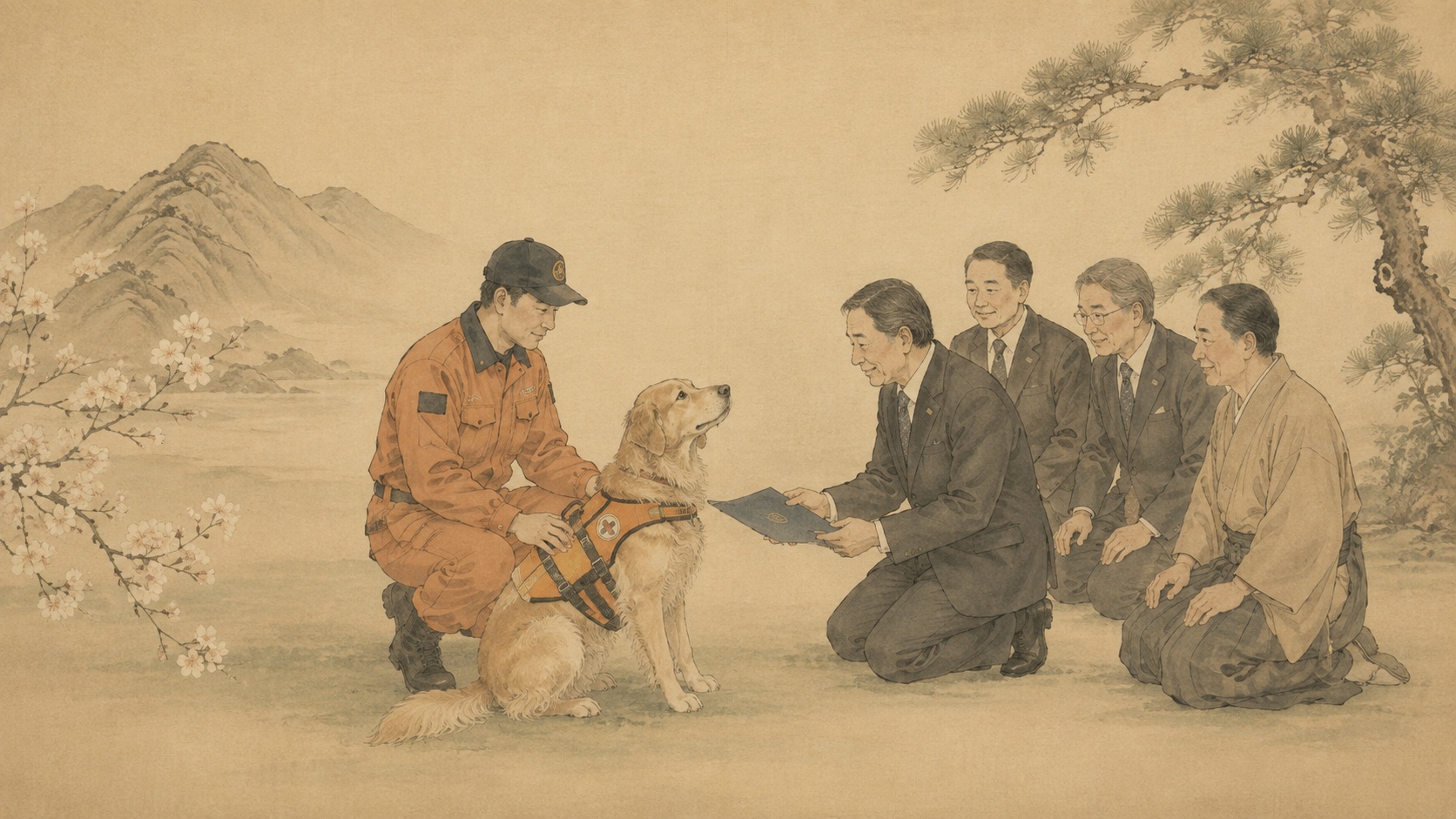
The first problem after a building collapses is not always how to lift the concrete. It is deciding where to lift it. A rescue team can have cranes, cameras, acoustic sensors and dozens of firefighters at the scene and still face the most basic uncertainty: is anyone alive beneath this section of rubble, or are precious minutes being spent in the wrong place?
Nagano Prefecture is moving to add another search tool to that decision chain. On September 3, the prefectural government announced that it plans to sign an agreement with the nonprofit Rescue Dog Trainers’ Association (RDTA) allowing Nagano to request disaster rescue-dog teams for victim searches after major disasters.
The signing is scheduled for September 10 from 2:25 to 2:40 PM at the Nagano Prefectural Government building. RDTA chairman Hidehiro Murase, rescue dog Matsugoro and Governor Shuichi Abe are listed as participants.
The agreement is really about access, not dogs
Nagano's announcement is only a few paragraphs long. Its core is simple: when a large-scale disaster produces a need to search for victims, the prefecture will be able to ask RDTA — which has a rescue-dog training facility inside Nagano — to deploy disaster rescue dogs so that searches can begin quickly.
That sounds almost obvious. It is not. Search-and-rescue capability is useful only if the incident command system can actually summon it, assign it, protect it and use the information it produces.
The dogs and handlers already exist. The training ground already exists. Nagano Prefectural Police have already trained with RDTA. The agreement's practical contribution is administrative: it is intended to establish the formal route by which a prefectural disaster organization can reach a civilian canine organization before an emergency creates the need to improvise one.
A rescue-dog training base is already embedded in Nagano
RDTA's administrative office is in Fujisawa, Kanagawa Prefecture, but its major training base is in Fujimi, Suwa District, Nagano Prefecture. The association identifies the facility as the Yatsugatake International Rescue Dog Training Center, at 6729 Ochiai, Fujimi.
The site has become a recurring venue for rescue-dog testing under standards associated with the International Search and Rescue Dog Organisation, or IRO. Dogs are tested in disciplines including rubble search and area search, together with obedience and dexterity work. In April 2025, an IRO-authorized event in Fujimi drew 49 dogs, including a team from Taiwan's fire service. Similar tests continued in 2026.
The center has also served as a bridge to public responders. In June 2022, RDTA conducted a joint exercise with the Nagano Prefectural Police Wide Area Emergency Assistance Unit at a simulated disaster site. Personnel from the prefectural riot police, Ina Police Station and Chino Police Station participated. That same month, RDTA trained with disaster rescue dogs from the Air Self-Defense Force's Iruma Air Base.
So the September agreement is not Nagano discovering rescue dogs for the first time. It is the prefecture moving to formalize a relationship with a capability that has been training inside the prefecture for years.
Why Matsugoro will be in the room
Nagano's press release does something unusual for a government signing notice: it lists a dog among the attendees. Matsugoro is scheduled to appear alongside Murase and Governor Abe.
The prefecture does not say why this particular dog was selected, and there is no basis for turning that ceremonial appearance into a claim that Matsugoro will become Nagano's designated deployment dog.
But Matsugoro does have a documented connection to the Fujimi testing program. RDTA records show that the Matsugoro–Yamaguchi pair passed the V-level area-search test there in April 2025 and placed third in the A-level rubble-search test later that year. In July 2026, an RDTA release reported that the pair passed IRO-standard B-level rubble search, describing it as the first such B-level qualification for a pair from the Tohoku region. The release said Matsugoro located three simulated victims within a 30-minute search window.
Those results show training progress, not automatic mission status. IRO separately maintains Mission Readiness Tests that are designed to assess operational deployment capability under repeated searches, night work and other mission-like conditions. RDTA runs a national MRT in Japan. Nagano's announcement does not state what qualification level a dog-handler pair must hold to be eligible for a prefectural call-out.
What a rubble dog is actually doing
Modern rescue-dog work is more disciplined than the familiar image of a dog simply sniffing around rubble. IRO divides search-and-rescue dog work into specialties including tracking, area search, rubble search, avalanche search, water rescue and mantrailing.
In rubble search, the dog works independently over an unstable field, looking for airborne human scent escaping from voids in a collapsed structure. International trial rules require hidden victims to be out of sight and physical contact. Dogs are judged on their search behavior, alert, mobility over rubble, ability to handle obstacles and endurance.
The dog has to be controllable too. Disaster sites can shift from safe to lethal in seconds. Handlers need reliable recall, directional control and emergency-stop behavior. Search work therefore combines nosework with obedience and dexterity rather than treating scent detection as a standalone talent.
Where dogs fit into a modern search
| Capability | Best at | Limitation |
|---|---|---|
| Rescue dog | Rapidly screening rubble or terrain for human scent | Indication still needs to be integrated with technical search and rescue operations |
| Search camera | Visual confirmation inside a void | Needs access to a suitable opening |
| Acoustic/seismic detection | Picking up sounds or movement beneath debris | Depends on conditions and victim activity |
| Location technology | Finding people carrying compatible devices or transmitters | Equipment may be absent, damaged or shielded |
| Human search teams | Assessment, stabilization, extrication and command | Slow to physically cover every void in a large site |
A 2026 case publicized by IRO illustrates the combined approach. After an explosion and house collapse in Vienna, three rescue dogs independently indicated the same area. Fire department acoustic specialists then used a camera to locate a 93-year-old resident and make verbal contact before rescuers extracted him alive. The point was not that the dogs did everything. It was that their indications told the technical team where to look next.
Japan's rescue-dog system grew out of the failures exposed in 1995
The 1995 Great Hanshin-Awaji Earthquake transformed much of Japan's disaster-response architecture. It led to the creation of new nationwide police and fire assistance structures, and it also forced Japan to take rescue dogs more seriously.
The Cabinet Office has described domestic rescue-dog development as accelerating after the Hanshin disaster. Police records from 1995 document the arrival of a French earthquake-response team of 61 people and four rescue dogs, with Japanese police providing support for their operations.
A decade later, a Diet committee hearing captured how uneven Japan's canine system still was. Officials discussed the mixture of foreign, volunteer and police dogs used after major disasters. In the 2004 Niigata Chuetsu Earthquake, the government told lawmakers, four Metropolitan Police Department dogs worked from October 27 to November 7. One was credited with first confirming that a survivor remained at the Myoken landslide site, where a car carrying a family had been buried.
By 2017, the Cabinet Office was still noting that, outside limited public-sector programs, much rescue-dog activity in Japan remained volunteer-based. That is the institutional gap agreements such as Nagano's attempt to narrow: civilian capability may exist, but government needs a prearranged way to use it.
RDTA has recent real-disaster experience
RDTA is not only a testing organization. After the January 1, 2024 Noto Peninsula Earthquake, the association says it deployed to the affected region from January 2 through January 6 and conducted searches alongside relevant agencies. Its 2024 business report also lists Noto disaster deployment among the year's activities.
Public documentation is less detailed about the operational outcomes. The sources reviewed for this article do not give a complete dog count, a site-by-site log of alerts or a verified list of finds that directly led to rescues. That matters because rescue-dog work is easy to romanticize after the fact. A serious evaluation needs both successful alerts and the full operational record, including false alerts, fatigue, access constraints and coordination problems.
The agreement can make future documentation more important. Once a prefecture formally requests a civilian capability, it becomes possible — and desirable — to track how long deployment took, how teams were assigned, how many search sectors they covered and how canine indications were confirmed by other methods.
Nagano has multiple kinds of terrain where search speed matters
Nagano has no coastline, but it has a dense map of disaster risk: active faults, steep mountain valleys, landslide-prone terrain, snow country and communities that can be isolated by damaged roads.
The 2014 Kamishiro Fault Earthquake struck northern Nagano with maximum intensity 6-lower. Prefectural records list 46 injuries, 81 homes destroyed, 172 half-destroyed and 1,828 partially damaged. No deaths were recorded, but the event produced the kind of collapsed-building environment in which rapid victim location is critical.
Five years later, the 2019 East Japan Typhoon flooded the Chikuma River basin and triggered landslides across the prefecture. Nagano's February 2024 tally listed 24 deaths, 920 homes destroyed and 2,496 half-destroyed. Search dogs can be used not only after earthquakes but in debris flows, forested area searches and other situations where people disappear into complex terrain.
Nagano's long-range earthquake scenario is more severe still. For a full rupture of the Itoigawa-Shizuoka Tectonic Line fault zone, prefectural material shows an estimated 5,600 to 7,100 deaths and roughly 83,000 to 98,000 buildings destroyed or burned. The same material cites a 30-year occurrence probability of 14% to 30%.
Those figures are planning scenarios, not forecasts. But they reveal why a prefecture might want several independent ways to find people quickly when many collapse sites appear at once.
2026 is becoming a year of layered search agreements
Nagano has already made another search-related agreement this year. In July, it signed a cooperation agreement with AUTHENTIC JAPAN, operator of the membership-based COCOHELI location and search service, to strengthen mountain rescue. The prefecture can obtain information needed to locate a member and can receive tracking equipment on loan.
The two systems solve different problems. A beacon can provide an extraordinarily efficient location clue when the missing person is carrying working compatible equipment. A dog can search for human scent when there is no beacon, when electronics have failed, or when a person is hidden beneath debris.
The strongest emergency network is therefore not “dogs versus technology.” It is dogs plus location technology plus drones plus cameras plus acoustic search plus trained rescue crews. Each operates on a different physical principle. Redundancy is the point.
Do not confuse rescue dogs with disaster pet care
Nagano already has another disaster agreement involving animals, but it serves the opposite purpose. In December 2011, the prefecture, Nagano Prefecture Veterinary Medical Association and Nagano Animal Welfare Association created a framework for the treatment, protection and management of pets and other companion animals affected by disasters.
That arrangement was activated after the 2019 typhoon, when Nagano established a disaster pet consultation and support center to help owners, provide temporary care and protect animals.
The planned RDTA agreement is about dogs as search assets for finding people. The older agreement is about animals as victims needing protection. Keeping the two systems distinct is important both administratively and editorially.
The unanswered questions are operational, not ceremonial
Nagano's September 3 announcement tells us who will sign and what the agreement is intended to do. It does not tell us enough to know how powerful the system will be in practice.
What triggers a call-out? The announcement uses the phrase “large-scale disaster,” but does not publish a threshold based on seismic intensity, missing-person reports, municipal requests or the type of collapse.
Which dog-handler teams qualify? Nagano has not said whether a specific IRO level, National MRT, health clearance, recent training interval or other standard will be mandatory.
How many teams can actually deploy? Neither the number of registered dogs nor the number available on short notice is given.
Who pays? Travel, lodging, canine transport, veterinary support, safety equipment and multi-day rotations all cost money. The public notice does not disclose the cost-sharing rules.
Who commands the search? In a mixed operation involving police, fire, Self-Defense Forces, local responders and civilian canine teams, sector assignments and evacuation orders need a single operational logic. The prefectural announcement does not yet publish that detail.
Some or all of those points may appear in the agreement itself or in operating rules after the September 10 signing. As of September 5, the text of the signed agreement is not available because the signing has not happened.
The real test will be the first 60 minutes
Signing ceremonies are easy to photograph. The harder part begins when a real hillside gives way at 3 AM or a neighborhood collapses after an earthquake.
Does the local incident commander know the dogs are available? Does the prefecture have the right phone number? Can the handler and dog leave immediately? Is the road open? Can the team enter the site safely? Who assigns a search sector? When a dog alerts, does a camera team arrive quickly? Is the location marked so the next shift does not repeat the same search?
Nagano's agreement matters because it tries to answer at least the first of those questions before the disaster happens.
Rescue dogs have been part of Japan's disaster landscape for more than three decades, but many remain outside the permanent public emergency structure. The next stage is not proving that dogs can smell people beneath rubble. That is already established. It is proving that public agencies can integrate trained civilian teams fast enough for that ability to change an outcome.
On September 10, Nagano plans to add one more formal connection between a training ground and an emergency command system. The dog in the signing-room photograph may be what people remember. The invisible achievement — if the agreement works — will be the phone call that no longer has to be invented when lives are already waiting.
Sources
- Nagano Prefecture, planned agreement on disaster rescue-dog deployment — September 3, 2026; primary source for signing date, participants and the official outline.
- Rescue Dog Trainers’ Association, office and training-center information — organization name, chairman and Yatsugatake center.
- RDTA, joint training with Nagano Prefectural Police — June 2022 exercise at the Yatsugatake training site.
- RDTA, joint training with Air Self-Defense Force rescue dogs — June 2022.
- RDTA, IRO-authorized rescue-dog test in Fujimi, April 2025 — 49 dogs, Taiwan fire-service participation and Matsugoro's area-search result.
- RDTA, 2025 night rescue-dog test in Fujimi — Matsugoro's A-level rubble-search result.
- RDTA release on the July 2026 night trial — association account of the Matsugoro–Yamaguchi pair's B-level rubble-search pass.
- RDTA, National IRO MRT-T Japan 2024 — mission-readiness testing in Fujimi and the romanization Hidehiro MURASE.
- RDTA, deployment to the 2024 Noto Peninsula Earthquake — January 2–6 search activity with relevant agencies.
- International Search and Rescue Dog Organisation, “Our response” — search specialties and operational roles.
- FCI/IRO International Trial Rules for Search and Rescue Dog Tests — rubble search, alerts, mobility and test conditions.
- IRO Mission Readiness Test — Rubble Guidelines — night searches, repeated missions and operational-readiness criteria.
- Cabinet Office of Japan, disaster rescue dogs — post-Hanshin development and search/obedience requirements.
- National Police Agency, 1995 Police White Paper — French earthquake team and four rescue dogs after the Great Hanshin-Awaji Earthquake.
- House of Representatives, Disaster Countermeasures Special Committee, August 4, 2005 — government testimony on police rescue dogs at the Niigata Chuetsu Earthquake.
- Nagano Prefecture, damage from the 2014 Kamishiro Fault Earthquake.
- Nagano Prefecture, damage from the 2019 East Japan Typhoon — updated February 2024.
- Nagano Prefecture earthquake and volcanic-risk material — Itoigawa-Shizuoka Tectonic Line scenario.
- Nagano Prefecture, COCOHELI mountain search-and-rescue agreement — July 2026.
- Nagano Prefecture agreement on rescue and care of companion animals during disasters — separate pet-protection framework.
This report was checked against public information available by 3:50 AM JST on September 4, 2026. The official Japanese agreement title is 災害時における災害救助犬の出動に関する協定. Governor Shuichi Abe's reading/romanization is confirmed by Nagano Prefecture; RDTA materials identify chairman 村瀬英博 as Hidehiro MURASE. The agreement is scheduled for signature on September 10 and was not yet executed at the reporting cutoff. Nagano had not publicly released the signed agreement text, activation threshold, required canine certification, number of immediately deployable teams, cost-sharing rules or incident-command procedure. Matsugoro's trial record is reported by RDTA and related association material; his scheduled attendance at the ceremony is not treated as designation as Nagano's permanent or exclusive deployment dog.
Image rights: © 2026 Japan.co.jp. AI-assisted editorial illustration. Unauthorized republication or reuse is prohibited. For licensing, use the contact page.