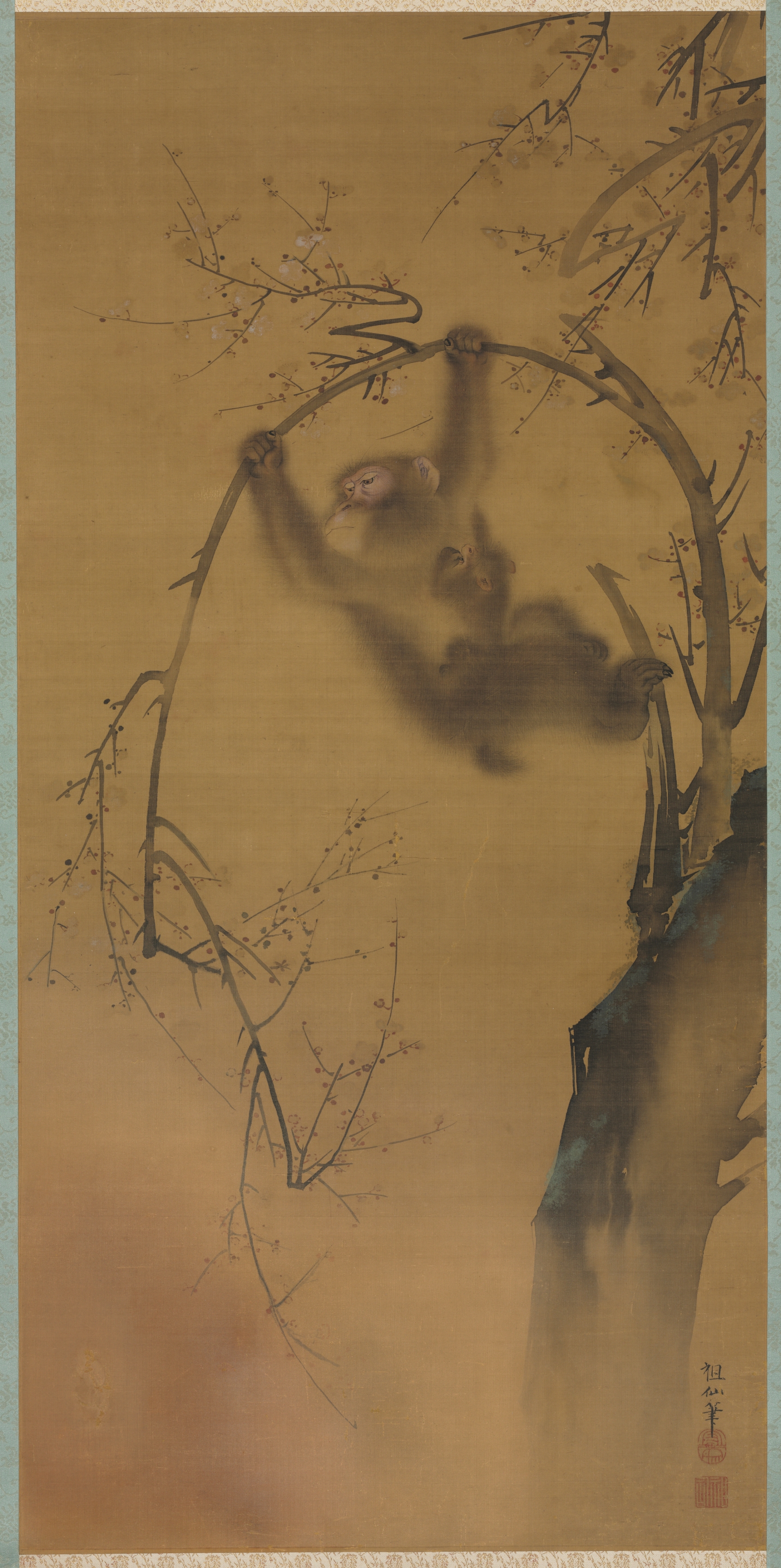
The cherry blossoms are not the first thing you notice. A monkey is suspended from a long, curving branch, and another, much smaller monkey has fastened itself against the adult's chest. Somewhere between the bend of the wood and the closeness of two bodies, an Edo-period painter has arranged a scene that seems to require no translation.
Mori Sosen (1747–1821), celebrated for his depictions of monkeys, understood that an animal portrait could be more than a study in fur and anatomy. Monkeys in a Cherry Tree, now in the Cleveland Museum of Art, invites a response that feels startlingly immediate after two centuries: affection, precariousness, trust. Yet it also challenges the certainty of our own interpretation.
A painting that moves without moving
The museum dates the hanging scroll to approximately 1800–1821. Made with ink and color on silk, the work measures 110.5 by 53.4 centimeters overall. A branch reaches from a rocky form at the right and curves outward. The large monkey hangs upon it. Against that larger animal, a smaller one clings. Blossoms and spare areas of silk surround the compact drama.
The branch appears elastic, the bodies weighted, the arrangement alive. That effect is not simply a matter of anatomical detail. The artist directs our attention with a line: from rock, to branch, to limb, to the small creature's hold. In a vertical hanging scroll, the composition creates a sense of suspension that is psychological as much as physical.
Can we call it a mother's embrace?
The phrase is irresistible. But here the obligation of a careful art writer is to distinguish what is visible from what has been inferred. The Cleveland Museum of Art describes a larger monkey and a smaller one clinging to its chest. Its record does not establish the larger animal's sex or prove that the two are biological mother and offspring.
“A Mother's Embrace” is therefore an interpretive title, not a zoological finding. We can see an intimate physical connection. Whether we name it maternal care, companionship, shelter or dependence says something about how human observers read emotional life in other species. An image can be moving without our inventing a biography for its subjects.
The man who could make monkeys feel present
Sosen worked in the Osaka region and became especially associated with monkey painting. He belonged to an artistic world in which competing and overlapping practices flourished: formal studio conventions, Chinese-inspired brush painting, decorative traditions and a growing interest in close observation of nature.
Maruyama Ōkyo (1733–1795) is often invoked in discussions of the period's turn toward sketching from life. But it is wiser to understand this as a broad artistic context than to claim, without documentation, that a particular Sosen scroll emerged from one direct lesson or one encounter with an animal. The work itself supplies ample evidence of Sosen's attentive eye.
In the large animal's fur, soft washes avoid the hardness of a rigid outline. Hands and feet make the bodily grip convincing. The woody branch and rocky anchor provide a contrasting material world: flexible and stiff, soft and sharp, animate and inert. Nature is observed, then carefully composed.
A brief history of looking at animals in Japan
Japanese animal painting reaches across a varied history of Buddhist iconography, Chinese painting traditions, courtly decoration and humorous or allegorical pictures. Monkeys, in particular, invite anthropomorphic readings because their hands, social bonds and expressions appear close to our own.
That resemblance has always been both an artistic opportunity and a trap. To paint a monkey as an amusing imitation of a human is one option. To study how it occupies a branch, gathers its limbs and presses close to another creature is another. Sosen's paintings reward the second kind of looking even as they stir the first kind of feeling.
Here, the artist never instructs us what to feel. There is no caption written into the landscape declaring the relationship. The tenderness exists in the relation of forms, the direction of bodies and the artist's willingness to leave room for the viewer.
One half of a pair
Monkeys in a Cherry Tree is not an isolated museum object. Cleveland also holds its companion, Monkeys on a Rock Ledge. Their accession numbers—1998.425.1 and 1998.425.2—identify them as a pair of hanging scrolls. Seen together, the contrast of branch and rock, airy space and solid ledge, extends our sense of Sosen's compositional thinking.
Hanging scrolls belong to a culture of display in which season, occasion and setting mattered. The museum's individual entries help scholars study each work closely, but the paired relationship also deserves recognition. A digital reproduction of one scroll can easily conceal the fact that another was conceived alongside it.
From Edo Osaka to an American museum
The Cleveland Museum of Art identifies the work as a 1998 gift of Frederick S. C. Perry. Its accession number is 1998.425.1. That is a secure part of its documented modern history; it is not a complete record of every earlier owner or journey between Japan and the United States. A serious account of provenance acknowledges where the available evidence stops.
Its present accessibility is nevertheless remarkable. The museum has made the work available through its Open Access program, allowing reproduction and reuse without requesting permission. The painting itself is in the public domain, and the museum's page describes the reproduction as freely reusable. The museum also says the original is not currently on view. A worldwide audience can study its image while the physical silk remains under the institution's care.
What a brushstroke can preserve
The date range—around 1800 to 1821—is not an exact year. Neither the identity of the animals nor a story of how Sosen encountered them is authenticated in the object record. These limits do not diminish the painting. They give us a reason to look more closely rather than turn art into a sentimental anecdote.
In an era of photographs that travel globally in a second, the painting demonstrates something slower. A single curved branch can organize a whole world. Two animals can appear inseparable without a single spoken word. What Sosen preserved was not an explanation of love, but the physical possibility of closeness. The viewer supplies the rest.
Museum records and sources
Based on the museum catalog and associated collection records. The sex and biological relationship of the monkeys are not identified by the museum; no original interviews were conducted.