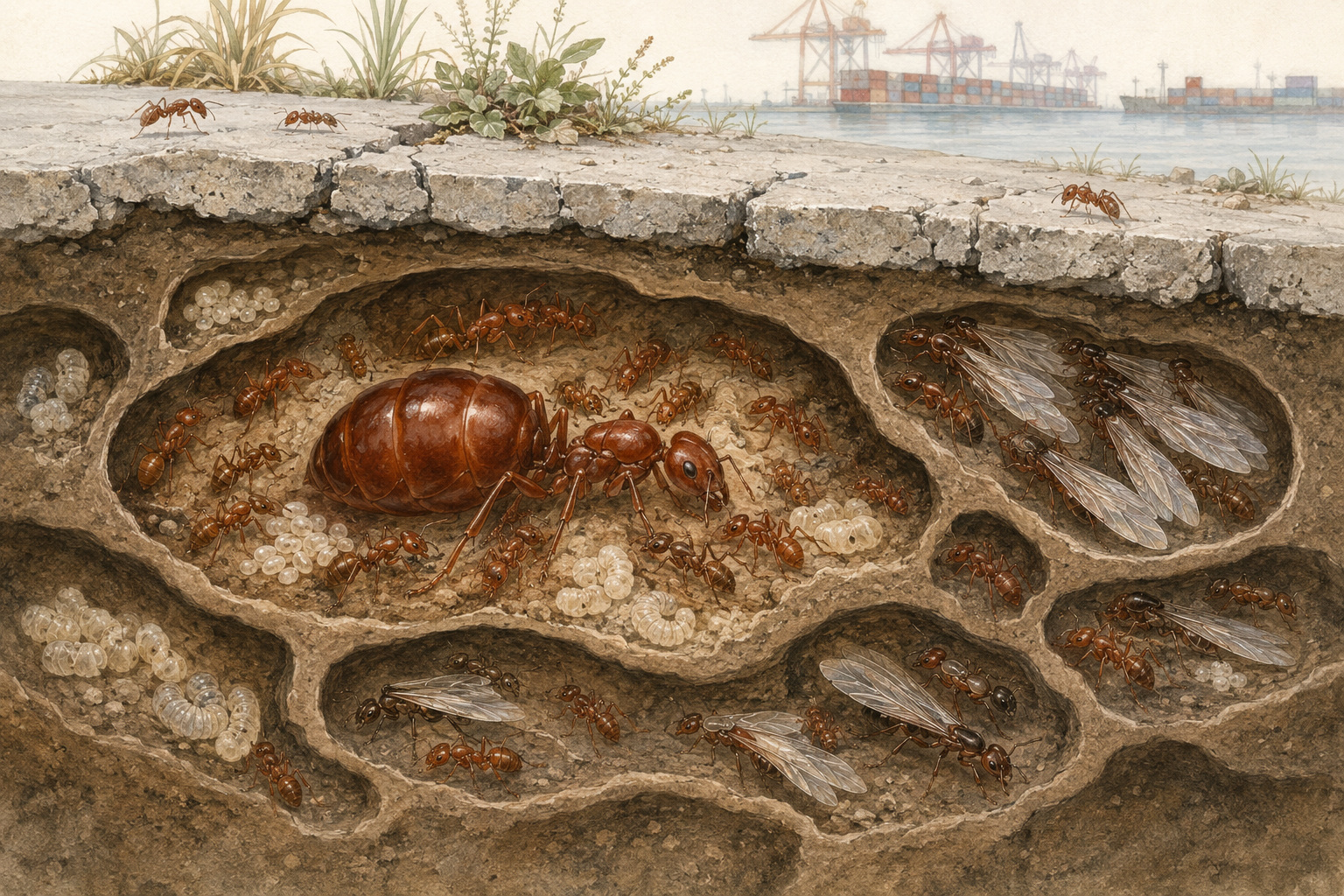
THE first warning was visible on the pavement: roughly 500 small reddish-brown ants moving outside a stored container. An Okayama Prefecture survey contractor found them at Mizushima Port on August 23 and placed insecticidal bait around the location.
When port personnel and the Environment Ministry expanded the inspection the next day, the scale changed. They found more than 2,500 additional workers, about 100 winged ants, one queen and large numbers of eggs, larvae and pupae outside the container, in the gap beneath it, on the paved surface below and around the site. Ants were also moving into soil through pavement cracks and joints.
An expert identified collected specimens on August 25 as the red imported fire ant, Solenopsis invicta. The ministry’s August 28 total was more than 3,000 workers, about 100 winged ants, one queen and extensive brood. Okayama Prefecture said the entire confirmed area had been treated and no human injury had been reported.
The species is aggressive. Its sting can cause intense pain and, in susceptible people, anaphylactic symptoms. The ministry advises people not to touch suspected fire ants with bare hands and to contact its fire-ant hotline or a regional environment office.
From 500 Ants to More Than 3,000
The chronology shows why the number first visible is not the size of the group. The contractor saw about 500 suspected fire ants outside the container on August 23. Only after the inspection moved beneath and around it the next day did officials find at least 2,500 more.
The ants were not simply clinging to the container’s exterior. The ministry recorded them between the container and the ground, across the pavement below and around it, and moving through cracks and joints into soil. Killing exposed workers without locating the concealed group would have risked leaving the reproductive core behind.
Identification proceeded alongside control. Native ants can resemble invasive fire ants, so official procedure calls for containment at the suspicion stage and expert confirmation rather than a visual declaration by an untrained observer. The species determination came on August 25; the national and prefectural announcements followed on August 28.
Why the Queen and Winged Ants Matter
Fire ants are social insects. Queens lay eggs while workers forage and care for young. Japan’s control guidance therefore treats the queen and immature stages—not just visible workers—as the critical target. A response that kills thousands of workers can still fail if the queen and enough brood survive.
Winged ants add a dispersal concern. The ministry explains that winged new queens and males can leave a nest on mating flights, after which a fertilized queen may begin a nest elsewhere. The August announcement does not identify how many of the roughly 100 winged ants were female, but their presence raises the importance of preventing flight and searching beyond the original point.
Numerous eggs, larvae and pupae also distinguish the finding from isolated workers spilled during transport. Even so, the public record does not establish whether the group arrived inside or beneath the container, or how long it had been developing at the port.
- More than 3,000 worker ants.
- About 100 winged ants.
- One queen.
- Large numbers of eggs, larvae and pupae.
- Ants moving between pavement cracks and the soil below.
A Discovery Is Not the Same as Establishment
The Environment Ministry uses a demanding operational definition of establishment: a group of the same origin has developed beyond effective suppression. Examples include a developed group producing next-generation groups over multiple years, or a developed group appearing somewhere that human-assisted import is implausible.
Under that definition, finding a queen and winged ants does not automatically establish a national population. As of March 2026, Japan had recorded 171 fire-ant cases across 20 prefectures since the first domestic confirmation in June 2017, while the ministry still assessed that establishment had not occurred.
The guidance also says an immediate judgment can be difficult. When officials find a developed group, they are expected to act on the possibility that new queens have already dispersed. The practical question at Mizushima is therefore not which label fits on announcement day, but whether every connected group can still be eliminated.
The Second Large Find in Five Weeks
Mizushima Port had produced another major detection on July 19. Over three days, Okayama and national officials found roughly 100 ants, then about 300, then more than 2,000 beneath a container. More than 2,400 were killed. The prefecture reported no injury and said surveillance would continue around the site.
The August 23 group appeared about five weeks later at the same international container terminal. The announcements do not say whether the two groups shared an import route, occupied connected sites or represented independent arrivals. They do not disclose the August container’s port of origin, arrival date or exact relationship to the July site.
Okayama’s July document called that event the seventh detection of either the red imported fire ant or tropical fire ant at Mizushima. Fire ants were first found there in 2017; tropical fire ants followed in 2018, 2019, 2020, 2022 and 2025. Repetition does not prove port-wide establishment, but it does show recurring invasion pressure through international logistics.
| Question | Confirmed by August 28 | Not established publicly |
|---|---|---|
| Species | Expert identification as S. invicta. | Genetic origin or relationship to another case. |
| Scale | More than 3,000 workers plus reproductive stages. | The exact population before discovery. |
| Range | Container underside, surrounding pavement and soil access. | Whether related ants reached another port or off-port site. |
| Route | The group was associated with a stored container. | Origin port, arrival date and duration at Mizushima. |
| July link | More than 2,400 ants were treated at the same terminal. | Whether the July and August groups had the same source. |
The Port Is the Last Practical Interception Line
The ministry’s April 2026 guidance says most of Japan’s 171 cases through March were found on container-yard ground, inside or outside containers, or in cargo. Among fiscal 2025 cases in which an origin could be traced, all three fire-ant cases involved departures from China.
Fiscal 2025 produced 36 fire-ant cases and 24 tropical-fire-ant cases. The fire-ant count sharply exceeded the previous annual record of 26 set in fiscal 2017. The Mizushima announcement was already fiscal 2026’s 28th fire-ant case.
Those counts are not the same as colonies, established sites or ant abundance. Better surveillance may itself produce more detections. It would therefore be unsound to infer that invasion pressure rose in direct proportion to the case count. But the frequency does show why the surveillance system cannot relax.
Proving Absence After Treatment
Okayama Prefecture says treatment covered the entire confirmed area. The Environment Ministry plans continued surveys and control with port operators and local governments. It has also asked cargo and terminal businesses to inspect for other contamination, prepare for future shipments on the same routes, contain suspected ants and report them quickly.
Japan’s invasive-species rules allow authorities to restrict or prohibit movement of containers and cargo while fire ants are suspected. After identification, authorities may order disinfection or disposal. The system is designed to stop escape before ordinary cargo movement resumes.
Control at the site must account for the group’s layout. A fast-acting spray may kill exposed workers while disturbing or dispersing ants elsewhere. The ministry’s guidance calls for methods suited to the observed conditions, potentially combining bait, liquid insecticide, physical collection and sustained monitoring.
For a ground detection with no known entry route, the guidance requires checks for at least a month after the last live ant is found. If nesting is confirmed, it calls for surveys within two kilometers of the site twice a year—in spring and autumn—during each of the next two fiscal years. The August 28 announcement does not say which follow-up category officials will apply here.
JUNE 2017 Japan confirms its first red imported fire ants.
APRIL 2023 The amended emergency invasive-species system takes full effect.
FISCAL 2025 Japan records a yearly high of 36 fire-ant cases.
JULY 19–21, 2026 More than 2,400 fire ants are found and killed at Mizushima Port.
AUGUST 23–25, 2026 The new group is found and confirmed by an expert.
AUGUST 28, 2026 National and prefectural announcements begin the public follow-up record.
Eradication Is Measured in the Months Afterward
The initial response was fast. Bait went down on the day of discovery, the inspection widened the next day, and expert identification followed within 48 hours. Survey, notification, field control and taxonomy worked as a connected system.
The harder proof comes later. With roughly 100 winged ants present, teams need to inspect nearby containers, pavement fissures, vegetation and drainage features, then demonstrate over time that neither workers nor reproductive ants are reappearing. If location and genetic evidence permit, the relationship to July’s group should also be tested.
The more-than-3,000 count represents both a serious incursion and the value of active surveillance. Preserving Japan’s record of no confirmed establishment will depend not on declaring the visible ants treated, but on accumulating evidence that no connected group survived or dispersed.
- Ministry of the Environment — Fire ants confirmed at Mizushima Port, August 28, 2026
- Okayama Prefecture — Fire ants confirmed at Mizushima International Container Terminal, August 28, 2026
- Kurashiki City — Official fire-ant and tropical-fire-ant information, updated August 28, 2026
- Ministry of the Environment — Basic Approach to Fire-Ant Control, Version 4.2, April 2026
- Ministry of the Environment — Fiscal 2025 fire-ant confirmation summary, April 21, 2026
- Okayama Prefecture — July Mizushima Port fire-ant report, July 21, 2026
This English report was written independently from Japanese national, prefectural and municipal primary material available through August 29, 2026. Species, control and legal terminology follows the Japanese sources. The origin of the container, duration of the group’s presence and relationship to the July case were not disclosed and are not inferred. No interview quotation has been reconstructed or translated as a direct quote.