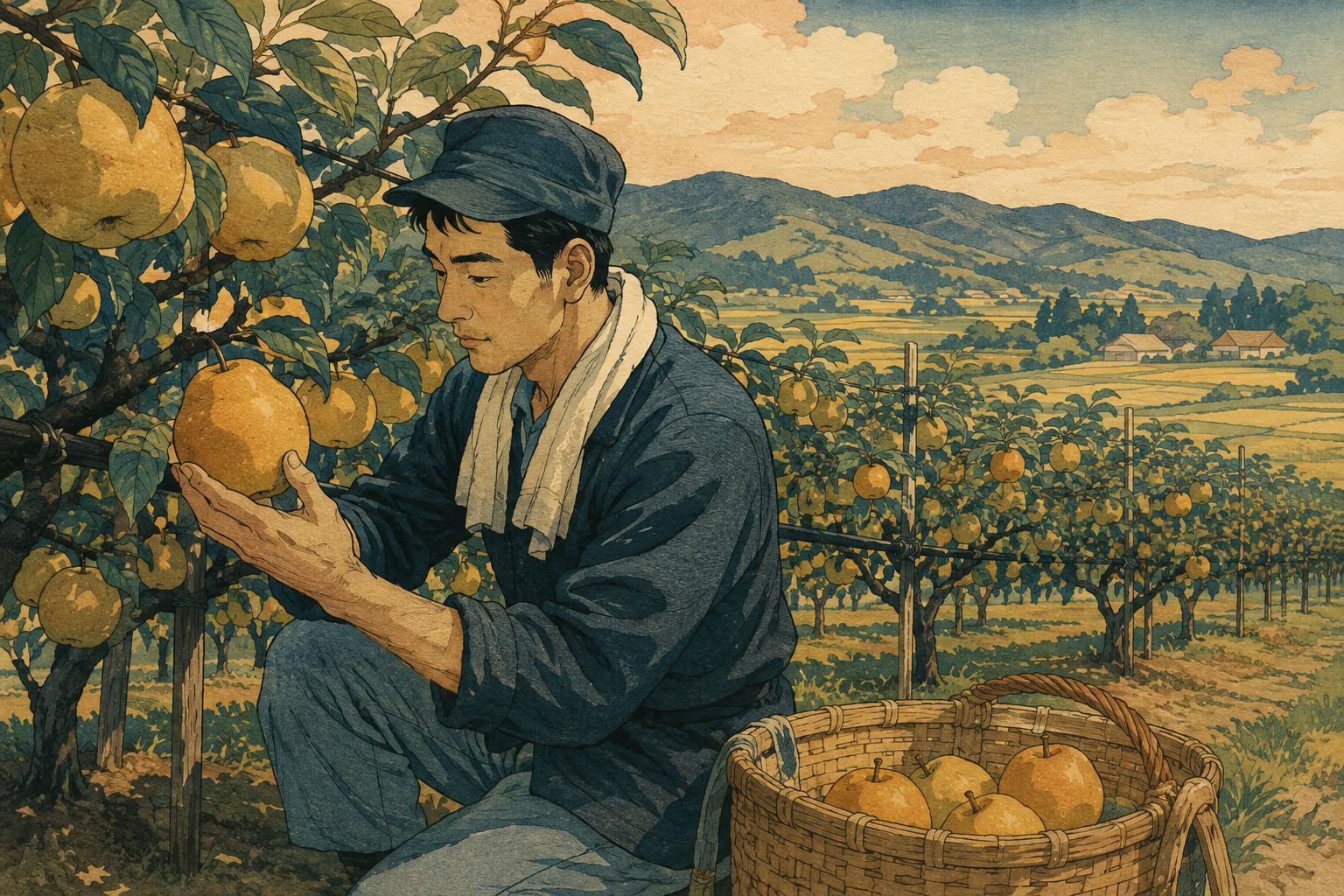
A pear tree is not an instant business. Pruning, pollination, fruit thinning, pest control, harvesting and sales recur in a seasonal cycle, while productive trees, practical knowledge and customers must all be secured. For someone without a farming family, gaining access to a field is only one part of entering fruit agriculture.
Takayuki Ohmi, proprietor of Rifu Omote Pear Orchard, found an entry point in Japan’s Regional Revitalization Cooperation Corps. Raised in Sendai, he worked for a large company in Tokyo for 12 years. When family circumstances required a return to Miyagi, he encountered Rifu Town’s recruitment booth at a regional-revitalization event at Tokyo Big Sight.
Ohmi moved to Rifu in 2019 and joined the town’s cooperation corps to work on pear production and value-added local products. He watched an experienced grower, repeated the work in a field arranged by the town and learned from other pear farmers. After completing the corps term, he succeeded to land that no longer had a cultivator and opened Rifu Omote Pear Orchard in 2023.
A different measure of work, not a flight from a bad employer
In an interview published by Miyagi Prefecture on August 28, Ohmi said he had found his corporate work rewarding and had not left because of dissatisfaction with the company. His priorities changed. He wanted discretion over the whole process of making something and the direct experience of giving it to someone who valued it.
Rifu was familiar from childhood soccer visits. It was also near his father in Sendai, making it more practical than other pear-producing areas in the prefecture. At the town’s event booth, Ohmi learned that the assignment could include not only cultivation but also processing and sales—a route toward an independent business.
Japan calls this approach “sixth-sector industrialization”: farmers and fishers add value by becoming involved in processing, distribution or sales as well as primary production. In Ohmi’s case, fresh pears and a product made from fruit outside ordinary retail specifications became two connected activities.
The corps period combined training with belonging
Many orchard tasks occur only once a year. A trainee gets one annual cycle to see bloom conditions, frost, rain, pests and fruit set, and the variables do not repeat exactly. Ohmi told the prefectural interviewer that he observed his mentor, practiced in a field the town rented and received help from pear growers around him.
The cooperation corps is not solely an agricultural training program. Members carry out local revitalization work while building a livelihood and community relationships. Rifu’s public materials date Ohmi’s activity from July 2019 through March 31, 2023. Although cooperation-corps terms are generally described as lasting no more than three years, the sources reviewed for this report do not explain his approximately three-year-and-nine-month span.
A Rifu official interviewed by the prefecture said three current corps members are learning pear cultivation in other fields and expressed the view that Ohmi’s example influenced their decisions. That is an institutional assessment, not a measured causal finding. Still, a visible case of a non-farm entrant reaching independence can make an otherwise abstract career path easier to imagine.
| Stage | Period | What it provided | Not disclosed publicly |
|---|---|---|---|
| Corporate employment | 12 years in Tokyo | Organizational experience and relationships later used in product testing | Employer, exact role and capital available at departure |
| Cooperation corps | 2019–March 2023 | Mentor, practice field, community relationships and seasonal experience | Annual compensation, activity spending and training hours |
| Processed product | Development from 2019; launch in 2021 | A use for nonstandard pears and an item sellable beyond harvest | Development cost, volume and profit |
| Independent operation | From 2023 | Succession to an orchard; two fields and 13 varieties today | Area, tenure, yield and farm income |
Land was the next barrier after technical training
Completing an apprenticeship does not create an orchard to operate. Newly planted trees take time to become fully productive. Succession to an established orchard can shorten that gap, but the owner, cultivator, equipment, condition of the trees and terms of use still have to be reconciled.
Ohmi took over land whose previous cultivation had stopped after his corps term. The prefectural interview does not give the area, ownership or lease arrangement, age of the trees, equipment costs or terms of succession. It would therefore be wrong to infer that the land was easy to obtain or free.
Passing established trees and local knowledge to a prepared entrant nevertheless matters. If cultivation stops, pruning and protection stop too, increasing the cost and time required for restoration. A system that identifies departing growers and connects them early with trained entrants can serve both farm succession and land preservation.
Turning nonstandard pears into a year-round curry product
Pears can fall outside premium fresh-fruit specifications because of appearance or minor damage even when usable as food. After seeing fruit discarded or given away, Ohmi began developing Kin no Rifu Nashi Curry—rendered here as “Golden Rifu Pear Curry”—in 2019, his first year in the corps.
Town employees tasted successive versions, and his former company helped test the dish in an employee cafeteria. The curry went on sale in 2021. Grated pear is combined with spices, turning harvest-season fruit into a packaged product that can be sold through the year and potentially reducing waste.
Processing does not by itself prove profitability. Ingredient preparation, contract manufacturing, packaging, inventory and distribution all cost money. No public figures show unit sales, revenue, gross margin or the volume of pears diverted from disposal, so the product’s contribution to the orchard’s finances cannot be calculated.
A precedent exists; the business evidence remains incomplete
Ohmi told Miyagi’s interviewer that Rifu had no pear grower from a non-farming family when he arrived and that he intended to establish the precedent. He now moves between two orchards growing 13 varieties and combines direct fresh-fruit sales with processed products.
The work extends far beyond autumn harvest. Winter pruning, spring pollination, thinning and summer management fill the year. Birds, insects, frost and other conditions remain outside the farmer’s control. Ohmi also noted that independence eliminated a regular paycheck. The exchange for greater discretion was personal exposure to weather, crop and market risk.
Rifu lists subsidies for pear-production facilities, labor-saving pollination and environmentally conscious agriculture, among other programs. Each has eligibility rules, cost-sharing rates and limits. The public record reviewed for this article does not establish which programs Ohmi used, in which year or for how much. A general town program should not be reported as a benefit paid to him.
- How many trainees secure orchards and become independent operators.
- The area, tree age, equipment condition and contract terms of orchards available for succession.
- Farm income, time to cover living costs and reliance on outside employment after independence.
- The effect of processed products on nonstandard-fruit waste and annual income.
- Whether new entrants remain in business after five and ten years and train successors themselves.
Can one person’s example become a reliable local entrance?
Ohmi told the prefecture that he wants to focus on quality and present farming as enjoyable, financially viable and attractive work. Beyond sales at the orchard, he has opened the setting to blossom viewing and other events and has spoken to local high-school students.
Visibility can attract candidates. It cannot replace access to skills, land, housing, capital and customers. Ohmi reached independence because his publicly supported corps period, a mentor, a place to practice, local relationships and an orchard available for succession formed a continuous route.
One orchard cannot establish the success of an entire policy. It does, however, offer a concrete example of linking a person without inherited land to existing trees and giving that person room to test processing and direct sales. Rifu’s next test is whether that route can become a dependable system for several new growers, rather than an outcome dependent on one person’s relationships and fortunate timing.
- Miyagi Prefecture, Miyagi Relocation and Exchange Guide — Interview with Takayuki Ohmi, August 28, 2026
- Rifu Town newsletter — Establishment of Rifu Omote Pear Orchard and sixth-sector activities (Japanese PDF)
- Rifu Town newsletter — Official reading of Ohmi’s name and cooperation-corps activity (Japanese PDF)
- Rifu Town — Agricultural support programs
- Rifu Town newsletter, April 2026 — Community events at Rifu Omote Pear Orchard