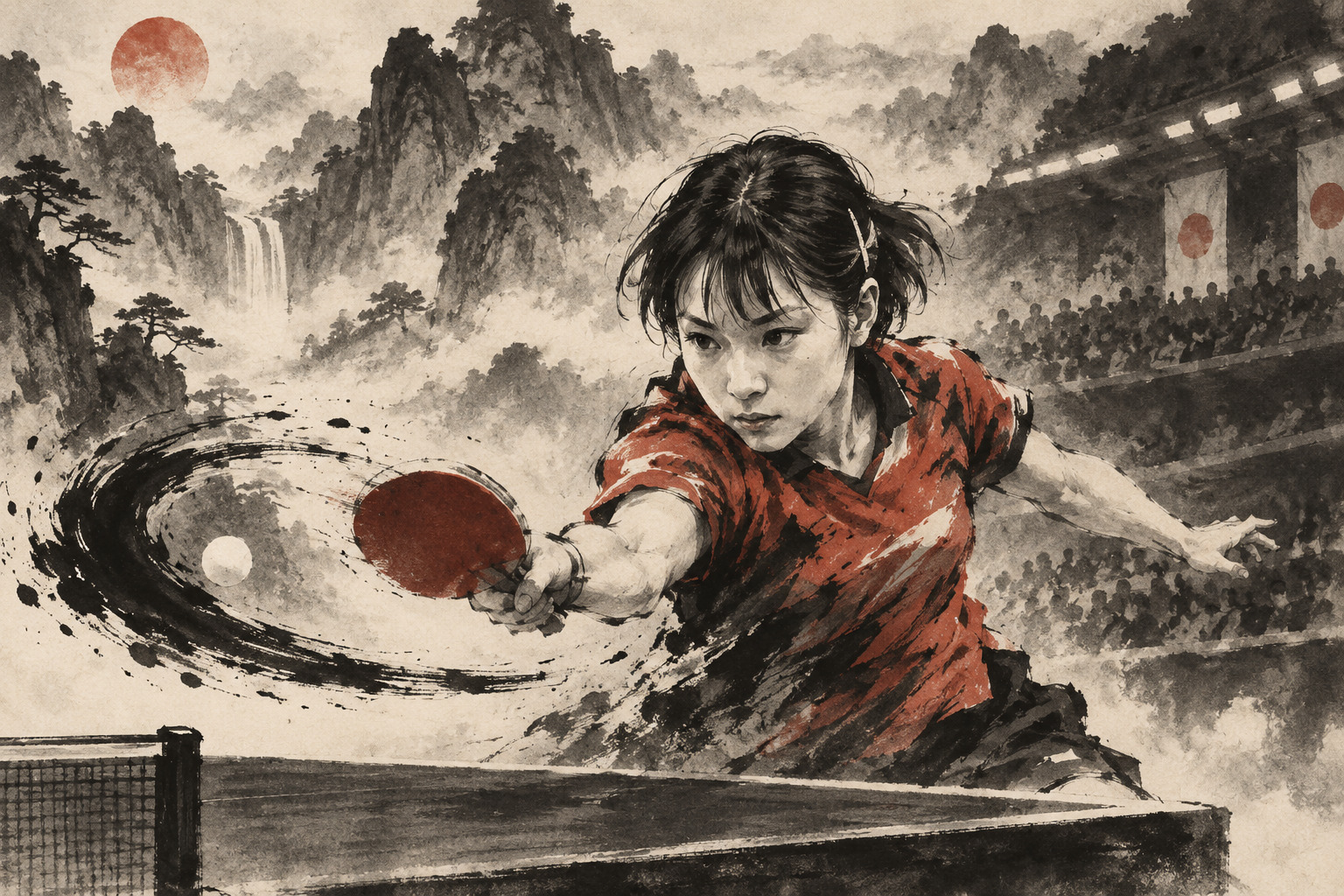
The match had been level for barely a few minutes when Miu Hirano accelerated away from it. After Hina Hayata took the second game, Hirano answered 11–7, then demolished the fourth 11–1. At 11–8 in the fifth, an all-Japanese final between two players born in 2000 ended with a result Hirano had waited three years to record: an international singles title.
WTT Contender Almaty, staged in Kazakhstan’s largest city from September 1 through 6, did not feature the leading Chinese women. It did, however, place Hirano opposite the tournament’s No. 1 seed in the final. Hayata was ranked sixth in the world entering the week and had shared both an Olympic generation and Japan’s intensely competitive national-team environment with Hirano.
The victory was not built on one upset. Hirano won five main-draw matches while conceding only three games in total. She handled a Korean veteran, two Russian opponents and two Japanese rivals, absorbing changes of pace and spin without allowing a lost game to become a lost match. The WTT ranking list updated on September 7 placed her at No. 27 with 1,315 points.
A final seized after the split
Hirano began the final with an 11–9 win, Hayata replied by the same score, and the contest appeared set for the long, tactical argument familiar between opponents who know one another well. It never arrived. Hirano won the next three games, with the 11–1 fourth game turning a narrow lead into command.
Her defining pattern remains early contact close to the table. Hirano takes time away from opponents by redirecting the ball before their stroke and recovery can fully develop. Japanese coverage described the familiar engine as her high-speed attack from both wings. Almaty showed something beyond raw tempo: she changed the match after losing a game, protected the new pattern, and closed before Hayata could stretch the final into a seventh-game test.
| Round | Opponent | Result |
|---|---|---|
| Round of 32 | VISHNIAKOVA (Russia) | 3–0 (11–1, 11–9, 11–8) |
| Round of 16 | Yang Ha-eun (South Korea) | 3–1 (11–5, 11–8, 9–11, 11–8) |
| Quarterfinal | Vlada Voronina (Russia) | 3–0 (11–8, 11–6, 11–3) |
| Semifinal | Miyu Nagasaki (Japan) | 3–1 (4–11, 11–8, 11–6, 11–7) |
| Final | Hina Hayata (Japan) | 4–1 (11–9, 9–11, 11–7, 11–1, 11–8) |
The evidence of recovery was not a single spectacular rally. It was the continuity of five matches in which one bad game never became the next one.
A second trophy with Miyuu Kihara
Hirano also partnered Miyuu Kihara to win the women’s doubles. They dropped one game in their opening round against Anastasia Abramian and Voronina, then swept three straight matches. In the final they beat India’s Syndrela Das and Sutirtha Mukherjee, 11–2, 11–5, 20–18.
The extraordinary 20–18 third game matters. A match that had looked one-sided became a sequence of game points and reprieves, the sort of compressed pressure that exposes communication and shot selection. Hirano and Kihara finished it without yielding a fourth game. From the quarterfinal through the final, they did not concede a game.
Japan enjoyed a broad set of results in Almaty. Shunsuke Togami won the men’s singles, while Kazuki Yoshiyama and Yuna Ojio finished second in mixed doubles. Hirano’s achievement stood apart because she carried two events through their final rounds and left with both trophies.
The three years between Zagreb and Almaty
Hirano’s previous WTT Series singles title came at WTT Contender Zagreb in July 2023. That run was more dramatic and, by opponent strength, more startling. She defeated three Chinese players from the quarterfinal onward and beat then-world No. 1 Sun Yingsha 4–3 in the final. Hirano saved herself through a 14–12 sixth game and took the seventh 11–6. The result moved her from No. 21 to No. 14 in the next ranking list.
The intervening years were not empty. Hirano won a second consecutive Olympic team silver at Paris 2024 after doing so at Tokyo 2020, reached the singles quarterfinals in Paris, and was part of Japan’s runner-up team at the 2024 World Championships. Japan then won the women’s team title at the 2024 Asian Championships.
Yet the individual international title did not return. Hirano exited the 2025 individual World Championships in the second round, and by February 2026 her world ranking had fallen to No. 65. Her route back was already visible at WTT Star Contender Chennai that month. She reached the final before losing in four games to Satsuki Odo. Almaty therefore was not a recovery from nowhere; it was the moment a player who had again learned how to reach Sunday finally converted the last match.
The burden of a precocious past
Hirano was born on April 14, 2000. At 16, she won the 2016 Women’s World Cup and became the youngest champion in the tournament’s history. In 2017 she won the Asian Championships singles title after defeating three elite Chinese opponents—Ding Ning, Zhu Yuling and Chen Meng—then earned bronze at the World Championships.
Those results fixed an unusually high reference point for everything that followed. When an athlete has beaten the world’s best as a teenager, a quarterfinal or silver medal can be made to look like decline. Elite table tennis offers a harsher reality. Opponents study successful patterns, younger domestic players rise, the ranking system changes, and a style based on taking the ball early must be executed with millisecond precision year after year.
Hirano has also lived through a structural transition in the sport. The old ITTF World Tour was replaced by the WTT circuit, with events arranged across Contender, Star Contender, Champions, Smash and Finals levels. A Contender title is not equal to an Olympic medal or a World Championship. It is nevertheless a full international title, carrying ranking points and the proof that a player can navigate a draw and finish the final.
2016 — Wins the Women’s World Cup at age 16.
2017 — Asian champion and World Championships bronze medalist in singles.
2021 — Wins Olympic team silver at Tokyo 2020.
2023 — Beats Sun Yingsha to win WTT Contender Zagreb.
2024 — Wins a second Olympic team silver and reaches the singles quarterfinals in Paris.
2026 — Runner-up in Chennai, then singles-and-doubles champion in Almaty.
What one title changes—and what it does not
Almaty does not settle Hirano’s place in the world order. The strongest Chinese players were absent, and Japan’s women’s field remains unusually deep: Hayata, Nagasaki, Kihara, Miwa Harimoto, Satsuki Odo and Mima Ito all possess major international experience or ranking strength. It would be reckless to turn one week into a forecast about future national-team selection.
What the title changes is the available evidence. Hirano did not merely play well against one favored opponent. She conceded three games across five singles rounds, reversed the semifinal after losing the opener, beat the No. 1 seed in the final and handled a separate doubles campaign without letting its pressure dilute her singles work.
The next test is repeatability: against stronger draws, at higher-tier events, in unfamiliar halls, and eventually against the Chinese leaders who define the ceiling of the women’s game. A three-year drought ended in Almaty. The more consequential possibility is that the week supplied a new baseline for what Hirano at 26 can still build.
- World Table Tennis, “WTT Contender Almaty 2026” — official event information, seeding and final result.
- Table Tennis Report, “Togami and Hirano Win WTT Contender Almaty,” September 7, 2026 — game-by-game singles and doubles results.
- TV Tokyo Table Tennis News, “Hirano Wins First International Tour Title in Three Years,” September 7, 2026 — tournament report and two-title summary.
- World Table Tennis, ITTF Table Tennis World Ranking — women’s singles ranking and points, updated September 7, 2026.
- Japanese Olympic Committee, “Miu Hirano” — birth date and Olympic record.
- TV Tokyo Table Tennis News, Zagreb interview and result, July 4, 2023 — route to the title, Sun Yingsha final and verified remarks from 2023.
- TV Tokyo Table Tennis News, world ranking update, July 4, 2023 — post-Zagreb ranking change.
- Japan Table Tennis Association, “2026 WTT Star Contender Chennai” — Hirano’s women’s singles runner-up finish.
- TV Tokyo Table Tennis News, Miu Hirano player profile — Japanese reading, playing style and career record.
Editorial note: Japanese names, readings, event titles, playing terminology and Olympic results were checked against Japanese federation and tournament materials. “First in three years” refers specifically to a WTT Series singles title; it does not erase Hirano’s team medals or doubles results. No verified post-final comments from Hirano were located, so none are quoted.