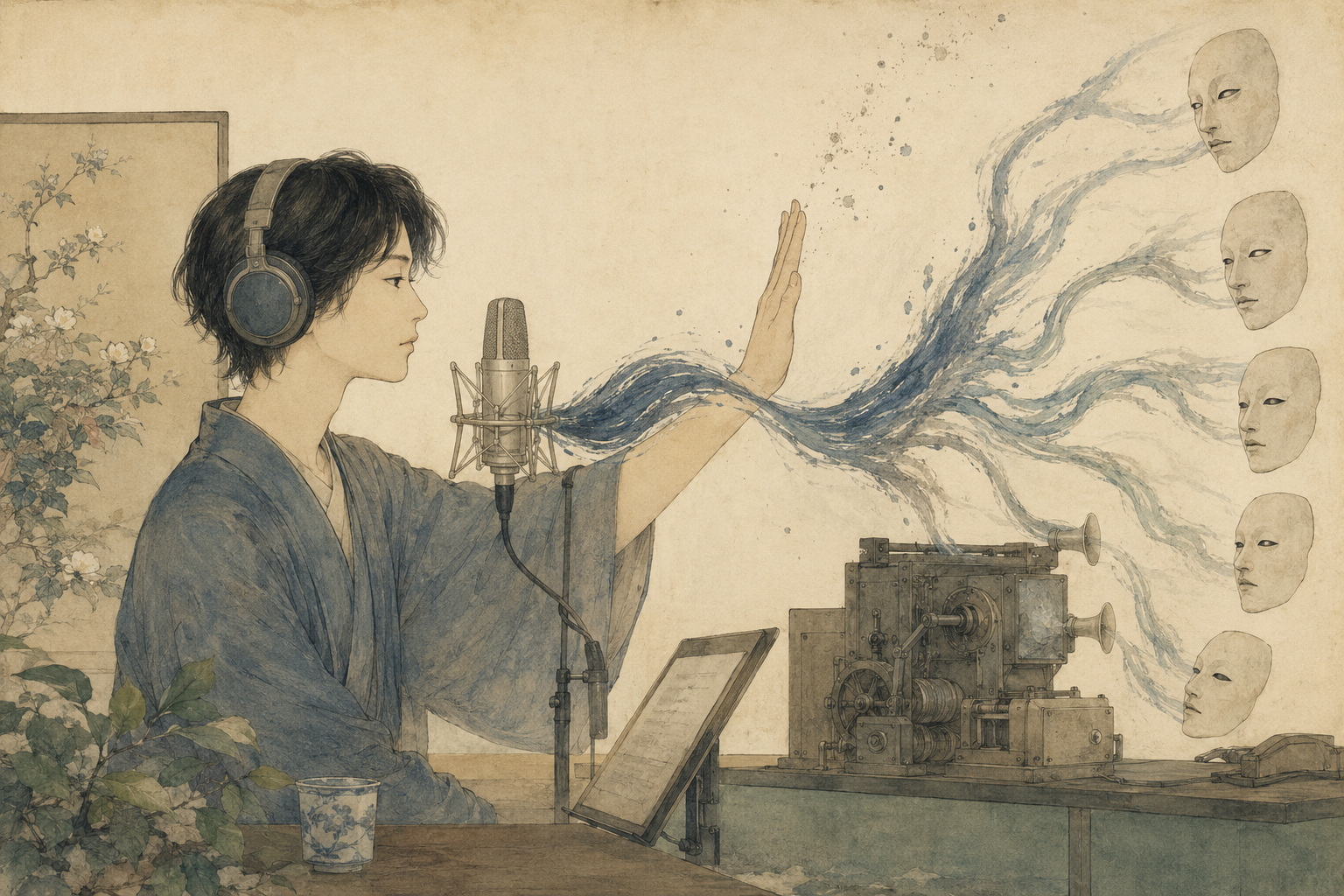
A voice actor enters a recording booth carrying more than a sound. There is a body behind the breath, a script marked with choices, a relationship with a director, an understanding of the character and a willingness to be held responsible for the line. The recording lasts seconds. The preparation may have taken a career.
Voice cloning breaks that bundle apart. It can take the recognizable acoustic identity—the grain, register, pace and recurring inflections—and attach it to words the actor never read, roles the actor never accepted and products the actor never endorsed. The result may be technically new audio rather than a copied recording. To a listener, however, it may still sound unmistakably like the person.
That is the wound Megumi Ogata described in a TBS interview broadcast at the end of July. “My voice is part of my identity,” she said in substance, objecting to sites and social posts that let users make a recognizable performer appear to say anything and, in some cases, commercialize the result. Her argument was not that speech synthesis should stop. She explicitly welcomed technological progress. Her objection was to progress built by taking a human being’s identity, labor and accumulated trust without permission.
Ogata’s intervention carries unusual weight because her career demonstrates how much identity can inhabit a voice. Trained first for musical theater, she moved into voice acting when her company dissolved. She broke through as Kurama in Yu Yu Hakusho, played Sailor Uranus in Sailor Moon, and became inseparable from the vulnerable, inward voice of Shinji Ikari in Neon Genesis Evangelion. Later roles range from Yugi Mutou and Yukito Tsukishiro to Yuta Okkotsu. Her official profile credits the low, androgynous young-man register associated with Kurama with opening new space for women performers.
A clone trained across such a body of work does not merely borrow a timbre. It draws on thousands of decisions about fear, restraint, age, gender, rhythm and intimacy. That is why Ogata’s concern reaches beyond lost fees. A performer can be made to utter obscene, political, fraudulent or cruel material; audiences can be deceived; a character’s history can be bent; and the actor may spend years trying to separate a synthetic statement from a real reputation.
The law protected the performance, not necessarily the voice
Japan’s legal gap begins with a category error that technology has exposed. Copyright law protects works: a script, composition, animation, film or other creative expression. Related rights protect a performer’s recorded or transmitted performance. If someone copies an actual voice track, reproduces an actor’s delivery or uses protected character art and music, copyright and neighboring rights may provide a remedy.
But a human voice itself has generally not been treated as a copyright work. It is a personal characteristic and a medium of expression, not the expression alone. When an AI system produces entirely new words in a close imitation of an actor’s vocal identity, it may avoid copying the old performance in the technical copyright sense. Japan’s Agency for Cultural Affairs confirmed this distinction in its 2024–25 deliberations: copyright does not protect the voice itself, though other doctrines such as publicity rights and general tort law may apply.
The distinction is narrow on paper and enormous in practice. A conventional pirate distributes the line an actor actually spoke. A voice-cloning service can generate an infinite number of lines the actor refused—or never had the chance—to speak. The second act may be more invasive while fitting less comfortably inside a law built around copies of fixed works.
Other laws can reach particular harms. Defamation may address false and reputation-damaging statements. Privacy and personality interests may protect intimate or degrading uses. Fraud and consumer law may apply when a fake endorsement extracts money. The Unfair Competition Prevention Act may help when a famous voice functions as a source identifier and its use causes confusion or exploits a well-known indication. None of those routes, however, was designed as a simple, comprehensive right to control a digital replica.
How a 2012 photograph case reached an AI voice in 2026
The Justice Ministry’s answer begins not with a computer but with photographs of Pink Lady. In a 2012 decision, Japan’s Supreme Court recognized publicity rights as part of the personality rights from which an individual can exclusively exploit the customer-attracting power of a name or likeness. The singers nevertheless lost because the magazine photographs at issue illustrated an article and were not used solely to exploit that commercial attraction.
The judgment did two things that matter now. It established a protected commercial interest without waiting for a publicity-right statute, and it limited that interest so reporting, commentary and legitimate expression would not be smothered. It identified typical infringement when a likeness is sold as the object of appreciation, attached to distinguish a product or used to advertise goods and services.
The ministry’s 2026 report extends that logic expressly to voice. A famous performer’s recognizable voice can itself attract customers. A synthetic voice message sold because it sounds like that performer, an alarm clock distinguished by the imitation, or an advertisement narrated in the replica can therefore implicate publicity rights. A monetized social video that uses a cloned voice to attract views may also qualify, depending on its full context.
Commercial value is only half the analysis. The report also treats voice as part of the personality interest in not having one’s identifying characteristics used indiscriminately. That protection is important for people who are not famous and for uses—such as a fabricated sexual recording—whose main injury is humiliation, fear or loss of autonomy rather than a diverted endorsement fee. Courts would balance identifiability, social position, purpose, manner, necessity, audience understanding and the severity of the intrusion.
| Legal route | What it protects | What must still be shown |
|---|---|---|
| Personality interest | The interest in not having an identifiable voice used indiscriminately; potentially relevant to famous and ordinary people. | Context, purpose and manner push the use beyond what society should reasonably require the person to tolerate. |
| Publicity right | The customer-attracting commercial power of a famous person’s identifying characteristics, now expressly including voice in the report. | The use is directed primarily at exploiting that attraction, not merely legitimate reporting, criticism or incidental reference. |
| Performer’s related rights | An actual recorded performance and specified uses of that performance. | The protected performance—not merely a newly generated sound-alike identity—has been reproduced or used. |
| Unfair competition | Business interests where a well-known voice functions as an indication of source or association. | Confusion, misappropriation of a famous indication or another statutory form of unfair competition. |
| Defamation, privacy, fraud | Reputation, private life and victims deceived by false statements or endorsements. | The elements of the particular wrong; a synthetic voice alone does not automatically establish them. |
Recognition is more than a waveform
A central question is how to decide whose voice the output is. No synthetic replica is perfectly identical. Pitch can be shifted; artifacts can distort consonants; a model may resemble both a performer and the character that performer once played. Acoustic comparison matters, but listeners encounter more than acoustics.
The report therefore looks to context as well as sound. A title naming the actor, a tag naming a role, the picture of a character, the choice of catchphrase and comments saying “that sounds like” the performer can combine to make a source identifiable. Removing the real name from the audio file is not a magic defense when the surrounding presentation tells the audience exactly whom to hear.
Conversely, resemblance is not the end of the inquiry. Japan has a long tradition of monomane, parody and performance built around disclosed imitation. The ministry’s draft discussion indicated that an impression clearly presented as an impression, without deceiving the audience into believing the person actually spoke, would not automatically violate publicity rights. News, criticism, biography, research and other socially valuable uses also require room. A rule broad enough to prohibit every vocal likeness would threaten expression as surely as a rule protecting none would threaten identity.
Labels help, but they do not manufacture consent. “AI-generated” may prevent some listeners from believing a recording is authentic. It does not answer whether the model was trained with permission, whether the performer approved this subject, whether commercial value was taken or whether degrading material should have been created at all. Transparency and authorization solve different problems.
Ogata’s warning belongs to a longer Japanese history
Japan did not invent vocal identity with anime. Radio drama taught audiences to recognize actors without seeing them. Imported television created a culture of dubbing; domestic animation made the voice-character bond durable; fan magazines, records, concerts, games and live events turned performers into public figures whose names could sell a production.
Ogata arrived during the early-1990s “third voice-actor boom,” when specialized magazines and character music gave audiences direct relationships with performers. The first issue of Seiyu Grand Prix appeared in 1994; Ogata was on a 1995 cover as Evangelion was changing the cultural reach of television animation. By the 2000s, voice actors were expected to perform across radio, songs, events and publicity. Smartphone games then multiplied the market for named casts.
At the same time, Japan became one of the world’s most creative homes for consensual synthetic voice. Yamaha unveiled VOCALOID in 2003. Crypton Future Media released Hatsune Miku in 2007 using a voice library recorded with performer Saki Fujita. The product did not pretend that Fujita had personally sung every user composition. It offered a licensed instrument and a distinct virtual character, with rules and a public identity of its own.
That history matters because it refutes a false choice between human performers and machines. Japanese creators have spent two decades showing that synthetic voices can generate new music, communities and careers. The ethical dividing line is not “natural” versus “artificial.” It is whether the person whose vocal identity supplies the system had meaningful knowledge, choice, defined scope and compensation—and whether the audience is told what it is hearing.
Radio to television — Audio drama, foreign-film dubbing and domestic animation establish voice acting as a specialized profession.
1992 — Megumi Ogata debuts as Kurama in Yu Yu Hakusho.
1995 — Ogata voices Shinji Ikari in Neon Genesis Evangelion during the third voice-actor boom.
2003 — Yamaha unveils VOCALOID singing-synthesis technology.
2007 — Crypton releases Hatsune Miku with a licensed voice library recorded by Saki Fujita.
2012 — The Supreme Court’s Pink Lady judgment defines the modern Japanese publicity-right framework.
2023 — The Japan Actors Union proposes creating a “voice portrait right.”
2024 — Twenty-six performers launch the NOMORE Unauthorized Generative AI campaign.
2025 — The union and Itochu group announce J-VOX-PRO, a consent and licensing infrastructure for professional voices.
2026 — A pending voice-clone lawsuit, performer testimony and the Justice Ministry report bring the issue into civil-law practice.
From protest to a market for permission
The performers’ campaign has evolved quickly. In June 2023, the Japan Actors Union called for a “voice portrait right,” clear consent and compensation. The following year, 26 prominent voice actors formed the NOMORE Unauthorized Generative AI initiative. Their message was carefully framed: their voices were tools of trade and parts of their lives, and society needed to decide how the technology should be used—not abolish it.
By 2025 the union had moved from a defensive slogan toward infrastructure. With Itochu and Itochu Techno-Solutions it announced J-VOX-PRO, a planned professional voice database connecting each performer’s recorded wishes with contracts and licensed corporate users. The design calls for controlled storage, voiceprints, watermarking, traceable permission and support when misuse is discovered. Proposed uses include education, health care, tourism and multilingual public information.
Other licensed projects provide useful contrasts. Voice actor Yuki Kaji conceived Soyogi Fractal around an authorized synthetic character derived from his own voice. Aoni Production and CoeFont agreed to develop multilingual voices from participating actors, while expressly excluding animation and foreign-film dubbing—the domain of acting—from the offered service. Those limits are not technical necessities. They are negotiated boundaries intended to preserve employment and performer control.
A functioning market for permission may protect performers more effectively than prohibition alone. Companies need a reliable place to learn who owns what, which uses are approved, what a license costs and how an output can be authenticated. Performers need the ability to say yes to medical navigation, no to political advertising, yes to one language, no to a character voice, or yes for one year at a royalty. Consent is not a single switch; it is an operating specification.
- Separate permissions: recording, model training, model retention, generation, distribution and adaptation are distinct acts.
- Purpose and boundaries: media, languages, territories, audiences, characters, prohibited topics and whether “acting” is included.
- Approval: whether the performer can review scripts, samples, campaigns and material changes to the model.
- Payment: session fees, model fees, per-use or revenue-based compensation and accounting access.
- Term and exit: expiration, revocation triggers, deletion of source files, model destruction or quarantine and treatment of already released works.
- Security and provenance: authorized datasets, access logs, watermarking, voiceprint detection, breach notification and audit rights.
- Sublicensing: who may host, fine-tune, translate or transfer the model, including overseas vendors and platforms.
- After death or incapacity: who may decide, and how dignity, existing contracts and family interests will be handled.
The young performer problem
Ogata teaches aspiring actors through Team BareboAt, the private school she founded. Her argument for legal protection is therefore also about the labor pipeline. A famous veteran may have evidence that a voice attracts customers, a manager who can send notices and enough public recognition to show that a clone is identifiable. A newcomer may have none of those advantages.
The smallest jobs matter because they are where craft is learned. Background lines, game characters, temporary narration and low-budget productions are not only income. They teach microphone distance, timing to picture, correction under direction, ensemble listening and the discipline of producing a repeatable performance. If synthetic voices remove the entry rungs while preserving only celebrity licensing at the top, the industry may protect famous voices and still stop creating future ones.
This is not proof that every automated narration displaces an actor, nor that technology cannot create new work. Authorized multilingual voices, accessibility tools, drafts and restoration can expand demand. The policy question is who shares the gain and who bears the transition. A system that compensates only an established source performer may still leave writers, directors, sound engineers and new actors outside the value chain.
The first courtroom test is already pending
In May 2026, voice actor Kenjiro Tsuda filed suit in Tokyo District Court seeking removal of TikTok videos that he alleges used an AI imitation of his distinctive voice. Reporting describes an unidentified account’s narrated videos and a claim based on publicity rights. The dispute has been described as a possible first major Japanese lawsuit focused on an unauthorized AI voice clone.
The case remains pending. No court had ruled on the merits by this article’s reporting cutoff, and allegations should not be confused with findings. The litigation nevertheless exposes an enforcement problem that a ministry report cannot solve by itself: the person who generated and uploaded a model may be anonymous or abroad, logs may disappear, and the performer may have to seek relief from the platform that carries the material.
The final report discusses damages and injunctions, including removal of online content, but it does not create a dedicated notice-and-takedown system for digital replicas. It also does not automatically assign liability to a model developer or platform for every user output. Knowledge, control, contractual role, technical measures and the particular legal claim remain fact-sensitive. A right that requires months of litigation for every short video will be real in doctrine and weak at internet speed.
Japan is neither first nor alone
Other jurisdictions have chosen different tools. China’s Civil Code expressly protects voice by applying portrait-right rules, and in 2024 the Beijing Internet Court held that an identifiable AI-generated voice could infringe personality interests. Tennessee’s ELVIS Act, effective in July 2024, added voice to the state’s property right and addressed AI-based simulation. The proposed U.S. federal NO FAKES Act advanced unanimously from the Senate Judiciary Committee in June 2026, but it had not become federal law by the reporting cutoff.
The European Union’s approach is partly about audience transparency. Article 50 of the AI Act began applying on August 2, 2026, requiring specified machine-readable marking and disclosure for AI-generated content and deepfakes, subject to scope and exceptions. That can make deception harder. It does not by itself grant the performer permission rights or compensation.
| Jurisdiction | Principal approach | Important limit |
|---|---|---|
| Japan | Justice Ministry interpretation of personality, publicity, tort and unfair-competition doctrine under existing law. | No standalone statutory digital-replica right; outcomes remain case-specific. |
| China | Civil Code voice protection and a 2024 Beijing Internet Court ruling centered on identifiability. | Chinese doctrine and enforcement do not automatically govern foreign services or Japan. |
| Tennessee | The 2024 ELVIS Act expressly adds voice and AI simulation to state-law protection. | A state regime, with defined exceptions and territorial limits. |
| United States | The 2026 NO FAKES proposal would create a federal digital-replica right and platform process. | It cleared a Senate committee but was not law by August 8. |
| European Union | AI Act Article 50 requires marking or disclosure for covered AI-generated content and deepfakes. | Disclosure is not the same as the source person’s authorization. |
What the August report still leaves open
The ministry has made an important doctrinal move: it has said clearly that a voice does not fall outside legal protection merely because it reaches the public as newly generated audio. Yet difficult questions remain.
Training is not the same as output. The report focuses on unauthorized use and civil consequences. It does not fully settle when copyrighted recordings may be ingested for analysis under Article 30-4, when a performer’s related rights limit that act, or whether training a model designed to reproduce one identifiable person should be treated differently from general speech research.
Identifiability has no simple meter. Courts will need evidence from listeners, acoustic analysis and context. Too low a threshold could let a person monopolize a broad vocal type; too high a threshold could reward deliberate distortion that leaves the target obvious to fans.
Character and performer are intertwined but not identical. An anime studio may own the character image and a producer may control recordings, while the performer retains personality interests in a recognizable voice. A single clone can implicate several rights holders. None should be assumed to own the whole human identity by contract silence.
Death remains unsettled. Japanese personality rights generally end with the person, while the inheritability of publicity rights remains debated. Families may have claims based on their own grief or reverence. Digital models, however, can remain commercially active indefinitely unless contracts and law specify who decides.
Platforms move faster than injunctions. Watermarks can be stripped, models can be re-uploaded and outputs can cross borders instantly. Effective protection requires evidence preservation, a reliable notice channel, model-level removal where justified, repeat-uploader controls and procedures that guard against fraudulent takedowns.
Guidance is not precedent. The report may influence negotiations, corporate compliance and judicial reasoning, but a ministry panel does not bind a court. The Tsuda litigation and future cases will show how far the doctrines travel when faced with a real model, real viewers, platform defenses and measurable harm.
The right to choose the next line
Ogata’s warning is sometimes framed as a defense of an old profession against a new tool. That misses the deeper contest. Japan’s voice actors helped create the very archive of expressive sound that makes high-quality imitation commercially attractive. The industry’s success produced the training material, the global fandom and the recognizable identities now exposed to extraction.
Japan also has evidence that another arrangement is possible. VOCALOID, licensed character voicebanks, Soyogi Fractal, CoeFont’s negotiated limits and J-VOX-PRO all treat synthetic voice as a product that must be designed around provenance and permission. They do not answer every question about bargaining power or future work, but they start with a relationship instead of a scrape.
The Justice Ministry report gives that relationship a clearer legal shadow. A person may object not only because a recording was copied but because a recognizable identity was operated without authority. A famous performer may recover diverted license value. An ordinary person subjected to a degrading fake may invoke dignity. An injunction may stop distribution. Those are meaningful advances.
They remain incomplete until performers can find the replica, identify the responsible party and obtain relief before a million copies appear. They remain incomplete if young actors sign perpetual model rights in opaque contracts because there is no work otherwise. And they remain incomplete if an “AI-generated” label becomes a substitute for permission.
Reporting note and primary sources
This article is based on information available through August 8, 2026, 6:00 a.m. Japan Standard Time. The Justice Ministry published its final report on August 7 after an expert panel broadly approved a draft on July 27. The report is interpretive and nonbinding; it did not enact a new statute or decide the pending Tsuda litigation. The JAPRO figures cited in source material cover suspected unauthorized uses of both likenesses and voices, not voice alone, and the ¥2–4.5 billion loss range is the organization’s reference estimate using licensing and advertising-reach approaches, not a judicial award or official national statistic. Legal outcomes depend on facts and jurisdiction; this article is journalism, not legal advice.
- TBS News Dig: Megumi Ogata interview and report on unauthorized AI voice services
- TBS News Dig, page 2: Ogata on identity, Japan’s content policy and the ministry draft
- TBS News Dig, page 4: Ogata’s teaching, young performers and her position on technological progress
- Megumi Ogata official profile: stage training, debut and representative roles
- Justice Ministry: Expert Panel on Civil Liability for Unauthorized Use of Likenesses and Voices
- Justice Ministry: final report on publicity-right infringement and other civil claims involving generative AI
- Justice Ministry: list of seven hypothetical cases considered by the panel
- Justice Ministry panel material: voice-actor harms and requested protections
- Japan Actors Union: official response and detailed summary of the ministry framework
- Mainichi Shimbun: the union’s roughly 2,100 members and the history of its voice-right campaign
- Japan Actors Union: 2023 proposals on generative AI and a “voice portrait right”
- NOMORE Unauthorized Generative AI: campaign definition, participating performers and supporting groups
- Japan Actors Union, Itochu and CTC: J-VOX-PRO consent, licensing, watermark and voiceprint plan
- Supreme Court of Japan: 2012 Pink Lady publicity-right judgment
- Agency for Cultural Affairs: voice imitation, copyright and performers’ neighboring rights
- Agency for Cultural Affairs: conclusion that copyright does not protect the voice itself
- JAPRO: 2025 fiscal-year survey of suspected likeness and voice infringements and reference loss estimate
- TBS News Dig: Kenjiro Tsuda’s pending suit seeking removal of alleged AI-voice videos
- Yamaha: development of VOCALOID and the 2003 and 2007 milestones
- Crypton Future Media: Hatsune Miku’s licensed voice artist and August 31, 2007 release
- Soyogi Fractal: Yuki Kaji’s authorized synthetic-voice character project
- Aoni Production and CoeFont: consent-based multilingual voices and exclusion of acting work
- Cabinet Secretariat: Intellectual Property Strategic Program 2026 and identifiable AI voice replicas
- Beijing Internet Court: 2024 AI-generated voice personality-right ruling
- Tennessee General Assembly: ELVIS Act bill information and voice protections
- U.S. Senate: 2026 NO FAKES Act proposal
- U.S. House member’s office: June 2026 Senate Judiciary Committee advancement of the NO FAKES Act
- European Commission: AI Act Article 50 transparency obligations applying from August 2, 2026