- A concert beside an instrument with a history
- A graduation, then a tsunami
- The miracle required maintenance
- Why the temple matters
- Playing a score from its last note
- The body as a metronome
- Hair as autobiography
- A Tokyo lunch and a Fukushima afternoon
- Fukushima reaches toward Kumamoto
- A score can be reversed; history cannot
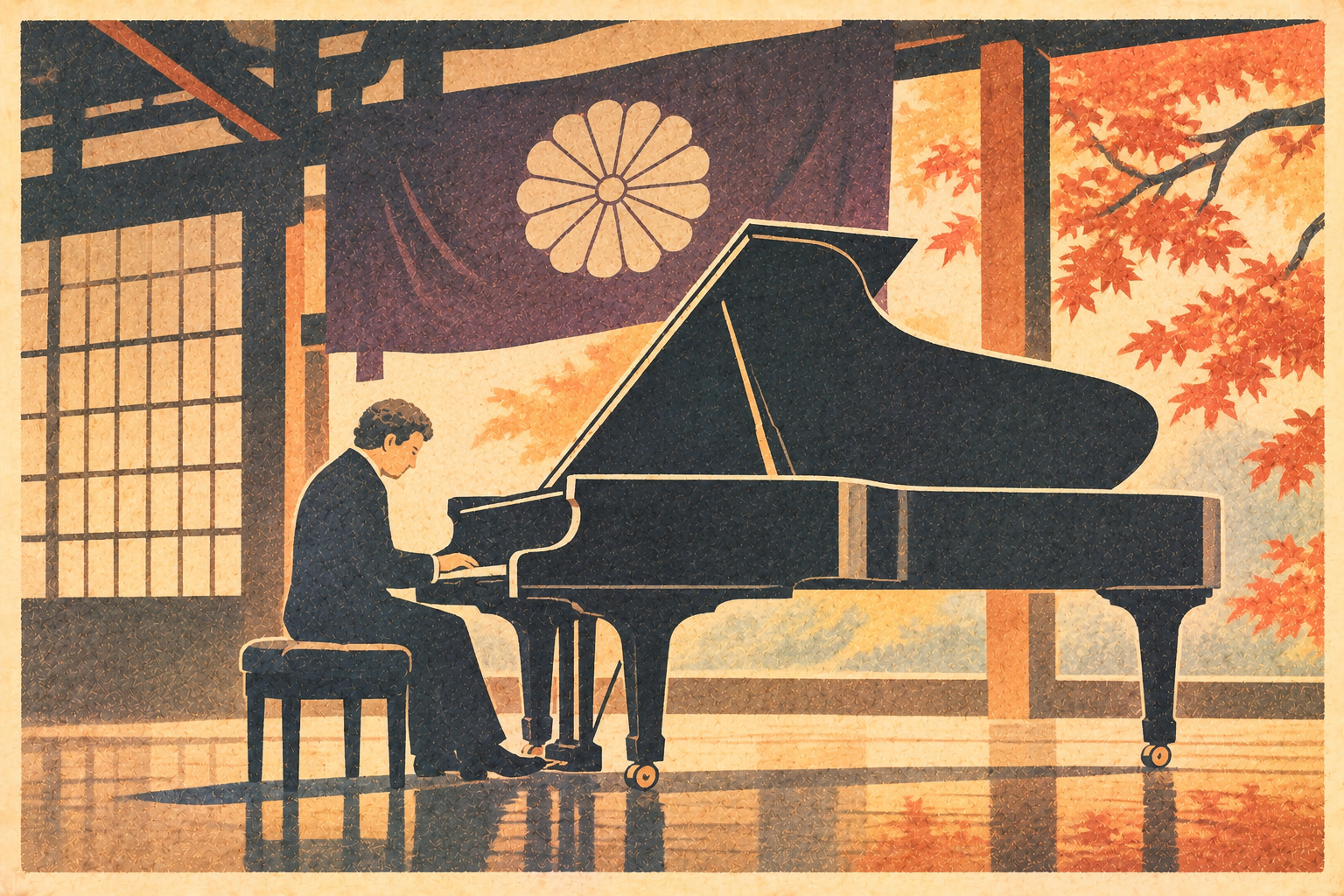
A concert beside an instrument with a history
A grand piano found amid the wreckage of a Japanese school has spent fifteen years carrying a story that cannot be reduced to a single miraculous repair. In March 2011, a tsunami swept through Toyoma Junior High School in Iwaki, Fukushima Prefecture. The instrument survived in terrible condition, was restored by local specialists and became known as the Miracle Piano.
On November 14, 2026, Italian pianist and composer Maurizio Mastrini is due to perform at Kozoji Temple in Iwaki. Local publicity promotes the Miracle Piano as part of the occasion. Mastrini, celebrated for experimenting with musical scores played in reverse, offers a striking artistic counterpoint to an object that exists because people refused to let its music disappear.
One detail must remain open: the available program does not independently establish precisely whether Mastrini will play the original tsunami-damaged instrument, or how it will be presented. A concert announcement should not be turned into an eyewitness account of an encounter that has yet to happen.
A graduation, then a tsunami
March 11, 2011, began at Toyoma Junior High with a graduation ceremony. Hours later, the earthquake and ensuing tsunami devastated the coastal school. The city records that students escaped under teachers’ guidance, but the buildings and contents were badly damaged. The school site was eventually cleared, with new arrangements made for the community.
Amid debris and mud lay a grand piano. Members of the Self-Defense Forces involved in clearing the wreckage left the instrument behind rather than treating it simply as rubbish, according to accounts recorded by the city and subsequent interviews. Piano technician Hiroshi Endo, with his family, took on the painstaking restoration.
The restored instrument gained national recognition after being played during Japan’s 2011 New Year’s Eve television program, Kōhaku Uta Gassen. Its significance was never that a repaired piano could undo a tragedy. It was that people could preserve one audible connection to a school and a community profoundly changed.
The miracle required maintenance
The shorthand “Miracle Piano” risks hiding the labor behind it. Salt water penetrates metal and wood; corrosion does not necessarily stop when an instrument first sounds again. Late in 2025, Endo appealed for funds for another substantial intervention. A February 2026 local report described further deterioration in the strings and the effort to restore the piano with public support.
A piano is simultaneously a cultural object and an exacting mechanical assembly. The strings, soundboard, felts and action respond differently to moisture, temperature and wear. Restorers have to decide which marks of damage should remain visible as historical evidence and which components must change to preserve playability.
Iwaki’s disaster memorial museum has displayed the piano and helped create opportunities for people to hear it. In this case preservation is not strictly a matter of putting an object behind glass. It also means enabling a new generation to encounter its sound.
Why the temple matters
Kozoji is not merely an atmospheric backdrop. According to local heritage records, temple tradition dates its founding to 807. Its three-story pagoda dates to the eighteenth century and is designated a Fukushima Prefecture Important Cultural Property. Here, a building that has endured centuries provides a setting for a concert linked to a much more recent disaster.
The November 14 recital is advertised for 1 p.m., with admission beginning at 12:30 p.m., at the temple in Takakura-machi, Iwaki. A small market featuring food is planned. Local reporting identifies Kimura Eye Clinic as organizer and gives admission as ¥1,000 plus an optional contribution, with proceeds intended for support in Kumamoto.
The venue’s significance is communal as well as historical. Temples continue to function in contemporary Japan as cultural gathering places, especially when local organizers make room for music, food and charitable activity.
Playing a score from its last note
Mastrini grew up in Panicale, Umbria, where, according to his official biography, he began exploring percussion by making improvised drums from discarded containers in his father’s workshop. He later studied at the Conservatorio Francesco Morlacchi in Perugia and built a career as a pianist and composer.
His breakthrough project, Il Mio Mondo al Contrario, appeared in 2009. Its unusual proposition was to play sequences of written notes from the end toward the beginning. This should not be confused with playing a recording backward: an acoustic pianist still strikes the notes normally, but in a radically reordered succession. Harmonies, expectations and musical closure are changed by the new sequence.
Mastrini’s publicity attributes the idea to a dream about Bach. That is an artist’s account of inspiration, not a historically verifiable intervention by the composer. And the available Japan program does not specify which, if any, reverse-order arrangements will be included in these recitals.
The body as a metronome
Another experiment appears in Mastrini’s 2016 project Heart, which, according to his press materials, incorporates the artist’s own heartbeat as a rhythmic basis. The idea questions the assumption that time in music must be fixed by a mechanical metronome or a precise digital grid.
A heartbeat changes with exertion, breathing and emotional states. Such variation may be artistically expressive; it does not by itself establish that the resulting music has a measurable medical treatment effect. The publicity material discusses a connection with cardiac surgeon Massimo Massetti, but we found no independent clinical study substantiating therapeutic outcomes.
The more interesting artistic question is what happens when the body’s time, rather than an externally imposed beat, becomes part of the composition’s structure.
Hair as autobiography
The new album Capelli, Italian for “hair,” turns Mastrini’s distinctive appearance into a personal narrative. In publicity accompanying the spring 2026 release, he described his hair as a refuge from the world. The record explores the movement from self-protection toward openness rather than treating hair merely as a promotional trademark.
The twelve-track program ranges from contemporary minimalist textures to South American influences and jazz. Mastrini’s official April announcement also linked a new rendition of Tango Clandestino to a tribute to Pope Francis. Independent Italian coverage describes the project as a musical self-portrait.
There is a minor release-date ambiguity: the artist announced the album April 21, while one major streaming catalogue lists May 1 for its particular edition. Describing it as a spring 2026 release is accurate without pretending those catalogue dates mean precisely the same thing.
A Tokyo lunch and a Fukushima afternoon
The two Japanese events could hardly have more different settings. On Friday, November 13, Mastrini is scheduled to perform at Flattoria, an Italian restaurant in Takadanobaba, Tokyo. The supplied announcement gives an 11:30 a.m. lunch opening and a 12:30 p.m. recital, with a ¥6,000 ticket covering the course meal and performance.
The program also features an Italian travel presentation by soprano Kaoruko Kombe, identified as artistic director. Operaccia is named as organizer. The precise Japanese rendering of Kombe’s name has not been verified from an independent Japanese-language organizer source, so the English spelling is retained here. The Tokyo details come from materials provided to the newsroom and should be checked with the venue shortly before attendance.
The following day brings the concert to Kozoji Temple and a smaller local audience. The contrast is instructive: contemporary classical music does not belong only in formal concert halls. It can take on different meanings at a dining table or in a temple community.
Fukushima reaches toward Kumamoto
According to the local November announcement, donations associated with the Iwaki event are intended to support Kumamoto. That is a meaningful connection. Communities recovering from one disaster sometimes become donors and advocates when another region is in need.
Yet charity should not be described more precisely than the evidence allows. We have not independently established the designated recipient, the final accounting arrangements or whether the funds are earmarked for a specific disaster. The broad stated intent can be reported; more detailed claims cannot.
The choice to link music, memory and charitable support gives the Iwaki event a public purpose beyond promotion of an album, without claiming that a performance completes the work of recovery.
A score can be reversed; history cannot
Mastrini’s reversed scores ask whether musical time can be rearranged and still become meaningful. The Miracle Piano speaks to a different limit: history does not run backward. The school, its community and the lives affected by the tsunami cannot be returned to a state before March 11, 2011.
Nevertheless, every repair and every carefully organized performance creates a new possibility for remembrance. The instrument’s scars and replacement parts express a kind of continuity that includes change, labor and collective responsibility.
The November concerts bring an Italian composer to Tokyo and Fukushima, but the more enduring story may be Japanese: the people who have continued to care for a damaged instrument long after a news cycle moved on, ensuring that the music—and the history attached to it—can still be heard.
Sources and reporting method
Concert details are attributed to publicity materials; historical claims are cross-checked against official city, cultural and independent reporting sources. The program and instrument-use arrangements remain unconfirmed.
- 2026年11月14日の公演案内/Local notice, November 2
- いわき市:旧豊間中学校と震災/Iwaki city school history
- いわき震災伝承みらい館:「奇跡のピアノ」/Museum notice
- いわき民報:2026年の修復/Iwaki Minpo, February 2026
- いわき民報:2025年の修復募金/Restoration fundraiser
- いわき市:高蔵寺の三重塔/Cultural heritage
- 福島県観光物産交流協会:高蔵寺/Fukushima tourism
- 本人の経歴/Artist official biography
- 本人のアルバム紹介/Artist on Capelli
- 伊紙 La Nazione:アルバム取材/April album coverage
- Rai News:2026年の作品と活動/Album reporting
- 琉球新報:調律師の証言/Restoration interview