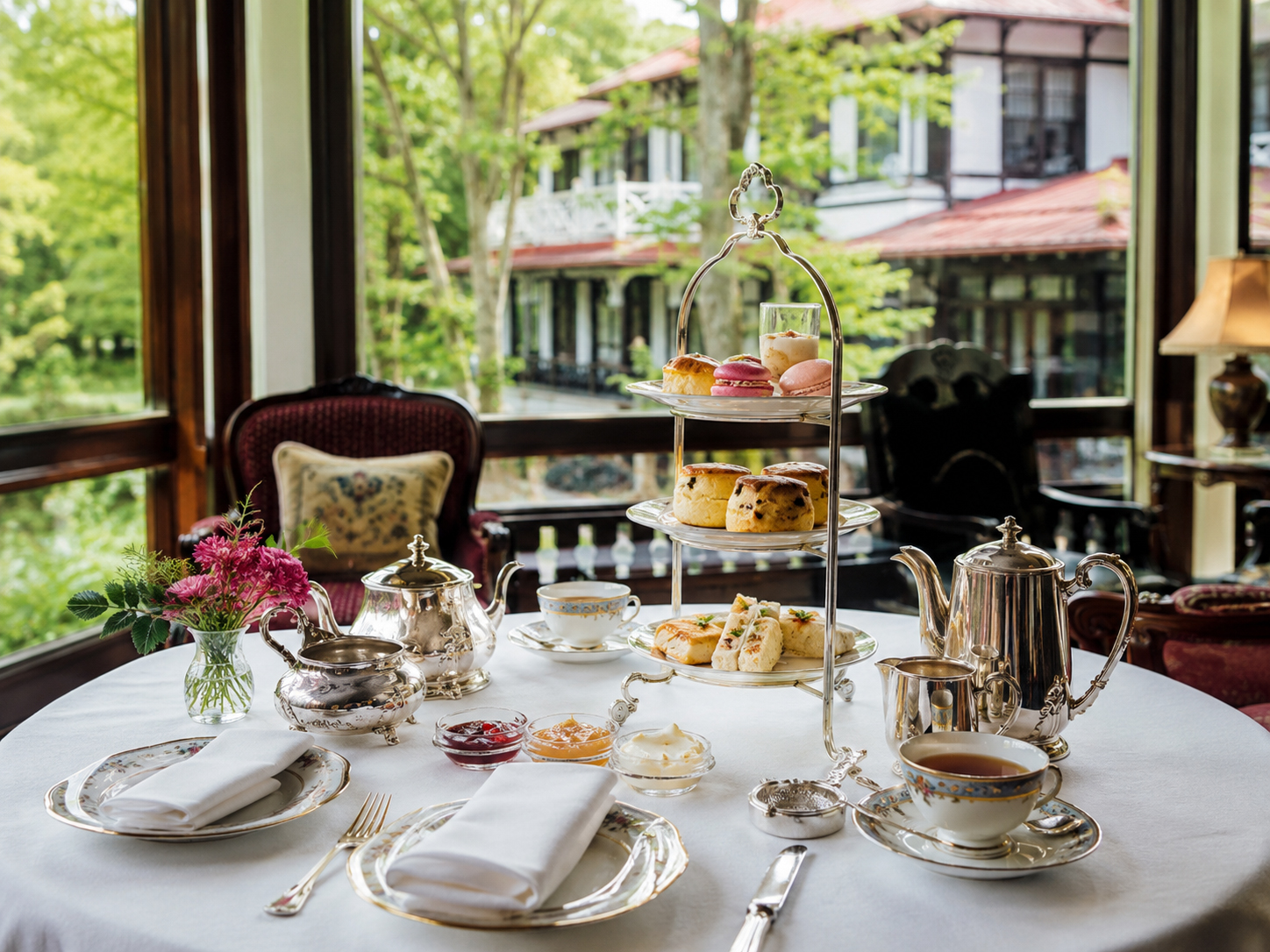
The Manpei Hotel story is almost wonderfully small. The Karuizawa classic hotel announced that, beginning July 1, 2026, its Cafe Terrace will serve a special “Scone Set for Enjoying Jam” as part of the 90th anniversary program for the Alps Wing. The set costs 2,760 yen including tax and service charge. It features scones stamped with the Alps Wing mark, black tea, Shinshu apple jam, and a second jam built around rhubarb, pumpkin and orange.
A small menu with a large memory
This is not just a dessert notice. Manpei Hotel explains that Karuizawa’s jam culture began in the Meiji era, when missionaries visiting the area introduced jam-making to the mountain resort. Over time, jam became part of local life, not only a souvenir but a flavor of summer villas, breakfast tables and highland hospitality.
The new set makes jam the main character. One option is Shinshu apple jam. The other combines rhubarb, pumpkin and orange. Rhubarb, known for its sharp acidity, has been grown in Karuizawa since the early Showa period, taking advantage of the area’s cool climate. The orange adds brightness; the pumpkin rounds the flavor with gentle sweetness. It is a quiet lesson in terroir, Karuizawa style.
From post-town inn to international resort hotel
Manpei Hotel’s deeper history begins in the Edo period. According to the hotel’s official history, Sato Manemon opened Kameya Inn in 1764 at Karuizawa-shuku, a post station on the old Nakasendo Road. In the Meiji period, the town began to change. Canadian missionary Alexander Croft Shaw and Imperial University instructor James Main Dixon stayed in Karuizawa and helped reveal the area’s potential as a cool summer retreat.
In 1894, Sato Mampei renamed the family inn Kameya Hotel and reimagined it as a Western-style hotel for foreign guests. In 1896, the name changed again to Mampei Hotel, easier for international visitors to pronounce. In that transformation, one can read the larger transformation of Karuizawa itself: from post-town to mountain resort, from Edo road culture to Meiji cosmopolitan leisure.
The Alps Wing as symbol
The current Alps Wing was completed in 1936. It was designed by Gonkuro Kume, the architect associated with classic resort architecture including Nikko Kanaya Hotel and Fuji View Hotel. Manpei Hotel describes the Alps Wing as the symbol of the property. Its rooms preserve a distinctive mixture of Japanese and Western elements: warm pendant lighting, glass shoji screens, clawfoot bathtubs and Karuizawa carved furniture.
The Alps Wing was registered as a tangible cultural property in 2018. In 2024, after major renovations marking the hotel’s 130th anniversary, the wing began welcoming guests again. That is why the little stamp on the scone matters. It turns the building into an edible emblem. Even a visitor who comes only for tea can touch the architecture through a small ritual of hospitality.
John Lennon’s Karuizawa, and the gift of ordinary time
Any story about Manpei Hotel eventually finds John Lennon and Yoko Ono. Nagano’s official travel guide notes that the couple stayed at Manpei when they came to Karuizawa, and that the Cafe Terrace is associated with Lennon’s favorite royal milk tea and apple pie. The hotel also displays a piano he is said to have played.
The reason these stories endure is not celebrity glamour. It is the opposite. Lennon’s Karuizawa is remembered as a place where an impossibly famous person could enjoy ordinary time: cycling, walking, drinking tea, sitting in a hotel cafe, moving through a town that allowed him to be human. That is the quiet power of Manpei Hotel. It does not shout history. It lets history sit down for tea.
Why Karuizawa became a jam town
Karuizawa is a mountain resort, not a beach resort. Its identity comes from cool air, forests, villas, churches, tennis courts, mountain roads and old wooden hotels. Western food culture did not simply arrive here and remain foreign. Bread, tea, jam, cakes, fireplaces and carved furniture became part of a Japanese seasonal vocabulary.
Jam is a perfect symbol of that blending. It preserves fruit, carries the color of the garden, travels well as a souvenir and belongs naturally on breakfast tables. For tourists, it is something to take home. For villa families, it is part of summer life. For locals, it is a way to use the climate and fields. Manpei Hotel’s decision to put jam at the center of a 90th anniversary tea set feels modest, but deeply correct.
Scones, black tea and a Russian-tea suggestion
The hotel suggests enjoying the jam on the scone or stirring it into black tea like Russian tea. That small invitation captures Karuizawa’s layered cultural history. An English-style scone is served at a Japanese classic hotel founded for foreign guests. The jam is made from Shinshu apple and highland rhubarb. The tea can be enjoyed in a Russian-inspired way. The elements are international; the mood is unmistakably Karuizawa.
The location matters too. This is not just a restaurant menu. It is Cafe Terrace time. One sits down, waits for tea, looks toward the garden and lets the tempo slow. As Japanese travel becomes faster, more crowded and more optimized, the value of such unproductive minutes rises. Sometimes the trip’s real memory is not a monument. It is half an hour when nothing happens beautifully.
Japan’s classic hotels as living cultural assets
Japan has a small group of hotels that function almost like cultural museums while remaining active places of hospitality: Nikko Kanaya Hotel, Fujiya Hotel in Hakone, Nara Hotel, Tokyo Station Hotel, Gamagori Classic Hotel and Manpei Hotel among them. They are not only places to sleep. They are records of how modern Japan learned architecture, diplomacy, tourism, dining and international leisure.
The value of a classic hotel is not age alone. It is the ability to translate age into present-day comfort without erasing the soul. Bathrooms, beds, safety systems, climate control and communications must change. But if everything changes, the hotel becomes only an imitation of itself. Manpei’s 2024 reopening after renovation shows how difficult and important that balance remains.
A quiet closer for Best Hotels in Japan
Hotel news often arrives with big numbers: room counts, investment totals, rankings, luxury brands and opening dates. Manpei Hotel offers something smaller and more Japanese. A scone set. Two jams. A terrace. A 90-year-old wing. A 130-year-old hotel. A town where missionaries, writers, aristocrats, travelers and musicians once found a cooler summer.
That is why this story belongs in a Best Hotels in Japan issue. Not every great hotel story needs a skyline view, an infinity pool or a global chain name. Some need a teapot, a wooden building, a garden and a taste that reminds a town of who it is.
In Karuizawa, the afternoon slows down. Jam meets tea. A stamped scone carries the Alps Wing to the table. The news is small. The pleasure is not.
Sources and references
This article is based on Manpei Hotel’s official announcement, PR TIMES, Manpei Hotel’s official history and Alps Wing pages, and Nagano’s official travel guide. Menu details may change, so travelers should check official information before visiting.
- PR TIMES: Alps Wing 90th anniversary “Scone Set for Enjoying Jam.”
- MAMPEI HOTEL: Kameya Inn, 1894 hotel founding, 1936 Alps Wing and 2018 cultural-property registration.
- MAMPEI HOTEL: Alps Wing rooms, Gonkuro Kume, Karuizawa carving and classic design details.
- Go! Nagano: John Lennon, royal milk tea, apple pie and Manpei Hotel’s cultural role.