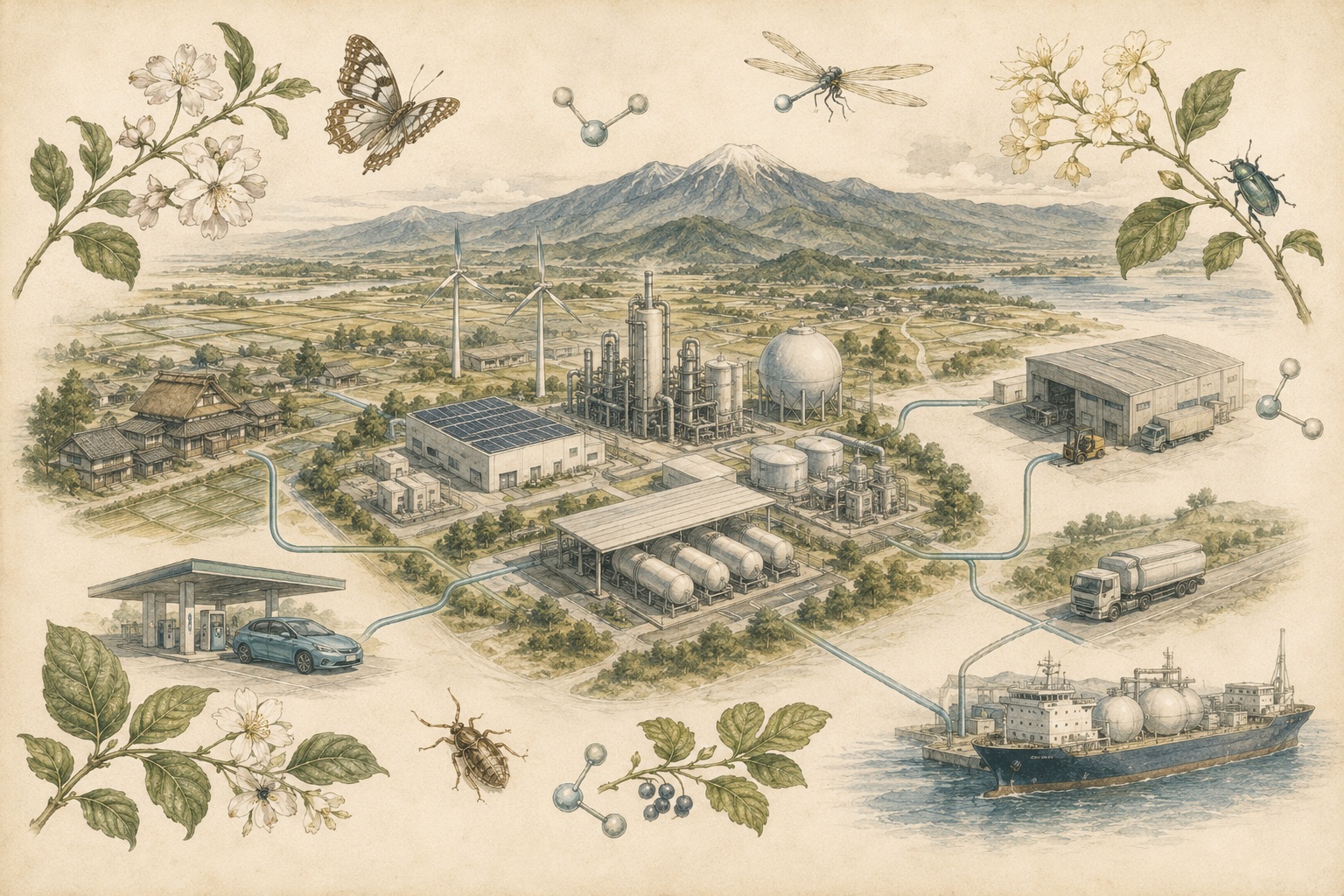
Japan’s grand hydrogen stories usually begin at the sea. Hydrogen is produced overseas, loaded onto an enormous ship, received in a coastal terminal and sent into steelworks, chemical plants or power stations. Kawasaki, Kobe and other ports naturally dominate the national imagination. Maibara is trying something almost opposite. Far from the ocean, at the foot of Mount Ibuki where traffic splits toward Tokai, Kansai and Hokuriku, the city wants to make hydrogen from water and electricity—and then squeeze more than one use out of almost everything the electrolyzer produces.
On July 30, 2026, NEDO said it had reviewed 17 proposals under its new regional hydrogen-model program and selected 12 implementation candidates. Among them is the “Survey on Hydrogen Production and Utilization in Collaboration with Regional Industries in Maibara City, Shiga Prefecture.” Kansai Electric, Daiwa House and Meijo Nano Carbon are the principal implementation candidates; Chiyoda is expected to examine the electrolyzer as a commissioned partner, while Shiga Prefecture and Maibara City cooperate with the research.
The cast tells the story. This is not a project led by a utility alone, an automaker alone or a municipality alone. It puts electricity, electrolysis, advanced materials, logistics real estate, roadside land development and government on the same map. The conceptual plan adds a hydrogen station, carbon-nanotube manufacturing, a logistics hub, aquaculture and even bathing facilities.
The central idea is not simply “make hydrogen locally.” It is to waste as little as possible. Hydrogen produced by electrolysis would first be used as a carrier gas maintaining the proper reaction atmosphere in carbon-nanotube production. The parties will then study supplying recovered hydrogen to a hydrogen station. Oxygen created alongside the hydrogen, and waste heat from the system, are also being examined for uses including Biwa-trout aquaculture and bathing facilities.
Maibara has always made value from being a crossroads
The logic of putting an inland hydrogen hub in Maibara becomes clearer on a map. The city describes itself as a junction linking Kansai, Chubu and Hokuriku. Historically, the Nakasendo, Hokkoku Kaido and Hokkoku Wakiokan carried people, goods and information through the area. Today the Tokaido Shinkansen, Tokaido Main Line, Hokuriku Main Line, Ohmi Railway, Meishin Expressway and Hokuriku Expressway converge around the city.
Since the Tokaido Shinkansen opened on October 1, 1964, Maibara has remained Shiga Prefecture’s only Shinkansen stop. On the road network, Maibara Junction divides traffic between the Meishin and Hokuriku expressways. Freight can move toward Nagoya, Kyoto-Osaka or the Japan Sea side. The repeated official description of Maibara as the junction of Tokai, Kinki and Hokuriku is not simply municipal branding.
The proposed hydrogen focus is not immediately around Maibara Station. It is farther east near the Ibuki Parking Area. The city is studying an Ibuki smart interchange together with a hydrogen production-and-supply base, a logistics relay center and other services in what it calls a combined “energy oasis.” The smart interchange has not yet been built; it remains a planning objective. But hydrogen is already being written into the city’s land-use and logistics strategy rather than treated as a detached science project.
Make it from water and electricity instead of hauling it inland
Coastal megaprojects make sense when imported hydrogen arrives by ship. An inland project faces a different equation: transporting relatively small volumes of hydrogen over long distances can make the fuel expensive before it reaches the customer. Maibara therefore puts local electrolysis at the center of the concept—turn water and electricity into hydrogen and oxygen near the places where the molecules might be consumed.
But local production is not automatically green production. Calling the product “green hydrogen” requires low-carbon electricity. The six-party announcement does not lock in a final power-supply arrangement. The conceptual illustration shows renewable sources including solar and hydropower, but actual procurement, capacity and annual operating profile are subjects for study, not finalized project specifications.
Maibara does have a decarbonization history to build on. In 2022 its ECO VILLAGE proposal was among the first 26 projects selected as Japan’s Decarbonization Leading Areas. That program includes solar on public and Yanmar facilities and plans for a combined 2,000 kW of agrivoltaic generation on abandoned farmland in the Koizumi and Yataka districts. The idea of making renewable power locally and combining it with agriculture and civic facilities predates the hydrogen plan.
Hydrogen extends that idea into sectors that cannot always use electricity directly. Trucks, certain industrial processes and longer-duration energy storage may value a molecule rather than an electron. The challenge is to determine when the electrolyzer should operate, how much cheap low-carbon power is actually available and whether the combined local demand is large enough to keep an expensive piece of equipment busy.
Using Toyota’s fuel-cell manufacturing knowledge in reverse
Chiyoda, which is expected to examine the electrolyzer portion of the Maibara study, has been jointly developing large-scale water-electrolysis systems with Toyota since 2024. The collaboration is technologically intriguing because knowledge developed to turn hydrogen into electricity in a fuel cell is being used in the reverse direction to manufacture hydrogen from water.
Toyota contributes fuel-cell cell and stack manufacturing know-how; Chiyoda contributes engineering for large process plants. Chiyoda’s broader platform concept describes 5–10 MW modules with a footprint around 2.5 by 6 meters and hydrogen production on the order of 100–200 kilograms per hour, with modules combined for larger systems.
Those numbers are not Maibara’s specifications. The Maibara release says Chiyoda will examine the electrolyzer while hydrogen demand and equipment scale are being studied. The final capacity has not been determined. That ordering is important: instead of choosing a prestigious electrolyzer size first and then searching for customers, the project is supposed to size equipment around credible demand.
The first anchor customer may be carbon nanotubes, not cars
A classic hydrogen-market mistake is to build supply first and hope demand arrives later. Maibara is testing the reverse approach. Its first industrial anchor is carbon-nanotube manufacturing by Meijo Nano Carbon.
Single-wall carbon nanotubes are nanoscale cylinders of carbon with unusually high electrical and thermal conductivity. Meijo Nano Carbon, founded in 2005, has proprietary technology for producing high-purity single-wall CNTs. Kansai Electric’s group first invested in the company in 2022 and made an additional investment through K4 Ventures in April 2026. Kansai Electric says the material has potential applications in batteries, water electrolyzers, semiconductors and other advanced technologies.
The manufacturing process is expected to use significant amounts of hydrogen. In the Maibara concept, hydrogen helps maintain the reaction atmosphere appropriate for CNT synthesis. If that process creates steady daily demand, it could give the electrolyzer a firmer utilization base than a hydrogen station that depends only on future vehicle traffic.
There is even a striking industrial loop. The CNT made with hydrogen may in the broader market be used to improve batteries or electrolyzers. The project does not say that CNT made in Maibara will be fed back into the same Maibara electrolyzer. But the relationship illustrates how a hydrogen economy could become an advanced-materials economy rather than merely a fuel-retailing business.
The heart of the project is “cascade use”
The phrase that best captures Maibara’s experiment is “cascade use.” The six parties define it as using hydrogen for one purpose and then reusing it for another. Hydrogen produced by electrolysis would be used as carrier gas in CNT manufacturing, after which recovered hydrogen would be considered for supply to the hydrogen station.
Industrial gases are often mentally classified as consumables: use them once and the value is gone. But if a process does not chemically consume all of the hydrogen, recovery, purification and recompression may create a second use. That could let the same kilogram generate more than one stream of economic value.
There is an important caveat. The public material does not disclose the hydrogen concentration after the CNT process, impurity profile, recovery rate, purification technology or compression requirement. Vehicle fuel must meet quality specifications. The concept should therefore not be understood as “send the same exhaust gas straight into a truck.” Determining whether recovery can be technically and economically worthwhile is itself part of the feasibility question.
Do not call oxygen and heat “waste” until the region has looked for buyers
Electrolysis produces oxygen as well as hydrogen, and the system also produces heat. In many hydrogen projects those outputs are peripheral. Maibara deliberately looks for local users.
The project diagram includes aquaculture—specifically Biwa trout and other fish—and bathing facilities. Oxygen may have value in controlling dissolved oxygen in aquaculture, while heat may be useful for water-temperature management or bathing. The detailed engineering is not yet defined: temperature level, oxygen purity, required volumes, pipeline distances and seasonal demand all matter.
The logic resembles cogeneration. A power plant that sells electricity while dumping all useful heat has lower overall resource utilization than one that finds a nearby heat customer. In Maibara, hydrogen, oxygen and heat may effectively become three products from one energy-conversion system. If all three have real customers, the economics of the electrolyzer can change.
| Output or intermediate stream | Use being studied in Maibara | What still has to be proven |
|---|---|---|
| Hydrogen | CNT carrier gas, then potential recovery for hydrogen station | Recovery rate, purification, fuel quality, recompression and cost |
| Oxygen | Biwa-trout and other aquaculture | Purity, volume, delivery distance and aquaculture demand |
| Waste heat | Aquaculture temperature management and bathing facilities | Temperature grade, seasonal demand and distribution losses |
| Hydrogen station | Fuel for logistics vehicles and other mobility | Fleet numbers, daily throughput, station utilization and delivered price |
Why is a homebuilder and logistics developer in a hydrogen project?
Daiwa House is not expected to manufacture hydrogen or consume it as a process gas. Its assigned role is to study the layout around the Ibuki Parking Area. That sounds mundane, but local hydrogen economics are intensely spatial.
The electrolyzer, storage, station, CNT factory, warehouses, truck lanes, aquaculture facilities, bathing facilities and renewable equipment have to be placed close enough to exchange molecules and heat safely and cheaply. Longer hydrogen piping costs more. Low-grade heat quickly loses value over distance. A truck that must detour far from the expressway just to refuel weakens the logistics proposition.
Daiwa House has developed logistics properties across Japan. In Maibara the challenge is not to attach a warehouse to a hydrogen plant after the fact, but to design energy and logistics as one land-use system from the beginning. If the proposed Ibuki smart interchange moves forward, direct or near-direct access between expressway traffic, logistics facilities and a hydrogen station could become one of the location’s most important advantages.
For heavy trucks, an inland expressway hub makes more sense than scattered retail stations
Japan’s early passenger-car hydrogen-station strategy struggled with low utilization. Policy has increasingly shifted attention toward commercial vehicles, where each truck consumes much more fuel and routes can be predictable. From the station operator’s perspective, a contracted logistics fleet is easier to plan around than an uncertain stream of private motorists.
Maibara is well positioned for that theory. The Meishin and Hokuriku expressways, National Routes 21 and 365 and freight flows toward Tokai, Kansai and Hokuriku all sit nearby. A logistics relay hub combined with hydrogen could bring driver changes, rest, cargo transfer and refueling into the same place—the practical meaning of the city’s “energy oasis.”
That does not mean hydrogen trucks are guaranteed to win. Battery-electric heavy trucks, megawatt charging, battery swapping and low-carbon liquid fuels will compete. Hydrogen must earn a role on total cost of ownership: range, payload, refueling time, station cost, vehicle price and fuel cost all matter. A hard-headed estimate of actual daily station throughput is more valuable than an optimistic assumption about future vehicle numbers.
NEDO’s new program reflects lessons from earlier hydrogen demonstrations
NEDO’s 2026 program is notable for what its official guidance says about the previous generation of regional hydrogen projects. From FY2021 through FY2025, many local models were investigated and demonstrated, but NEDO states that a significant number still lack a clear outlook for economic viability.
The new program therefore places unusual emphasis on business formation. It asks projects to think toward viable operation around 2035, rather than simply maximizing physical scale. The survey phase can last up to two years. Under the program’s basic plan, survey projects have a maximum project scale of 30 million yen, with NEDO generally covering up to two-thirds; that is a program ceiling, not a disclosure of Maibara’s individual award amount.
This framework fits Maibara. It is not a million-tonne import terminal. It is an attempt to stack moderate local demands until the combined economics work. If hydrogen alone is too expensive, sell oxygen and useful heat. If a filling station alone cannot keep the electrolyzer busy, add an industrial anchor. Instead of waiting for one enormous customer, aggregate several customers that need different outputs.
For a regional city, hydrogen is industrial policy as much as energy policy
Maibara’s interest is not purely decarbonization. The city’s population plans have long confronted demographic decline, even while its transportation location is exceptional. A city can host Shinkansen tracks and major expressways and still capture surprisingly little value if people and freight merely pass through.
The energy-oasis concept tries to change that. A smart interchange, logistics hub, hydrogen production, advanced-material manufacturing and regional services could turn transit into economic activity: trucks stop, freight transfers, companies locate, fuel is purchased and employment remains in the region. Energy policy becomes land-development and industrial-location policy.
Maibara’s urban-planning documents already describe the Kashiwabara area as a future industrial and logistics node integrating the Ibuki smart interchange, energy oasis and logistics facilities. The city also identifies a potential role as an energy backup base in a major disaster. In peacetime the system supports freight and industry; during disruption, local energy production and storage could contribute to resilience.
Turning water into hydrogen in a city that calls itself a “source of water”
Maibara often describes itself as a “water-source community.” Water stored in the forests around Mount Ibuki and Mount Ryozen flows through rivers toward Lake Biwa. That makes water electrolysis symbolically appropriate—but symbolism does not replace resource accounting.
Electrolyzers require purified water. At larger scale, water supply, treatment, discharge, land use, renewable-energy installations and ecosystem impacts all deserve evaluation. Japan is not generally water-scarce in the way some proposed hydrogen-export regions are, but hydrogen should never be assumed to be environmentally benign merely because its point-of-use product can be water.
In fact, one virtue of the Maibara concept is that the hydrogen equipment cannot be hidden in an isolated industrial world. Farms, aquaculture, bathing facilities, logistics, settlements and natural landscapes all sit on the same planning map. Energy efficiency, land use and community acceptance will rise or fall together.
Inland and coastal hydrogen models are complements, not rivals
Kawasaki’s coastal model and Maibara’s inland model solve different problems. Steelmaking, chemicals and very large power generation may eventually require hundreds of thousands of tonnes of hydrogen per year, making international shipping, large terminals and trunk pipelines economically plausible.
Inland logistics, advanced materials and medium-sized industrial users face a different equation. Transporting small hydrogen volumes from a distant port can be expensive. If sufficiently cheap low-carbon electricity is available locally, electrolysis plus clustered demand may be competitive. Japan’s future hydrogen system may therefore become a network of different architectures: very large import hubs on the coast and smaller local production-and-use hubs inland.
The biggest enemy may be an idle electrolyzer
Electrolyzer economics are not determined by capital cost alone. Annual utilization matters enormously. Operating only during a few hours of very cheap renewable electricity can reduce power cost but leave expensive equipment idle. Running nearly all day raises utilization but may force the project to buy higher-priced—or more carbon-intensive—electricity.
This is where combined demand becomes an economic strategy. CNT manufacturing can provide industrial baseload. Trucks can refuel at different times. Storage can shift hydrogen in time. Oxygen and heat customers can add value to the same operating hours. Maibara’s cascade model is therefore not only an elegant circular-economy idea; it is an attempt to increase the economic productivity of the entire asset base.
There are many ways the arithmetic could fail. Purifying recovered hydrogen may cost too much. The oxygen customer may be too small. The heat may be at the wrong temperature. Fuel-cell trucks may arrive more slowly than forecast. Land-use approvals or the smart-interchange process may take longer than expected.
That is precisely why the word “survey” matters. The objective should not be to prove a pretty rendering correct. It should be to identify the boundary conditions under which the business fails. NEDO’s emphasis on economic viability means asking those uncomfortable questions before concrete is poured.
- Actual electricity cost per kilogram of hydrogen: including renewable procurement and electrolyzer efficiency.
- Annual electrolyzer utilization: how many hours it can run at acceptable power price and carbon intensity.
- Hydrogen recovery after CNT production: how much can be reused and what purification costs.
- Daily hydrogen-station sales: whether real commercial fleets can support station fixed costs.
- Value of oxygen and heat: whether coproduct customers materially improve project economics.
- Lifecycle CO₂ reduction: measured across power supply, compression, storage and use—not merely at the vehicle.
The future of hydrogen may depend more on ordinary regions than on megaprojects
Maibara has no giant hydrogen carrier in this project and no 50,000 m³ cryogenic tank. For now it has an expressway parking area, a possible electrolyzer, a CNT demand anchor, logistics potential, aquaculture ponds, bathing facilities and six organizations studying the same diagram.
That may be exactly why the experiment matters. If hydrogen genuinely spreads through Japan, ports alone cannot transform the country. Nor is it plausible to truck expensive hydrogen from coastal terminals to every regional user. Communities will have to combine their own electricity, water, industrial demand, transport patterns, land and skills and discover the scale that actually works.
Maibara has always been a crossroads. Nakasendo and Hokkoku routes; Tokaido and Hokuriku rail; Shinkansen and conventional lines; Meishin and Hokuriku expressways. Its value has often come less from producing everything itself than from receiving, dividing and reconnecting flows.
The next flows may be electricity and water, nanocarbon and freight, agriculture and energy. Use the hydrogen once, recover it if the chemistry allows, find a customer for the oxygen and another for the heat, and make passing trucks leave economic value behind. If the arithmetic works, Maibara will not be a “small rural hydrogen demonstration.” It will be evidence that a regional city can build a hydrogen business differently from Tokyo Bay.
And if the arithmetic does not work, that is useful knowledge too. A rational hydrogen society does not mean using hydrogen everywhere. It means finding the places where hydrogen genuinely solves a problem without wasting energy, money or local resources.
Ancient to early-modern era Nakasendo, Hokkoku Kaido and related routes make the area a junction linking Kansai, Chubu and Hokuriku.
October 1, 1964 The Tokaido Shinkansen opens; Maibara becomes and remains Shiga Prefecture’s only Shinkansen station.
2005 Meijo Nano Carbon is established and develops single-wall CNT technology.
April 2022 Maibara’s ECO VILLAGE concept is selected in Japan’s first round of Decarbonization Leading Areas.
May 2022 Kansai Electric’s group makes its first investment in Meijo Nano Carbon.
February 2024 Toyota and Chiyoda agree to jointly develop large-scale water-electrolysis systems.
2025 Maibara planning documents formalize the direction of integrating the Ibuki smart interchange, energy oasis and logistics hub in the Kashiwabara area.
February 2026 The city’s policy program highlights study of the Ibuki smart interchange, hydrogen production-and-supply base and logistics relay hub.
March 16, 2026 Shiga, Maibara, Kansai Electric, Daiwa House, Chiyoda and Meijo Nano Carbon sign the basic agreement.
April 2, 2026 Kansai Electric’s group announces an additional investment in Meijo Nano Carbon.
July 30, 2026 NEDO selects 12 regional hydrogen proposals; the six parties announce the start of the Maibara survey.
Next The project will examine cascade hydrogen use, CNT demand, a hydrogen station, oxygen and heat utilization, logistics and land-use economics.
Reporting notes and principal sources
This article uses public information checked through August 9, 2026, 12:50 a.m. JST. The project is in NEDO’s survey phase. Electrolyzer capacity, electricity procurement, hydrogen-station capacity, investment cost and commercial startup have not been finalized or publicly disclosed. The published concept diagram is not treated as a finalized construction plan. Hydrogen recovery rate, purity and purification technology after the CNT process have also not been disclosed and are described here as feasibility questions rather than settled engineering.
- Shiga Prefecture: Start of Maibara hydrogen production and utilization survey, July 31, 2026
- Six-party release: NEDO selection, project concept and roles, July 30, 2026
- NEDO: Selection of implementation structure for regional hydrogen-model program, July 30, 2026
- NEDO: Hydrogen Society Model Development Advancement program overview, duration and budget framework
- Maibara City: Basic agreement for the hydrogen production and utilization study, March 16, 2026
- Maibara City: FY2026 policy program and Ibuki Smart IC / Energy Oasis concept
- Toyota and Chiyoda: joint development of large-scale water-electrolysis systems, February 2024
- Chiyoda: technical overview of large-scale water electrolysis
- Kansai Electric / K4 Ventures / Meijo Nano Carbon: capital and business alliance, April 2, 2026
- Japan Ministry of the Environment: first round of Decarbonization Leading Areas and Maibara ECO VILLAGE
- Maibara City: ECO VILLAGE, agrivoltaics and local-energy plan
- Maibara City: comprehensive plan on transportation junctions, historical routes and “water-source” identity