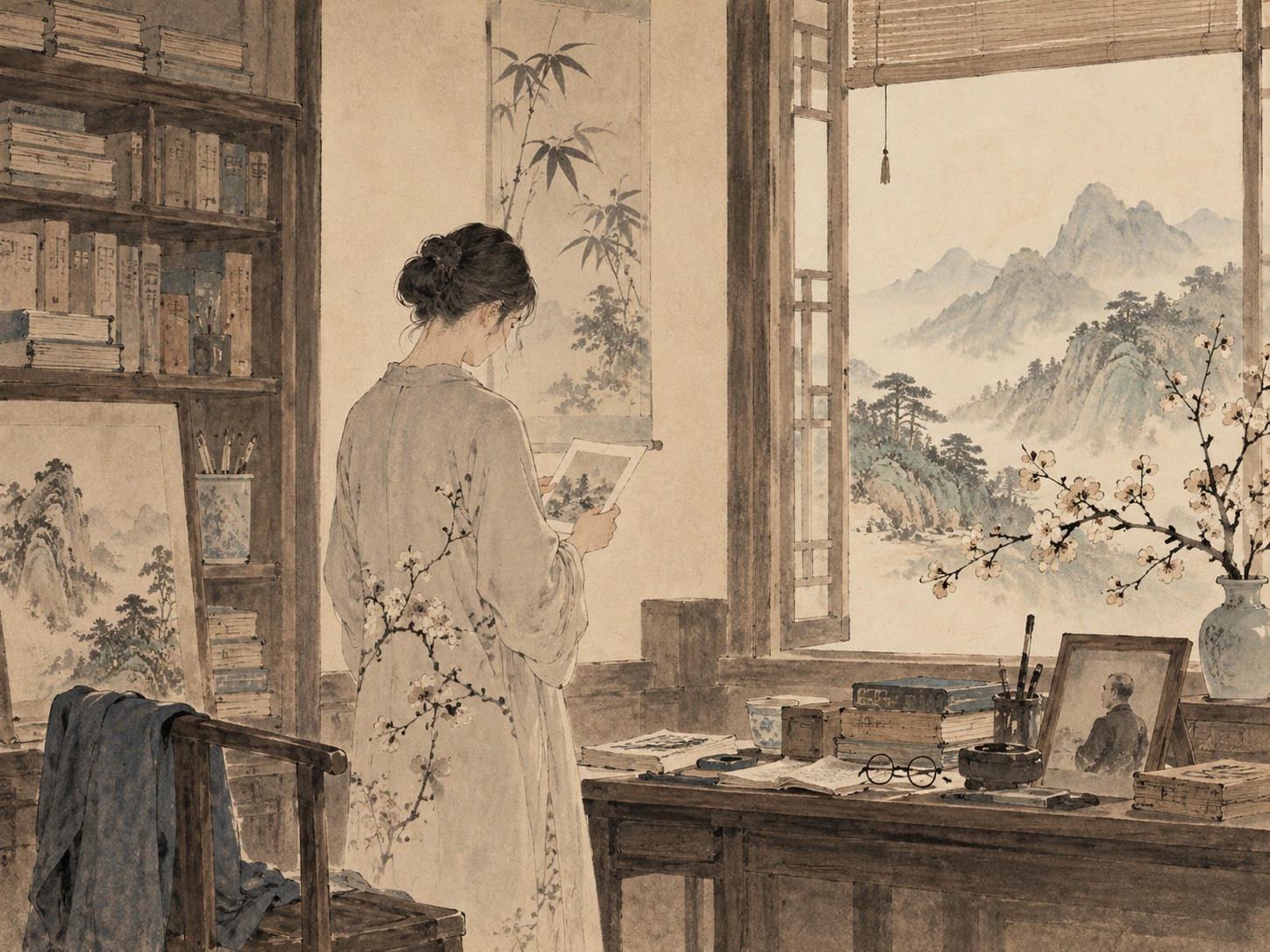
Before Maha Harada became a novelist, she worked inside the art world. She learned to look at objects, arrange them in space, build exhibitions and decide how an audience might move through meaning. Then she became a writer. In 2026, at 64, that long practice of seeing became a feature film.
Her directorial debut, In My Father’s Room—Japanese title Muyou no hito—competed in the Official Selection of the 74th San Sebastián International Film Festival and won the festival’s FIPRESCI Award. The official winners list also records a second honor, the Ateneo Guipuzcoano Award. FIPRESCI’s own 2026 festival-awards page lists Harada’s film as its San Sebastián winner.[1][2]
A key arrives after the father is gone
Yu Aoi plays Satomi, a woman working at an art museum. One month after her father dies alone, an envelope arrives containing a mysterious key. It opens a room she never knew he had. The father, played by Issey Ogata, is absent from the present but increasingly present through what he left behind.[3]
Eita Nagayama and Eri Watanabe also appear. San Sebastián’s official synopsis describes the father as a man who seemed to have been left behind by society but sustained himself through words, tea and quiet beauty. Satomi reconstructs his final days through traces rather than confession. The film runs 109 minutes; Harada is credited as source author, screenwriter and director.[3]
The first push toward directing came from a high-school reader
The source story “Muyou no hito” appeared in Harada’s collection Anata wa, dareka no taisetsu na hito. On her official website, Harada says the story was excerpted in a high-school Japanese textbook. A female high-school student later wrote to say she had bought the full book and felt, on finishing the story, as if she had watched images unfold before her. Harada identifies that letter as a starting point for her decision to direct.[4]
She explains that she has always written by chasing images in her head. Film offered a new possibility: instead of handing the story to another director and screenwriter, she could finally show audiences something closer to the images that existed before the prose.
She was an exhibition-maker before she was a novelist
Harada was born in Tokyo in 1962. She studied Japanese literature at Kwansei Gakuin University and art history at Waseda University. Her career included Itochu Corporation, the preparation office for the Mori Art Museum and work connected with New York’s Museum of Modern Art. In 2002 she became a freelance curator and culture writer. Her fiction career followed: Waiting for Good News won the first Japan Love Story Award, and she made her literary debut in 2006.[5]
Her later novels repeatedly fused art history and fiction. Canvas of Paradise won the Yamamoto Shugoro Prize in 2012; Leach Sensei won the Nitta Jiro Prize in 2017; Itan ni Saku won the Izumi Kyoka Prize in 2024. Her work has engaged with Picasso, Rousseau, Van Gogh, Monet, Munakata and the institutional world around art.[6]
So although directing is new, composing experience for an audience is not. Curators decide sequence, distance, context and what not to explain. Cinema asks related questions with time, bodies and sound.
“A film cannot begin with one person”
In her 2025 interview announcing the project, Harada contrasted fiction and filmmaking. Writing requires solitude; film cannot begin alone. Returning to a movie set reminded her of the atmosphere of building exhibitions from scratch during her curator years, she said.[4]
That distinction fits the story itself. Satomi cannot understand her father by memory alone. A key, a room, objects, tea, art and other people’s recollections must accumulate before another version of him becomes visible.
Yu Aoi and Issey Ogata build a father-daughter relationship out of absence
Because the father is already dead, the dramatic engine is not confrontation but reconstruction. Satomi is not arguing with him; she is revising the story she had told herself about him.
The festival daily called the film “a room full of memories,” describing art, poetry, rituals and objects as things that seem to whisper. It also noted a partial inspiration from Víctor Erice’s The Spirit of the Beehive and praised the film’s commitment to small gestures and unanswered questions.[7]
An art-museum worker as protagonist is no accident
Satomi’s job inside a museum strongly reflects Harada’s own intellectual world. A museum separates an object from its ordinary use, places it in a new context and asks the viewer to see again.
The father’s room works similarly. It becomes a private exhibition whose curator is absent. Satomi enters, looks, sorts and reinterprets. Things her father never explained begin to function like labels without text.
Reversing the meaning of “useless”
The Japanese title, Muyou no hito, can carry a cruel social implication: a person who is no longer useful, no longer necessary to work or family. The English title shifts emphasis toward place—In My Father’s Room.
The story asks whether usefulness is an adequate measure of human value. A person can lose a visible role and still have a private world of reading, tea, beauty and ritual. Once Satomi sees that world, “useless” begins to look less like a fact and more like a failure of other people’s attention.
A debut in San Sebastián’s Official Selection
The film had its world premiere in San Sebastián’s Official Selection, the festival’s main competition. For a first-time director, the selection alone was notable. The festival press conference featured Harada alongside several producers, and the local festival newspaper presented directing in her 60s not as a novelty stunt but as a natural extension of how she had always created from images.[3][8]
What the FIPRESCI Award means
FIPRESCI is the International Federation of Film Critics, a global organization of professional critics and film journalists. At major festivals, FIPRESCI juries select their own prize independently of the festival’s main jury.
At San Sebastián in 2026, In My Father’s Room received that FIPRESCI Award. It is listed among the festival’s parallel prizes, separate from the Golden Shell and other official-jury honors.[1]
The similar name can cause confusion. The FIPRESCI Grand Prix is a different annual award selected from films released over the year. In 2026 that honor went to Paul Thomas Anderson’s One Battle After Another.[9]
A second honor from Ateneo Guipuzcoano
The festival’s final awards list gives Harada’s film another parallel prize: the Ateneo Guipuzcoano Award. That means the debut connected not only with an international critics’ jury but also with a regional cultural institution.[1]
That dual response may say something about the story’s portability. The details—tea, museum work, a Japanese family—are specific. The emotional mechanism is not. Many adults discover too late that their parents had identities far beyond “mother” and “father.”
We usually understand our parents too late
Children first encounter parents as roles. Their earlier ambitions, abandoned paths, private tastes and loneliness often remain invisible for decades.
In My Father’s Room turns that delay into plot. The door to understanding opens only after the person who could answer the questions is gone.
Tea and art create a cinema of under-explanation
Tea and art are not decorative signs of Japanese refinement here. Both involve meaning that cannot be exhausted by explanation: the handling of a bowl, the placement of an object, the time spent looking.
The festival’s description emphasizes “small gestures and unanswered questions.” That makes the film less interested in a single revelation than in the discipline of noticing traces.[7]
The danger when an author directs her own work
An author directing her own fiction has obvious advantages: no one knows the imagined world better. It also carries risk. The author may be too attached to exposition, too unwilling to cut a beloved scene or too certain that an actor should reproduce the image already fixed in her mind.
Harada consciously chose that risk. The FIPRESCI prize does not prove that every adaptation decision works, but it does show that her personal translation from prose to cinema earned serious critical recognition at a major international festival.
Japan’s long conversation between literature and cinema
Japanese cinema has always borrowed heavily from literature, but the usual path places a director between the novel and the screen. A major novelist making her own feature debut in her 60s, adapting and scripting her own story, then entering an international A-list competition is much less routine.
Harada’s bibliography already included fiction about film, including Kinema no Kamisama. Cinema was therefore not an alien interest suddenly added to her career. It looks more like another medium in a long movement among images, exhibitions and narrative.
Japan will see it in January 2027
Japanese theatrical release is scheduled for January 29, 2027, with Bitters End distributing. The domestic audience will therefore encounter the film after its world premiere and festival prizes have already shaped expectations.[10]
The awards will be useful marketing, but they should not dictate the viewing experience. The more interesting question is how Harada converts prose into duration: what she removes, where she leaves silence, and what Yu Aoi and Issey Ogata can communicate that a paragraph cannot.
Is Maha Harada now a filmmaker?
One film does not establish a second permanent career, and Harada has said directing was not an old ambition. The catalyst was a reader’s letter.
But after the FIPRESCI Award, it is difficult to dismiss the project as a celebrity novelist’s side experiment. She has crossed the threshold professionally and critically.
Harada once arranged art in museums, then arranged images in prose. Now she has arranged actors, rooms, time and sound. Across those forms, the underlying question remains remarkably consistent: what do we discover when we look at something we thought we already knew?
In the film, Satomi receives a key to her father’s room. In Harada’s life, a high-school reader’s letter opened another room. The first major object she found inside it was an international critics’ prize.
Sources and references
- San Sebastián International Film Festival, 2026 awards list — FIPRESCI Award and Ateneo Guipuzcoano Award.
- International Federation of Film Critics, 2026 festival awards — In My Father’s Room / Muyou no hito.
- San Sebastián International Film Festival, official film page — synopsis, cast, credits and 109-minute runtime.
- Maha Harada official website, interview on directing Muyou no hito, March 12, 2025.
- Maha Harada official English biography.
- Shinchosha, Maha Harada author profile and literary awards.
- San Sebastián Festival Daily, “A room full of memories,” September 22, 2026.
- San Sebastián Festival Daily, profile and Harada comments on directing, September 22, 2026.
- San Sebastián Festival, Paul Thomas Anderson’s One Battle After Another wins the separate 2026 FIPRESCI Grand Prix.
- Eiga.com, Japanese release date, cast and credits for Muyou no hito.
Reporting cutoff: October 4, 2026. The FIPRESCI prize is confirmed by both the festival and FIPRESCI. Japanese theatrical reception and box-office performance do not yet exist because release is scheduled for January 29, 2027. Critical interpretation is Japan.co.jp analysis.