- The armor, the missing sword and the city that rebuilt its castle
- Why a lord had to move from Himeji in 1749
- The Tone River changed the map of government
- An extraordinary return in the final year of the shogunate
- A suit of armor that documents craftsmanship
- Shikibu Masamune: restoring what the air raids destroyed
- A matchlock demonstration at a castle site
- A historical film and the ceremony of tea
- Forty volumes of records complicate the legend
- How to visit—and what has not yet been verified
The armor, the missing sword and the city that rebuilt its castle
A river undermined Maebashi Castle. Its lord moved away. Nearly a century later, the town helped bring a castle and its ruler back. That improbable sequence gives unusual depth to a historical festival scheduled for November 15 in Maebashi, the capital of Gunma Prefecture.
The fifth Matsudaira Yamato-no-kami Family Commemoration will display designated armor, a reconstruction of a sword destroyed in World War II, and demonstrations of matchlock technique. The city describes the theme as martial skill and culture cultivated in an age without war. It is a festival built around material objects, but the more consequential story is how political authority, ecology, commerce and memory shaped the city.
Why a lord had to move from Himeji in 1749
The Matsudaira family’s Maebashi chapter began in 1749. Lord Matsudaira Tomonori arrived from Himeji as Sakai Tadayasu left Maebashi for the far larger and prestigious Himeji domain. Such transfers—known as kunigae—reorganized the location and obligations of entire households, not simply the addresses of rulers.
The family’s surviving domain records describe accumulated debts, negotiations with merchants, and pressure to economize. For retainers and townspeople, changes in feudal appointments could mean alterations to employment, housing, trading relationships and public works. The festival’s screening of the comedy-drama The Samurai Shifter offers an accessible entry to this world, though cinema is not a substitute for archival evidence.
The Tone River changed the map of government
Maebashi’s vulnerability was not merely military. The Tone River eroded the land around its castle. Municipal historical materials describe the threat reaching the inner compound, repeated efforts to relocate buildings, and the eventual decision to abandon the site. In 1767, Matsudaira Tomonori moved his residence to Kawagoe.
Maebashi remained inhabited and economically active, administered as territory attached to the Kawagoe domain. It is therefore misleading to read “a century without a castle lord” as a century without civic life. The story is one of political displacement shaped by environmental conditions: a reminder that rivers can determine where state power is physically housed.
An extraordinary return in the final year of the shogunate
In 1867, the rebuilt Maebashi Castle was completed and Matsudaira Naokatsu returned from Kawagoe. The city credits local residents with encouraging its restoration. For merchants and residents, restoring a lordly seat could carry both economic prospects and symbolic value.
The timing was extraordinary. The Tokugawa order was nearing collapse. The Meiji Restoration followed in 1868, with the return of lands and people to imperial authority in 1869 and the abolition of domains in 1871. A revived castle quickly became a monument to a political system that was disappearing. Maebashi’s surviving castle-related landscape is consequently as much about transition as continuity.
A suit of armor that documents craftsmanship
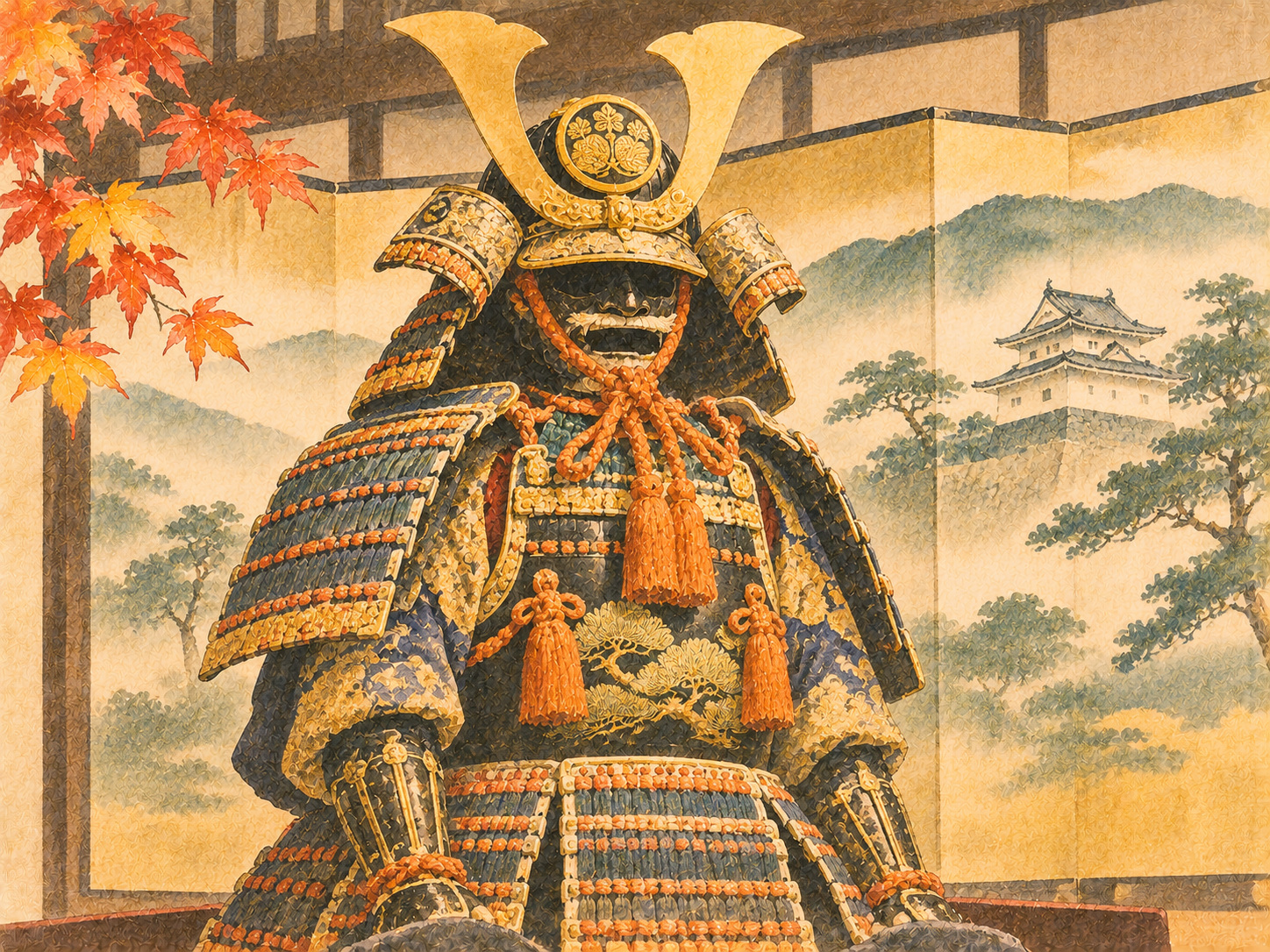
The festival’s featured suit of armor is a Maebashi-designated tangible cultural property associated with Matsudaira Narinori, the family’s eighth lord. The city says an inventory accompanying the armor dates its commission to 1843, under Narinori’s authority. The maker is attributed to the armor craftsman Myōchin Ki no Muneyasu; that attribution should not be inflated into definitive authentication.
Armor in the Edo period could express legitimacy, status and technical mastery as well as military preparedness. Lacquered surfaces, metal fittings and intricate silk lacing required specialized artisans working across disciplines. Seen today, the armor helps visitors ask how a warrior elite preserved symbols of martial authority during a long era of relative internal peace.
Shikibu Masamune: restoring what the air raids destroyed
Another centerpiece is a reconstructed version of the Shikibu Masamune sword. Maebashi City says the original entered the family’s possession through its third lord, Motochika, and was treasured for generations before being destroyed during the 1945 Tokyo air raids.
The reconstruction was commissioned through a commemorative association with donations and crafted by smiths Kamibayashi Kōhei and Takahashi Kōgen, according to the city notice. It is not the surviving original, and the display should never be described as if it were. Recreating a lost object can preserve workmanship and cultural memory, while leaving necessary questions about documentary evidence, fidelity and artistic judgment.
A matchlock demonstration at a castle site
The finale is scheduled at Maebashi Park (Rakuho-do naming-rights venue), on the former castle grounds, from 2:00 to approximately 3:20 p.m. A preservation group maintaining the traditions of a Kawagoe domain matchlock unit will perform under a Maebashi domain designation. The program also lists a local taiko group and falconry participants.
The demonstration speaks to an interesting distinction between the preservation of technical skills and the reconstruction of lived history. A modern public performance can illustrate weapons handling and ritualized military display. It cannot reproduce the risks, social structure or circumstances of an actual Edo-period campaign. The festival’s challenge is to make that gap instructive rather than invisible.
A historical film and the ceremony of tea
The morning program includes a screening of The Samurai Shifter, a period film centered on the upheaval of a domain transfer. It is listed for 9:30–11:40 a.m. at Gunma Kaikan, with advance reservations and a maximum audience of 400. The organizer’s published application deadlines had already passed by the reporting cutoff.
Tea offers a different connection to the past. A private memorial offering honors Matsudaira Naokatsu, followed by scheduled public tea sittings from 11:45 a.m. to 1:45 p.m. The fee is ¥600, including confectionery, with advance booking. Together, these programs suggest that historical identity was made as much through etiquette and cultural practices as through swords.
Forty volumes of records complicate the legend
Maebashi City Library preserves the Matsudaira domain records spanning 1698–1869. These papers, designated as prefectural cultural property, follow political decisions and ordinary pressures: tax and finance issues, fires, castle repairs, merchant donations, official correspondence and religious festivals. Transcription work began in 1986, with forty published volumes of the Maebashi portion completed between 1994 and 2006.
The documentary record also helps recover people missing from celebratory genealogies. One further contribution arrived in March 2026, when Maebashi designated an assemblage of Inaba family papers as municipal cultural property. The family’s materials extend the inquiry from rulers to retainers and later civic history. Heritage should invite reading beyond the artifacts on display.
How to visit—and what has not yet been verified
The special displays are scheduled for November 15 from 9:00 a.m. to 3:00 p.m. in the ground-floor hall of Gunma Kaikan. The outdoor matchlock program is in nearby Maebashi Park (Rakuho-do naming-rights venue); the city estimates five to ten minutes on foot between venues. It advises visitors to consider public transport and notes that Gunma Kaikan’s parking is not available to general visitors.
The city says it will announce cancellations or a reduced program caused by severe weather by 9 a.m. on the day. As this article was prepared before November 15, the festival’s actual attendance, completed performances and any last-minute schedule changes were not confirmed. The event may be an occasion to enjoy historical objects, but its enduring value lies in understanding the sources behind them.
Primary sources and verification
This report distinguishes historical records from interpretation, authentic artifacts from reconstructions, and announced programs from completed events.