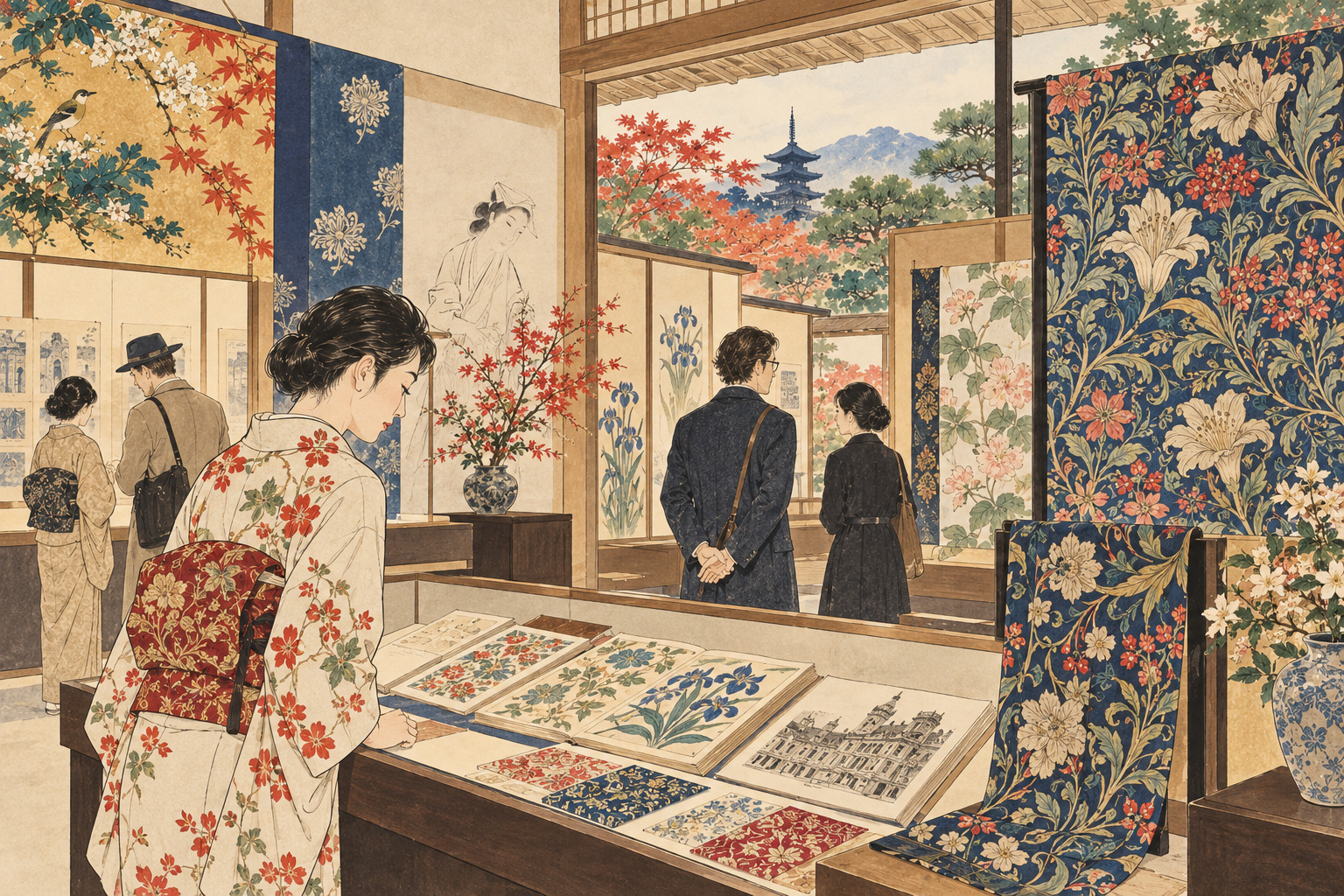
Liberty's first exhibition in Kyoto is not simply a story about a British brand discovering Japan. Japan was inside the business almost from the beginning. When Arthur Lasenby Liberty opened his shop in London in 1875, imported textiles, objects and decorative arts from Japan and the wider “East” were part of what he sold. In 1889, Arthur and his wife Emma traveled to Japan. More than a century later, Liberty's archive is returning to Japan not only as evidence of influence, but as material for new work with Japanese makers. [1][5][8]
From October 9 through 18, Liberty will present an expanded edition of I Am. We Are. Liberty. at Shōsei-en Garden as principal international cultural sponsor of the inaugural Kyōto YouMe Triennale. Art historian Ester Coen is curator and Silvia Spagnol co-curator. The exhibition occupies the garden itself, the Rinchitei pavilion and Tekisuiken, combining archive material with new craft-research projects involving Japanese makers. [1][2]
The garden itself becomes the first chapter
The exhibition does not begin in a conventional gallery. Visitors first move through Shōsei-en, where structural frames displaying archival Liberty prints create a route through greenery, stonework and planted landscape. The prints are placed in conversation with an actual garden rather than treated only as flat designs on a wall. [1][2]
The second chapter brings I Am. We Are. Liberty. into Rinchitei in a presentation designed specifically for the historic room. Original artworks, textile designs, archival references and the journey from drawing to finished print are used to trace what curator Ester Coen has described in the London edition as Liberty's creative “DNA”: design, nature and art. [1][15]
The final chapter, in Tekisuiken, introduces research projects developed with Japanese makers, including designer Keiji Ashizawa. Liberty says these projects are intended not only to celebrate inherited craftsmanship, but to examine how established techniques can generate contemporary approaches to design. [1][2]
A circa-1903 “cherry blossom” textile—and the limits of attribution
One of the images chosen to announce the exhibition is an archival fabric reference from around 1903 with a pattern that Liberty describes as resembling cherry blossom. The source is listed as unknown. It provides a visual example of Japanese-associated botanical imagery inside the archive, but it should not be overinterpreted. [1]
A motif that looks like cherry blossom is not proof that the design was made in Japan, copied from a specific Japanese source or created for the Japanese market. Liberty itself labels the image cautiously. Japan.co.jp does the same.
The larger archive contains about 50,000 designs and records spanning Liberty's history from 1875 onward. It is still actively expanded with hand-drawn artwork from the London studio, functioning as a working design resource rather than a sealed historical repository. [6]
Japan was not a late inspiration added to the Liberty story
Arthur Lasenby Liberty's relationship with Asian goods began before his own company. In the 1860s, he worked for Farmer & Rogers on Regent Street and gained experience with its Oriental department. When he opened his own shop in 1875, silks, decorative objects and arts from Japan and other parts of Asia helped define its identity. Liberty's own corporate history describes a British public deeply fascinated by Japan and the East. [5][14]
Arthur and Emma Liberty traveled to Japan in 1889. The official publication accompanying the 150th-anniversary exhibition includes historical photographs from that trip, and Liberty design director Mary-Ann Dunkley has identified it as a pivotal moment in the company's long creative exchange with Japan. [1][8]
Japan, then, was not only a market that Liberty later targeted. It was part of the material supply, visual language and retail imagination from which the business developed.
It was creative exchange—and Victorian Japonisme inside imperial trade
That history becomes less useful if it is told only as an uncomplicated cultural romance. In late-19th-century Britain, Japanese prints, ceramics, textiles, dress and decorative arts circulated through the craze now called Japonisme. Liberty was one of the retailers that commercialized that appetite. [14]
London Museum places Liberty's trade in the context of British imperial expansion and a Victorian commercial system that grouped multiple Asian cultures together as “the East.” Liberty's original store name, East India House, belonged to that world of meanings. Some goods were made in Japan for Western buyers; others were adapted in shape or decoration to British tastes. [14]
Recognizing that asymmetry does not erase Japanese influence on British design. It makes the story more precise. The historical questions include who selected the objects, who controlled distribution, whose cultural context was preserved and whose was changed.
The contemporary Kyoto exhibition is notable partly because Japanese artists and makers increasingly appear not as anonymous sources of inspiration but as named collaborators.
From importing textiles to designing and printing its own
Early Liberty sold fine printed fabrics and silks imported from Asia and the Middle East. Arthur Liberty soon began experimenting with dyeing and printing in Britain, and in 1904 the company acquired the Merton Print Works, expanding the development of Liberty's own printed textiles. [7]
In the early 1950s, Liberty created its in-house design studio with specialist artists developing seasonal prints. The studio still produces hundreds of designs each year, with new work catalogued into the archive. [7]
The history therefore moves from importing fabric, to learning from imported material, to commissioning and producing textiles, to building an archive that continually recycles and transforms its own past.
Even Tana Lawn carries an echo of silk
Liberty's signature Tana Lawn is a fine long-staple cotton named after Lake Tana in Ethiopia. Its defining appeal is a smooth, light, silk-like hand. Liberty Japan describes early Asian and Japanese silks as an important part of the material world from which Liberty's later high-grade cotton identity developed. [7][10]
That does not justify saying Tana Lawn is a direct copy of Japanese silk technology; British industrial spinning, weaving and printing history also shaped the fabric. The stronger, supportable point is that Liberty itself treats Japanese silk as one of its long-term material and aesthetic reference points.
In 2021, the relationship shifted from “looking at Japan” to making with Japanese artists
The From Japan With Love collection made that contemporary shift visible. Liberty Fabrics collaborated with eight Japanese artists working across woodblock printmaking, graphics, jacquard textiles, kinetic objects, photography and fine art. Their original works were then transformed into repeatable fabric layouts by Liberty's London studio. [9]
Nana Shiomi brought a modern interpretation of ukiyo-e and traditional imagery. Textile designer Yuri Himuro contributed work based on jacquard structures that change as threads are cut. Designer Daijiro Ohara worked across typography, graphics, sound and kinetic forms. [9]
The 19th-century model placed a London merchant between Japanese objects and British consumers. In the 21st-century collaboration, named Japanese artists produce the starting artworks and Liberty acts as translator into textile. The relationship is not free of commercial power, but it is more explicitly co-creative.
In 2025, two companies founded in 1875 met through Tango chirimen
The most direct bridge into the Kyoto exhibition is Liberty's collaboration with Marusen, a Tango-chirimen manufacturer based in Iwataki, Yosano, Kyoto Prefecture. Marusen and Liberty were both founded in 1875 and reached their 150th anniversaries in 2025. [3][10]
The collaboration began through work connected to Expo 2025 Osaka, Kansai, after Liberty's team visited Marusen's workshop. The resulting silk furoshiki combined the shibo texture of heavily twisted-weft Tango chirimen with double-sided digital printing. The two selected designs were William Morris's Strawberry Thief and Liberty's 2025 design Floral Muse. The pieces were sold at the UK Pavilion. [10]
The result was not simply “British pattern on Japanese cloth.” A Morris motif associated with British Arts and Crafts was transferred onto a Japanese silk structure and into the format of a furoshiki—changing not only material but use and cultural context.
London, Osaka, Kyoto: a traveling exhibition that changes with each site
I Am. We Are. Liberty. was first shown in Liberty's London flagship as part of the 150th anniversary celebrations, then appeared in the UK Pavilion at Expo 2025 Osaka. The Osaka presentation emphasized British creativity, cultural exchange and the breadth of Liberty's archive, while also offering the Marusen collaboration. [11][15]
Kyoto is described as an expanded edition rather than a simple touring installation. The archive moves from department-store galleries and a national Expo pavilion into a temple garden, and new research with Japanese makers is added. [1][2]
That shift of setting matters. A pattern presented inside a London retailer speaks partly about brand history. In a British Expo pavilion it speaks partly about national creative identity. Inside Shōsei-en, surrounded by Kyoto craft and architecture, the same archive is forced into a more direct conversation with one of the cultures that helped shape it.
Shōsei-en is not merely a picturesque Kyoto backdrop
Shōsei-en is the detached garden of Higashi Hongan-ji. Kyoto City's official history says the land was donated by Tokugawa Iemitsu in 1641 and that the garden was developed in 1653 under the 13th head priest Sennyo, with Ishikawa Jōzan among those associated with its creation. Its design centers on the large Ingetsuchi pond, islands, stone and earthen bridges and literary references to Minamoto no Tōru's Kawara-no-in. It was designated a national Place of Scenic Beauty in 1936. [12][13]
Buildings including Rinchitei and Tekisuiken were reconstructed in the early Meiji period after fires associated with the Hamaguri Gate Rebellion destroyed earlier structures. The site hosting a 150-year design archive is therefore itself a place of destruction, reconstruction and cultural transmission. [12]
Shōsei-en has historically been associated with poetry, tea and Noh. The Triennale is placing art, craft and design into that accumulated setting and asking visitors to treat “making” as a way of generating meaning rather than merely manufacturing objects. [2][3]
The Triennale itself is still an experiment
Kyōto YouMe Triennale is new in 2026 and intends to recur every three years. It presents art, design and craft together and brings international curators into dialogue with Kyoto makers and institutions. The ticket page also describes this inaugural edition as “Edition Zero.” [3][4]
Shōsei-en and Jūshin Kaikan are the principal venues. Other programmes include Adaptive Radiation, India's The Future Is Handmade, Qatar's Design As Memory, and Italy's Le Mani Pensano. [2]
This is therefore not an established global biennial transplanted to Kyoto. Whether it creates repeat visitors, commissions, maker relationships and a durable platform for the next edition is itself part of the 2026 experiment.
Visitor information
The current official ticket page lists the event from October 9 through 18, with opening hours from 9:30 a.m. to 5 p.m. and last admission at 4:30 p.m. A combined advance ticket for Shōsei-en and Jūshin Kaikan is ¥3,500 for general admission, rising to ¥3,700 for same-day purchase. Students are ¥2,500 advance and ¥2,700 same day. Garden-only viewing at Shōsei-en is ¥700 and does not include exhibition admission. [4]
The September 18 Liberty Japan release and the current programme and ticket pages all support October 9–18 for the exhibition. [1][2][4]
More interesting than a simple story of British-Japanese friendship
The exhibition is designed to celebrate exchange, and there is much to celebrate. But good design history becomes more interesting when influence is not reduced to mutual admiration.
Japanese aesthetics were consumed in Victorian Britain partly as exotic difference, and commercial circulation could strip objects of original context or reshape them for Western buyers. Liberty participated in that system. Japanese textiles and craft also materially changed British dress, interiors and print design. Both statements can be true. [14]
In Kyoto, visitors can now look back at that exchange from the Japanese side: a circa-1903 cherry-blossom-like print against a living Kyoto garden; a William Morris design on Tango chirimen; Japanese contemporary artworks turned into London textile repeats and returned to Japan.
The value of cultural exchange is not deciding once and for all which country influenced the other. It is watching how meaning changes every time image, material, technique, product and place make another journey.
What remains undisclosed
As of September 22, the public materials do not provide a complete checklist of the Kyoto Liberty exhibition, the total number of objects, the maker or place of production of the circa-1903 cherry-blossom-style archival textile, the full list and technical details of all Tekisuiken craft-research partners, or the lender for every object.
The publicity also says the exhibition includes designs inspired by and created for the Japanese market. Those categories should not be collapsed. For any specific archive pattern, “made for Japan,” “inspired by Japan,” “made in Japan” and “later marketed in Japan” are different historical claims and require object-level documentation.
After 150 years, can Japan be collaborator rather than inspiration?
In 1875 London, Japanese silks and decorative arts arrived as unusual merchandise from a distant source. In 1889, Arthur and Emma Liberty went to see Japan themselves.
In 2026 Kyoto, the flow is more complicated. Japanese makers become research partners. Contemporary Japanese artworks become Liberty textiles. Tango chirimen alters British patterns. A Kyoto garden changes the way a London archive is installed.
The title I Am. We Are. Liberty. contains a plural for a reason. Liberty's identity was never produced by one founder or one city alone. It was made by designers, dyers, printers, retailers, customers and external cultures—including Japan.
The most revealing thing at Shōsei-en may not be the beauty of the floral patterns. It may be the route they have traveled: how many times they crossed borders, whose hands changed them, and what they become when they return.
Sources & documents
- Liberty Japan: Kyoto debut exhibition at Kyōto YouMe Triennale (Sept. 18, 2026; Japanese primary release)
- Kyōto YouMe Triennale: Programme—Shōsei-en / I Am. We Are. Liberty
- Kyōto YouMe Triennale: About the MANIFESTO Edition
- Kyōto YouMe Triennale: Tickets and opening hours
- Liberty: Our Heritage—founding in 1875 and Eastern arts/crafts
- Liberty Japan: The Archive Book—approximately 50,000 designs
- Liberty Japan: History of Liberty Fabrics and Tana Lawn
- Liberty: I AM WE ARE LIBERTY exhibition book—1889 Japan journey material
- Liberty: From Japan With Love—collaboration with eight contemporary Japanese artists
- Liberty Japan: Marusen collaboration and Tango chirimen furoshiki (May 22, 2025)
- Liberty Japan: I Am. We Are. Liberty at Expo 2025 UK Pavilion (Aug. 1, 2025)
- Kyoto City Official Travel Guide: History of Shōsei-en Garden
- Kyoto City Official Travel Guide: Shōsei-en visitor information
- London Museum: Liberty, Japanese imports, Japonisme and imperial-trade context
- Liberty: Meet the Curator—Ester Coen on the 150th-anniversary exhibition