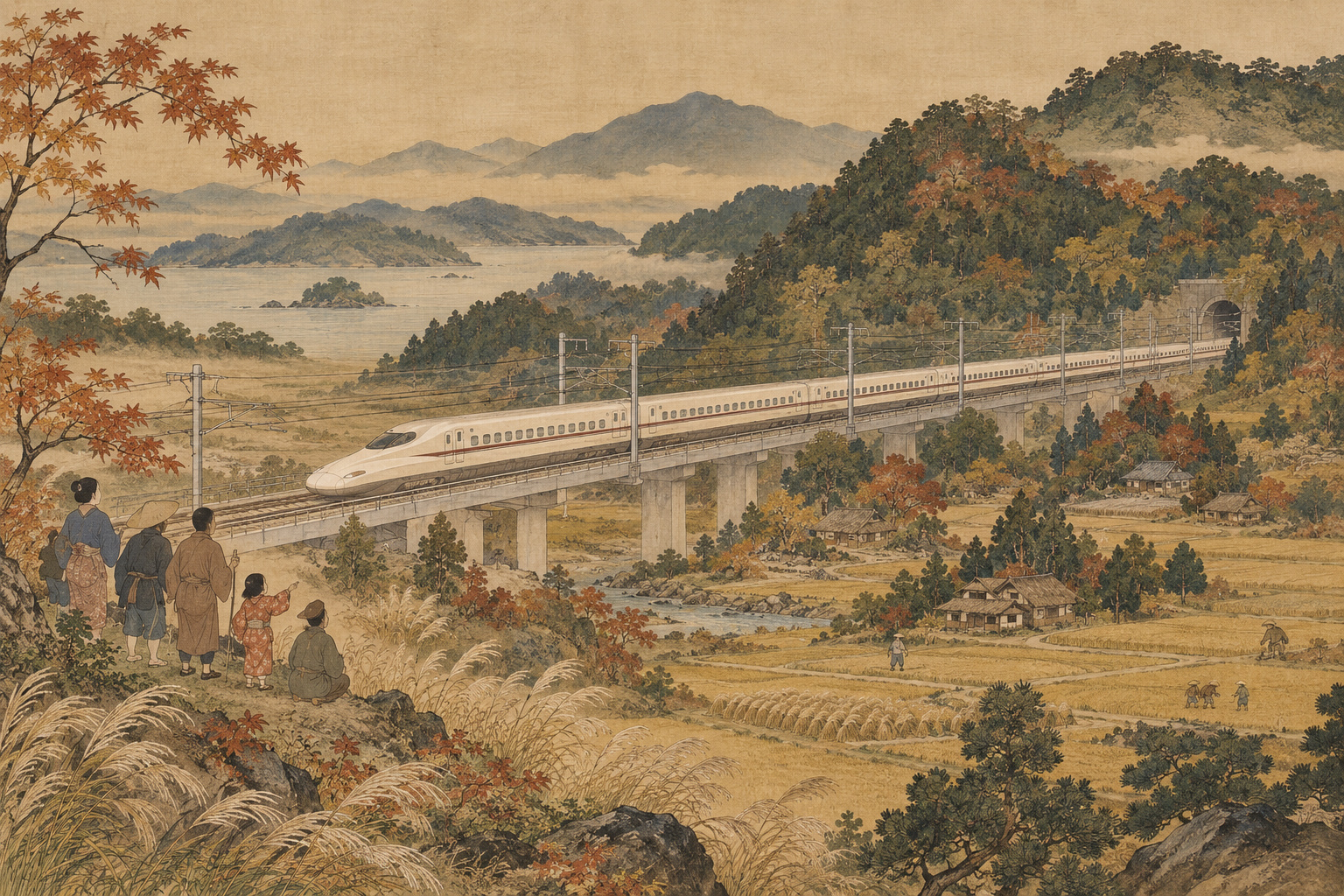
Kyushu’s interrupted high-speed rail spine is approaching a consequential reopening. JR Kyushu plans to restore service between Kumamoto and Shin-Minamata from the first trains on Friday, September 18, reconnecting the route before the autumn holiday break. The company cautions that aftershocks and other conditions could alter the plan.[1]
Passengers should read “the entire route” carefully. The September 1 Express Reservation notice says reduced speeds in some sections will require altered timings and some cancellations. The railway is preparing to reconnect cities while operating under continuing restrictions, rather than promising its ordinary timetable.[2]
A recovery already unfolding in stages
The disruption follows the July 28 Kumamoto earthquake. Japan’s transport ministry also records continuing interruptions on conventional railways, including the Kagoshima Main Line and Hisatsu Orange Railway. Restoring the Shinkansen therefore addresses an important part of a wider transport emergency.[6]
JR Kyushu’s earlier announcements show how incremental the process has been. On August 5 it announced a planned August 7 restart between Shin-Minamata and Kagoshima-Chuo, with fewer trains stopping at every station. That initial plan excluded Green accommodation and use of onboard toilets and washrooms—an unusually concrete reminder that restarting train movements and restoring the full passenger experience are separate tasks.[3]
An August 12 release set out operations from August 17 for that southern section, while maintaining that reopening Kumamoto–Shin-Minamata during August would be difficult. Those documents describe earlier recovery stages. Their temporary onboard restrictions should not be assumed to apply to the September 18 timetable.[4]
For a passenger, a missing link can dominate an entire journey. A relatively short interrupted section may introduce road transfers, uncertain connections and repeated handling of luggage. Reconnecting it can make a multi-city visit practical again. Yet a journey that becomes possible is not necessarily one that can be completed at its familiar speed.
Why the holiday timing matters
The calendar gives the planned restart particular significance. Respect for the Aged Day falls on September 21 and the Autumnal Equinox holiday on September 23. September 22 is also a statutory holiday because it sits between the two. Combined with the weekend, that creates a September 19–23 break for people who normally have Saturdays and Sundays off; September 18 itself is not a national holiday.[7]
That creates an opportunity for family visits, longer stays and trips combining several Kyushu destinations. It also puts an immediate planning problem in front of businesses. A hotel must decide how many rooms it can service; a restaurant must balance staffing and perishable stock against uncertain arrivals. These are likely channels through which restored access could affect commerce, not evidence that bookings or sales have already rebounded.
The most useful message a destination can offer is specific: how to get there from the station, what is open, when a shuttle leaves and how to make the return connection. A general declaration of recovery does less for a hesitant visitor than a workable itinerary. Businesses can reduce uncertainty by matching their arrival instructions to the operating timetable.
There is also a risk in treating reopening as an instruction to restore every business activity at once. Staff may face difficult commutes even when guests can arrive by high-speed train. Extra inventory can become a cost if a connection changes. A practical recovery plan distinguishes firm reservations from inquiries and scales staffing to the customers a business can actually accommodate.
The Shinkansen becomes a substitute for local rail
The connection to everyday life is explicit in JR Kyushu’s September 10 announcement. From the planned restart, it will provide substitute Shinkansen travel between Kumamoto and Shin-Yatsushiro while the interrupted Kagoshima Main Line section is being restored. Eligible valid tickets, including commuter passes, can be used without a separate limited-express ticket.[5]
The transport ministry also describes this arrangement alongside replacement buses. It illustrates a broader role for recovered infrastructure: the same line that brings visitors back can help people whose ordinary railway remains unavailable. JR Kyushu is aiming to reopen the Uto–Yatsushiro conventional section around mid-October, with the date still subject to conditions.[6][1]
Travelers using those arrangements must check the details. JR Kyushu says the direct Uto–Yatsushiro replacement bus will cease from September 18, requiring a change at Ogawa. Large buses cannot serve Arisa or Sencho stations. Stored-value balances on transport IC cards such as SUGOCA cannot be used for these replacement buses or the substitute Shinkansen arrangement.[5]
The practical test of recovery is therefore a complete journey, not simply a station appearing on a reopened map. A longer walk to a bus stop or an additional interchange may be manageable for an occasional visitor but difficult for a daily commuter, a person with reduced mobility or a parent accompanying children. Long-distance connectivity and neighborhood access recover on different schedules.
What the line changed before the earthquake
The railway’s history explains why reconnecting it matters beyond the immediate repair zone. The Shin-Yatsushiro–Kagoshima-Chuo section opened in 2004. Hakata–Shin-Yatsushiro followed in 2011, when through-running with the Sanyo Shinkansen also began. JR Kyushu describes the route as both an internal Kyushu connection and an important business and tourism link with the Sanyo and Kyoto–Osaka–Kobe regions.[8]
A connected network lets people combine places in ways that separate services cannot. A business trip can include another meeting; a holiday can include a second city; relatives can consider a visit without rebuilding their plans around an interruption. Reopening restores some of that freedom to arrange a day, even before every timetable restriction disappears.
Accessibility, however, does not guarantee that visitors will stay longer or spend more in every town. Faster travel can also make a day trip easier. The commercial benefit depends on what travelers do after arrival and whether smaller destinations are reachable from the main stations. The same challenge that accompanied the line’s expansion returns during reconstruction: turning transport access into reasons to spend time locally.
The engineering history beneath the timetable
The 2016 Kumamoto earthquake provides an earlier record of the work hidden beneath a service announcement. In a presentation to the Japan Society of Civil Engineers in April 2017, JR Kyushu documented damage beneath Shin-Yatsushiro’s platform, cracks in viaduct columns and displacement of rubber bridge bearings. Its photographs and repair examples show why railway recovery extends beyond the visible running surface.[9]
That is historical evidence, not a damage assessment of the 2026 earthquake. The earlier repair quantities and methods cannot be transferred to today’s sites. Its relevance is more fundamental: a train depends on structures and components that most passengers never see. Reopening decisions have to address those supporting systems as well as the rails.
A reduced-speed timetable should consequently be understood as an operating condition. It does not, by itself, establish that a reopening has failed, nor does a train moving through a repaired section prove that all recovery work is complete. Clear communication allows passengers to use the capacity being restored without mistaking it for a return to every pre-disaster condition.
What to check before leaving
Express Reservation resumed sales at noon on September 1 for journeys from September 18 covering Kumamoto–Kagoshima-Chuo. Customers using its one-year advance reservation service may receive confirmation for a different train or time from their original request. The confirmed booking, not the initial selection, is what needs checking.[2]
A useful pre-departure review begins with the actual travel date, train and arrival time, then works outward to onward transport and the return trip. Passengers needing assistance should confirm transfer arrangements, particularly where buses replace rail. Ticket changes and refunds depend on the product purchased; the appropriate source is the booking provider’s current conditions.
Businesses can perform the same review from the destination end: can an arriving guest reach the property, and can an employee reach work? Publishing those answers makes the restored railway more useful. It also acknowledges residents whose recovery will continue after the first through journey has attracted attention.
September 18 is a planned milestone, not a completed event. Its lasting significance will be measured after the holiday rush: in reliable commutes, resumed appointments, workable business visits and shops that can keep serving their customers. A railway reconnects places; recovery takes hold when people can again rely on the journeys between them.
Sources and references
- JR Kyushu: operating information and restoration outlook
- Express Reservation: reopening and booking arrangements, September 1
- JR Kyushu: planned reopening south of Shin-Minamata, August 5
- JR Kyushu: operating plan from August 17, August 12 release
- JR Kyushu: substitute rail travel and revised replacement buses, September 10
- Ministry of Land, Infrastructure, Transport and Tourism: 2026 Kumamoto earthquake response
- Cabinet Office: national holidays in 2026
- JR Kyushu: history and role of its Shinkansen routes
- JR Kyushu: damage and restoration after the 2016 earthquake, JSCE presentation, April 26, 2017
- JR Kyushu: Shinkansen station names and readings
Evidence reviewed September 14, 2026, Japan time. September 18 is a planned route reopening, with timetable restrictions still expected. Interpretations are Japan.co.jp analysis unless otherwise attributed.