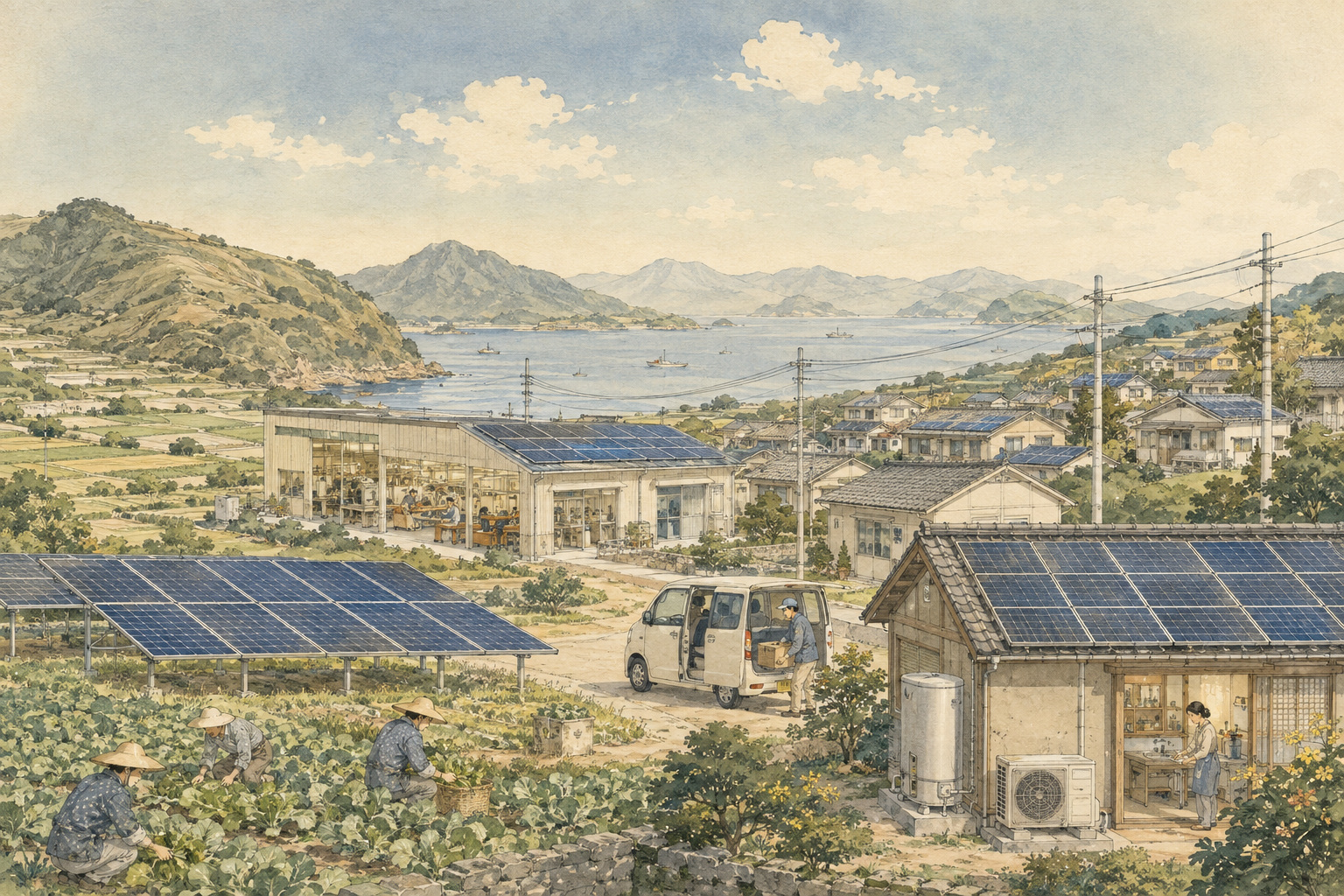
At noon on a clear autumn day in Kyushu, the most valuable action in a home may be almost comically ordinary. Heat water. Charge a car. Run the dishwasher. Cook with a microwave. The important thing is not the appliance, but the clock.
That idea reverses a century of electricity etiquette. Utilities built tariffs and public campaigns around the danger of the peak: too many air conditioners, cookers and machines drawing power at once. “Save electricity” meant both consuming less and avoiding the busiest hours. But a grid rich in solar power has two peaks to manage—the evening peak in demand, and a midday peak in generation. On mild, sunny days, supply can climb just as demand softens.
Kyushu Electric and KPMG will now test how to make that unfamiliar condition intuitive. Participants will receive requests to increase or shift electricity use during solar-rich periods. One experiment will personalize the message to a customer’s interests. The companies’ own example is strikingly domestic: someone interested in health might be encouraged to use a microwave for oil-free cooking. A second experiment will use the community surrounding Kyushu Electric’s Kyuden Voltex rugby team, including tickets or merchandise for some successful participants.
The point is not to manufacture waste. It is to move useful consumption that would otherwise happen at night or in the evening into hours when renewable electricity is plentiful. In grid language this is upward demand response, or upward DR. The word “upward” describes demand during the requested window, not necessarily a household’s total monthly consumption.
A trial built around attention, identity and repetition
The formal test is behavioral as much as electrical. KPMG is responsible for the overall design, project management and data analysis. Kyushu Electric will operate the app, recruit and support customers, and acquire electricity-use data. Participants will be divided into groups receiving different requests and messages. The companies say they will quantify the electricity shifted, response and continuation rates, acceptance and behavior change, then test whether personalized recommendations and a sports community improve participation.
That distinction matters. A single response to a generous reward can prove that a household is technically flexible. It does not prove a durable habit or a commercially viable service. A grid needs a resource it can call with some confidence. The research question is therefore not merely, “Did a person run an appliance?” It is, “Which people responded, by how much, on which days, at what cost, and did they keep doing it?”
The detailed recruitment sheet promises 500 yen-equivalent PayPay points for each required survey, 5,000 yen-equivalent points for cooperating through the trial, and additional daily rewards related to successful demand response. The company says the daily calculation will take an associated increase in the electricity bill into account. Some participants may also receive Voltex tickets or goods. The requests themselves are voluntary.
The public materials do not state a fixed target number of participants. They say selection may be necessary if applications exceed the program’s needs. That omission is worth preserving: the study can be evaluated only after its sample, group assignment, baseline method, weather adjustment and statistical results are published.
- Use the Kyuden Eco app, complete an intake survey and two later surveys, and respond to DR requests when reasonably possible.
- Allow analysis of interval electricity use, contract and app information, survey answers and trial participation history.
- Receive survey and completion rewards, plus event-based points and possible rugby benefits under the published conditions.
- Keep the right to decline a request. The rules warn that bills can rise depending on the customer’s tariff and usage.
- Expect published findings to be anonymized; relevant data may be shared among Kyushu Electric, KPMG and the Environment Ministry for the project.
This transparency is not a side issue. Personalization requires knowledge: what interests a customer, when power is normally used and whether a request changed that pattern. The more accurately an energy service predicts behavior, the more carefully it must explain consent, retention, sharing and the ability to opt out. A persuasive nudge should not become an opaque command.
The grid has no pantry
Electricity is not like rice delivered to a warehouse. In an ordinary alternating-current grid, generation and consumption must be kept in balance moment by moment. Storage creates breathing room, but only within its power, energy and network limits. If generation exceeds demand, system frequency tends to rise; if demand exceeds generation, it tends to fall. Operators continuously adjust power plants, storage and transfers to hold Japan’s grids near their designed frequency.
When Kyushu forecasts too much variable renewable output for local demand, curtailing solar and wind is not the first step. Under the priority dispatch rules, thermal generation is reduced; pumped-storage plants consume electricity to pump water uphill; grid batteries charge; power is exported over interregional links where capacity is available; and certain biomass generation is reduced. Only after those measures remain insufficient does the operator constrain variable renewables. OCCTO, the national grid coordination body, reviews whether the forecasts and sequence were reasonable.
Curtailment is thus both a safety valve and an economic signal. It prevents an electrical surplus from threatening stability, but it also means a panel capable of producing carbon-free electricity has been instructed not to. Some curtailment can be cheaper than building enough wires and batteries to capture the last kilowatt-hour of every rare surplus. Persistent or rising curtailment, however, reveals that generation, networks, storage, markets and demand are no longer developing at the same speed.
How Kyushu became Japan’s solar laboratory
Geography set the stage. Kyushu has strong sunlight, available land, a long history of geothermal and hydro development, and large agricultural and industrial loads—but it is joined to the rest of Japan’s western grid through a constrained gateway at the Kanmon Strait. Electricity can cross that gateway; it cannot cross without limit.
Policy supplied the acceleration. After the 2011 Fukushima Daiichi disaster and the nationwide shutdown of nuclear reactors, Japan sought new domestic generation with extraordinary urgency. The feed-in tariff that began in July 2012 guaranteed eligible renewable generators a fixed purchase price. Solar modules could be installed faster than dams, wind projects or thermal stations, and Kyushu’s sun and land made the economics especially attractive.
The result was a midday transformation. Roofs, fields and former industrial sites became power stations whose output followed the sky rather than a dispatcher’s order. On a hot weekday, air-conditioning demand could absorb much of it. On a mild spring or autumn holiday—factories quieter, heaters and air conditioners resting, clouds absent—the regional load could sink while solar production rose.
On October 13, 2018, Kyushu became the first of Japan’s main interconnected regions to curtail renewable generation under the national priority rules. The grid operator had already reduced thermal output, used pumped storage and sought transfers out of the region. The remaining arithmetic still did not balance. What looked from a distance like “too much clean energy” was more precisely too much generation in one place during particular hours for the available demand, storage and transmission.
The event was not the failure of solar; it was evidence that the next stage of the transition had arrived. Kyushu strengthened forecasting and online control, used a 50-megawatt grid battery at Buzen in the dispatch sequence, expanded transfers and improved the precision with which individual generators could be curtailed. Yet the solar fleet continued to grow. Kyushu Electric says renewable curtailment occurred on 128 days in fiscal 2024. OCCTO counted 50 days in the first three months of 2026 alone—12 in January, 14 in February and 24 in March.
The window is lengthening as well as recurring. In March 2026, Kyushu Electric Power Transmission and Distribution said mainland spring curtailment hours would generally expand from 8 a.m.–5 p.m. to 7 a.m.–5 p.m.; from July through March, the normal window remains 8 a.m.–4 p.m. In June, it began a more granular control method for online extra-high-voltage generators, using updates 15 to 30 minutes before real time to reduce unnecessary curtailment. Better control wastes less—but it does not create demand.
2011 Fukushima Daiichi changes Japan’s energy politics and accelerates the search for non-nuclear domestic supply.
July 2012 Japan’s feed-in tariff begins, opening a decade of rapid solar construction.
October 13, 2018 Kyushu orders the first renewable curtailment on one of Japan’s main interconnected islands.
April 2023 The revised Energy Conservation Act takes effect, formally recognizing demand optimization—including upward and downward DR—in reporting by large energy users.
Fiscal 2024 Kyushu records renewable curtailment on 128 days.
January–March 2026 OCCTO verifies 50 Kyushu curtailment days.
2026 Kyushu Electric tests home batteries, Tesla smart charging, heat-pump water heaters and behavior-based household demand shifting.
October–November 2026 The new personalized and rugby-community upward-DR trial is scheduled to run.
From “negawatts” to “posiwatts”
Demand response is older than the smartphone. Utilities have long paid factories to interrupt load in emergencies or offered time-of-use tariffs that made off-peak electricity cheaper. Analysts sometimes called a unit of avoided demand a “negawatt”: a megawatt the system did not have to generate at the peak.
Japan’s postwar power system trained households in a particular version of load shifting. Heat-pump water heaters such as EcoCute were commonly scheduled overnight, when demand and wholesale costs were low and large power stations continued operating. After March 2011, summer conservation campaigns intensified the lesson that the responsible citizen cuts use during a strained peak.
Solar alters the sign. On a surplus afternoon, the useful response may be a “posiwatt”—an increase at the right moment. Japan’s Agency for Natural Resources and Energy was explaining upward DR by 2017 and 2018, even while acknowledging how odd it sounded within a culture of energy conservation. The 2023 revision of the Energy Conservation Act resolved part of that policy contradiction by asking large regulated users to report actions that optimize electricity demand according to grid conditions, including increases during renewable surpluses and reductions during scarcity.
True optimization preserves efficiency. Heating water at noon with an efficient heat pump is better than switching on a resistance heater solely to claim a reward. Charging an EV that must be charged anyway is useful; circling the block to empty its battery is not. Running a washing machine half-full at noon may consume more water and electricity than one full load later. The carbon value of a shift also depends on what generation is marginal at both times, not merely on whether the sun is visible.
| Flexible service | Useful solar-hour shift | Guardrail |
|---|---|---|
| Heat-pump water heater | Heat the insulated tank around midday instead of overnight. | Maintain hot-water comfort and avoid inefficient reheating. |
| Electric vehicle | Charge before departure during a forecast solar surplus. | Driver sets the required departure time and minimum charge. |
| Home battery | Charge near noon and discharge during the evening ramp. | Reserve capacity for outages if the household chooses; account for cycling losses. |
| Laundry or dishwasher | Use a timer for a full load in the requested window. | Observe fire, noise and manufacturer safety guidance; do not run unsafe equipment unattended. |
| Cooking | Move meal preparation or batch cooking into the event period. | Do not encourage consumption that has no household value. |
| Cooling and heating | Pre-cool or pre-heat an efficient building modestly before evening demand rises. | Comfort, health and indoor air quality remain constraints. |
Kyushu’s 2026 fleet of small experiments
The October trial is one tile in a larger mosaic. From March to May, Kyushu Electric and Sharp Energy Solutions tested remote operation of Sharp home batteries: charge in solar hours, discharge in the evening. Another battery trial with Shizen Connect is scheduled for August and September and is designed to work across multiple manufacturers.
A Tesla smart-charging experiment scheduled from April 27 to June 26 used Kaluza software to move vehicle charging away from evening pressure and into solar-rich hours, while completing the charge by a driver-selected departure time. A separate heat-pump-water-heater test, announced August 3, will remotely move operation from early morning into daytime for up to 100 households from September through October, covering selected Panasonic and Daikin units through Infometis technology.
These are not redundant projects. A battery can respond quickly but loses some energy in charging and discharging and costs money to install. An EV can absorb a large flexible load, but only when it is plugged in. A water heater stores energy cheaply as heat, but its schedule is bounded by household hot-water use. A behavioral request can reach existing appliances without new hardware, but it is less predictable and asks for human attention.
A mature system will combine them. Automation handles frequent, low-friction shifts; people set comfort, mobility and safety boundaries; price or reward signals express the grid’s need; and an aggregator combines thousands of small responses into a resource visible to the power market.
Why personalization—and why rugby?
A generic alert competes with work, school, family messages, shopping notifications and every other demand on a phone. Behavioral research has repeatedly shown that information alone is often weak. A person must notice a request, understand what action is possible, believe it matters, trust the sender and remember at the right time.
Personalization tries to shorten that chain. “Please increase demand” is an engineering instruction. “Prepare a low-oil dish with your microwave between noon and 2” is an imaginable act. The risk is that personalization becomes superficial, manipulative or too narrow: not every health-conscious person is home at noon, owns the relevant appliance or wants an algorithm to infer private interests.
The rugby experiment tests a different mechanism—identity. A supporter may react to a request framed as a collective Voltex effort even when a small financial reward is forgettable. Tickets and merchandise make the reward tangible and local. But loyalty can produce a novelty spike rather than a stable habit. Researchers will need to distinguish the effect of the community message from the value of the prize, and first-event enthusiasm from persistence in the eighth week.
- The number and broad characteristics of applicants, selected participants, dropouts and analysis groups.
- How baseline electricity use was estimated, and how weather, holidays, rooftop solar and unusual household events were handled.
- Average and distributional change in kilowatts and kilowatt-hours—not only the percentage of people who clicked “participate.”
- Incremental cost per shifted kilowatt-hour, including rewards, bill effects, administration and technology.
- Whether changes persisted after repeated events or after the strongest rewards ended.
- Opt-out rates, customer complaints, comfort effects, privacy concerns and any rebound in later hours.
The hard measurement problem inside a quiet home
No separate meter can show the counterfactual—what a home would have used if no request had arrived. The program must estimate that baseline from previous comparable days, a control group or a statistical model. A family returning from vacation can look like successful upward DR. A sudden cloud can erase the solar surplus the request was intended to absorb. A hot afternoon changes air-conditioning demand whether or not anyone saw the app.
There is also a difference between increasing load in the event window and shifting load from a more difficult hour. If a dishwasher runs at noon but would otherwise not have run at all, grid demand rose without an evening benefit. If it moved from 7 p.m. to noon, the system gains at both ends. Follow-up measurement must look for that later reduction—or for rebound, when deferred appliances all restart together.
Scale should be interpreted with care. As a purely illustrative calculation, if 100,000 households each shifted one kilowatt-hour into the same solar-rich period, the result would be 100 megawatt-hours. That is material, but timing, concentration on local feeders and reliability matter as much as the total. A resource that appears on half the requested days cannot be scheduled like a turbine that responds on command.
Fairness is part of grid design
Flexible demand is not equally distributed. A homeowner with an EV, battery, rooftop solar and connected water heater may collect several revenue streams. A renter with an old appliance, no parking space and a job away from home may have little to shift. Care workers, people with medical equipment and families with young children cannot always place system convenience ahead of immediate need.
That does not make household DR unfair by definition. It means program design must count who can participate, who pays and who benefits. Simple timers, smart plugs, community facilities and landlord programs can widen access. Rewards should reflect delivered value without inviting waste. Default automation needs clear consent and an easy override. Essential use and health must never be penalized.
Distribution grids add another layer. A regional solar surplus does not mean every local wire has spare capacity. If thousands of EVs on one feeder begin charging simultaneously, a program intended to help the bulk system can create a neighborhood peak. Dispatch must eventually become aware of both regional balance and local constraints.
No app can replace a power system
The charming image of a rugby supporter switching on a dishwasher should not obscure the scale of the infrastructure problem. Demand response can reduce curtailment and peak costs, but it cannot substitute for stronger interregional transmission, grid-scale and distributed storage, flexible industrial processes, improved forecasting, market reform and generation that can adjust safely.
Kyushu already uses pumped hydro, the Buzen grid battery, exports and increasingly precise online control before curtailing renewable plants. More batteries can move solar energy by hours; expanded transmission can move it by geography. Heat storage, electric boilers and hydrogen production may eventually absorb larger industrial surpluses. Time-varying retail prices can make the signal routine rather than episodic, but poorly designed volatility can confuse customers or expose vulnerable households.
Some curtailment will remain rational. Building a rarely used asset to capture every last unit can cost more—in money, materials and environmental impact—than occasionally turning a generator down. The policy objective is not a magical zero. It is to ensure that curtailment happens only after lower-cost flexibility has been used and that developers face transparent, predictable rules.
A local experiment with national stakes
Japan’s Seventh Strategic Energy Plan, approved in February 2025, envisions renewables supplying 40–50 percent of electricity in fiscal 2040. Its reference outlook assigns solar alone 23–29 percent, up from 9.8 percent in fiscal 2023. At that scale, the country cannot manage solar only from the supply side.
The old power system followed demand: operators raised or lowered generation as people lived their lives. The emerging system must perform a duet. Generation will still respond, but millions of water heaters, vehicles, batteries, buildings and factories will also move within limits set by their owners. The control room becomes partly a market, partly software and partly social convention.
Kyushu is an apt place to learn that choreography because its solar future arrived early. The region has already lived through the first curtailment, the argument over wasted clean power and the engineering work of making control more precise. Now it is testing the quieter human question: can the household clock become infrastructure?
The answer will not be found in the number of app notifications sent, nor in a photograph of smiling rugby supporters. It will be found in meter traces and opt-outs, in whether people understand the request, in whether a new habit survives November, and in whether the saved evening kilowatt-hour is worth more than the reward and inconvenience required to move it.
Reporting notes and primary sources
This article reflects information published through August 8, 2026, 6:00 a.m. JST. The trial had been announced but had not started. Dates, benefits and conditions can change; applicants should use the current official rules. Curtailment is a grid-balancing measure, not proof that every curtailed kilowatt-hour could economically have been stored or transmitted.
- Kyushu Electric: announcement of the household upward-DR trial
- Kyushu Electric: trial outline, recruitment, rewards and schedule
- Kyushu Electric: participant rules, data handling and tariff cautions
- Environment Ministry: Decokatsu trial announcement
- KPMG Consulting: experimental design and project roles
- Kyushu Electric: Tesla smart-charging trial and fiscal 2024 curtailment days
- Kyushu Electric: EcoCute daytime-shift trial
- Kyushu Electric and Shizen Connect: multi-maker home-battery trial
- Kyushu Electric and Sharp Energy Solutions: home-battery trial
- OCCTO: verification of Kyushu curtailment in January–March 2026
- OCCTO: Kyushu priority-dispatch sequence and Buzen battery
- Kyushu Electric: history and operation of renewable curtailment
- Kyushu Electric Power Transmission and Distribution: 2026 curtailment windows
- Kyushu Electric Power Transmission and Distribution: finer online curtailment control
- Agency for Natural Resources and Energy: upward and downward demand response
- Agency for Natural Resources and Energy: 2023 Energy Conservation Act revision
- Agency for Natural Resources and Energy: feed-in tariff start in July 2012
- METI: Cabinet decision on the Seventh Strategic Energy Plan
- Agency for Natural Resources and Energy: fiscal 2040 power-mix outlook