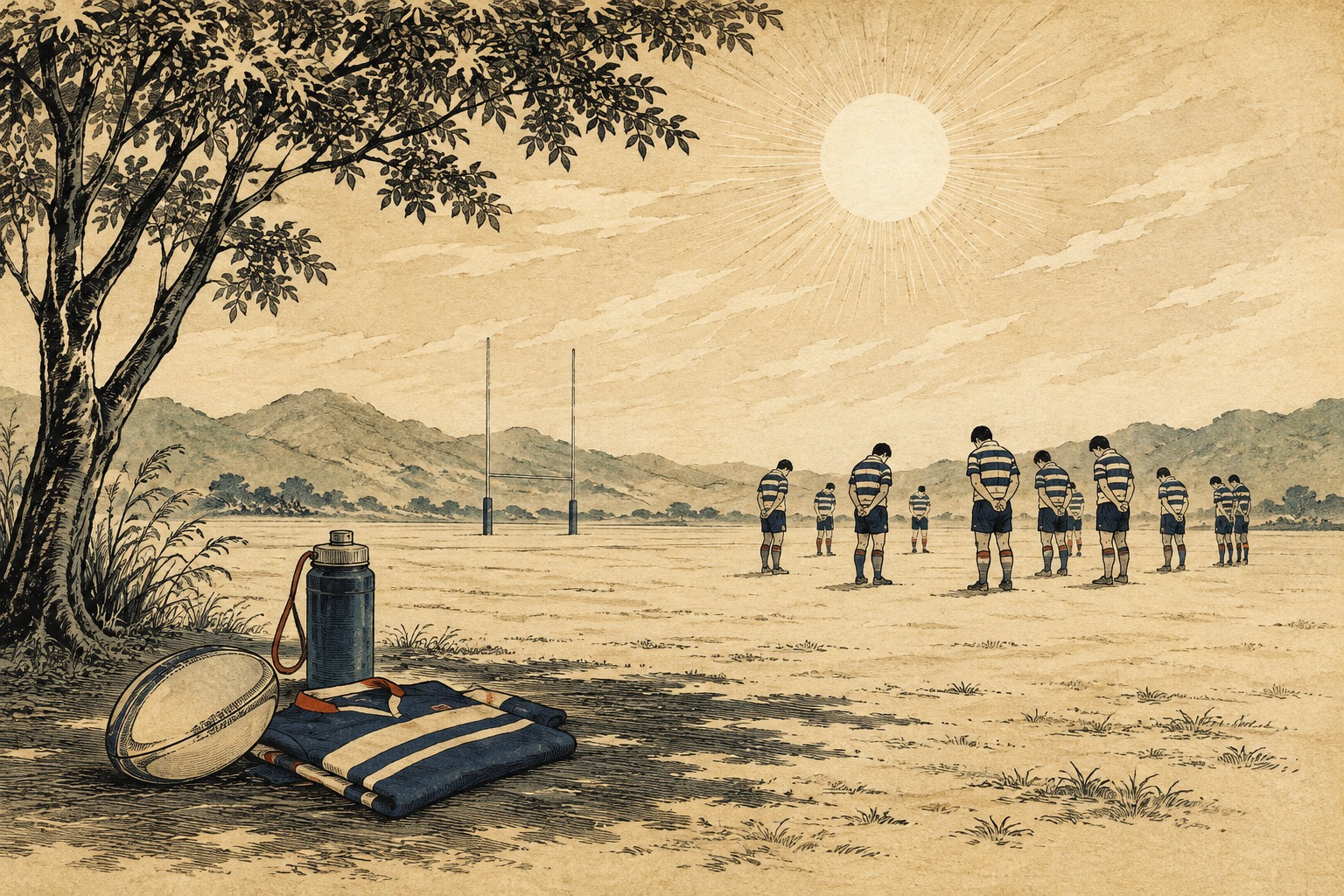
On August 3, Fukuoka’s heat had moved beyond the casual question of whether training was possible. It required a harder question: under what conditions could anyone safely authorize it? The Fukuoka observatory recorded a high of 36.9°C. A heatstroke alert covered the prefecture. Elsewhere in Fukuoka, Kurume reached 40.4°C and Dazaifu 40.2°C, both new all-time records for their stations.
According to details Kyushu Electric provided to local media, Vunilagi trained indoors in Fukuoka’s Higashi Ward, then joined an outdoor team session shortly before 5 p.m. for approximately one hour. He became unsteady afterward and was taken to a hospital. Reports say he could answer questions while being transported. That fact, however, cannot by itself rule out severe heat illness or predict its course. At around 8 a.m. on August 7, four days after the session, he was pronounced dead.
The club’s first statement did not disclose the start time, duration outdoors, on-field heat index, training load, breaks, hydration or cooling measures. Subsequent reporting supplied part of the outline, but essential gaps remain. If a memorial account stops at “record heat,” his death can disappear into the language of an unavoidable summer. Yet sports safety is the work of changing training on days when no one can change the weather.
In One Week, the Future Tense Became the Past
Vunilagi’s 2026 summer was introduced as the beginning of a new chapter. On July 1, Kyuden Voltex announced him as a signing for the 2026–27 season. He wrote that he was grateful and excited to join, eager to work with the team, and committed to helping it win Division 2 and earn promotion. KBC later reported that he joined team activities on July 23.
| Date | Confirmed event | Source |
|---|---|---|
| July 1 | Kyuden Voltex announces Vunilagi and publishes his ambition to win Division 2 and reach Division 1. | Kyuden Voltex / League One |
| July 23 | He joins his new team’s activities, according to local reporting. | KBC |
| August 3 | After indoor work, he participates in an outdoor session beginning shortly before 5 p.m. and lasting about an hour; he becomes unsteady afterward and is hospitalized. | TNC reporting based on Kyushu Electric |
| August 7 | He dies in a Fukuoka hospital. Severe heatstroke is reported as the cause. | Kyuden Voltex / TNC |
| August 8 | The club and League One announce his death and ask that his family’s privacy be respected. | Kyuden Voltex / League One |
That is the public chronology as of this edition. It does not reveal his pre-session medical screening, the detailed training program, rest intervals, fluid intake, field-level WBGT, the time his first symptom was recognized, on-site cooling, the emergency-call time or hospital arrival. The available record is also insufficient to reach criminal, civil or workers’ compensation conclusions.
From Fiji to Japan: A Young Forward Standing 196 Centimeters
League One’s official profile lists Vunilagi at 196 centimeters and 117 kilograms. Born on June 13, 2000, he played lock and had also been registered at No. 8. His was the demanding work of a large forward: contesting lineouts, absorbing contact, driving into defensive lines and doing much of the labor on which more visible moments depend.
He moved from Massey High School in Fiji to Daito Bunka University, then joined Tokyo Suntory Sungoliath in 2023. In his arrival statement, he described his love of attacking rugby and his determination to grow on and off the field. League One’s official record lists three appearances. The number is small; the years of competing for those opportunities inside one of Japan’s deepest squads were not.
His move to Kyushu was a chance to move his career forward. The club introduced him as a 196-centimeter, 117-kilogram lock with a path through Massey, Daito Bunka and Sungoliath. His first public message centered on what he could do for the team. Only 38 days separated that announcement from the notice of his death.
August 3: A Heatstroke Alert Over Fukuoka
JMA’s daily observations put Fukuoka’s maximum temperature at 36.9°C on August 3. Other sites in the prefecture reached 40.4°C in Kurume, 40.2°C in Dazaifu, 39.1°C in Hakata and 39.0°C in Omuta. Kurume and Dazaifu broke their previous all-time station records. Across Japan, 227 of 914 observing sites reached at least 35°C, and seven reached 40°C.
Air temperature alone cannot establish the risk on a particular field. The body’s ability to shed heat also depends on humidity, radiant heat and airflow. That is why heat policy uses wet-bulb globe temperature, or WBGT. Grass, artificial turf, surrounding stands, reflected sun and wind exposure can make the field-level value different from a city reading.
Japan’s heatstroke alert is issued when the maximum WBGT at any forecast point in a region is expected to reach 33. Such an alert was active for Fukuoka Prefecture that day. Japan Sport Association guidance says exercise should be stopped in principle at a field WBGT of 31 or above; from 28 to below 31, strenuous exercise should stop. Public information does not show the measurement at the training ground or who made the decision to continue.
- Air temperature: What a standard thermometer measures.
- WBGT: An index incorporating humidity, radiant heat and airflow as well as temperature.
- Heatstroke alert: Issued when a forecast point in the region is expected to reach a daily maximum WBGT of 33.
- Field measurement: The value at the actual place and time of training is the operational number that should be recorded.
Heatstroke Is Not Another Word for Dehydration
Severe exertional heat illness is not simply a later stage of being thirsty. Hard exercise produces immense metabolic heat. When the body can no longer discharge it to the environment, core temperature can rise and damage the brain, circulation, liver, kidneys and clotting system. An athlete may initially remain able to walk or answer questions; that alone does not exclude severe heatstroke or predict the outcome.
Japan Sport Association says survival in suspected exertional heatstroke depends on lowering body temperature below 40°C within roughly 30 minutes. The most effective field method is whole-body immersion in ice or cold water. Where that is impossible, continuous water dousing or repeated wet towels combined with strong airflow should begin immediately. Rectal temperature is regarded as the reliable field measure of core temperature, but the absence of a reading must not delay cooling.
Those are general medical principles, not findings about this case. The club says Vunilagi was transported immediately, but his field temperature, neurological condition, cooling method and the interval before cooling have not been disclosed. The public record therefore cannot establish that the response was adequate or inadequate. That uncertainty is precisely why a verified timeline matters to prevention.
Japanese Sport Has Known the Answer for More Than Thirty Years
Managing exercise in heat is not a newly discovered problem. In 1991, the body now known as the Japan Sport Association organized a research group on preventing heat illness in sport. It studied accidents, measured sporting environments and examined thermoregulation during exercise. In 1994, it released its first exercise guidelines and heatstroke-prevention guidebook, turning WBGT thresholds, reduced intensity, rest, fluid and salt replacement, and cancellation in dangerous conditions into a coherent policy.
The guide has been revised repeatedly, reaching its sixth edition in 2025. Its five principles are plain: do not exercise unreasonably in heat; take sudden heat seriously; replace water and salt; cool the body externally and internally; and treat poor health as a risk. The central problem is no longer the absence of knowledge. It is whether that knowledge becomes a schedule, a chain of command, a written record and emergency equipment.
Japan’s Sports Agency again told sporting organizations in 2026 to base cancellation decisions on WBGT regardless of place or sport, build heat acclimatization, provide water and salt before, during and after activity, and begin early cooling and medical transport when symptoms appear. Following a July 31 cabinet-level meeting, the agency renewed that request. Vunilagi was hospitalized after training three days later.
1991 Japan’s national sports body establishes a heat-illness prevention research group.
1994 It publishes the first exercise guidelines and guidebook.
2021 Japan begins nationwide operation of the heatstroke alert system.
2024 JSPO formally states that its own events should stop in principle at WBGT 31 or above.
June 2025 Revised occupational safety rules require systems and procedures intended to prevent severe workplace heat illness.
2025 JSPO releases the sixth edition of its guidebook, placing greater emphasis on active cooling.
July 31, 2026 The government renews its request for heatstroke prevention in sport.
August 3, 2026 Vunilagi is hospitalized after training while a heatstroke alert is active in Fukuoka.
Can “Personal Responsibility” Protect a Professional Athlete?
Sport rewards the ability to approach physical limits. Answering “one more” and concealing fatigue can become part of an athlete’s competitive value. If safety depends primarily on self-reporting, a player may be forced to choose between health and the opportunity to earn selection. Authority to stop a session must also belong to a medical or safety professional whose judgment is independent of performance evaluation.
Japan strengthened its occupational heat rules in June 2025. For qualifying work expected to take place at WBGT 28 or above, or air temperature 31°C or above, for at least one continuous hour or more than four hours in a day, an employer must establish and communicate reporting and response procedures. Those procedures include leaving the work, cooling the body, obtaining medical assessment where necessary, and identifying emergency contacts and a destination for transport.
The public record does not reveal Vunilagi’s contract, so this article cannot determine how those labor rules legally applied to his training. Japanese corporate rugby has long mixed employee-players and professional contracts. An official League One feature previously described Kyuden Voltex as a team made up largely of company employees with professionals added. Whatever a player’s classification, a club that schedules training and controls the facility and staff retains an organizational duty to explain how it protects its athletes.
Seven Questions That Need Answers
Kyushu Electric says it takes the death seriously and will accept corporate responsibility for recurrence prevention. Giving that pledge substance requires disclosure sufficient to evaluate organizational decisions and the safety system, while continuing to protect the family’s privacy and Vunilagi’s confidential medical information.
- Was field-level WBGT measured and recorded before, during and at the end of training?
- What rule permitted outdoor work during an alert, and who had final authority?
- How were combined indoor and outdoor load, rest, fluids, salt and cooling planned?
- How was heat acclimatization assessed for a player who had joined team activity on July 23?
- Who recognized the first sign, and when did exercise stop, cooling begin and emergency transport start?
- Were cold-water immersion, reliable core-temperature measurement and trained medical staff available?
- Will the review involve League One or independent specialists, with lessons shared across clubs?
These questions do not assume guilt. They are the questions needed to protect another player when the same conditions recur. A safety investigation should not isolate one person’s decision; it should examine the system that supported—or obstructed—that decision.
Turning “Exceptional Heat” Into a Planning Assumption
Japan’s heat is no longer an occasional exception in sports operations. JMA says the national summer average has risen at a long-term rate of 1.38°C per century. The summer of 2025 was 2.36°C above the 1991–2020 average, the highest since national records began in 1898. On August 3, 2026, seven Japanese observing points reached 40°C.
Japan’s labor ministry counted 1,803 workers who died or missed at least four days after occupational heat illness in 2025, the highest number in the series; 19 died. The ministry said the reporting and response systems made mandatory that year may have helped reduce fatalities. Rules do not remove the heat. They decide how a warning is reported and what must happen after it is received.
Sport needs the same operational discipline: preserve field-level WBGT records; automatically cancel, move indoors or reduce work at set thresholds; give medical staff stop authority independent of coaches; manage acclimatization for new arrivals, players returning from injury and those coming off travel; maintain cold-water immersion and core-temperature capability at ordinary practices, not only matches; and require serious incidents to be reviewed and anonymized lessons shared across the league. Safety is not a poster. It is a schedule, a budget and a distribution of authority.
How a Sport Can Remember Him
League One’s official record gives Vunilagi three appearances. A life cannot be measured in caps. He came from Fiji to a Japanese university, competed for opportunity at a powerhouse club, chose a new start at 26 and joined teammates who intended to pursue promotion. The loss of that future is the center of this story.
Remembrance is not a reason to silence scrutiny. The club has asked reporters to give the bereaved family privacy, and that request should be honored. The questions belong with those who organized the session, administered safety rules and hold the records—not with a family in grief. Kyushu Electric’s recurrence-prevention pledge cannot end with a private instruction to “be more careful.” Responsibility becomes tangible when players, families, the league and the public can see what was examined and what changed.
When Vunilagi arrived in Kyushu, he spoke about helping the team win Division 2 and reach Division 1. He will never appear in its jersey in a competitive match. The reform rugby can carry forward in his name will not appear in a standings table: proving that stopping training in dangerous heat is professional judgment, not weakness; giving a young athlete the power to step away without losing his future; and making sure the next player returns home alive. That would be the most concrete form of remembrance a sport can offer a life interrupted at 26.
Reporting Notes and Principal Sources
This article uses public information available through August 12, 2026 at 9:18 AM JST. It does not speculate about private medical information. The exact field WBGT, training load, rest and hydration plan, cooling response, employment classification and review process were not established in the public record. This article therefore does not make a legal finding or assign individual fault.
- Kyuden Voltex: Announcement of Saimoni Vunilagi’s death, in Japanese and English
- Japan Rugby League One: Kyuden Voltex statement
- League One: Kyuden Voltex 2026–27 signings and Vunilagi’s statement
- League One: Official player profile and appearance record
- Television Nishinippon / FNN: Training timing, symptoms, cause of death and Kyushu Electric’s response
- Japan Meteorological Agency: August 2026 daily maximum temperatures in Fukuoka Prefecture
- JMA: Nationwide observation ranking for August 3, 2026
- Japan Sports Agency: Prevention of heatstroke accidents in sport
- Japan Sport Association: Heatstroke-prevention exercise guidelines
- Japan Sport Association: Field cooling for suspected heatstroke
- Ministry of Health, Labour and Welfare: Stronger workplace heat rules effective in 2025
- MHLW: Occupational heat illness injuries and deaths in 2025
- JMA: Long-term trend in Japan’s summer temperature
- World Rugby: Updated heat guidelines explained