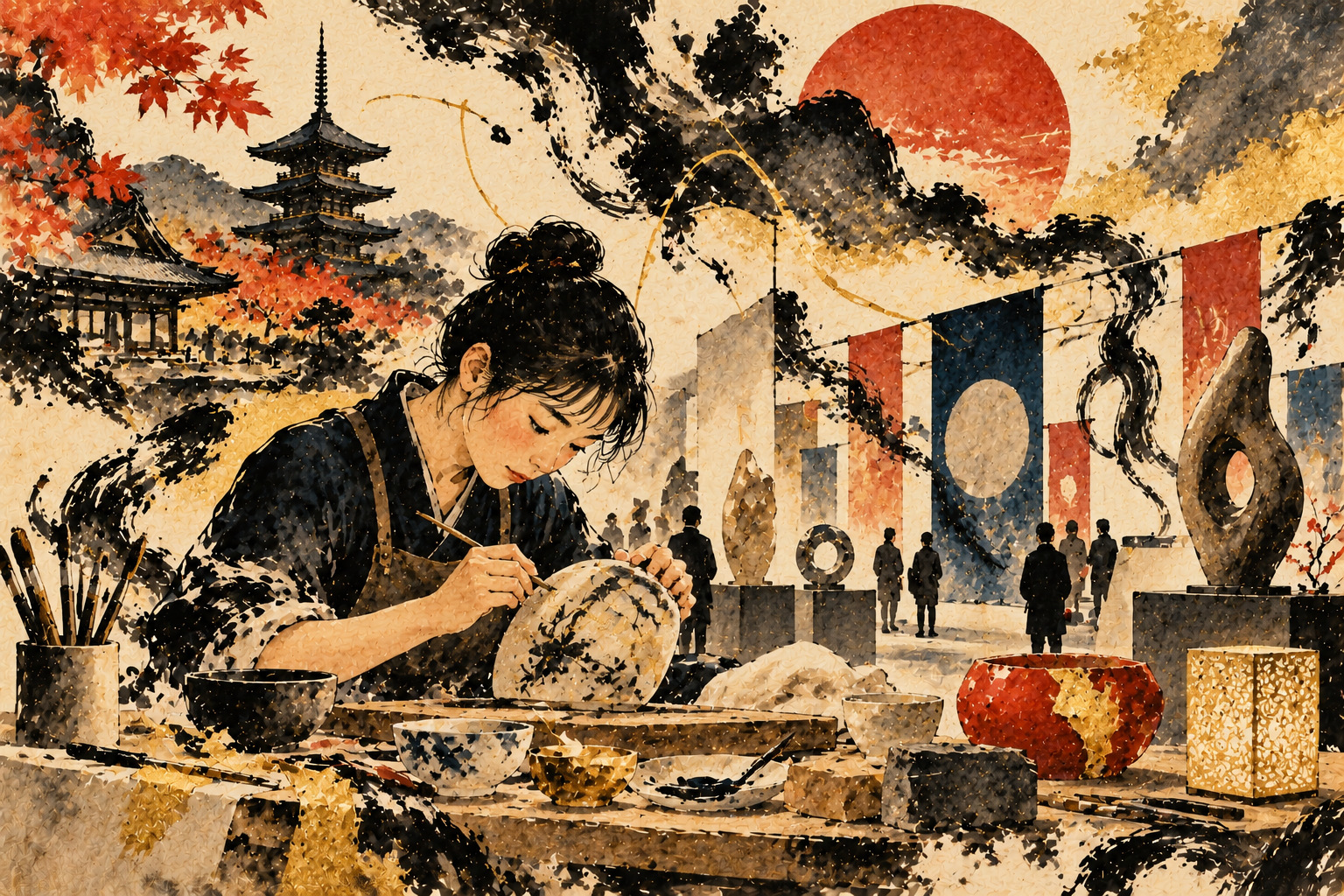
The deeper question is not whether machines can make objects. It is what society chooses to value in the people who make them.
An old garden asks a question for a new technological age
In the heart of Kyoto, a garden shaped over centuries became the setting for an unusually contemporary argument: what does making something mean when software can generate a design in seconds? The inaugural Kyōto YouMe Triennale brought craft, art and design into a shared conversation under the banner of its “Manifesto” edition, scheduled for public exhibition from October 9 through 18, 2026. Its main venues were Shōsei-en Garden and nearby Jūshin Kaikan, associated with Higashi Honganji.
The event was ambitious precisely because it avoided defining tradition as a catalogue of old objects. International curators and Japanese artists were asked to consider what is carried in a skill, a material and the human relationships that give work meaning. This October 20 analysis is grounded in programs and institutional documents available by October 17. It does not claim to have attended the exhibition or to know final visitor figures and reviews.
A 350-year conversation in architecture and landscape
Shōsei-en is no neutral white box. The historic temple garden has long been linked to poetry, tea and performance, and was nationally designated a Place of Scenic Beauty in 1936. Its buildings and landscapes embody a kind of cultural making that unfolds across generations. Placing experimental craft within them creates an encounter between the living present and an inherited setting.
Official plans assigned an exhibition called Adaptive Radiation to the Rōfūtei building and a Liberty-themed installation to rooms and garden spaces including Rinchitei and Tekisuiken. A venue with such historic status also creates responsibilities: exhibiting a challenging object does not remove the obligation to protect the site and to explain how temporary installations coexist with its conservation.
Why “adaptive radiation” is a revealing metaphor
Borrowed from evolutionary biology, adaptive radiation describes how related organisms diversify as they adapt to different ecological opportunities. Applied to craft, the metaphor questions a sentimental model in which the future consists simply of copying the past. Kyoto Prefecture listed ten groups of younger makers in the Adaptive Radiation exhibition, curated by Kodama Kanazawa. Among the artists represented in official materials were Sayaka Miyata, Satoshi Kunimasa, Keiko Masumoto, Noda Hanga and Osamu Yokoyama.
For these creators, inherited practice can be raw material for new ideas rather than an obligation to repeat a canonical object. That does not mean every experimental work succeeds, or that a curator’s interpretation speaks for its maker. It means visitors are invited to examine the boundary between a craft object that serves a purpose and an artwork that questions the purpose itself.
International exchange is more than an export showcase
Across Jūshin Kaikan, the organizers assembled perspectives from India, Qatar, Italy and Britain. Kyoto Prefecture identified curators Esha Gupta, Shaikha Al Sulaiti, Maria Vittoria Baravelli and Harry Pearce, while program information described projects ranging from handmade futures and design memory to graphic communication. The country mix matters because contemporary craft is not one uniform global style.
For international visitors, Kyoto is often packaged as a model of perfect workmanship. A serious cross-border dialogue requires room for disagreement, different economic circumstances, and the recognition that skilled making exists in many cultures. Whether that dialogue leads to sustained exchanges, commissions or new production partnerships will require evidence after the event, not celebratory copy issued beforehand.
Two companies founded in 1875 — a partnership across 150 years
The event’s organizers trace one part of the project’s origins to an unlikely historical coincidence. Liberty, the London retailer founded in 1875, and Marusen, a Tango chirimen textile company established in Kyoto Prefecture that same year, met through the open-studio networks developed around DESIGN WEEK KYOTO. Organizers describe a collaborative furoshiki using William Morris’s Strawberry Thief design and new textile work, shown in connection with the UK Pavilion at the Osaka–Kansai Expo.
The detail is revealing. Tango chirimen depends on sophisticated twisting and weaving techniques that produce its characteristic textured silk. Liberty’s distinctive printed-fabric history comes from another set of markets and influences. A collaboration can connect these traditions without treating either as a museum relic. It is less clear, from the available records, whether the project created repeat business or materially strengthened the local manufacturing workforce.
When artificial intelligence enters the workshop
On October 11, the triennale scheduled a conference at Kyoto Research Park devoted to the meaning of making. Its advertised premise explicitly considered a world in which AI challenges familiar distinctions between thinking, designing and production. The discussion was planned across art, design and craft, with speakers from Japan and abroad.
That makes an interesting test case for the creative industries. Generative systems can explore patterns, suggest forms and support documentation. They do not automatically settle questions of authorship, compensation, cultural appropriation or where skills are learned. Nor is refusing technology necessarily protective of craft: digital tools may assist accessibility and reduce repetitive work. The valuable question is which technologies expand makers’ agency and which make it harder for them to earn a living.
The exhibition extends into workshops and neighborhoods
Two strands of the official program moved beyond the main exhibition. YouMe Open brought satellite presentations into studios, companies and other sites around Kyoto. YouMe Journey proposed small-group excursions to places where materials and skills are cultivated, including communities in and around Kyoto, Kameoka, Mukō and Nagaokakyō. The excursions were designed for designers, artists, researchers, architects and curious visitors.
It is easy for cultural tourism to privilege the exhibition photograph and forget the production network. A workshop visit may reveal supply chains, costly equipment, long training periods and the judgment embodied in a practiced hand. It may also impose a burden on a small business that must interrupt work to host outsiders. Lasting value depends on how much knowledge, revenue and opportunity return to the makers themselves.
What does a triennial leave behind?
The event is described by its organizers as a project intended to recur every three years, not simply a ten-day fair. Kyoto Prefecture lists the exhibition within a regional and cultural-development initiative, and the organizing network draws in design institutions, businesses and cultural partners abroad. Its international links include the Department of Design at Politecnico di Milano and organizations in the United Kingdom and elsewhere.
To become a durable institution, the event will need to demonstrate more than attendance. Useful measures could include repeat commissions, apprenticeships, collaborative research, international residencies and access for makers who are not already prominent. Financial transparency, fair compensation and continued local participation matter as much as a polished visual identity. None of those longer-term outcomes can be inferred from the inauguration alone.
The future of craft will be made, not inherited intact
Kyoto’s exceptional craft reputation was built by people experimenting over centuries with materials, patrons, uses and tastes. A culture that cannot accommodate contemporary change risks turning skilled work into nostalgia for consumers who can afford it. A culture that discards accumulated knowledge in pursuit of novelty loses something equally difficult to replace.
The YouMe project is most compelling where it refuses that false choice. The artist, the toolmaker, the textile workshop, the international curator and the student all have a stake in how knowledge passes from one generation to the next. A new triennial can create a meeting place for them; whether it can secure the conditions in which they continue making is the bigger story.
Reporting note: Based on official material available through October 17, 2026. Final outcomes from October 18, attendance, and actual conference remarks were not independently verified. No onsite reporting is claimed.