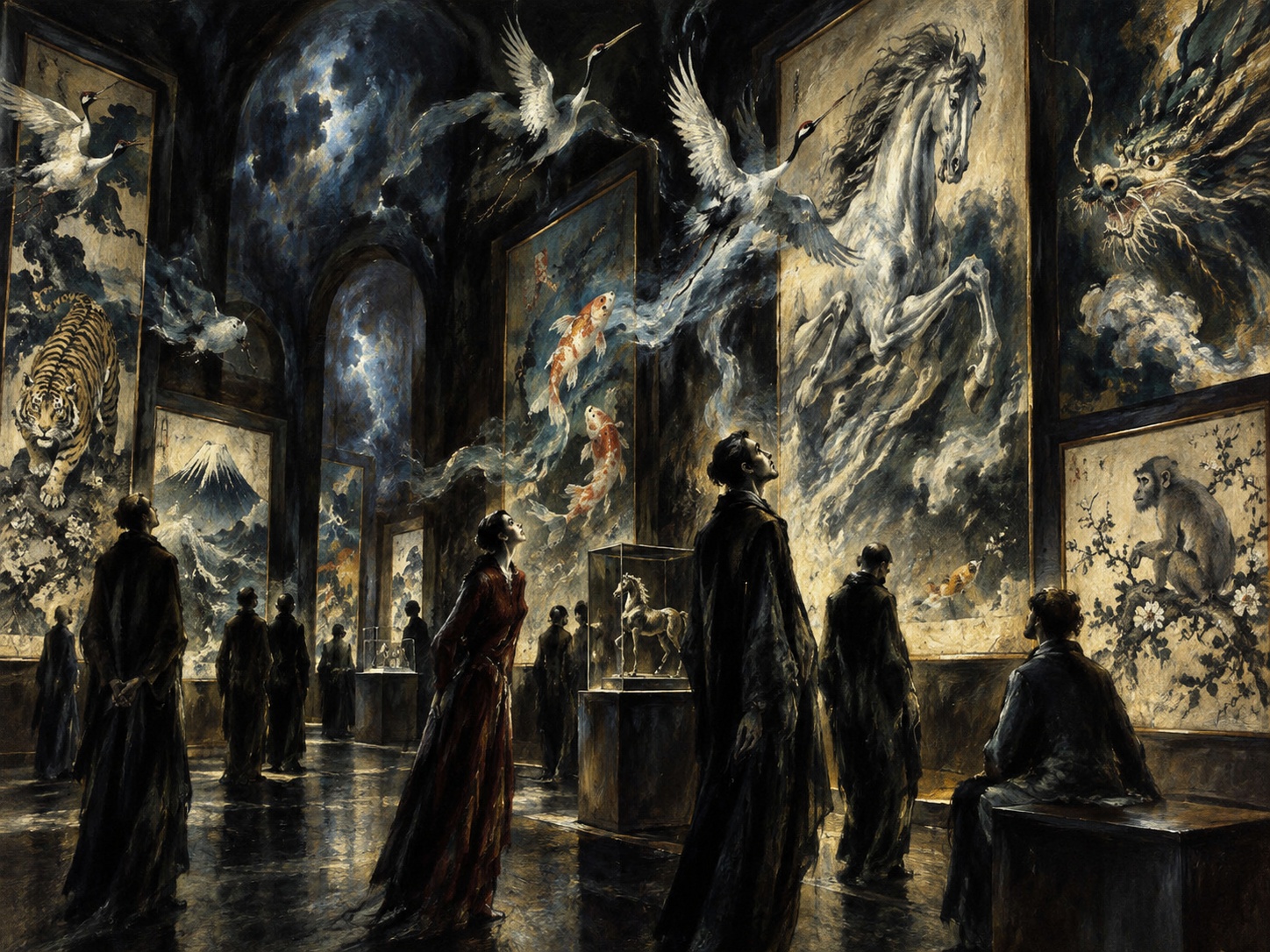
A cow drawn to understand its weight is not the same image as a tiger painted for auspicious power. A cat held in a woman’s arms can express intimacy; a rabbit cut into a dyeing stencil becomes a repeatable textile pattern. In Hokusai’s instructional books, fish and birds become things to observe and learn to draw. In a four-panel fusuma by Shiko Munakata, writing, brushwork, plants and living creatures occupy the same painted surface.
Kyoto Seika University Gallery Terra-S will bring those very different ways of seeing together from October 2 through November 9 in Animals Depictions: Kyoto Seika University Gallery Terra-S Collection Exhibition 2026. The free exhibition ranges across Western-style painting, Japanese painting, prints, craft, Ise katagami stencils, rubbings and other parts of the university collection, using animals as the connecting theme. Curator Mayumi Ito organized the exhibition.[1]
Announced artists include Takeji Asano, Kenichi Imai, Keinen Imao, Katsushika Hokusai, Tatsuhiro Kaneda, Kyosai Kawanabe, Bairei Kono, fourth-generation Rokubei Shimizu, Hiroshi Saito, Kunitaro Suda, Seiichi Tamura, Jiro Hashida, Bernard Leach, Isamu Fukui, Toshihide Migita, Shiko Munakata and Akira Yuri, among others.[1][2][3][4]
Hokusai and Munakata are both here — but not in the same medium
The presence of Katsushika Hokusai and Shiko Munakata immediately gives the exhibition two famous names associated with printmaking. That label, however, hides the more interesting comparison.
Kyoto Seika’s collection database lists two holdings described as recarved editions of Hokusai Manga, volumes one through fifteen.[2] The original series began with the first volume in 1814. The Sumida Hokusai Museum describes the complete work as containing about 3,900 images covering people, nature, gods, Buddhist figures, supernatural beings and almost anything else Hokusai thought worth drawing. Volume Two includes goldfish, medaka, gobies, loaches, anglerfish and flatfish, with birds, animals and plants organized around nearby pages.[5][6]
Kyoto Seika has not yet published which Hokusai volume or animal page will actually be shown in the 2026 exhibition. The existence of the university’s Hokusai Manga holdings does not justify inventing a specific display list.
Munakata is different. The gallery has specifically announced his 1952 work Hana Fukaki Tokoro Gyoseki Nashi. Kyoto Seika’s record of a 1998 Munakata exhibition identifies its version as color on paper across four fusuma panels; the current collection database classifies it as Japanese painting.[1][7][8]
Showing Munakata through a painted folding interior rather than a woodblock print makes the exhibition’s point before a visitor reads a label: animal imagery changes with the physical thing on which it is made.
| Item | Published information |
|---|---|
| Dates | October 2-November 9, 2026 |
| Hours | 11:00 a.m.-6:00 p.m.; 10:00 a.m.-6:00 p.m. on Oct. 4 |
| Closed | Sundays, except Oct. 4 and Nov. 1 |
| Venue | Kyoto Seika University Gallery Terra-S |
| Admission | Free |
| Media | Western-style and Japanese painting, prints, craft, Ise katagami, rubbings and other collection material |
| Curator | Mayumi Ito, Gallery Terra-S curator |
From a cow study to a woman holding a cat: Takeji Asano in depth
Two of the works already illustrated by the gallery are a drawing of a cow by Takeji Asano and his 1979 Woman Holding a Cat.[1]
Asano was born in Kyoto in 1900, studied Japanese painting at the Kyoto City School of Painting and moved toward woodblock printing around age 30. After his death, his family donated roughly 1,500 works to Kyoto Seika University. The online database now lists 1,518 Asano records, including studies and works involving birds, horses, shrimp and other animals.[9][10]
That depth matters. A museum can show one finished cat print and call Asano an animal artist. A university collection with more than 1,500 objects can instead show how an artist observed, sketched, simplified and reused living forms across decades.
On October 3, Kazue Fujimaki, chief curator at the Tottori Prefectural Museum of Art, will give a free lecture on Asano’s “free prints,” one of several programs attached to the exhibition.[1]
The university keeps living animal models on campus
Kyoto Seika’s relationship with animal drawing is not confined to historical collections. The university campus includes Rokuyauen, a deer enclosure whose animals serve as drawing models. An aviary keeps birds including cranes, golden pheasants and long-tailed fowl, and peacocks are also kept on campus for student drawing.[11]
Drawing a living animal is different from copying a photograph. The animal does not hold a pose. It shifts weight, turns its head, changes the angle of its legs and leaves. The artist has to understand motion, structure and balance quickly enough to make a useful mark.
The exhibition’s official description explicitly includes drawings made to capture animal movement. That makes the show not only a history of past images but an extension of how the university still teaches observation today.[1]
Japanese animal imagery has long allowed animals to act like people
In Kyoto, any long history of animal depiction quickly reaches the National Treasure Choju Jinbutsu Giga, the four scrolls preserved at Kozanji.
The Kyoto National Museum describes rabbits, monkeys and frogs in the first scroll behaving with strikingly human gestures. The second scroll ranges from familiar horses and cattle to imaginary beasts such as kirin, dragons and baku. The first two scrolls are associated with the Heian period, while the third and fourth are from the Kamakura period.[12][13]
It is wise to be cautious with the popular phrase “the origin of manga.” What the scrolls undeniably demonstrate is something more useful here: animals in Japanese art have long been able to carry human behavior, humor, rivalry and social observation.
The inclusion of Kyosai Kawanabe in Kyoto Seika’s exhibition extends that line into the nineteenth century. Kyosai trained first with Kuniyoshi Utagawa and later in the Kano school, then moved easily between formal painting and caricature, including wildly animated animals.[14][15]
Hokusai drew real creatures and animals that existed only in pictures
The Sumida Hokusai Museum’s 2019 exhibition Hokusai’s Animals emphasized just how wide Hokusai’s field was: realistic animals, affectionate or comic creatures, animal-shaped toys and designs, legendary beings and supernatural creatures could all become subjects.[16]
A later exhibition on birds documented a related pattern. Hokusai’s large- and medium-format flower-and-bird prints of the Tenpo era helped establish that subject within color woodblock publishing. His instructional books mix birds found in Japan, imported species and creatures known through stories or inherited visual knowledge.[17]
The distinction between natural-history observation and imaginative image-making was therefore porous. To draw an animal could mean recording what stood in front of the artist, reproducing a pattern, teaching a pupil, illustrating a story or giving visible form to something that had never existed.
Keinen Imao and the modern pressure to look more closely
Kyoto Seika’s description includes “modern animal picture books” in which greater realism was expected, and the artist list includes Kyoto-born painter Keinen Imao, 1845-1924.[1][18]
Imao became known for flower-and-bird painting. The Aichi Prefectural Museum of Art, for example, holds works combining birds with irises, rocks and chrysanthemums.[18]
In the Meiji era, older painting manuals and flower-and-bird conventions met new demands associated with natural history, observation and modern art education. Animal picture books could function as art, reference material and teaching tools at once.
Placing drawing studies beside finished pictures lets viewers see something exhibitions often hide: the labor of learning how a body is constructed before an artist decides how much to simplify it.
A rabbit becomes a stencil rather than a picture
One of the announced works has no named artist or date: Dyeing Stencil: Waves and Rabbit.[1]
Here the animal is not painted for a frame. It is cut out of paper so that the image can be transferred to cloth.
Ise katagami are dyeing stencils made by cutting patterns into specially prepared persimmon-tannin paper. Mie Prefecture explains that the technology flourished in the Edo period around Shiroko and Jike in present-day Suzuka. Its principal techniques include push cutting, stripe cutting, punch cutting and tool cutting. The production technology was designated an Important Intangible Cultural Property in 1993.[19]
A rabbit’s ear and back have to be translated into positive and negative space that will survive cutting and repeated dye work. The physical logic of the tool changes the drawing.
On November 7, senior cultural-property specialist Yuki Ikuta of Japan’s Agency for Cultural Affairs will give a lecture on reading katagami through research in Japan and abroad.[1] That a stencil lecture sits inside an animal exhibition demonstrates how far Terra-S has expanded the idea of “depiction.”
Tigers, cranes and turtles carry wishes as well as anatomy
The gallery says another section will consider animals such as tigers, cranes and turtles used with auspicious meanings.[1]
In Japanese painting and craft, animals are rarely neutral biological specimens. Their meanings can depend on season, poetry, religion, patronage and occasion. Cranes and turtles evoke longevity; powerful beasts may carry protective or authoritative meanings; rabbits can be connected to the moon as well as decorative pattern; horses may signal labor, travel, martial identity or sacred offering.
The Kyoto National Museum’s holdings range from animal study scrolls and hawk paintings to zodiac imagery and animal-decorated lacquer. Its late-2026 schedule even includes an exhibition devoted specifically to animals in maki-e lacquer.[20][21]
To study animals in art is therefore also to study what human beings wanted those animals to mean.
A pair of Chinese cats complicates the category “Japanese art”
The announced display also includes an undated Chinese New Year print described as Pair of Cats.[1] Kyoto Seika’s database contains about 90 Chinese New Year print records, including images involving cattle, dogs, cranes, deer and other animals.[22]
That matters in a university exhibition otherwise full of familiar Japanese names. East Asian animal imagery did not develop inside modern national borders. Printed images, textile patterns, auspicious signs and visual formulas circulated through trade and popular culture.
Showing a folk print beside Hokusai, Munakata and modern painters also disturbs a museum hierarchy. Reproducible images made for household use can carry as much information about how societies imagined animals as a signed “masterpiece.”
The exhibition is also the second stage of a collection revival
Kyoto Seika’s collection numbers roughly 12,000 objects and documents across Western-style and Japanese painting, prints, sculpture, craft, design, manga, Ise katagami, rubbings and calligraphy.[23]
Collection building from 1980 through 2017 emphasized work by retiring faculty and active graduates, objects shown in university exhibitions and material useful to both art and humanities education. The result is not a conventional art-history survey but a teaching collection with unusual concentrations and overlaps.[24]
The university’s earlier Gallery Fleur opened in 1997 and closed for renovation in 2020. Gallery Terra-S opened in 2022. Beginning in fiscal 2025, collection care and the creation of new opportunities to exhibit holdings became a formal part of the gallery’s mission. The late-2025 exhibition Masterpieces Awakened was Terra-S’s first major collection show under that mandate; Animals Depictions is the second.[23][25][26]
Owning 12,000 objects is easier than making them visible responsibly
A university may possess an object for decades without students or the public seeing it. Works on paper, textiles, prints and fusuma are also sensitive to light, humidity and handling; “put everything on view” is not responsible collection management.
Terra-S said in March that it is reorganizing storage conditions, planning storage-room improvements and carrying out conservation and restoration in stages. It has also begun regular permanent-collection presentations in a smaller exhibition room.[25]
The value of a collection exhibition is therefore not simply the thrill of bringing a famous name out of storage. Re-curating thousands of objects around a new theme lets things that were catalogued separately begin to speak to one another.
In this case a Hokusai instructional book, a Munakata fusuma, an Asano cow study, an anonymous rabbit stencil and an anonymous Chinese cat print become neighbors because of one word: animals.
Looking at animal pictures means looking at how humans see
Animal art can appear immediately legible. A dog is a dog; a cat is a cat; a cow is a cow.
But the form changes with purpose. A drawing manual clarifies structure. An auspicious image intensifies symbolic meaning. A stencil must survive cutting. A caricature borrows human gestures. A sketch tries to catch a shifting center of gravity.
The more useful question is therefore not only “what animal is this?” It is “why did this medium require the animal to look this way?”
One Hokusai detail remains deliberately unresolved
As of September 14, the exhibition page names Hokusai among the participating artists but its illustrated list of eight planned works does not identify a specific Hokusai volume or page.[1]
The university database confirms two holdings of recarved editions covering all fifteen volumes of Hokusai Manga.[2] That makes the books relevant collection context, but it does not establish the exact display.
The gallery also warns that dates, hours and content may change. The responsible description is therefore simple: Hokusai is an announced exhibiting artist; the precise animal page has not yet been publicly specified.
From an exhibition of animals to an exhibition of looking
Japan.co.jp’s analysis is that the strongest question at Terra-S will not be whether Hokusai or Munakata is the larger name.
Hokusai put fish and birds into an encyclopedia of drawing. Asano studied the physical body of a cow and placed a cat in human arms. A stencil cutter transformed a rabbit into negative space for textile dyeing. A Chinese printmaker paired cats for household display. Modern painters used observation and anatomy; other artists made tigers, cranes and turtles carry inherited wishes.
And at Kyoto Seika today, students still draw living deer and birds on campus.
The animals may appear timeless. What changes is the human purpose directed toward them.
What will fill Gallery Terra-S in October is therefore more than a menagerie. It is a collection of ways of looking — accumulated across eras, techniques and roughly 12,000 university holdings.
Sources & Reference Material
- Kyoto Seika University Gallery Terra-S, Animals Depictions: Collection Exhibition 2026
- Kyoto Seika University Gallery Terra-S collection database, Katsushika Hokusai
- Kyoto Seika University Gallery Terra-S collection database, Shiko Munakata
- Kyoto Seika University Gallery Terra-S collection database, creator index
- Sumida Hokusai Museum, Hokusai Manga Volume One
- Sumida Hokusai Museum, Hokusai Manga Volume Two
- Kyoto Seika University Gallery Terra-S, 1998 Shiko Munakata hand-painted works exhibition
- Munakata Shiko Memorial Museum of Art, museum and principal works archive
- Kyoto Seika University Gallery Terra-S, 2026 permanent exhibition: Takeji Asano
- Kyoto Seika University Gallery Terra-S collection database, Takeji Asano
- Kyoto Seika University, Animals on Campus — deer, aviary and peacocks used as drawing models
- Kyoto National Museum, National Treasure Choju Jinbutsu Giga and Kozanji
- Kyoto National Museum, learning guide to Choju Jinbutsu Giga
- National Museum of Modern Art, Kyoto, collection database: Kyosai Kawanabe
- Tsuruga City Museum collection database: Kyosai Kawanabe biography
- Sumida Hokusai Museum, Hokusai’s Animals
- Sumida Hokusai Museum, Hokusai Bird Park
- Aichi Prefectural Museum of Art collection database: Keinen Imao
- Mie Prefecture, Ise Katagami — Important Intangible Cultural Property
- Kyoto National Museum, animal study scrolls and bird paintings in the collection gallery
- Kyoto National Museum, exhibition schedule including animals in maki-e lacquer
- Kyoto Seika University Gallery Terra-S collection database, Chinese New Year prints
- Kyoto Seika University Gallery Terra-S, Masterpieces Awakened: Collection Exhibition 2025
- Kyoto Seika University Gallery Terra-S, collection history and acquisition policy
- Kyoto Seika University Gallery Terra-S, fiscal 2026 collection-care and exhibition mission
- Kyoto Seika University Gallery Terra-S, gallery history
Sources checked through September 14, 2026. The official exhibition page names Katsushika Hokusai as an exhibiting artist, but the eight currently illustrated planned works do not identify a specific Hokusai title, volume or page. Kyoto Seika's collection database lists two recarved-edition sets covering Hokusai Manga volumes 1-15; that collection record is not treated as confirmation of the precise exhibition page. Shiko Munakata's 1952 Hana Fukaki Tokoro Gyoseki Nashi is explicitly listed for the 2026 exhibition and is described as color on paper across four fusuma panels using Kyoto Seika's 1998 exhibition record. No authorship or date is inferred for works that the gallery lists as unknown. Analysis is by Japan.co.jp.