The measure of renewal is not the size of the crowd, but whether makers can build a future.
A market attempts to become an institution
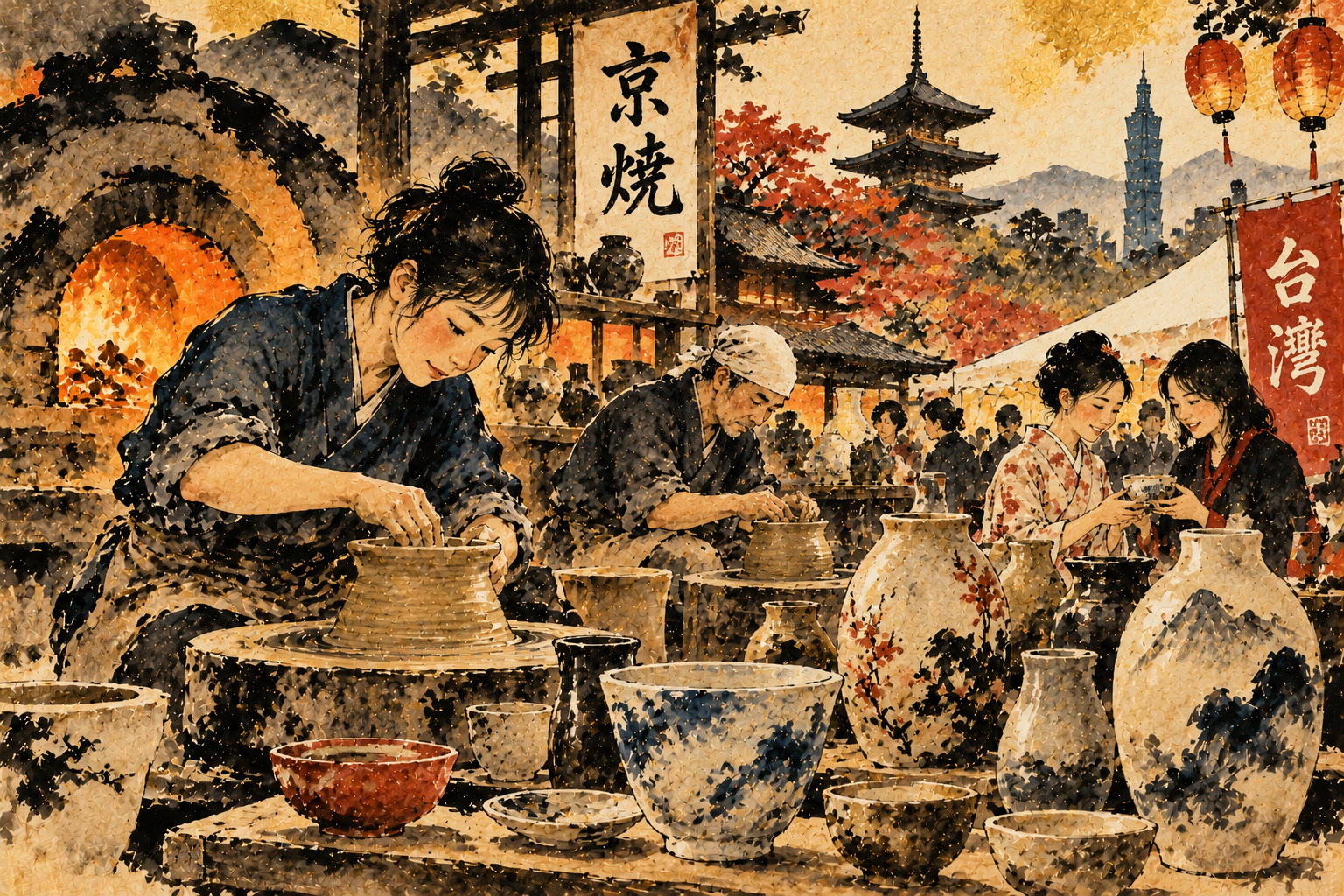
For half a century, autumn has brought pottery buyers to Yamashina, a part of Kyoto that rarely leads international travel itineraries. In 2026 the fair born in 1975 as the Kiyomizu-yaki Village Festival has acquired a new name: KYOPO, short for Kyoto Pottery Expo. Its fiftieth edition was scheduled for October 16–18 across the Kiyomizu-yaki industrial district. The transformation matters less as a branding exercise than as an experiment in the economics of keeping a craft community alive.
Organizers promised a Taiwanese exchange program, hands-on learning for children and a theatrical contest among potters. They have also announced another market for spring 2027. But the festival’s completion, visitor count and receipts are not independently established in the available sources as of this report’s research cutoff. The event programs described here come from organizer announcements, not eyewitness observations.
Kyoto ceramics are not one type of blue-and-white souvenir
Kyō-yaki and Kiyomizu-yaki describe a family of techniques and traditions, rather than a single fixed appearance. Kyoto Prefecture and craft-industry bodies document tea vessels, richly painted earthenware, porcelain, tableware and objects made in numerous workshops. A kiln’s distinctive glaze or brushwork can be its competitive advantage, but variety makes mass-production economies harder to achieve.
Kyoto’s ceramic heritage is inseparable from tea practice, temple culture and the demand created by an old capital. The celebrated seventeenth-century potter Nonomura Ninsei elevated overglaze painted wares; Ogata Kenzan brought inventive decoration to functional forms. Later innovators, including Okuda Eisen and Aoki Mokubei, developed porcelain and other approaches influenced in part by Chinese literati culture. The important historical pattern is reinvention, not perfect preservation of one immutable style.
Why the workshops moved
The present-day ceramics village in Yamashina embodies an industrial decision. As kiln work became harder to accommodate in old urban neighborhoods and production networks evolved, a concentration of workshops and related businesses developed in Yamashina during the 1960s, according to KYOPO’s history. The area brings together makers, wholesalers and companies supplying the craft. The festival therefore opens a functioning production district to outsiders.
For visitors, this can change the relationship with an object: the cup is no longer merely merchandise behind glass. It is a made thing whose clay, firing, decoration, labor and price invite questions. That perspective may be more valuable for future customers than any discount at a three-day fair.
The economics behind the fiftieth edition
Organizers reported roughly 48,000 visitors to the 2025 festival—the highest since the pandemic—but that is their figure and has not been independently audited here. They also described more than 100 sellers and craft businesses in the 2026 event, and issued inconsistent totals of 155 and 159 booths. A precise reconciled booth count is therefore not presented as fact.
The new association is led by representative director Takayuki Izumi (泉孝之). KYOPO says its name brings together Kyoto, people, pottery and potential. What would meaningful success look like? More young makers earning a sustainable living, sales relationships that continue after October, new collectors who understand the work, and a district able to maintain kilns, materials suppliers and skilled labor. Visitor numbers alone cannot answer those questions.
Why the Taiwan invitation matters
The festival’s new KYOPO INTERNATIONAL initiative invited two Taiwan-based ceramic organizations: chin chin pottery (青青土氣) and Tu Xing studio (土星工作室). According to the association, the former concentrates on approachable objects for everyday use; the latter’s work draws on research into Taiwanese soils. That is a more intriguing cultural exchange than a generic overseas sales booth. It sets up a conversation about regional earth, family dining, material experimentation and how studios reach customers.
There is an important reporting boundary. The confirmed news is their announced participation in the program. We have not independently verified which objects were sold, the number of visitors they met, any revenue, or whether a lasting collaboration has resulted. Internationalization should be judged by durable ties, not merely foreign names on a participant list.
Making skilled labor visible
One of the cleverest festival concepts is KYOPO CUP. The announced tests include throwing the tallest form, producing multiple small drinking vessels and fashioning a broad plate from eight kilograms of clay. These are contests, not standardized measures of professional excellence, but they make invisible skills legible to spectators: pressure of the fingers, centering, time, water and the judgment needed to prevent collapse.
A separate KYOPO PLAY program planned clay activities, painting and electric-wheel experiences for children, with students from Kyoto Tachibana University helping to operate it. Such activities do not prove that a participant will become a potter. They do provide a first tactile encounter with a craft increasingly experienced only through finished products and photographs.
A marketplace cannot carry the whole industry
Japan’s designated traditional crafts face structural pressures: training time, rising production costs, limited workshop space, distribution, changing household tastes and the difficulty of charging prices that fairly compensate skilled labor. Government and trade organizations have long treated demand development as an essential part of revitalization. A Ministry of Economy, Trade and Industry–recognized plan for Kyō-yaki and Kiyomizu-yaki includes demand-development activity.
There is no verified basis to conclude that the 2026 relaunch has solved any of these problems. A festival may introduce visitors to a craft; it cannot, by itself, provide affordable workshops, apprenticeships, business succession and consistent orders. The distinction between publicity and measurable industry renewal is the central test for KYOPO.
The next experiment arrives in spring
On October 13 the association announced a proposed March 2027 event at Okazaki Park near Heian Shrine. Provisionally called Spring KYOPO: Tableware and Food Market, it aims to connect the experience of eating with the people who make the vessels. This would extend the fair’s contact with consumers across the year and move beyond the production district, while retaining Yamashina as the autumn anchor.
As with all future event plans, the announced date and venue do not demonstrate that the market will take place or succeed. The interesting question is whether buyers who discover handmade pottery in Okazaki subsequently visit workshops in Yamashina, commission work or become repeat customers.
The meaning of a vessel
The value of a handmade bowl cannot be reduced to nostalgia. It embodies choices about local material, energy, craft training, aesthetic risk and how a household uses an object every day. KYOPO has placed these questions in public view at a moment when Japanese traditional industries need new audiences and dependable markets.
If this anniversary produces more than a memorable weekend—new makers, enduring cross-border partnerships and a viable next generation of workshops—it may offer a model for other craft districts. If it produces only crowds, the transformation will remain unfinished. The fiftieth edition is best understood as the start of a test, not its successful conclusion.
Reporting note: Based on public records available through October 17, 2026. Final event outcomes and attendance were not independently confirmed. Organizer statements differ between 155 and 159 booths; neither is treated as a reconciled final count.
Sources and further reading
- KYOPO official event website
- KYOPO September 18 organizing statement
- KYOPO October 13 expansion announcement
- Kyoto City Tourism official event listing
- Kyoto Prefecture: Kyō-yaki and Kiyomizu-yaki
- Kyoto ceramics wholesalers association: History
- Kyoto Traditional Crafts: Kyō-yaki / Kiyomizu-yaki
- Kyoto Traditional Industry Future Construction project
- METI traditional crafts industry revitalization plan