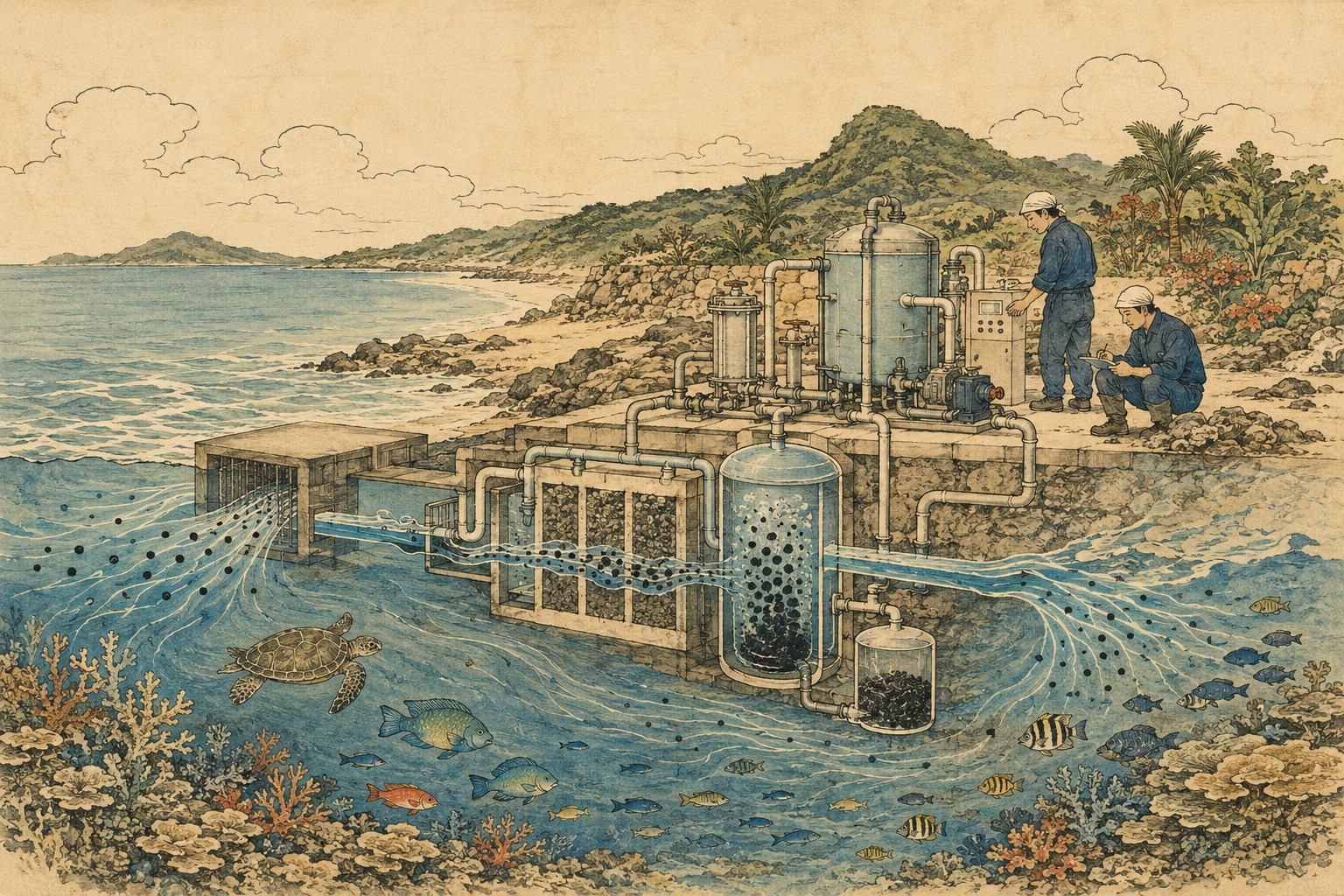
On Kumejima’s eastern shore, seawater has been treated as an economy in motion for a quarter of a century. Cold water is drawn from the deep. Its temperature difference with warm surface water generates electricity. Afterward, the same water moves into aquaculture, agriculture and research. The ambition is to extract several kinds of value from one carefully measured flow.
A metal container may soon join that landscape. Hitachi, Mitsui O.S.K. Lines, or MOL, and Japan Airlines plan to bring technology developed by California-based Captura Corp. to this Okinawan island. The system will take in seawater, convert part of its dissolved inorganic carbon into a recoverable stream of carbon dioxide gas and send treated water back toward the sea.
The attraction is immediate. If seawater holds carbon at a much higher volumetric concentration than air, perhaps existing coastal water systems can do some of the work otherwise assigned to giant fans in direct air capture plants. But producing CO₂ at the outlet of a container is not the same as proving that the atmosphere contains less CO₂. Between those events lies a chain of evidence: air-sea exchange, energy emissions, ecological effects, carbon accounting and the ultimate fate of the captured molecule.
The Announcement—and the Empty Spaces Around It
The joint release is specific about configuration and responsibility. The equipment will be containerized and installed on land. It will draw real seawater from around Kumejima, separate CO₂ and discharge the water. The purpose is to determine whether the technology works with local seawater and to obtain baseline information on operational problems and environmental effects before deployment elsewhere along Japan’s coast.
The companies also describe possible local uses for the recovered gas, public education and a contribution to the blue economy. Yet the announcement offers no quantity against which to judge those ambitions. There is no stated throughput, capture rate, energy intensity or operating schedule. Nor does it say whether the gas produced in this test will be stored, converted, consumed by a local business or released after measurement.
| Confirmed in the joint release | Not established as of August 12 |
|---|---|
| Land-based container unit using a real seawater intake and discharge | Operating start, completion date and continuous run time |
| Application of Captura’s DOC technology in Japan | Annual capture capacity, seawater flow and extraction efficiency |
| Plans to measure DIC, pH, captured CO₂ and electricity | Energy per ton, lifecycle emissions and cost per ton |
| Study of operating issues and environmental effects | Intake and outfall locations, mixing conditions, permits and monitoring radius |
| Consideration of local use and future E-SAF | The actual storage, use or transport route for this pilot’s CO₂ |
That list is not an indictment. A pilot exists to replace unknowns with measurements. The distinction matters because phrases such as “first in Japan,” “low cost” and “low energy” can make projected performance sound like a result. The precise statement today is narrower: the partners have agreed on a framework and intend to test it under Japanese coastal conditions.
Carbon in the Ocean Is Not Waiting as a Layer of Bubbles
Understanding DOC begins with a chemical correction. Carbon in seawater is not present only as molecular CO₂. The dissolved inorganic carbon, or DIC, measured by the U.S. National Oceanic and Atmospheric Administration consists of three principal forms: dissolved CO₂, bicarbonate and carbonate. At ordinary seawater pH, most is bicarbonate. Their proportions shift with pH, temperature, salinity and pressure.
When atmospheric CO₂ dissolves at the surface, some forms carbonic acid and moves into bicarbonate and carbonate. This buffer helps the ocean absorb roughly a quarter to a third of humanity’s emissions, while the accompanying increase in hydrogen ions drives ocean acidification. Direct ocean capture intervenes in this reversible system.
Captura’s design combines bipolar-membrane electrodialysis with gas extraction. Caltech’s account of the process says a small fraction of the water flow passes through the membrane system, which generates acidic and alkaline streams from water itself. The acidic component shifts bicarbonate in the larger flow toward dissolved molecular CO₂, which can then be separated as gas. The decarbonized water is recombined with the alkaline component before return. Captura says the process uses seawater and renewable electricity, with no chemical additives or waste by-products.
The returned water contains less DIC and therefore has capacity, relative to the atmosphere, to absorb more CO₂. After it mixes and reaches the surface, gas exchange should move carbon from the air into the water until equilibrium is restored. This is both DOC’s advantage over direct air capture and its accounting problem. The captured gas is measurable inside a plant. The compensating atmospheric drawdown unfolds later, across a moving and naturally variable sea surface.
- The plant: Captured-gas mass, seawater flow and extraction efficiency.
- The ocean: Where treated water travels and how much additional air-to-sea uptake occurs against a baseline.
- The lifecycle: Emissions from power, membranes, pumping, compression, transport and storage.
- The destination: Whether the carbon is durably stored or returned through fuel and short-lived products.
Kumejima Was Not Chosen Overnight
The island’s ocean-technology history began long before this MOU. The Okinawa Prefectural Deep Sea Water Research Center has operated on Kumejima since 2000. Okinawa Prefecture records describe water drawn from a depth of 612 meters at roughly 13,000 tons per day. Cold, nutrient-rich and largely beyond sunlight, it has supported products ranging from salt and beverages to cosmetics, shrimp and sea-grape aquaculture.
In April 2013, Okinawa’s ocean thermal energy conversion demonstration began operating on the site. OTEC uses the roughly 20°C difference between warm surface seawater and deep water—listed at about 9.5°C at the facility—to evaporate and condense a low-boiling working fluid and turn a turbine. It generates power without combustion. In fiscal 2016, infrastructure was added to route post-generation seawater into local industries rather than treat it as a one-use waste stream.
That cascade is the core of the “Kumejima Model”: energy, seawater, aquaculture, industry and employment designed as a linked system. MOL joined operation of the island’s 100-kilowatt-class OTEC demonstration in April 2022. In October 2025, it signed a comprehensive cooperation agreement with Kumejima Town covering a one-megawatt-class OTEC intake system, DOC, industrial tourism and workforce issues. The town’s stated goal is to supply all energy consumed on the island from renewables by 2040.
Kumejima, then, offers more than proximity to blue water. It has intake infrastructure, monitoring experience and a local practice of passing seawater from one use to the next. There is a revealing parallel in Kona, Hawaii, where Captura began operating a 1,000-ton-per-year pilot in 2025: it too is an ocean-technology park organized around deep-seawater infrastructure. Kumejima and Kona are not remote margins. They are dense junctions in the practical history of seawater engineering.
2000 Okinawa’s Deep Sea Water Research Center begins operating on Kumejima.
April 2013 The island’s OTEC demonstration starts.
FY2016 Equipment is added to send post-OTEC seawater into local industries.
Around 2021 Captura is launched from Caltech research.
2022 Captura operates a 1-ton-per-year unit and wins a $1 million XPRIZE award; MOL joins Kumejima’s OTEC operation.
2023 A 100-ton-per-year Captura unit operates at AltaSea in the Port of Los Angeles.
February 2025 Captura starts its 1,000-ton-per-year pilot in Kona.
October 2025 MOL and Kumejima Town sign a broad cooperation agreement.
August 4, 2026 Hitachi, MOL and JAL announce the Japan pilot MOU.
From a Caltech Membrane to Los Angeles, Hawaii and Okinawa
Captura grew from work by Caltech professor Harry Atwater, research professor Chengxiang “CX” Xiang and colleagues. One origin lay in research on converting CO₂ into fuels and other products. Scaling that work raised a prior question: where could an enormous, continuous supply of carbon come from? Capturing a smokestack can prevent new emissions, but it does not remove accumulated carbon from the environment. The team instead turned to the ocean as a giant reservoir in equilibrium with the atmosphere.
The company advanced through deliberately larger systems: a one-ton-per-year unit at Caltech’s Kerckhoff Marine Laboratory in Newport Beach in 2022; a 100-ton-per-year system at AltaSea in the Port of Los Angeles in 2023; and the 1,000-ton-per-year plant in Kona in February 2025. Captura and Equinor said in November 2025 that they had completed a year-long qualification program against 20 performance measures, including safety, stability, capture efficiency and MRV. Captura is now designing an initial commercial plant in the 30,000-to-50,000-ton range.
None of that establishes the capacity of Kumejima’s unit. The companies have not said it will replicate the Kona plant, and there is no basis for assigning it a 1,000-ton figure. Japanese coastal chemistry, typhoons, salt damage, grid conditions, land, discharge rules and industrial connections differ. The value of technology transfer is not the importation of a foreign headline number. It is the discovery of operating conditions that can be reproduced in Japan.
Three Companies Sketch One Carbon Economy
Hitachi leads the project. Hitachi High-Tech instruments will measure operating conditions, DIC, pH and environmental data. The group says “physical AI” will feed analysis back into plant control to find more energy-efficient operating conditions. Captured volume and electricity data are intended to support an MRV platform, while Hitachi Industrial Products studies core equipment for commercial plants. The company is cast as both machine operator and custodian of credible numbers.
MOL connects the plant to the sea and community. It will use relationships built through the town agreement and OTEC work to prepare the site and organize cooperation with local stakeholders. MOL is also an investor in Captura and has separately agreed to buy carbon-removal credits from it, giving the shipping group several roles: investor, prospective buyer and developer of ocean projects.
JAL will work with Japan Transocean Air and Ryukyu Air Commuter, both serving Kumejima, on public communication and regional partnerships. It will also evaluate captured CO₂ as a future feedstock for electro-sustainable aviation fuel, or E-SAF. The presence of a shipping line and airline is not accidental. Both operate in sectors where batteries alone cannot readily eliminate every long-distance emission.
That alignment also makes conflict-of-interest safeguards essential. Members of the same coalition are investors in the developer, operators of the test and potential users of credits or fuel. Independent verification, public methods and accessible data are therefore not decorative transparency. They are how a consortium prevents its own commercial enthusiasm from becoming its proof.
What Must Be Measured Beside the Outfall
Captura says its system requires no additives, adds no new chemicals to the ocean and creates no waste by-products. That is a meaningful design claim, especially compared with electrochemical routes that must handle excess acid or gases such as chlorine. But “nothing added” does not mean “nothing changed.” Removing carbon lowers DIC, the treatment creates a pH swing, intake structures can entrain plankton and larvae, and outfall effects depend on flow, temperature, salinity, pH and mixing.
A 2025 Captura report modeled a roughly 20,000-ton-per-year system in Southern California and estimated that additional atmospheric uptake in the first year could equal 65% to 98% of the amount extracted by the machine. That was a preliminary company model, did not deduct process emissions and cannot simply be transferred to Kumejima. Company-sponsored exposure tests on mussels, fish larvae and kelp spores found no significant effects, but Captura itself said longer, larger studies using the full effluent composition remained necessary and described future peer-reviewed publication as a next step.
The U.S. National Academies’ ocean-carbon-removal research strategy reaches a sober middle ground. The underlying electrochemistry is established, but the knowledge base for climate-scale application remains low to medium. Potential could be large. So could power and water requirements, monitoring costs and uncertainty about impacts around discharge zones and downstream. A reassuring tank test is a beginning; it is not the final verdict for an island coast with reefs, fisheries and seasonal extremes.
- DIC, pH, total alkalinity, temperature, salinity and dissolved oxygen before treatment, at discharge, through the mixing zone and at control sites.
- Water flow, extraction fraction, dilution and changes in dispersion across tides, seasons and typhoon conditions.
- Acute and chronic effects on plankton, fish eggs and larvae, coral, algae and benthic life.
- Instrument calibration, missing data, model uncertainty and the findings of independent reviewers.
The Hardest Measurement Is a World That Did Not Happen
Measuring a stream of purified CO₂ at the plant is comparatively straightforward. The difficult quantity is the counterfactual: what would the ocean and atmosphere have exchanged if the DOC plant had not existed? Depending on place and season, the sea can absorb CO₂ or release it. Currents, wind, surface temperature, biology, freshwater and typhoons move the baseline. If treated water sinks before returning to the surface, re-equilibration may be delayed.
MRV—measurement or monitoring, reporting and verification—is therefore part of the science, not a clerical attachment. The captured amount must be translated into additional atmospheric uptake using observations and models. Emissions from power, materials, transport, compression and storage must be subtracted. Natural absorption must not be sold as project-caused removal. Uncertainty needs to be reported and ledgers corrected as better evidence arrives. Hitachi’s plan to measure captured gas and electricity while feeding DIC and pH data into operations addresses the right problem.
The ledger also has a social column. Who owns the removed carbon? Does credit revenue return to the island? Will fishers help design monitoring? Who has authority to stop the system when readings move outside limits? A blue economy is not merely a collection of businesses near water. It includes governance that protects ocean health and local livelihoods while value is extracted.
E-SAF Matters, but It Is Not Permanent Removal
The partners’ long-range picture is an island-based, domestically supplied carbon economy in which recovered CO₂ combines with renewable hydrogen to make synthetic fuels such as E-SAF. For aviation, replacing newly extracted fossil carbon with captured carbon in a liquid fuel compatible with existing aircraft could be consequential. It may reduce dependence on imported petroleum and circulate the same carbon atom.
But when an aircraft burns that fuel, the CO₂ returns to the atmosphere. If renewable power, hydrogen production, synthesis and transport are managed well, the fuel may produce much lower lifecycle emissions than conventional jet fuel. It is still not the same as isolating carbon for centuries. The difference is fundamental to the value and integrity of a carbon-removal credit.
| Destination for captured CO₂ | Principal climate value | Accounting caution |
|---|---|---|
| Qualified geological storage | Can create long-term atmospheric removal after lifecycle emissions | Requires transport, injection, leakage monitoring and storage rights |
| E-SAF or synthetic fuel | Can displace newly extracted fossil carbon with recycled carbon | Combustion returns CO₂; it belongs in a fuel ledger, not permanent-removal totals |
| Greenhouses, aquaculture or beverages | May replace fossil-sourced industrial CO₂ locally | Most uses release carbon quickly and markets are limited |
| Minerals or durable products | May provide longer storage depending on chemistry and product life | Added processing, volume, quality and end-of-life must be verified |
Kumejima should therefore keep separate accounts. Gas sent to storage, gas placed in fuel, gas used briefly and emissions created by the process should not collapse into one “removal” number. Giving E-SAF its correct name does not diminish its potential. Accurate classification protects confidence in both the fuel and the removal claim.
Success Will Be More Than the First Ton
The first visible stream of CO₂ from the container will make an appealing milestone. The more valuable outcome may be a less dramatic set of operating records: how salt and biofouling change membrane performance; how power demand shifts by season and after typhoons; where discharged water mixes and where pH and DIC return to background; how instruments drift during continuous use; and what net removal remains when the island’s actual electricity is counted.
A successful pilot should publish failures as well as uptime. Membrane replacements, pump trips, off-spec discharge, missing observations and disagreements between models and measurements can save the next coastal project from repeating the same expense. Early involvement of regulators, fishers, residents and independent environmental scientists can also prevent a project developer’s self-declaration of safety from becoming the only public record.
Kumejima’s greatest resource may not be seawater alone. It is the institutional memory built by 25 years of drawing, measuring, generating with and reusing that water. If DOC joins the cascade, the island could become a place where intake, power, carbon, products and discharge are tested within one transparent material balance—not merely a scenic test site.
“Drawing carbon from the sea” sounds almost like folklore. What this demonstration owes the public is the opposite of magic: open flow meters, calibrated sensors, mapped mixing zones, independent checks and a traceable destination for each recovered molecule. Only when that chain closes does a machine that separates CO₂ become a system that can credibly claim to reduce it in the atmosphere.
Reporting Notes and Principal Sources
This article uses public information available through August 12, 2026 at 9:18 AM JST. It does not infer a start date, capacity, flow, cost, energy intensity, discharge condition or final CO₂ destination that the joint announcement did not provide. “Japan’s first” is the partners’ defined claim for a DOC pilot connected to an intake that draws, processes and discharges water from an actual sea area. Captura’s performance and environmental figures are identified as company research, not treated as independently established universal results.
- Hitachi, MOL and JAL: MOU for Japan’s first field-connected DOC pilot, August 4, 2026
- Joint announcement in Japanese
- MOL and Kumejima Town: Comprehensive cooperation agreement, October 28, 2025
- MOL: Participation in Kumejima’s 100-kilowatt-class OTEC demonstration
- Okinawa OTEC Demonstration Facility: Project overview
- Okinawa OTEC: Cascaded uses of deep seawater
- Okinawa Prefecture: Marine-resource use and support-base feasibility study
- Captura: Technology and pilot chronology
- Caltech: Captura’s origins and electrochemical pH swing
- Captura: Start of the 1,000-ton-per-year Hawaii pilot
- Captura and Equinor: 2025 technology qualification
- Captura: 2025 ocean-health and MRV research update
- NOAA Ocean Acidification Program: The three principal forms of DIC
- U.S. National Academies: Ocean-based carbon-removal research strategy overview