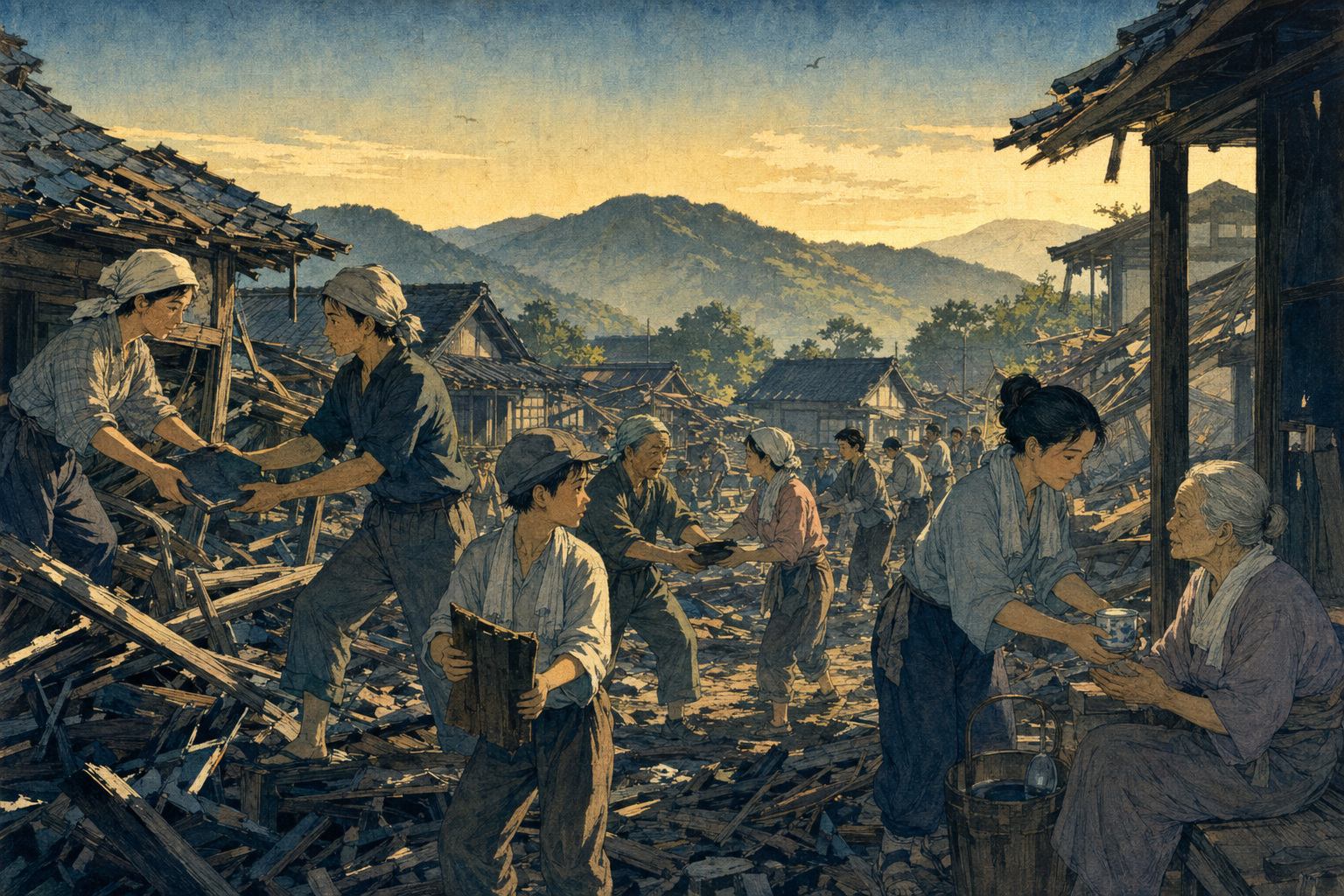
On August 13, the first day of month-late Obon, the disaster volunteer center in Uki City posted a short notice: it had ended participation intake for the day. Many volunteers had come, the city social welfare council said, and there would be no afternoon reception.
There was no cinematic tally and no speech about sacrifice. The notice did not tell us who had postponed a family visit, who lived around the corner, who had driven from elsewhere in Kyushu or who had returned home to Kumamoto and decided to spend a day helping strangers. It documented something smaller and more reliable: at the start of Japan’s great season of homecoming, the local system had received all the helping hands it could responsibly place that day.
In Yatsushiro, the first volunteer registration period ran from August 10 through 16. Organizers reported many inquiries from groups around Japan and created a separate procedure for teams of five or more. The work list was bluntly domestic: clean inside homes, carry out furniture and household goods, remove fallen block walls where the task was judged light enough, and do other non-specialist work. The day was scheduled to end around 3:00 PM. Volunteers were told to bring their own food, water, protective clothing and, because working toilets could not be assumed, a portable toilet.
This is what the phrase “spending Obon volunteering” means in practice. It is not simply a person with a shovel appearing beside a ruin. It is a holiday day transferred from one household to another, then disciplined by registration, insurance, road capacity, heat, aftershocks, the resident’s wishes and the number of safe tasks a center can match.
A Holiday That Is Not a Legal Holiday
Obon occupies a peculiar place in Japanese time. It is one of the country’s most consequential travel and family seasons, but it is not among the 16 national holidays established by law. In August 2026, the statutory holiday was Mountain Day on August 11. Custom, employer calendars and family obligation did the rest, turning the days around August 13–16 into a practical national pause for many workers.
The observance joins Buddhist memorial traditions to local household customs. Across much of Japan, families return to ancestral homes, clean graves, prepare offerings and mark the arrival and departure of the dead. Trains and expressways describe this movement as a “return rush.” The language is revealing: Obon is an act of going back.
The volunteers in Kumamoto did not necessarily reject that logic. Some may have been local residents helping their own wider community; some may have combined a return trip with service; others may have used time off that happened to fall at Obon. Public records do not support assigning one motive to all of them. What can be said is that the seasonal release of time created a surge of possible labor, and that thousands of people had already passed through the prefecture’s volunteer centers before Obon formally began.
The moral contrast is still powerful. A holiday organized around the continuity of one’s own family became, for at least part of a day, an encounter with the broken continuity of another family’s home.
Inside a Stranger’s House
Earthquake cleanup is often photographed at the moment of maximum legibility: a line of people carrying splintered wood or filling a truck. The more difficult work happens before the photograph. A resident must decide that help is wanted. Someone must record the request, assess whether volunteers can do it safely, decide how many people and what equipment are needed, and arrange a meeting that does not clog a damaged road.
Then comes the house itself. An overturned cupboard is debris and biography. A cracked dish may be rubbish or the last object bought by a dead parent. Papers that appear ruined may contain insurance information, a family register or a child’s drawing. Clearing a room quickly can be efficient in the physical sense and violent in the human one.
The volunteer’s authority is therefore narrow. The resident decides what leaves. Dangerous structural work belongs to qualified professionals. Photographs are not souvenirs. A person who accepts help does not surrender privacy, control or the right to change their mind. The most respectful worker may be the one who stops with an object in hand and asks again.
Yatsushiro and Uki’s published task lists make this ethic concrete. The centers offered help with indoor cleanup, moving household goods and clearing yards. They did not promise reconstruction, demolition or any dangerous job a willing person might attempt. Disaster volunteering works because compassion accepts a boundary.
The Invisible Machine Behind a Day of Goodwill
A disaster volunteer center is part switchboard, part dispatch office, part safety system and part neighborhood listening post. In Japan it is commonly run by the local social welfare council, an organization that already knows community associations, welfare providers and households that may need support. After a disaster, that everyday network becomes emergency infrastructure.
Requests arrive unevenly. A person with relatives and a car may reach the center first; an older resident living alone may not know it exists. Staff and local leaders therefore conduct needs surveys rather than simply waiting for calls. They separate tasks that volunteers can handle from work needing engineers, builders, waste contractors, public authorities or medical and welfare specialists. They organize teams, explain hazards, issue tools, map addresses, track departures and ask teams to report what remains unfinished.
That sequence produces the visible labor but also limits it. On August 15, the Kumamoto City center and its Minami satellite were scheduled to close for a day of needs coordination before a second activity period running August 16–23. A closure in the middle of a crisis can look like inactivity. In reality, matching is part of the work. Sending twenty people to a house that can safely use five helps nobody; sending an unbriefed crew into an unstable building can create another emergency.
| Before the work | At the household | After the work |
|---|---|---|
| Confirm the center’s current geographic eligibility and preregistration rules; enroll in volunteer insurance; bring food, water and protective equipment. | Follow the resident’s decisions; stay within the assigned task; stop for heat, shaking or structural danger; do not photograph people or possessions without permission. | Return tools; report completed and unfinished work; flag welfare or specialist needs; do not promise a return visit the center has not arranged. |
The National Council of Social Welfare reported 11 disaster volunteer centers operating in Kumamoto Prefecture by August 12. Their recruitment zones were not identical. Some accepted applicants broadly; others limited participation to prefectural residents, Kyushu residents or a smaller area. Those boundaries could change. The restrictions were not a verdict on outsiders’ generosity. They reflected parking, road access, insurance, staff capacity and the quantity of verified work.
The Most Useful Volunteer Sometimes Waits
Two days after the July 28 earthquake, social welfare councils were still asking would-be helpers not to deploy. Aftershocks continued. Power, water and communications were disrupted. Damaged roads were congested by rescue, assessment and supply traffic. Volunteer centers were gathering information and preparing to receive people, but the public phase had not begun.
That interval matters because spontaneous arrival feels morally urgent. The first images of a disaster create a strong desire to move toward suffering. Yet an extra vehicle can block an ambulance, an unprepared visitor can consume scarce water, and a person injured by glass or a weakened wall becomes someone the damaged community must rescue.
By early August the system began opening in stages. Uki’s field work moved into full operation on August 6. Yatsushiro began sending registered volunteers on August 10 after the center had first concentrated on infrastructure and needs. The transition from “do not come” to “register here” was not bureaucratic hesitation. It was the creation of conditions in which goodwill could become useful.
- Long sleeves and long trousers, sturdy shoes or puncture-resistant insoles, gloves, a dust mask and a helmet or hat.
- Enough drinking water, heat protection and food for the day; affected communities should not have to supply helpers.
- Volunteer insurance arranged in advance where possible, with earthquake coverage confirmed.
- A portable toilet in Yatsushiro’s guidance, because damaged utilities and work locations made facilities uncertain.
- For people able to provide one, a light truck—often more operationally scarce than another pair of hands.
From “Volunteer Year One” to a National System
Modern Japanese disaster volunteering has a founding year: 1995. After the Great Hanshin-Awaji Earthquake struck on January 17, a huge citizen response converged on Kobe and surrounding communities. Government figures place participation coordinated through volunteer centers at about 1.377 million person-days. The year entered public memory as borantia gannen—“Volunteer Year One.”
The achievement exposed weaknesses as well as generosity. People and supplies could arrive faster than reliable information. Local coordinators had to match an enormous unstructured response to intimate household needs. The lesson was not that spontaneous action was wrong; it was that action needed institutions capable of translating it.
Japan designated January 17 Disaster Prevention and Volunteer Day, and the week around it a national awareness period. A December 1995 revision of the Disaster Countermeasures Basic Act incorporated the need to improve the environment for voluntary disaster-prevention activity. The 1998 NPO Act then gave many civic groups a more workable legal form. Over subsequent disasters, the local disaster volunteer center became a standard—though never perfectly uniform—part of recovery.
The Great East Japan Earthquake brought about 1.545 million cumulative center-mediated participations, while an official estimate including activity outside those centers reached 4.4 million. The difference shows why a volunteer count must always carry a definition. Social welfare council tables capture a major channel of service, not every neighbor, religious group, mutual-aid network, company team or independent NPO.
January 17, 1995 The Great Hanshin-Awaji Earthquake prompts roughly 1.377 million center-mediated volunteer participations and “Volunteer Year One.”
December 1995 The Disaster Countermeasures Basic Act is revised to recognize the environment needed for voluntary disaster activity.
1998 The NPO Act creates a legal pathway for many nonprofit civic organizations.
March 2011 The Great East Japan Earthquake expands coordination across social welfare councils, NPOs, companies and countless informal groups.
April 2016 Kumamoto’s earthquakes eventually draw about 121,000 cumulative participations through disaster volunteer centers.
June 2, 2026 Kumamoto’s prefectural social welfare council convenes partner organizations to review disaster-center coordination in peacetime.
July 28, 2026 Another major earthquake strikes Kumamoto.
August 11 The center-mediated cumulative count reaches 4,642 participations.
August 13 Obon begins across much of Japan; Uki ends volunteer intake for the day after a large turnout.
Kumamoto Remembers How Long This Takes
The 2026 response takes place in the tenth-anniversary year of the 2016 Kumamoto earthquakes. That earlier disaster shook the prefecture at the highest intensity twice, displaced communities and produced a long tail of housing, health and social needs. Disaster volunteer centers eventually recorded roughly 121,000 cumulative participations.
Institutional memory is visible before the new earthquake. On June 2—less than two months before the ground broke again—the Kumamoto Prefecture Social Welfare Council convened a disaster volunteer center liaison meeting with partner organizations. They discussed ordinary relationships, roles and lessons from recent floods. No meeting can make a prefecture ready for a specific earthquake. It can ensure that people know one another before phone networks fail.
Memory also belongs to residents. For a household damaged again, “resilience” can be a cruelly tidy word. A volunteer should not assume that surviving 2016 made 2026 easier. Previous loss can teach practical skills and still deepen exhaustion. The person receiving help may be managing grief, insurance, an unsafe house, disrupted work and family members scattered across shelters—all while a group of strangers waits politely for instructions in the front yard.
The experienced system therefore has to protect more than bodies. It must protect agency. Recovery is not something volunteers perform upon a community. It is work the community directs, sometimes slowly and inconsistently, because the consequences belong to the resident after the volunteers drive away.
Heat Changes the Meaning of Enough
Summer disaster work is an exercise in limits. Dust masks trap heat. Long sleeves protect skin from glass and nails but reduce cooling. A helmet is necessary near falling hazards and uncomfortable under August sun. Carrying a soaked cabinet or shattered block wall raises body temperature quickly. Aftershocks can turn a familiar path into an evacuation route without warning.
The local instructions responded with shorter days, self-supplied water, protective clothing and the possibility of cancellation. Yatsushiro planned to stop field work around 3:00 PM. Uki told participants to bring lunch in a cold bag. Centers could close intake even when more people were willing to work.
This is not timidity. The number that matters is not how many volunteers arrive at the gate; it is how many people return without injury after doing work the resident actually needed. “Enough” is determined by heat, tasks, supervision, vehicles, toilets and safe access—not enthusiasm alone.
Not Every Volunteer Carries Debris
The photograph of recovery privileges muscle. The system depends on other forms of labor: answering a phone without rushing an older caller; entering requests into a map; translating; watching children while a parent handles damage; checking blood pressure; sorting tools; driving a light truck; preparing meals for exhausted staff; locating a contractor; and listening when the practical request is inseparable from fear.
Some of this work does not pass through municipal centers. Religious networks, local associations and NPOs began assessments and supply distribution before general recruitment opened. Businesses offered water and cooling space. A short-term project in Uki supplied meals to local and dispatched officials who were themselves working through the disaster. The Central Community Chest created a dedicated “Borasapo” fund for volunteer and NPO activity. These actions should not be mixed into the 4,642 center count, but neither should they disappear because the accounting categories differ.
People unable to travel also have choices. They can donate to a verified relief or support fund, buy from affected businesses when access is welcomed, offer professional skills through an established group, or preserve their energy for later. In disaster recovery, the first wave receives the most attention and the later months often require the more difficult commitment.
After the Holiday Rush
Yatsushiro announced a second registration round on August 13. Kumamoto City’s next phase was set to begin August 16. Those dates contain the real problem of holiday volunteering: Obon creates a burst of available time, but damaged households do not recover on the holiday calendar.
The easy jobs do not necessarily come first. Some homes remain inaccessible. Some residents have not decided what to do. A crack must be assessed before a room can be cleared; an insurance inspection may need to occur before possessions move. Later needs can include temporary-housing support, paperwork, transportation, children’s routines, community gathering places and the quiet social isolation that emerges after emergency attention leaves.
Japan’s history since 1995 shows a recurring pattern: public willingness rises sharply, then fades while the work changes form. The 2026 volunteer network will be judged not only by how it handled an Obon surge, but by whether it can retain people, money and trust after the trains empty and offices reopen.
Time Given to Another Household
There is a temptation to make the Obon volunteer into a moral hero: the person who chose debris over rest, strangers over family, service over self. The public record does not give us one person who can honestly carry that symbolism, and the disaster does not need a manufactured protagonist.
The collective record is compelling enough. By August 11, 4,642 volunteer shifts had moved through 11 centers. On August 13, Uki received more willing participants than it could accept that day. Yatsushiro asked people to arrive prepared not only with gloves and water, but with the humility to register, wait and do the task assigned. Kumamoto City used August 15 to turn requests into safe work for the next phase.
Obon is commonly described as the time when the living receive the dead at home. In earthquake-stricken Kumamoto, another form of receiving was underway. Residents opened damaged thresholds to people they did not know. Volunteers entered without claiming the house, lifted only what they were asked to lift and returned time—one room, one load, one careful decision at a time—to a family whose calendar had been broken on July 28.
The holiday was not abandoned. Its circle of obligation became wider. Some people went home. Some honored ancestors. Some rested, as the body requires. And some put on work gloves and helped make it possible for a stranger to have a home to return to.
Reporting note and principal sources
This article uses public information checked through August 14, 2026 at 7:04 AM JST. It does not invent a composite volunteer, quote or individual motive. “Cumulative participations” translates the Japanese nobe measure and should not be read as a count of unique people. Recruitment, eligibility and activity status can change daily; prospective volunteers should use the latest center notice rather than this feature as operational guidance.
- National Council of Social Welfare: 2026 Kumamoto earthquake report, August 12
- National Council of Social Welfare: Kumamoto disaster volunteer center status
- Yatsushiro City Social Welfare Council: information for 2026 earthquake volunteers
- Yatsushiro Disaster Volunteer Center: notices and second registration round
- Uki City Social Welfare Council: disaster volunteer center participation guidance
- Uki City Social Welfare Council: August 13 intake ended for the day
- Kumamoto City Social Welfare Council: 2026 earthquake volunteer-center notices
- Saga Prefecture Social Welfare Council: July 30 warning against premature deployment
- Government of Japan: how to participate in disaster volunteering and historical participation totals
- Fire and Disaster Management Agency: Disaster Prevention and Volunteer Day and the post-1995 legal response
- Journal of Japan Society for Natural Disaster Science: institutionalization of disaster volunteer centers after 1995
- National Council of Social Welfare: 2016 Kumamoto earthquake volunteer activity
- Kumamoto Prefecture Social Welfare Council: June 2026 liaison meeting
- Central Community Chest of Japan: Borasapo support for Kumamoto volunteer and NPO work
- Cabinet Office: Japan’s statutory national holidays
- Government of Japan: Obon customs and the August observance