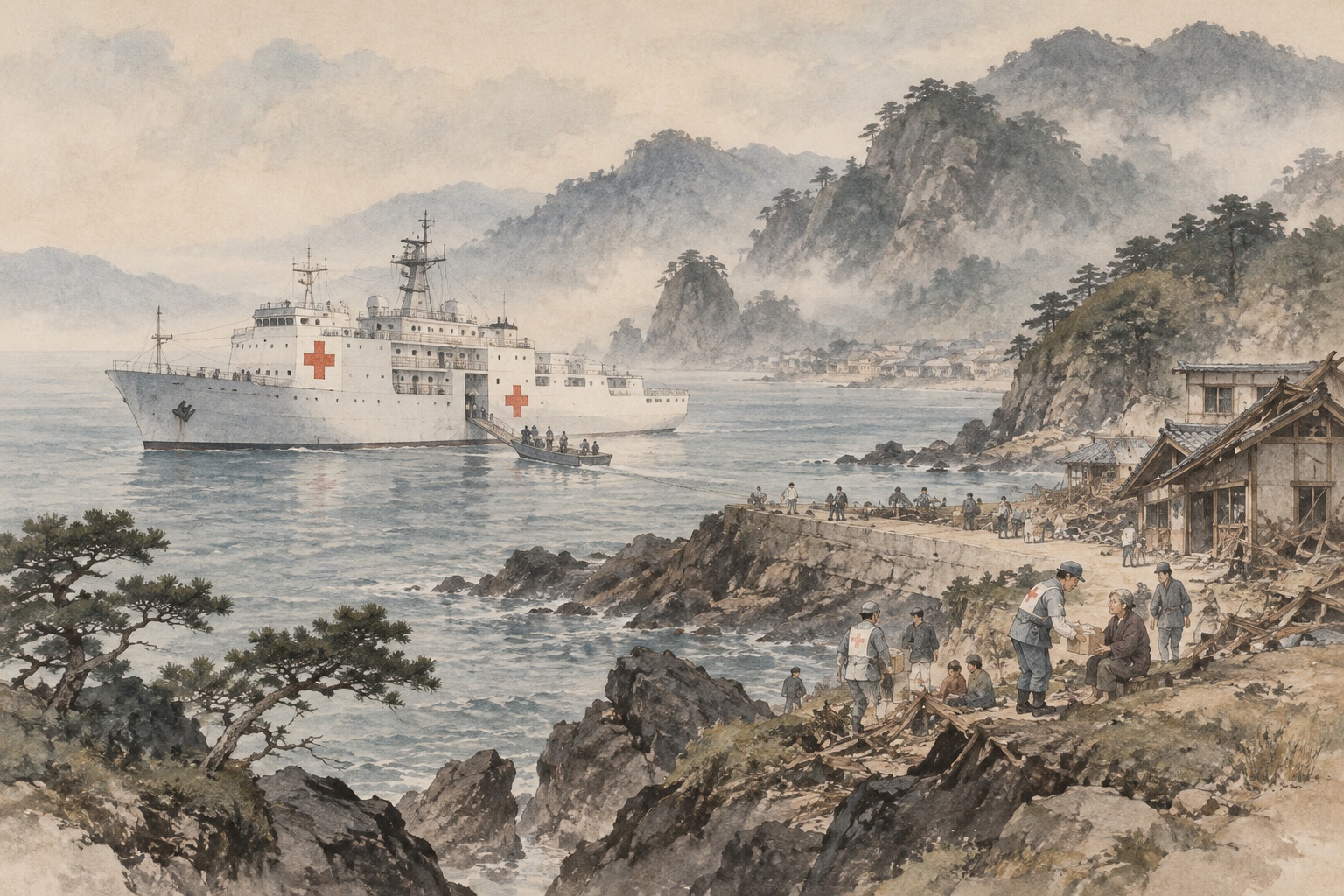
At 2 p.m. on August 5, doctors from the Japan Medical Association Team, or JMAT, began seeing disaster-affected residents aboard the large ferry Hakuo II at Yatsushiro Port in Kumamoto Prefecture. The deployment followed the magnitude-7.1 earthquake that struck the Kumamoto region on July 28 with a maximum Japanese seismic intensity of 7. With medical facilities affected and daily life disrupted, the prefecture asked the national government to add medical care to a vessel originally being mobilized for bathing, accommodation, food and other living support. The result became the first real-world use of shipboard medicine under Japan’s 2021 law promoting medical care using ships in disasters and other emergencies.[1] [2] [3]
Calling Hakuo II a “hospital ship,” however, would overstate what happened. Kumamoto Prefecture told users that the vessel was not providing hospitalization, surgery, advanced testing or specialist treatment. JMAT’s role was closer to medical screening, pre-hospital care for mild conditions and referral: check people using the ship, identify health problems, and connect those needing further treatment with medical institutions on land.[6] [7]
Eight days after the quake, medical care joined the living-support mission
The main earthquake struck at 4:27 p.m. on July 28 in the Kumamoto region. The Japan Meteorological Agency measured magnitude 7.1 and a maximum seismic intensity of 7; significant aftershocks followed in the Kumamoto and Amakusa-Ashikita areas. The first phase of the disaster centered on rescue and acute medical care. As days passed, the health burden shifted toward disrupted water supplies, evacuation, summer heat, medication continuity and chronic disease management.[1]
The Ministry of Defense organized a Hakuo support unit by July 31. Hakuo II left Aioi Port in Hyogo on August 1, refueled and took on water at Himeji, and arrived at Yatsushiro on August 4. The following afternoon it began offering bathing and an air-conditioned rest area. The Defense Ministry said the vessel could receive roughly 700 people at one time and had 144 cabins plus 12 washing machines and dryers — a large, self-contained platform for improving evacuation conditions.[4]
Medical care was added after local requests. The Japan Medical Association says Kumamoto medical organizations pressed for shipboard care and Governor Takashi Kimura formally asked Disaster Management Minister Jiro Akama on August 1 to implement medical support using the vessel. Coordination among the Cabinet Office, Ministry of Defense and medical organizations led to the August 5 start.[3] [7]
The first job was less “treat everything” than “find problems and connect people”
According to the Japan Medical Association, JMAT’s two core roles aboard the ship were to conduct health checks and connect patients identified on board with appropriate medical institutions ashore. Reports from participating physicians said the disaster had already moved beyond its acute phase and many local medical institutions had resumed services, so activity centered on pre-hospital care for relatively mild conditions.[7]
That may sound modest compared with popular images of a hospital ship packed with operating rooms. In a prolonged disaster, however, health risks often arise in ordinary places. A resident who comes aboard for a bath may also be dehydrated, have uncontrolled blood pressure, have missed medication, or be struggling with pain and mobility. The value of a medical team in that setting is partly to detect problems before they become emergencies.
The JMA described one patient who was examined aboard Hakuo II, advised by a JMAT physician about the appropriate specialty, and then successfully connected to treatment and rehabilitation at a local medical facility. The total number of shipboard patients was not necessarily large, the association said. But that case illustrates a role that treatment counts alone would miss: using the ship as a bridge back to the local health system.[7]
A typhoon exposed a limitation almost immediately
The first real-world deployment encountered one of the most obvious constraints of maritime disaster support almost at once. With Typhoon No. 13 approaching, the Defense Ministry moved Hakuo II away from Yatsushiro Port for safety and suspended support from August 6 through August 9.[5]
Ships bring powerful advantages: electricity, water systems, kitchens, beds, climate-controlled space and transportation in one mobile platform. They also depend on safe ports, channels, weather, fuel, mooring and embarkation routes. The ability to approach when roads are damaged is balanced by the possibility that a storm can force the vessel away.
Kumamoto Prefecture later warned users that ship operations could require changes, temporary interruption or suspension, and that no hospitalization, surgery or advanced specialist care was available aboard. The lesson is operational as much as medical: a ship should be planned as a mobile complement to land systems, not as a replacement for them.[6]
The name Hakuo already had a Kumamoto history
There was a precedent at the same port. During the 2016 Kumamoto earthquake, the Defense Ministry used the earlier civilian vessel Hakuo as a rest facility at Yatsushiro. From April 23 through May 29, it provided 17 rounds of generally one-night, two-day accommodation, meals and bathing to about 2,600 disaster survivors.[12]
That operation did not constitute the legally organized shipboard medical system used in 2026. But it proved a related concept: a large ferry could be brought to a disaster area and used as a concentrated living-support platform. Ten years later, Hakuo II added formal medical care to that same basic architecture.
The Defense Ministry says Hakuo II began operating as its PFI-contracted vessel in January 2026. The Kumamoto deployment therefore became both a continuation of an older support model and the first time the newer legal framework put medicine inside it.[4]
Why Japan did not bet everything on a dedicated hospital ship
The idea of a Japanese hospital ship has been debated for years. After the 2011 Great East Japan Earthquake, government studies identified major obstacles to a dedicated vessel: enormous construction and maintenance cost, difficulty securing medical staff, and limited peacetime use. The government therefore also pursued exercises using existing ships.[11]
The COVID-19 pandemic revived discussion about creating additional medical capacity outside ordinary hospitals. In June 2021, lawmakers enacted the Act on Promoting the Development of a System for Providing Medical Care Using Ships in Disasters and Other Emergencies. Its core logic is complementary: shipboard medicine should supplement medical facilities in affected regions, not automatically replace them.[8]
The law took effect on June 1, 2024. Government agencies continued tabletop and practical exercises using civilian vessels, medical modules and Self-Defense Force ships. On March 18, 2025, the Cabinet approved the national implementation plan required by the law. The evolving concept was broader than owning a single purpose-built hospital ship: Japan would need procedures, ships, medical teams and interagency coordination that could be assembled according to the disaster.[9] [10]
“Multipurpose use” became a real disaster operation
The Japan Medical Association says it has participated in government tabletop and shipboard exercises since 2021 and argued against overly rigid concepts limited to evacuation ships or dedicated medical vessels. It advocated multipurpose use of ships, language that was eventually reflected in the 2025 national plan. Kumamoto became the first opportunity to see that concept under real disaster conditions.[7]
Hakuo II was already good at things that matter medically even when they are not “medical” in a narrow sense: bathing, sleep, meals, climate control and rest. Adding a clinical team meant that residents could encounter health care along a route they were already using for daily survival. For a subacute disaster phase, that may be more useful than building a highly specialized floating hospital far beyond local need.
Multipurpose use, however, requires more preparation rather than less. Medication storage, clinical documentation, patient privacy, infection control, communications, ambulance access, referral pathways and the division of responsibility among JMAT, local physicians, the Self-Defense Forces and government agencies all have to be worked out in advance.
JMAT’s shipboard deployment ended September 9
On September 9, the Japan Medical Association said JMAT deployment to Hakuo II would end that day. A cumulative 26 teams and 97 personnel had been sent aboard. Medical demand was subsiding, the prefectural medical-relief coordination headquarters was closing, and JMAT coordination was moving from the prefectural government to the Kumamoto Medical Association as care transitioned back to local institutions.[7]
The association said on September 9 that Hakuo II’s broader bathing and accommodation support was scheduled to reach its final day on September 13. At Japan.co.jp’s reporting cutoff, that final day had not yet been fully confirmed as completed, so this article does not state it as a completed fact. The end of JMAT’s shipboard medical deployment on September 9 is confirmed.[7]
Success cannot be reduced to a patient count
The first real-world deployment did not produce dramatic numbers of operations or critical-care transports. That is not necessarily a failure. The Japan Medical Association itself said patient numbers were not especially high while judging the support useful in a disaster that had moved beyond the acute phase.[7]
The more important evaluation questions are operational. How long did it take from disaster onset to the decision to deploy shipboard medicine? Did the prefecture-to-national-government request channel work? How long after docking did clinical services take to establish? What happened when the typhoon forced the ship away? How many patients were successfully referred to land institutions? Could medical and living-support traffic share the vessel safely?
- At what disaster phase does shipboard medical support add the most value?
- What is the fallback when port damage or severe weather prevents docking?
- How should JMAT, DMAT, the Red Cross, local medical associations, the Self-Defense Forces and local government share command and referral responsibilities?
- Which conditions should be managed aboard, and which should be moved immediately to land hospitals?
- How should Japan measure whether combining living support with medical screening reduces disaster-related illness and death?
Another option for the next coastal disaster
Japan is an island nation with large populations and medical infrastructure concentrated near coasts. A major earthquake can damage hospitals and roads at the same time. A ship that arrives with electricity, water, beds, food and medical personnel offers a route that does not depend entirely on land transport — particularly around peninsulas, islands and port cities.
But a vessel is not a magic hospital. It needs a usable port and safe weather. Advanced care still requires equipment and specialist staff. Patients still need routes into the wider health system. The Kumamoto mission points toward a more practical model: use ships as adaptable nodes between living support and community medicine.
In 2016, Hakuo gave Kumamoto survivors a place to bathe, eat and sleep. In 2026, Hakuo II added JMAT. The next test is no longer whether Japan can put medicine on a ship. It is whether the country can decide quickly when to deploy it, match the vessel to the disaster phase, and connect the people found aboard back into a recovering local medical system.
- Japan Meteorological Agency: 2026 Kumamoto Earthquake portal — M7.1, maximum seismic intensity 7
- Prime Minister's Office: emergency disaster headquarters meeting on Hakuo II and JMAT shipboard care
- Cabinet Office: disaster-management minister briefing on Aug. 5 start of shipboard medical support
- Ministry of Defense: Hakuo II capacity, cabins and disaster-support functions
- Ministry of Defense: Aug. 5 launch of support and temporary interruption for Typhoon No. 13
- Kumamoto Prefecture: medical services aboard the ferry Hakuo II
- Japan Medical Association: JMAT activity in the 2026 Kumamoto earthquake and shipboard medicine, Sept. 9
- House of Representatives: Act on Promoting the Development of a System for Providing Medical Care Using Ships in Disasters and Other Emergencies
- Cabinet Secretariat: national plan for shipboard medical-care capability, approved March 18, 2025
- Cabinet Office: 2024 White Paper on Disaster Management — development of shipboard medical capability
- Cabinet Office: 2021 White Paper — hospital-ship studies and earlier exercises
- Ministry of Defense: use of the earlier Hakuo during the 2016 Kumamoto earthquake
Editorial note: JMAT's deployment aboard Hakuo II is confirmed to have ended September 9. The Japan Medical Association said broader bathing and accommodation support was scheduled to continue through September 13; at this article's reporting cutoff, completion of that final day had not yet been independently confirmed, so the article does not state it as a completed event. The mission did not provide inpatient surgery or advanced hospital-level care aboard the vessel.