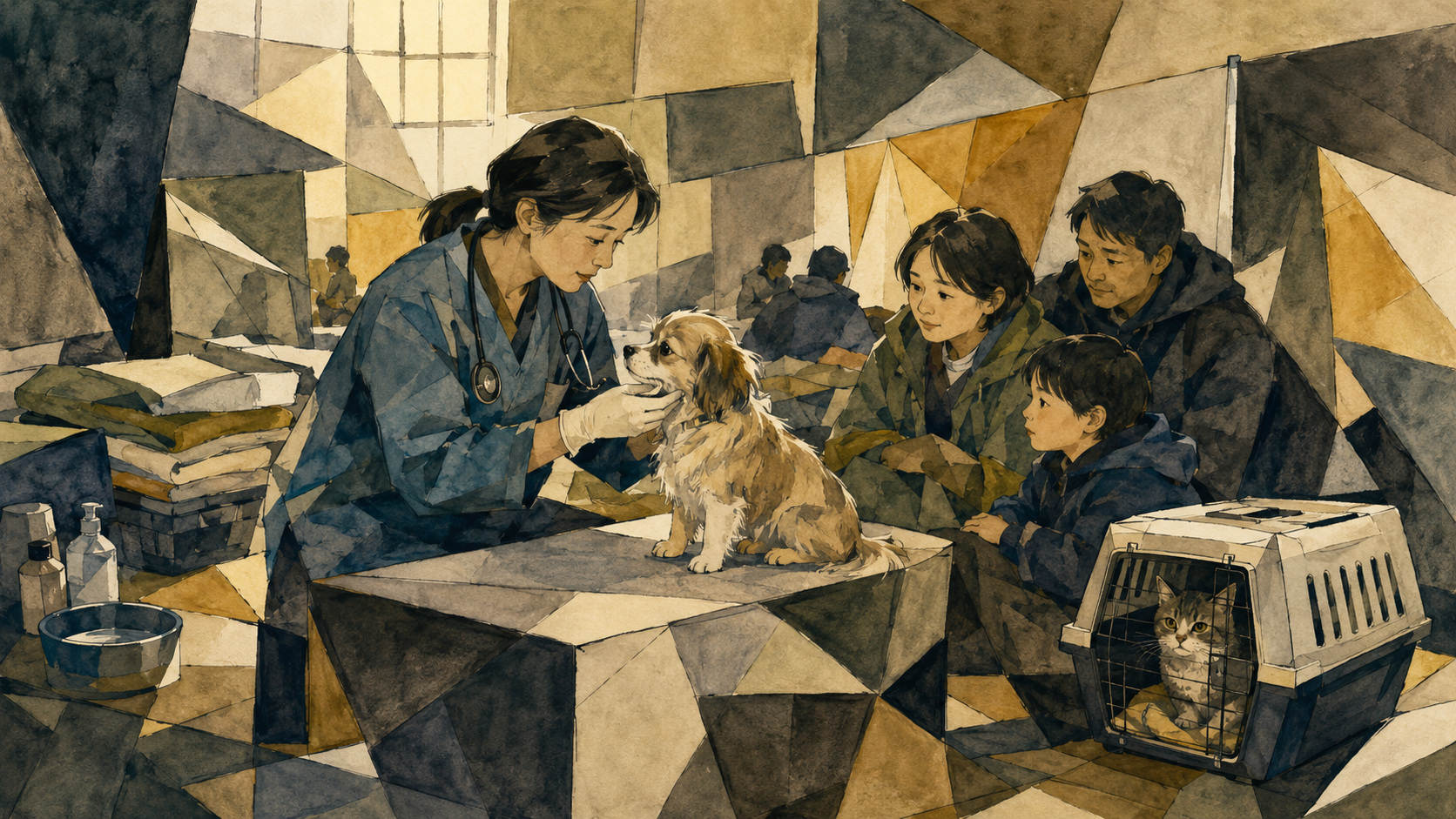
In a disaster, an animal’s silence does not mean that nothing is wrong.
A dog reads the tension in people and reacts to strange footsteps or public-address announcements. A cat withdraws into the back of its carrier, making changes in eating and elimination harder to see. Medication times shift; familiar food disappears; a walking route is gone; unfamiliar people and animals fill the surroundings. The owner is also short of sleep and busy finding water or completing housing paperwork. Every condition encourages one tempting explanation: it must simply be the earthquake.
At 4:27 PM on July 28, a magnitude 7.1 earthquake struck at a provisional depth of 16 kilometers beneath the Kumamoto region. Uki City and Hikawa Town registered intensity 7, the top of Japan’s seismic scale. Kumamoto Prefecture counted 3,585 registered residents in 81 open shelters at 2:00 PM on August 12. Those shelter statistics do not reveal how many households have pets, or how many people and animals are living in cars, damaged homes, relatives’ houses, hotels or other accommodation.
That is why the meaning of the free consultation extends beyond its four announced hours. A veterinarian can translate an owner’s “not quite normal” into clinically useful information: appetite, drinking, elimination, breathing, movement, medication, previous illness and changes in environment. When advice alone is not enough, that conversation can identify why ordinary veterinary care should come next. The first thing missing in disaster medicine is not always sophisticated equipment. It is often a conversation that decides what cannot wait.
“Stress” Is Not a Diagnosis
Organizers said the consultation was needed because unfamiliar evacuation conditions were placing a burden on animals. But stress can also become too convenient an explanation. Loss of appetite, hiding, barking, restlessness, vomiting, diarrhea and altered sleep can follow fear and a broken routine. They can also accompany pain, infection, chronic illness, interrupted medication, dehydration or heat exposure.
A cat that stops eating should not be dismissed as merely sensitive. Cornell University’s College of Veterinary Medicine says a cat that will not eat warrants veterinary evaluation, beginning with a physical examination. With diarrhea in dogs or cats, failure to eat, lethargy, black stool, associated vomiting or persistence are reasons to seek veterinary care. The consultation’s value is not remote diagnosis. It is recognizing an ambiguous change and deciding what should happen next.
- When the change began and how it differs from normal; if possible, note food, water, elimination, vomiting or diarrhea
- Age, previous illness, regular medications, allergies, vaccination history and the usual veterinary hospital
- Whether the animal is in a gymnasium, outdoors, a vehicle, hotel or temporary home; note temperature, noise and contact with other animals
- Patient card, medication packaging, health records, and photos or video of the sign; check a facility’s rules before bringing the animal itself
A vehicle in August presents a special danger. Advice issued by the Japan Veterinary Medical Association on July 31 warned displaced owners about heat risk to both people and animals, urged adequate hydration and said pets must not be left in a closed vehicle. The American Veterinary Medical Association likewise warns that shade or partly open windows cannot prevent a parked vehicle from rapidly reaching deadly temperatures, even when the weather does not seem severe.
A car can feel like a private place where an owner need not leave an animal behind. But safe use requires continuous cooling, ventilation, elimination, exercise, secure restraint and control of noise. Owners face their own risk of heat illness and blood clots; animals face temperature and confinement together. Being together and living safely are not the same thing.
The Grammar of Evacuation: Together Does Not Always Mean Beside
Understanding Japan’s disaster-pet policy requires separating two similar expressions. Dōkō hinan means the action of evacuating safely to a destination with one’s pet. It does not promise that the animal can live in the owner’s room. Dōhan hinan means staying at a shelter while caring for the animal there. Even then, one facility may separate human and animal zones while another allows them in the same space.
Yatsushiro City says every one of its shelters permits evacuation to the site with a pet. Where the animal remains, however, varies by shelter; the policy does not mean that people and pets can occupy the same indoor space. On August 12, the city opened Kongo Community Center as a shelter where owners and pets could remain in the same space. The prefecture’s 5:00 PM list that day also showed a pet-accessible area at Ryuhoku Seibu Elementary School gymnasium in Hikawa. Uki was still coordinating arrangements, while Kumamoto City’s pet evacuation location had closed.
| Term or place | What was confirmed by August 12 | What it does not mean |
|---|---|---|
| Evacuating together Dōkō hinan | The owner takes the pet and escapes safely to an evacuation site | A guarantee that the animal can live in the same room or sleeping area |
| All Yatsushiro shelters | Arrival with a pet is permitted; ask each site where the animal stays | That a pet can remain beside its owner at every site |
| Kongo Community Center | Opened August 12; owners and pets can stay in the same space | That capacity, equipment, eligible animals and opening status never change |
| Temporary foster care | Relief headquarters began taking dog-and-cat requests through member veterinary hospitals | Surrender of the animal or transfer of ownership; terms must be confirmed with the desk |
There are real reasons a shelter cannot simply remove every boundary around animals: allergies, fear, barking, odor, bites, waste, infection and conflict between animals. Good accommodation does not dismiss those concerns and place pets unconditionally among sleeping residents. It records numbers and characteristics at reception, designs human and animal routes, and makes rules for carriers, cleaning, ventilation, exercise, elimination, isolation and complaints visible.
Yatsushiro asks owners to bring a cage or carrier, food, a lead, waste-disposal tools and cleaning supplies. This is not a declaration that everything is the owner’s problem. It is a division of work in scarce conditions: owners continue everyday care, while operators provide space and rules shared by everyone.
A Hotline, Foster Care, Lost-Pet Records, Shared Shelter—and a Consultation
Kumamoto’s 2026 pet response did not appear complete from a single doorway. On July 29, the day after the earthquake, the prefecture publicized a desk at its Animal Friends Kumamoto welfare center for missing pets, difficulties at shelters, unavailable food and supplies, or an owner’s inability to continue care.
On August 4, the Kumamoto Veterinary Medical Association, Kumamoto Prefecture and Kumamoto City created the Kumamoto Earthquake Pet Relief Headquarters. It began accepting requests for temporary dog and cat care through association-member hospitals. The prefecture also said pet-health consultations and flea-and-tick control at shelters and temporary housing, as well as veterinary support through member hospitals, would begin once the system was ready. On August 10, a site began collecting and publishing information about dogs and cats found after the earthquake. Kongo’s same-space shelter opened on August 12; the arena consultation was scheduled for the 16th.
July 28 M7.1 earthquake; intensity 7 in Uki and Hikawa.
July 29 Animal Friends Kumamoto pet-advice desk publicized.
August 4 Pet-relief headquarters formed; temporary dog-and-cat care begins through member hospitals.
August 10 Found dog-and-cat information site opens.
August 12 Yatsushiro opens Kongo Community Center for owners and pets in the same space.
August 16 Free health consultation scheduled at Yatsushiro Toyotaoka Chiken Arena.
- General pet problems: Animal Friends Kumamoto, 0964-27-8115, weekdays 9:00 AM–4:00 PM, for missing animals, shelter arrangements, supplies and difficulty continuing care
- Temporary dog or cat care: Kumamoto Earthquake Pet Relief Headquarters office at the prefectural veterinary association, 090-7481-3406, Monday–Saturday 9:00 AM–4:00 PM, excluding Sundays and holidays
- Urgent symptoms: Do not wait for an advice event or general help desk; contact the usual or an operating veterinary hospital and confirm intake, hours and costs
Hours and services can change during a disaster. Check current prefectural and municipal information before using them.
Japan’s Long Learning Curve, Beginning in 1995
It took repeated catastrophes for Japan to abandon the idea that leaving pets outside disaster planning would make the problem disappear.
In the 1995 Great Hanshin-Awaji Earthquake, more than 9,000 dogs and cats were affected, according to the Japan Veterinary Medical Association. Large-scale cooperation among veterinarians, animal-welfare groups and government became a model for later national relief. The first emphasis, however, was on rescuing, treating and housing injured or displaced animals.
The 2011 Great East Japan Earthquake and nuclear accident exposed a different failure. Owners fled quickly and could not return to animals left inside an exclusion zone. Some shelters did not admit animals, leaving people isolated at home or in cars. Information systems could not always reunite a rescued animal and its owner. Japan learned that if rescue focuses on the animal alone, evacuation can fail for the whole household. In 2013, the Environment Ministry used those lessons to issue disaster-pet guidance recommending evacuation with pets.
The April 2016 Kumamoto earthquakes then revealed the distance between a recommendation and a working shelter. Environment Ministry records show appeals to prevent blood clots among evacuees sleeping in vehicles with dogs, cages dispatched to shelters, and requests for pet-compatible temporary housing. A joint headquarters of Kumamoto Prefecture, Kumamoto City and the prefectural veterinary association was formally established on May 27. Eventually, people lived with pets in emergency temporary housing in every relevant municipality.
After reviewing that experience, the national government issued its 2018 “Disaster Preparedness Guidelines for Humans and Pets.” The subjects in the title matter. The purpose had widened beyond animal welfare to protect owner safety, shelter order and public health together. Evacuation with an animal was not a rule that placed pets unconditionally in human sleeping quarters. It was a system designed so that owners would not remain in dangerous locations because leaving a pet was unthinkable.
The 2024 Noto Peninsula earthquake added pet-care trailers at evacuation sites, temporary fostering, a found-animal information service and pet-compatible temporary housing. That design is visible in Kumamoto in 2026: multiple exits from crisis through a hotline, member-hospital foster care, a found-animal site, same-space shelter and planned mobile health support.
The timing has changed too. In 2016, 41 days passed between the April 16 main shock and the May 27 establishment of the three-party pet-relief headquarters. In 2026, the same three types of institution formed a headquarters on August 4, one week after the July 28 earthquake. The disasters and the work already underway were different, so this is not a simple performance ranking. It is nonetheless evidence that relationships once assembled in meetings remained available as institutional memory and could be called sooner in the next earthquake.
| Disaster | Problem exposed | What remained in the system |
|---|---|---|
| Hanshin-Awaji, 1995 | Large numbers of injured and missing animals; limited medical and holding capacity | A broad relief model joining veterinary associations, welfare groups and government |
| Great East Japan, 2011 | Animals left behind, exclusion zones, separation, isolation in cars and homes | 2013 guidance and a national recommendation to evacuate with pets |
| Kumamoto, 2016 | Different shelter rules, vehicle sleeping, temporary housing and coordination | 2018 human-and-pet guidelines and practical experience with pet-compatible temporary housing |
| Noto, 2024 | Prolonged displacement, peninsula logistics, dispersed owners and animals | A mix of pet trailers, fostering, found-animal records and pet-compatible temporary homes |
| Kumamoto, 2026 | Long evacuation in summer heat; gaps between arrival and shared shelter; cars and interim homes | Three-party headquarters in one week, followed by advice, fostering, search and shared-shelter measures |
Support Must Travel Beyond the Gymnasium
Pet support is easiest to lose after a family leaves the gym. A hotel may not accept animals. Privately rented units used as disaster housing retain property-specific pet rules. A purpose-built temporary site can permit animals, yet still isolate owners if it has no workable rules for barking, exercise, waste, common areas or multiple pets.
By this article’s August 13 reporting cutoff, the 2026 relief headquarters had announced health consultation and flea-and-tick measures at “shelters and temporary housing” once arrangements were ready. Japan.co.jp did not find a public document guaranteeing pet cohabitation across every temporary accommodation in the prefecture. The 2016 result in all relevant municipalities is a powerful precedent, but precedent is not an automatic right. Owners gain confidence only when the rule appears in application documents, leases and site-management policies.
This is where outreach matters. Support must find people who cannot reach a shelter: residents protecting animals in gardens or cars, older owners without transport, and multi-pet households that cannot move easily. A single consultation should be able to connect veterinary care with food, medication, carriers, temporary fostering, housing and lost-animal information. The goal is not a pet desk isolated from the rest of relief. It is a desk that can exchange information with human health, housing and shelter operations.
What a Free Consultation Can Measure
The August 16 event should not be evaluated only by the number of animals represented. Which changes are owners reporting? Which living arrangements are they coming from? Are medication, food, transport or housing the largest barriers? How many cases require urgent referral? Which households cannot reach the venue? If those answers inform the next outreach round and the next supply shipment, four hours can become a sensory organ for the entire response.
A small turnout would not necessarily mean little need. An owner may be unable to transport an animal, uncertain about the process, afraid of costs, ill themselves or compelled to clear a damaged home instead. Measuring reach requires more than counting a queue. It requires counting why others could not join it.
A dog or cat cannot complete a medical history. The owner must notice a change, the veterinarian must interpret its medical meaning, and government must remove the obstacle in daily life. When that chain holds, animal illness is found sooner and people have a better chance of remaining in safe accommodation.
After an earthquake, “normal” returns through small repetitions: drinking at the usual time, receiving the regular medication, eliminating without fear, sleeping beside the familiar person. The free consultation on August 16 may restore one of them. Refusing to overlook evacuees without a voice is also a way of refusing to overlook the people beside them.
Reporting Notes and Principal Sources
This article reconciles information published by governments, veterinary associations, news organizations and veterinary institutions through August 13 at 9:52 AM JST. The August 16 consultation had not yet occurred, and no results are included. Discussion of stress is general context and does not diagnose an individual animal. Help-desk hours, shelter status and available services can change; users should recheck official information.
- KAB: free August 16 pet-health consultation, venue and hours
- Japan Meteorological Agency: July 28 earthquake time, magnitude, depth and intensity
- Kumamoto Disaster Response Headquarters: shelter and evacuee count at 2:00 PM on August 12
- Yatsushiro City: evacuation-together/shared-shelter distinction, Kongo Community Center and supplies
- Kumamoto Prefecture: pet-accessible shelter list at 5:00 PM on August 12
- Kumamoto Prefecture: pet-relief headquarters, temporary care and consultation/treatment-support plan
- Yatsushiro City and Kumamoto Prefecture: Animal Friends Kumamoto pet-advice desk
- Yatsushiro City: found dog-and-cat information site
- Japan and Kumamoto veterinary associations: heat and vehicle warnings for displaced pet owners
- American Veterinary Medical Association: disaster stress, routine, records and medication
- American Veterinary Medical Association: vehicle heat and warm-weather pet safety
- Cornell University College of Veterinary Medicine: feline appetite loss and veterinary evaluation
- Cornell University College of Veterinary Medicine: warning signs accompanying diarrhea
- Japan Veterinary Medical Association: disaster-animal support since Hanshin-Awaji
- Environment Ministry: animal treatment, shelters and vehicle evacuation after the Great East Japan Earthquake
- Environment Ministry: timeline of the 2016 Kumamoto pet response
- Environment Ministry: 2016 shelter and temporary-housing measures and review
- Environment Ministry: 2018 Disaster Preparedness Guidelines for Humans and Pets
- Environment Ministry: pet-care space, fostering and temporary housing after the 2024 Noto earthquake