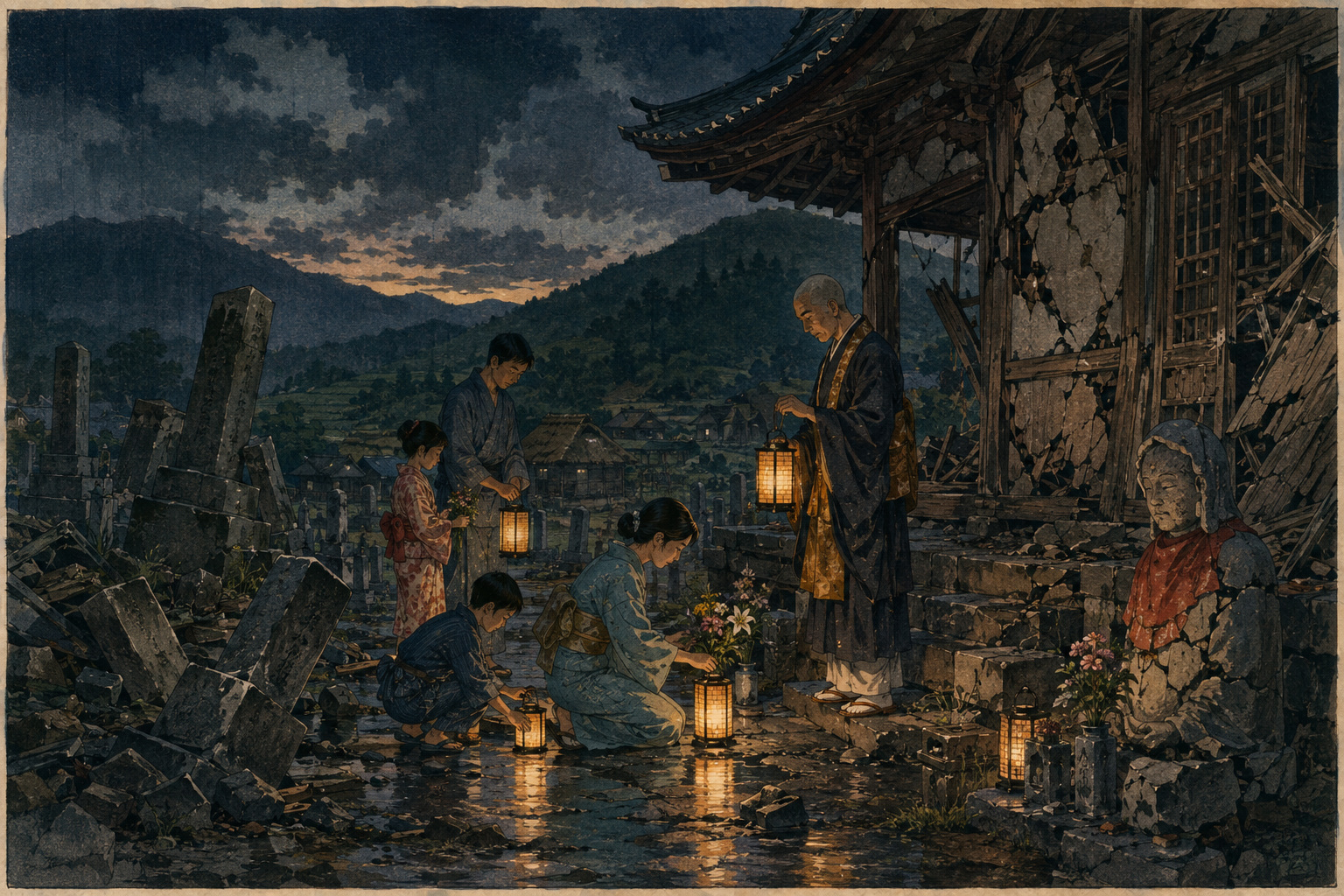
The official damage list reads like a litany stripped of verbs: main hall collapsed; temple gate collapsed; bell tower collapsed. Altar fittings scattered. Gravestones down. Ground cracked. Liquefaction. No electricity, water or gas. Evacuated to a shelter. Sleeping in a car.
These are not descriptions gathered from a distant historical disaster. They were being typed into the record during the first days of August 2026, while volunteers cleared broken glass at temples in the Yatsushiro group and Obon approached. At one temple the place where a congregation ordinarily sits was unsafe. At another the central cabinet around the principal image had fallen. In a cemetery, a stone carrying a family name no longer stood upright.
The calendar did not pause. On August 13, families across much of Japan entered month-late Obon. By August 15, only 18 days had passed since the July 28 earthquake. Priests, parishioners and returning relatives faced a painful contradiction: this is the season for going back to the places that hold the dead, but some of those places could not safely receive the living.
The Ground Moved Beneath Places Built to Last
The Japan Meteorological Agency places the earthquake at 4:27:15 PM on July 28, at a depth of 16 kilometers and magnitude 7.1. Uki City’s Toyono district and Hikawa Town registered the highest intensity on Japan’s scale, shindo 7. Parts of Yatsushiro, including Sencho and Kagami, registered upper 6. The strongest shaking extended through an area where towns, rice fields, river plains and temple communities are closely interwoven.
The movement was not metaphorical. The Geospatial Information Authority of Japan’s provisional satellite positioning analysis measured the Sencho station in Yatsushiro moving roughly 84 centimeters northeast. Other stations moved in different directions. Local ground deformation, cracks and liquefaction complicated the picture. In the Hongwanji survey, those geophysical changes appear at human scale: stone approaches shifted, foundations failed, pillars slipped and temple grounds split.
Continued earthquakes kept the first damage from becoming settled damage. A magnitude 5.8 event late on July 29 brought another lower-5 jolt to Yatsushiro. The Meteorological Agency’s standing guidance after a large earthquake is blunt: weakened houses, block walls and slopes can fail in subsequent shaking, so people should not approach them casually. A temple compound contains all three kinds of hazard—heavy buildings, freestanding masonry and sometimes steep ground—before one even counts roof tiles, bells, lanterns and tombstones.
What 145 Damaged Temples Does—and Does Not—Mean
There is no complete public, all-faith inventory of damaged religious sites in the earthquake zone. Many graves are privately owned but located in temple cemeteries; other burial grounds are public, communal or privately operated. Repair responsibility and reporting routes differ. Any neat total would therefore create a certainty that the evidence does not support.
The most detailed available record comes from Hongwanji-ha, a major branch of Jodo Shinshu with deep roots in Kyushu. By August 9, it had reports from 145 temples across seven of its districts. The value of the list is not merely the total. Its local entries show how an earthquake disassembles a religious place system by system.
| Religious site element | Damage recorded in the Hongwanji-ha survey | Why it matters at Obon |
|---|---|---|
| Main hall and inner sanctuary | Collapse, tilting, wall and ceiling failure, shifted columns, fallen roof tiles | The principal place for chanting, sermons and collective Bon services may be closed |
| Principal image and altar | Principal images toppled; shrine cabinets, altars and ritual fittings fell or broke | Sacred objects require reverent handling, documentation and skilled stabilization |
| Gate, bell tower and paths | Collapsed gates and towers, shifted approach stones, broken stairs and walls | A service space may survive while access to it remains dangerous |
| Columbarium and cemetery | Damaged ceilings and altars, scattered fittings, toppled or broken gravestones and stone lanterns | The family’s physical point of remembrance may be inaccessible or unstable |
| Priest’s residence and utilities | Severe tilting, power and water outages, gas stoppage; some people in shelters or cars | The people expected to support others may themselves be displaced |
The Yatsushiro group’s 19 reports include collapsed halls, gates and bell towers; fallen altar structures; scattered fittings; toppled graves; outages; cracked or liquefied grounds; and people evacuating or sleeping in vehicles. The adjacent Taneyama group also listed 19 temples, with collapsed halls and gates, falling tiles, tilted living quarters and disrupted utilities. In the wider Uto and eastern Kumamoto religious groups serving communities around the worst-shaken Uki side, reports included toppled principal images, damaged columbaria, fallen stone lanterns and collapsed cemetery masonry.
Those geographic descriptions must remain careful. A “group” is an administrative unit within the denomination, not a municipal damage polygon. The survey also withholds most temple names, reasonably protecting affected communities. It proves the nature and scale of the damage within one network; it does not license a reporter to pin every line to a named town or temple.
A Hall Is Architecture; a Temple Is a Relationship
A conventional disaster ledger separates structural, contents and infrastructure damage. Temple life does not separate so neatly. A main hall’s columns support a roof, but the hall also organizes bodies: where the priest sits, where a family listens, where a coffin once rested, where the names of the dead are read. A bell tower is masonry and timber, but its sound marks time for a neighborhood. A columbarium is a structure and, simultaneously, a dense geography of individual grief.
This is why a toppled principal image cannot be treated as ordinary debris. Its material may be wood, metal, lacquer, cloth or gilding; its religious status is something else. Moving it can cause further damage and can violate the community’s expectations for handling a sacred object. The same is true of tablets, registers and ritual implements. Emergency cleanup needs photographs, labels, dry storage and expert advice—not a fast trip to the rubbish pile.
The response record shows that basic labor mattered immediately. Hongwanji-ha established a Kumamoto support center on July 31. On August 4, teams delivered supplies, cleared glass at a Yatsushiro-group temple, helped clean a Taneyama-group temple and watched children affected by the disaster. Glass was cleared again in Yatsushiro on August 6. None of these acts is spectacular. Together they make worship possible: first remove what cuts the feet, then make a safe corner, then gather.
Obon Does Not Mean Exactly the Same Thing Everywhere
Obon grew from Buddhist Ullambana observances, rites for the dead and Japanese family and community customs. Its history reaches deep into the court record: the Nihon Shoki describes seventh-century observances associated with the fifteenth day of the seventh month. After Japan adopted the solar calendar in 1873, much of the country shifted the season one month later, producing the August 13–16 “month-late” Bon that dominates this weekend.
Popular descriptions say ancestral spirits return home, guided by lanterns and welcoming fires, then depart after several days. That language fits many household and regional traditions. It should not be imposed on every Buddhist school.
Hongwanji-ha’s own teaching explains Jodo Shinshu Obon differently. The dead who have been born in the Pure Land are not believed to require special rites to remove sin or obtain merit, nor are they absent until a few midsummer days. Obon is an occasion to hear the Dharma, feel gratitude toward those who died and reflect on one’s own life. A family may visit a grave and a temple, but it is not rescuing an ancestor through ritual performance.
That distinction becomes especially meaningful in a disaster. If the hall is closed, the grave blocked or the altar broken, remembrance has not failed. A rite can be shortened, moved or delayed for safety. A name can be spoken at home. Yet this theology should not be used to minimize the loss of place. People grieve through touch and repetition: washing a grave, setting flowers in the same holder, sitting where a parent once sat. Saying the sacred is not confined to a building is true; rebuilding the building still matters.
- Check the temple, cemetery or municipality’s latest access notice before traveling. A familiar route may be closed.
- Do not enter a tilted or cracked hall without approval. Stay away from damaged gates, bell towers, block walls, stone lanterns and slopes.
- Treat every leaning tombstone as unstable. Do not try to raise a fallen stone yourself; contact the temple or cemetery manager and a qualified stone professional.
- Expect heat, disrupted water and another earthquake. Carry drinking water, keep visits brief and know where to move away from masonry.
- Observe local fire restrictions. Yatsushiro’s temporary car-camping parks, for example, prohibit flame; conditions also vary at religious sites.
- Photograph damage from a safe position before cleanup. Do not discard tablets, registers or sacred objects without guidance.
The Grave Is a Vertical Family Archive
Japanese family graves often make continuity visible in stone. The household name faces outward; individual posthumous names and dates may be recorded on the monument or a companion slab. Ashes may be interred below. Flowers, water and incense make the grave a place where abstract ancestry becomes a repeated physical act.
An earthquake attacks that form directly. A tall stone has mass above a small footprint. Pieces can rotate, slide or separate. Lanterns and retaining walls create additional hazards. Even when a grave has not fully fallen, shifted joints or disturbed soil may leave it unstable. Liquefaction can move the ground beneath the entire arrangement.
The emotional impulse is to set the stone upright before Obon, restoring the family order with one act. The safe response is slower. A toppled monument can weigh hundreds of kilograms. Lifting it without equipment can crush hands or legs, damage the burial chamber, or destabilize nearby stones. The first act of respect is therefore restraint: record the condition, tell the manager, let the ground and the professionals be assessed.
Delay may feel like abandonment, especially for relatives who have traveled far. It is not. Flowers can be offered at a temporary memorial; hands can be joined outside a closed gate. In a disaster, refusing to create another casualty is part of the obligation to the dead.
Ten Years After 2016, Damage Lands on Damage
Kumamoto entered 2026 already carrying a benchmark disaster. In April 2016, two major earthquakes struck within roughly 28 hours: magnitude 6.5 on April 14 and magnitude 7.3 on April 16. Shindo 7 was observed twice. The sequence killed 275 people in Kumamoto Prefecture under the official count, which includes disaster-related deaths, and caused widespread building and cultural-property damage.
The year 2026 had been a moment for ten-year reflection. Then the ground broke again. One entry in the new Hongwanji-ha survey makes the overlap painfully concrete: in its Mashiki North group, a main hall still undergoing restoration from the 2016 earthquake tilted in the 2026 shaking. Its priest’s residence tilted severely; the bell tower and gate collapsed.
Restoration after a major earthquake is measured in years, not news cycles. Aso Shrine’s nationally designated Romon gate, destroyed in 2016, was not fully restored until December 2023—seven years and eight months later. Temples without the same designation, fundraising reach or visitor profile may face an even harder path. Specialized carpenters, roofers, plasterers, stoneworkers, conservators and engineers are limited, while houses, schools and businesses need the same labor.
Recovery can also expose an uncomfortable hierarchy of visibility. A famous monument’s reopening becomes national news. A village hall where forty people hear a Bon sermon, or a cemetery known mainly to descendants who have moved away, can disappear quietly. Its cultural importance is not measured by tourism. It is measured by how much community life becomes impossible when it is gone.
April 14 and 16, 2016 Two powerful Kumamoto earthquakes produce shindo 7 shaking and a long reconstruction.
December 2023 Restoration of Aso Shrine’s Romon gate is completed after seven years and eight months.
July 28, 2026 · 4:27 PM A magnitude 7.1 earthquake strikes; Uki and Hikawa register shindo 7, parts of Yatsushiro upper 6.
July 31 Hongwanji-ha opens its Kumamoto earthquake support center.
August 4 and 6 Teams clear glass at Yatsushiro-group temples as Obon nears.
August 9 · 5:00 PM The denomination’s working count reaches 145 damaged temples in seven districts; the survey continues.
August 13–16 Month-late Obon arrives across much of Japan.
How a Service Survives Without Its Usual Room
There is no single 2026 Kumamoto solution. Each temple’s safety, denomination, congregation and damage are different. Some halls can be entered after inspection; others cannot. Some families can reach their graves; others face a locked gate, broken road or unsafe stonework. A responsible article should not turn possible adaptations into claims that every local temple adopted them.
The available evidence does show the necessary order: assessment, access, cleanup, communication and only then gathering. A service can move to an undamaged room, a community space or a later date if its organizers judge that safe. Families can pray at home or ask a temple how names and offerings will be received. What matters is that the change be explicit, not that people improvise inside a damaged building because tradition created pressure to attend.
There is also a subtle matter of timing for the newly bereaved. The July 28 deaths occurred less than three weeks before August 15. Families and Buddhist schools differ on when a first Bon observance is held; in many traditions, the forty-nine-day memorial boundary affects whether hatsubon occurs that summer or the next. Reporters and visitors should not label this weekend “first Obon” for every earthquake victim. Fresh grief does not need an inaccurate ritual name to be real.
The Work of Remembrance Is Also Disaster Recovery
A temple’s first post-earthquake Obon will not look like the last one. There may be plywood where a door stood, a taped boundary around a bell tower, a temporary table in place of an altar, and fewer people because roads, heat and fear keep them away. The absence is part of the record.
But the damage list also records the opposite of absence. Someone inspected 145 temples. Someone answered a displaced priest’s call. Someone drove supplies. Someone cleared glass twice. Families checked on graves even when they could not touch them. Institutions built over centuries began, in small actions, to reassemble their relationships.
This does not make the earthquake redemptive. Communities should not have to prove resilience by holding a picturesque service among ruins. Safety may require cancellation. Grief may require privacy. Reconstruction will expose shortages of money, labor and time, and some structures may never return in their former shape.
Obon’s deeper force is not that the dead demand an intact stage. It is that the living refuse to let destruction have the final word about who belonged here. A fallen family stone still carries a name. A closed hall still holds the memory of voices. The responsible task is to protect the people first, document what was broken, and rebuild the places of remembrance without turning remembrance itself into another hazard.
On August 15, the earthquake is 18 days old. Restoration will take years. Between those two measures of time—a ritual calendar that arrives now and a recovery calendar that stretches ahead—Kumamoto’s temples are doing the quietest work of disaster response: making a safe place, however temporary, in which loss can be named.
Reporting note and principal sources
This article uses public information checked through August 14, 2026 at 7:04 AM JST. Temple figures are attributed to Hongwanji-ha and are not presented as an all-faith count. Specific unnamed damage entries have not been assigned to individual municipalities. The safety guidance is general; visitors should follow current local and site-manager instructions.
- Jodo Shinshu Hongwanji-ha: 2026 Kumamoto earthquake damage and response, updated August 10
- Hongwanji-ha 2026 Kumamoto Earthquake Support Center
- Japan Meteorological Agency: July 28 earthquake source and mechanism
- Association for the Development of Earthquake Prediction: observed intensity by station
- Geospatial Information Authority of Japan: provisional crustal deformation
- Yatsushiro City: 2026 Kumamoto earthquake information portal
- Yatsushiro City: temporary evacuation and car-camping parks
- Japan Meteorological Agency: safety during continuing earthquake activity
- All Japan Excellent Stone Association and three industry groups: warning against entering earthquake-damaged cemeteries
- Hongwanji-ha: the meaning and observance of Obon in Jodo Shinshu
- Government of Japan: Obon customs and the August observance
- Nara National Research Institute for Cultural Properties: early Japanese records of Urabon-e
- Kumamoto Local Meteorological Office: overview of the 2016 Kumamoto earthquakes
- Shimizu Corporation: completion of Aso Shrine Romon restoration