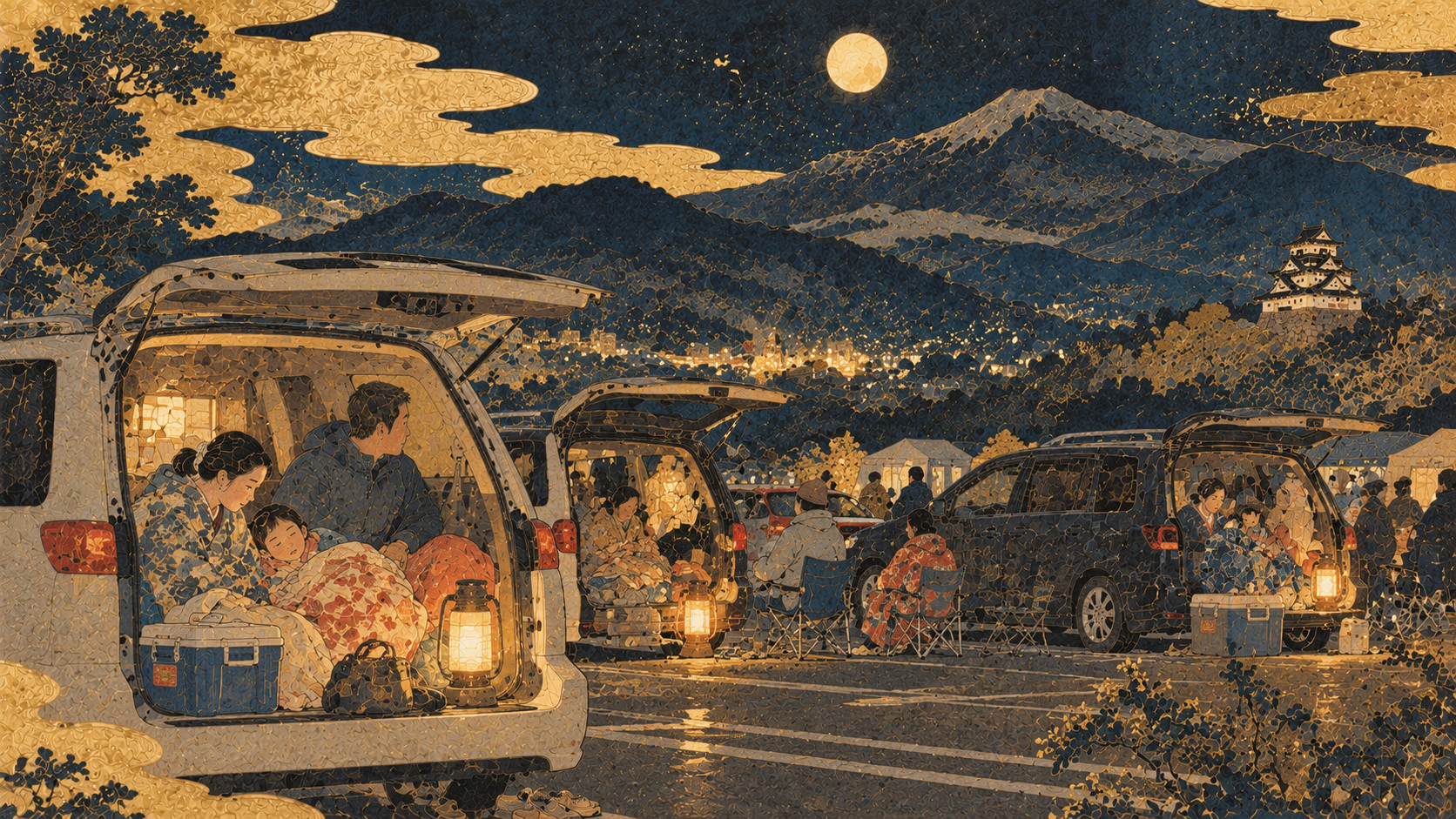
The place that feels safest after an earthquake is not always the place where it is safest to sleep.
When a car becomes the place that feels safest
The doors lock. A family can stay together. If the ground shakes again, there is no ceiling overhead to fear. For people displaced by an earthquake, a parked car can offer an immediate sense of control. Yet a car is a difficult place to live, especially through summer heat or repeated nights without proper sleep. A newly reported survey from Kumamoto lays bare the tension between perceived safety and the hidden costs of sheltering in a vehicle.
Fear, not simply convenience
On October 23, the Kumamoto Nichinichi Shimbun reported that more than six in ten respondents to a survey of people who had evacuated in vehicles cited anxiety about another powerful earthquake. The study was conducted by Kumamoto-based disaster-support organization minori and collaborators. The newspaper identified minori representative Satoshi Takagi and emeritus professor Tadashi Inatsuki of the University of Kitakyushu at the presentation. Heat and the gasoline needed for air conditioning were among the problems cited. The report does not mean that six in ten people in Kumamoto slept in cars; it describes answers from the surveyed group.
What the survey cannot yet tell us
The publicly accessible portion of the newspaper report does not give enough information to verify the sample size, recruitment method, survey dates or detailed questionnaire. Those omissions matter. A survey of vehicle evacuees tells us about the experiences of participants; it cannot establish what share of all survivors chose a vehicle, or how representative the responses were. Obtaining the original survey instrument and interviewing its organizers would make the evidence stronger. The finding is important without overstating its reach.
The appeal and limits of a private refuge
A car offers privacy, the possibility of keeping pets and belongings close, and flexibility if conditions change. Families who struggle in crowded communal shelters may regard those advantages as essential. But heat builds up, space restricts movement, toilets and clean water are not necessarily close at hand, and sleeping positions can be difficult to sustain. When fuel becomes scarce, using air conditioning adds yet another dilemma. The point is not to blame people for choosing their vehicles. It is to ask what they lacked in the alternatives.
The memory of the 2016 Kumamoto earthquakes
Japan has confronted this problem before. After the damaging Kumamoto earthquakes in April 2016, many evacuees stayed outdoors or in cars as tremors continued. Cabinet Office reviews documented reasons extending beyond aftershock anxiety: overcrowded shelters, infants, older relatives, pets, worries about property and difficulties accessing supplies. Officials also struggled to reach people outside designated shelters. The 2026 survey echoes some of those concerns, although figures from different events and methodologies cannot be directly compared.
A medical risk that is not confined to airplanes
Japan’s Ministry of Health, Labour and Welfare warns that prolonged immobility in cramped seats, especially when hydration is inadequate, can promote deep-vein thrombosis. A clot that travels to the lungs can cause pulmonary embolism. The condition is often called “economy-class syndrome” in Japan, but prolonged sitting in a car can present a similar danger. Leg swelling or pain, chest pain and sudden breathing difficulty warrant prompt medical attention. Heat-related illness adds a separate risk in warm weather. Those concerns do not make every instance of sleeping in a car a medical emergency, but they make repeated nights of evacuation a public-health issue.
Precautions are not a substitute for shelter
The ministry recommends moving and stretching periodically when possible, flexing the ankles, drinking water regularly and avoiding tight clothing. Such measures may lower risks, but they cannot convert a cramped vehicle into an adequate long-term shelter. Pregnant people, those with limited mobility and people with certain medical conditions may need tailored medical advice. A durable response requires accessible indoor options and reliable outreach, not merely distributing leaflets about exercising while seated.
Japan has a plan to reach people beyond shelter walls
The Cabinet Office’s 2024 handbook for supporting people sheltering at home or in vehicles explicitly addresses those who do not sleep in designated centers. The challenge is administrative as well as medical: how can municipal staff and support organizations locate scattered people, track their changing needs and deliver information, water, toilets and health services? Earlier Japanese reviews found that those living beyond formal shelters could fall outside ordinary registration and distribution systems. The policy test is whether that gap can be closed in practice.
A practical resource already offered in Kumamoto
Kumamoto Prefecture published information for people sheltering in cars, most recently updated on August 31. It lists a dedicated health consultation telephone number, 050-3499-7402, with published hours of 8:30 a.m. to 11 p.m., along with municipal contacts for housing, health and recovery support. Readers should consult the latest prefectural notice before relying on availability or hours. A phone line is one element of assistance; it does not establish how many vehicle evacuees have actually been reached.
Why the measurement of recovery must change
Official shelter occupancy is an incomplete picture of displacement if people are sleeping in parking areas, relatives’ driveways or damaged homes. Japan’s response must distinguish the number of registered shelter residents from the wider population still in need of help. There is a risk in treating a household that has left a gymnasium as automatically recovered. Better questions are whether the family has secure housing, a place to sleep without medical hazards, access to services, and a realistic path back to ordinary life.
The disaster question behind the survey
The most revealing part of the reported finding is that evacuation decisions begin with human judgments about danger. For some people, an enclosed building no longer feels safe even when it is an officially designated refuge. Trust must be rebuilt through clear safety information, usable alternatives and consistent contact with people who are staying elsewhere. Listening to why a family remains in a car is not separate from disaster policy. It is where an effective policy begins.
Sources and verification
The accessible newspaper report supports the reported survey finding but not a full methodological audit. Government guidance is separately sourced. No original interviews or on-site reporting were conducted.
- Kumamoto Nichinichi Shimbun — survey report, Oct. 23
- Kumamoto Prefecture — advice for vehicle evacuees
- Kumamoto Prefecture — 2026 earthquake information
- Cabinet Office — supporting evacuees outside shelters
- Cabinet Office — shelter environmental guidelines
- Ministry of Health — disaster health guidance
- Ministry of Health — blood clot prevention
- Cabinet Office — 2016 earthquake evacuation patterns
- Cabinet Office — vehicle evacuation and support lessons