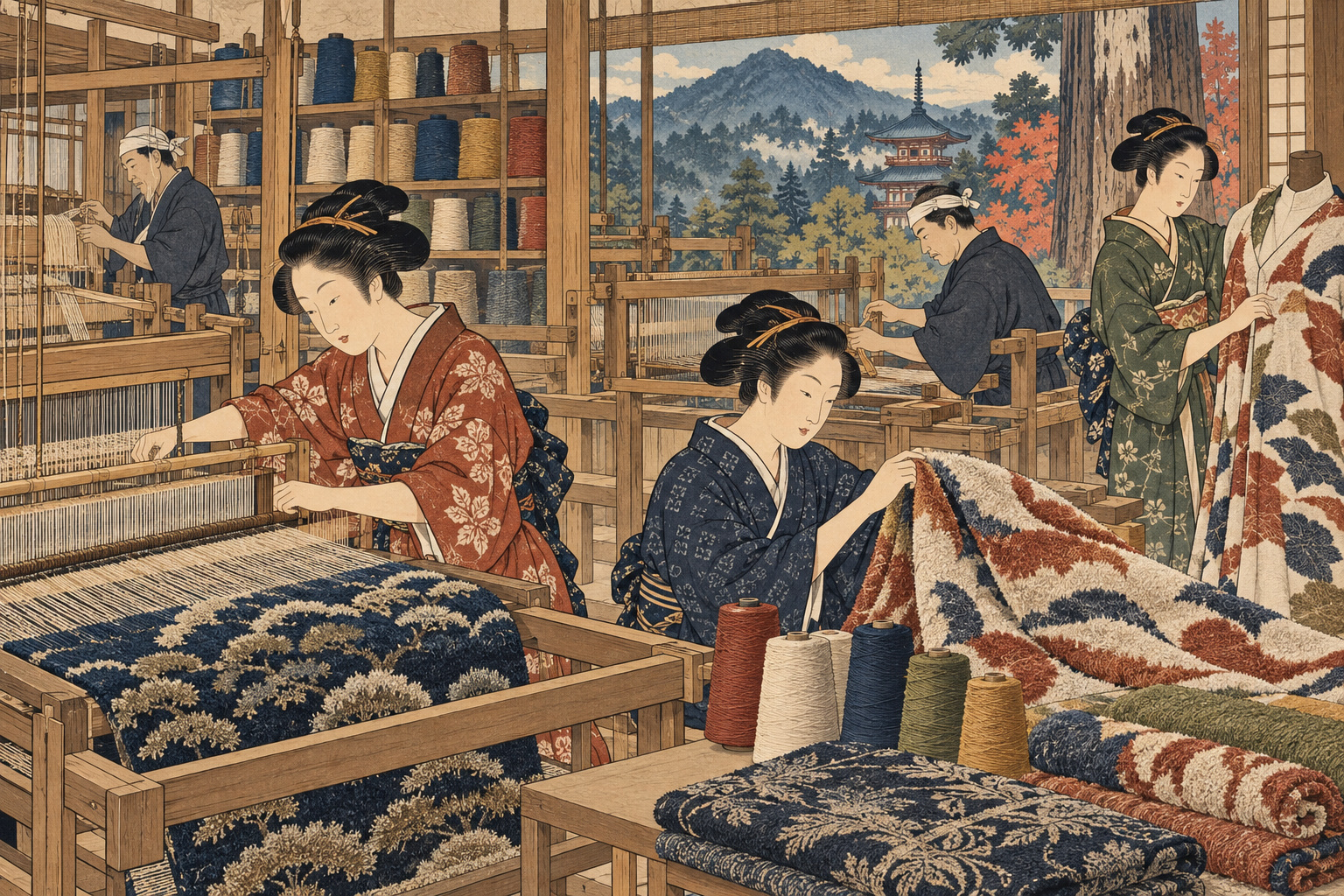
A swatch of pile fabric is a small landscape. Its fibers rise from the ground cloth in loops or cut ends; they catch light, bend under a hand and recover. Adjust the yarn, density, height, cutting and finish, and that landscape can become a coat, a blanket, an upholstered train seat, a polishing surface or a filter. In and around Koyaguchi, at the foot of Mount Koya in northern Wakayama Prefecture, generations of manufacturers have built a business around those variations.
Now the district is trying to give that unusually broad capacity a clearer public identity. The Kishu Textile Industry Cooperative and Hashimoto City launched Koyaguchi LifeTextile in August, replacing the previous Koyaguchi PileFabric brand as the production area approaches its 150th anniversary in 2027.
The official explanation loads three meanings into “Life”: living, everyday life and a human lifetime. The declared concept pictures Koyaguchi as “a town inhabited by magicians who command fibers,” while its Japanese tagline promises to pursue everything textiles can do. These are the brand owners’ words, not an independent certification. Yet the metaphor points to something real about the local economy. Koyaguchi’s product is not one protected pattern or famous household item. It is the ability to turn an unfamiliar brief into cloth by selecting from a dense network of looms, knitting machines and finishing skills.
Before pile, there was cloth—and trade
Koyaguchi did not become a textile town in a single inventive moment. According to the cooperative’s history, cotton growing, skein production and cotton weaving were well established in the Kishu domain during the Edo period. Local makers produced fabrics known as Kawakami cotton and Kawakami flannel. The skills and commercial habits required for a manufacturing district were already taking shape.
The date now used to mark the district’s birth is 1877. That year, the cooperative says, Yasuke Maeda devised saiori, a local form of chenille weaving. The method begins by weaving fabric, cutting it lengthwise into narrow strips that become fuzzy chenille yarn, and then weaving that yarn again as the weft. The Japanese name literally evokes weaving a second time. The result can carry intricate color and texture on both faces.
The cooperative says Maeda had obtained Scottish chenille fabric and worked out a production method after sustained experimentation. Orders for curtains and tablecloths came through foreign trading houses, and exports traveled to the United States and Africa. The success drew more textile businesses into the area. It is an origin story built not on preserving an isolated folk craft, but on reverse engineering an imported object, adapting it locally and selling the result overseas.
Modern Koyaguchi pile is much larger than saiori. In the Taisho era, Sadakichi Nishiyama developed what the cooperative calls seal fabric, helping production move into a mechanized, higher-volume phase. German double-pile looms arrived in the early Showa period. Pile knitting in the district can be traced to around 1907, and later decades brought rapier looms, Raschel machines, high-pile equipment and sinker-pile circular knitting. Synthetic fibers and postwar changes in homes and clothing further widened the market.
Edo period Cotton cultivation, yarn preparation and weaving form the region’s textile base.
1877 Yasuke Maeda devises the saiori chenille method.
Taisho era Sadakichi Nishiyama develops seal fabric; mechanization advances.
Early Showa German double-pile looms enter the district.
1986 The Pile Fabric Museum opens for the district’s 110th anniversary.
August 2026 Koyaguchi LifeTextile launches.
2027 The district marks 150 years.
Two cloths emerge where one knife passes
The word “pile” describes yarn that projects from a ground fabric as loops or cut fibers. A double-pile loom constructs two ground cloths at once, one above the other, with pile yarn passing between them. A blade travels through the middle and separates the structure into two facing lengths of plush fabric. Jacquard or dobby mechanisms can control pattern; dyeing, raising, shearing and other finishing processes then determine the final surface.
That is only one branch of Koyaguchi’s technical family tree. Double Raschel warp knitting can produce broad material with pile of different lengths. Sinker-pile circular knitting creates stretchable looped fabric that can remain looped, be raised into fleece or be sheared into velour. Sliver knit feeds a rope-like mass of fiber directly into a knitted base, enabling very long, dense pile for faux fur, outerwear, rugs and technical uses. The cooperative says some high-pile specifications can reach roughly 200 millimeters and two kilograms per square meter; such figures describe the district’s capability, not a universal product standard.
Machines matter, but proximity may matter more. Weaving or knitting, dyeing, raising, shearing and finishing are divided among specialist businesses in the area. Wakayama Prefecture describes Koyaguchi as Japan’s only comprehensive pile-fabric district able to complete every production stage locally. The cooperative similarly calls the wider area—Hashimoto, Kudoyama and Katsuragi—Japan’s sole production center covering both pile weaving and knitting. Those are official and industry descriptions rather than the result of a current national census with published comparison criteria. They should be read as claims about the breadth and concentration of capability.
The list of applications helps explain the claim: apparel and fashion accessories; blankets and bedding; curtains, rugs and upholstery; train, bus and automotive seating; toys and cosmetic puffs; and technical materials used in care products, paint rollers and filters. Hashimoto City says the district leads Japan in output, but the public materials reviewed for this article do not provide a current production value, workforce total or national market share. Those numbers have therefore not been estimated here.
Why replace a perfectly accurate name?
“PileFabric” said exactly what the district made. “LifeTextile” asks buyers to notice where the material goes. The organizers describe a day that begins in bedding, continues in clothing and transport, and ends again among upholstered and woven surfaces. The name also makes room for uses consumers rarely see, from care products to industrial filtration.
The new logo draws on crossing warp and weft. Its red, seal-like device is intended, the launch announcement says, to signal Japanese quality. A logo is not a technical specification or quality certification, however. Buyers still need evidence for fiber content, durability, environmental performance and traceability at the product level. The commercial value of the shared identity lies elsewhere: it can function as a front door to a fragmented supplier network, helping outside designers and manufacturers discover which local combination of skills might answer a brief.
The first major test under the new name comes in Tokyo. The 22nd “Puwapuwa” Koyaguchi LifeTextile exhibition will run at La Collezione in Minami-Aoyama on September 30 and October 1. The cooperative lists 12 participating businesses and says the business-to-business show will present new pile fabrics for apparel and interiors. On October 11, a consumer-facing LifeTextile appreciation festival at the north parking area of Koyaguchi Station will bring together 11 member companies. The program is also expected to include work by fashion-school students.
A heritage industry survives in the future tense
The district has a place devoted to memory. Its Pile Fabric Museum opened in October 1986 as a 110th-anniversary project, displaying a hand loom for saiori, specialized cutting equipment and finished goods. Workshops let visitors experience the root technique themselves. That work keeps the physical logic of the craft visible.
But preservation alone cannot keep a production network alive. Machines must receive orders; tacit knowledge must pass to people with time to practice; specialist firms must remain close enough to solve problems together. The cooperative’s own description of the October festival emphasizes local residents and especially younger generations. Its aim is not merely to sell remnants and finished goods, but to show people living nearby what their home industry actually makes.
Japan.co.jp’s analysis is that LifeTextile will matter only if it improves three connections. The first is between veteran judgment and a new workforce. The second is between a complex, divided production system and an accessible point of entry for designers, engineers and buyers. The third is between sensory promises—softness, depth, luxury—and measurable performance such as abrasion resistance, warmth, absorbency or filtration.
There is an apt lesson in saiori. Its makers did not preserve the first cloth intact. They cut it into strips, transformed those strips into yarn and wove it again, creating a surface the first weaving could not produce. Koyaguchi’s new brand attempts a similar operation on the district itself: retain the substance, change the connections, reveal another pattern. The decisive measure will not be the anniversary celebration in 2027. It will be the orders, apprenticeships and viable workshops still present when the banners come down.
- Koyaguchi: The production area centered on today’s Koyaguchi district of Hashimoto City and extending into Kudoyama and Katsuragi.
- Saiori: A chenille method in which woven cloth is cut into fuzzy strips and woven a second time as weft.
- Pile: Looped or cut yarn projecting from the surface of a ground fabric.
- Warp and weft: Warp yarns run lengthwise under tension; weft yarns cross them from side to side.
- Hashimoto City: Koyaguchi LifeTextile launch announcement—official name, concept, launch timing and mayoral statement (Japanese).
- Wakayama Prefecture: cooperative and city launch LifeTextile—anniversary and event details (Japanese).
- Kishu Textile Industry Cooperative: The Koyaguchi production district—history, processes, uses and terminology (Japanese).
- Kishu Textile Industry Cooperative: About the cooperative—membership and organization (Japanese).
- Kishu Textile Industry Cooperative: Puwapuwa 22—schedule, venue and exhibitors (Japanese).
- Kishu Textile Industry Cooperative: LifeTextile appreciation festival—local program and exhibitors (Japanese).
- Wakayama Prefecture: Koyaguchi Pile—specialization within the district and applications (Japanese).
- Hashimoto City: Koyaguchi Pile—municipal description of characteristics and uses (Japanese).
Editorial policy: Promotional language and claims of uniqueness or market leadership are attributed to their official or industry sources. Current output, employment and market-share totals were not available in the reviewed public materials and are not estimated. Forward-looking conclusions are labeled as Japan.co.jp analysis.