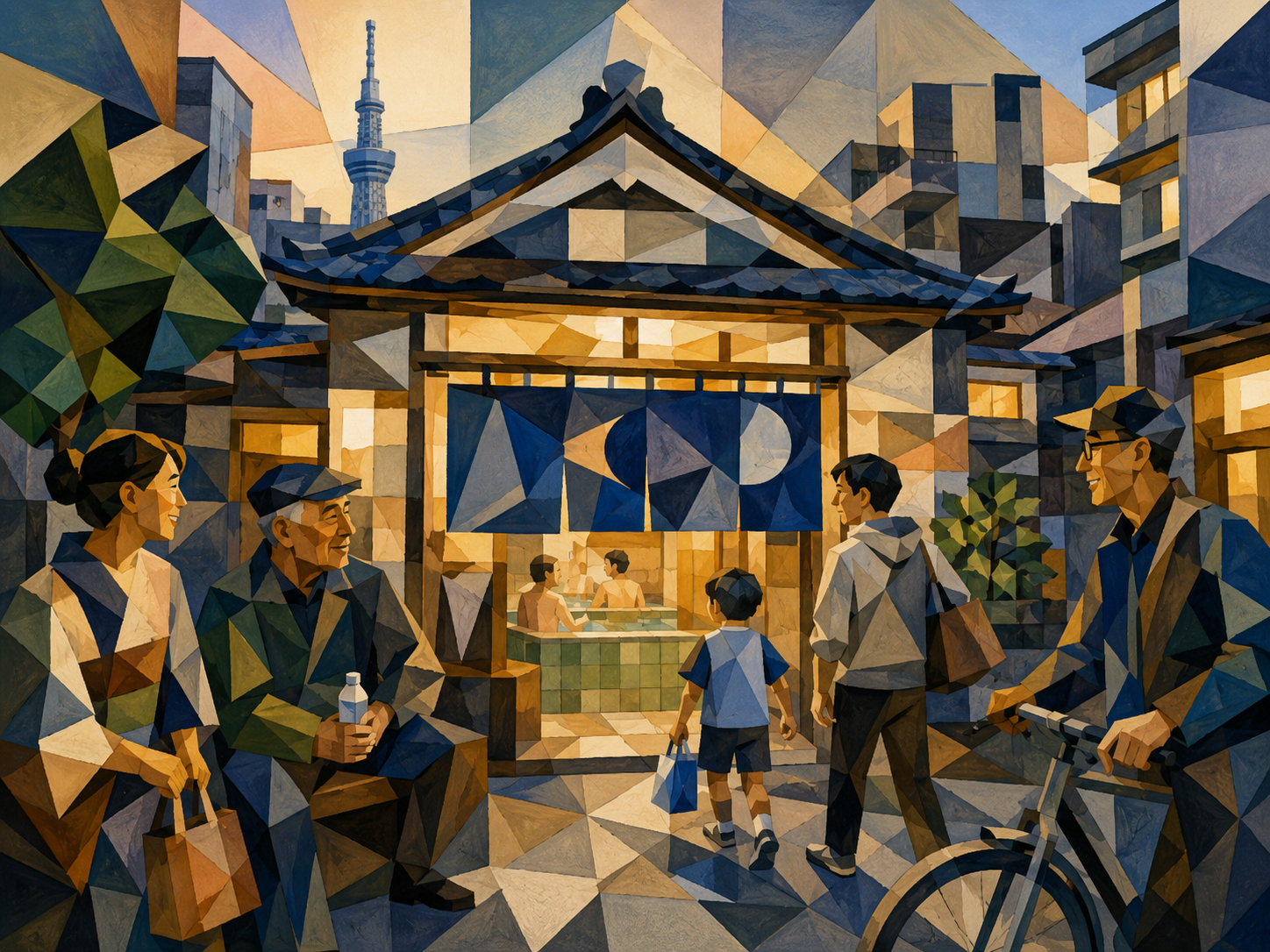
The story of Kosugiyu in Koenji is not just a sentimental tale about an old Tokyo bathhouse surviving another year. It is a larger story about how a piece of everyday infrastructure from the Showa era can be reimagined for a city of remote workers, small apartments, aging communities, young regulars, tourists, neighborhood associations, local shops and lonely urban lives. At Kosugiyu, and especially at Kosugiyu Tonari next door, the sento is no longer only a place to wash. It is becoming a living room for the neighborhood.
JapanGov recently highlighted Kosugiyu as a case where fans became community builders. The bathhouse, founded in 1933, has evolved from a sanitation facility into a local hub, and regular customers formed an independent group, Sentogurashi, that launched Kosugiyu Tonari, a shared space beside the bathhouse. The important point is not merely that a historic sento has been preserved. It is that the people who loved the bathhouse became part of its future.
Kosugiyu Tonari describes itself as a shared space with access to the public bath next door. On weekdays it works as a coworking and living space; on weekends it becomes a cafe. Visitors can relax after bathing, work, eat, read, join events or use the space like a second home. The first floor has a shared kitchen and living area, the second floor has a tatami workspace, and the third floor has a private six-tatami room with a balcony. The bath is still the heart of the model, but the experience now extends into the hours before and after the bath.
The numbers behind the sento crisis and revival
What Kosugiyu is
Kosugiyu is a public bathhouse in Koenji, Suginami Ward. Experience Suginami describes it as a beloved neighborhood sento that has kept the community warm since 1933 and became a National Tangible Cultural Property in 2021. It is about a five-minute walk from JR Koenji Station. The listing includes practical details such as admission prices, towel rental, hours and phone number, which matters because Kosugiyu is not a frozen tourist object. It is still a working neighborhood bath.
Its appeal is not simply age. Kosugiyu is known for its milk bath, jet baths, rotating themed baths, events, collaborations with artists and local businesses, and even runner-friendly programs. It fits Koenji’s personality: vintage clothing, live music, small shops, local eccentricity, and the freewheeling culture of Tokyo’s Chuo Line. Kosugiyu does not preserve tradition by sealing it off. It lets the neighborhood’s present-day character enter the steam.
What makes the current story especially interesting is the connection beyond the bathhouse itself. Kosugiyu Tonari does not merely add a cafe counter or a renovated lobby. It adds time, space and social possibility around the bath. You can soak, then read. Bathe, then work. Sit with a drink. Join a market. Talk to someone you have seen every week but never had a reason to speak with. It turns the sento from a single point on the map into a small neighborhood ecosystem.
From Edo to the modern city
The history of sento is close to the history of Tokyo itself. Nippon.com notes that the first public bathhouse in Edo, the former name for Tokyo, is said to have opened in 1591 near what is now Otemachi. Bathhouses spread quickly and became part of everyday life for common people during the Edo period. By 1810, records suggest there were 523 sento in the city. In a dense wooden city where most homes did not have private baths, the sento was a hygiene facility, an information network and a daily rhythm.
Edo-period bathhouses were not the bright tiled facilities many people imagine today. They were often low, dark, steamy rooms designed to retain heat. Through the Meiji period, new ideas about hygiene, public morality, ventilation and gender separation changed the form of the bathhouse. By 1908, Tokyo had 1,217 sento. Nationwide, public baths reached a postwar high of 18,325 in 1968, according to bathhouse association materials cited by Nippon.com. For much of modern Japan, sento were not nostalgic. They were infrastructure.
Tokyo also developed a distinctive architectural image of the sento. Many people associate Tokyo bathhouses with miyazukuri structures that resemble temples and shrines. That style is linked to rebuilding after the 1923 Great Kanto Earthquake, when carpenters with shrine-building skills created bathhouses that could lift the spirits of damaged neighborhoods. Curved gables, noren curtains, Fuji murals and high ceilings made the sento not only useful, but beautiful.
Why the bathhouses disappeared
The decline of the sento came partly from success. As postwar housing improved and private baths became common, the original need for public bathing diminished. The Tokyo Sento Association explains that the number of sento declined from around 1965 as more homes acquired baths. Tokyo Updates reports that sento use peaked in the 1960s and then fell as homes and apartments installed private bathrooms. By December 2024, roughly 430 sento remained in Tokyo.
The decline is also economic. Bathhouses face high fuel, electricity, water, repair and maintenance costs. Many owners are aging. Heirs may not want to continue the business. Land in Tokyo can be more profitable as an apartment building, shop or redevelopment site. A sento has to heat a large amount of water every day while keeping admission affordable. To keep one open is not only a cultural decision; it is a business commitment.
Yet the sento is being revalued. The Tokyo Sento Association now describes sento as a kind of “hot spring in town,” an inexpensive leisure and relaxation space. Tokyo Updates notes that younger users are rediscovering sento, helped by the sauna boom and the appeal of affordable bathing. The same facility that once served as a household substitute can now function as wellness, community and urban refreshment.
The invention of Kosugiyu Tonari
Kosugiyu Tonari’s genius is that it does not try to make the bathhouse do everything. Instead, it creates a neighboring space for the hours around bathing. The shared kitchen, living room, tatami coworking area, bookshelves, cafe, drop-in plans, post-bath drinks and private room all make the visit last longer and mean more. They do not replace the bath. They protect it by giving people more reasons to return.
The official site presents Kosugiyu Tonari as a place that can become a second home. There are membership and drop-in options, a weekend cafe, a plan that includes a bath ticket, and takeaway drinks such as craft cola and beer. The project has also expanded into what it calls a bathhouse apartment model, using vacant houses in the surrounding area. The bath is at Kosugiyu, the kitchen and workspace are at Kosugiyu Tonari, and the bedroom is in a nearby apartment. Home becomes something distributed through the neighborhood.
That idea fits Tokyo’s current problems. Many people live in small rooms. Remote work has blurred the boundary between home and office. Single-person households are common. Neighborhood ties can be weak. Kosugiyu Tonari offers what a private apartment, office and cafe each lack: a local place where people can come back repeatedly, be known lightly, and stay without the pressure of a formal membership club.
When regulars become operators
The most important part of the Kosugiyu story is that regulars helped make the new model. JapanGov’s post emphasizes that this revitalization was driven by fans, not merely by the business itself. Sentogurashi, the team behind Kosugiyu Tonari and related bathhouse-lifestyle projects, began with regular customers who lived in a bathless apartment next to Kosugiyu. They understood the bathhouse not as a brand concept, but as a daily necessity and pleasure.
That matters for local revitalization. Government subsidies alone rarely create living culture. Tourism alone can turn a neighborhood place into a performance. Corporate capital can renovate a building while flattening its soul. Regulars know what must not be changed. They also know what must change if the place is to remain alive. Kosugiyu feels both old and new because the people involved are not outsiders decorating tradition; they are users extending it.
The sento is also unusually good at mixing generations. Families, students, retirees, office workers, shop owners, foreign visitors, runners and longtime residents can all use the same bath. In the bath itself, clothing and status are temporarily removed. The Tokyo Sento Association describes public baths as places where neighbors meet and generations gather, encouraging direct communication and mutual respect. Kosugiyu Tonari extends that quality beyond the changing room and into the neighborhood.
Can the model travel?
Kosugiyu cannot simply be copied everywhere. It depends on Koenji’s density, Chuo Line culture, a historic building, a passionate user base, a nearby property, a capable operating team and a city where people need third places. But the principle can travel: a sento should not be supported only by admission fees. It can become a platform for neighborhood time.
That platform might connect with vacant houses, small food businesses, markets, art, books, running, childcare, elder care, remote work, local history or tourism. The bath creates a reason to return. The location inside a residential area gives it everyday relevance. The price keeps it accessible. The ritual gives it emotional depth. A neighborhood that loses its sento loses more than tubs and tiles; it loses a repeating social rhythm.
Sento & Neighborhood, a nonprofit founded in Tokyo in 2020, calls sento essential nodes of local communities and notes that Tokyo’s public baths have fallen from more than 2,500 in the late 1960s to fewer than 430 in 2024. Its work on restoration, documentation and neighborhood use places Kosugiyu in a broader movement: not nostalgia for old buildings, but a search for sustainable urban commons.
Japan.co.jp view
The reason this story works is that it is not only nostalgic. Japan has many beautiful stories about saving old things. Kosugiyu is more interesting because it uses an old thing to make new city life. It does not turn the bathhouse into a museum. It keeps it wet, warm, social and useful.
In 2026 Tokyo, loneliness, summer heat, cramped housing, remote work and weakened neighborhood participation are all real problems. Kosugiyu Tonari is a small answer to all of them. Take a bath. Cool down. Work on tatami. Eat in a shared kitchen. Meet a regular. Join an event. Maybe volunteer in a neighborhood association or fire brigade. The city is not repaired only by big policy. It is repaired by repeated routes through ordinary places.
The future of the sento is not a return to the era when homes lacked baths. That world is gone. But even when every home has a private bath, a city may still need a public one. Kosugiyu shows why. A bath can warm the body. A good sento can warm the neighborhood.
Reader guide
| Question | What to understand |
|---|---|
| What is happening? | Kosugiyu and Kosugiyu Tonari are drawing attention as a model for turning a traditional bathhouse into a broader community, work and cafe space. |
| What is the history? | Sento grew from Edo-period urban life, became essential modern hygiene infrastructure, and declined after private bathrooms became common. |
| What is the crisis? | Tokyo’s public baths have fallen sharply from their 1960s peak, facing fuel, maintenance, succession and redevelopment pressures. |
| What is new? | Bathhouses are being revalued through sauna culture, wellness, community events, remote work, local tourism and heritage preservation. |
| Japan.co.jp view | Kosugiyu is a Tokyo model for reconnecting old infrastructure to modern neighborhood life. |
Sources and references
This article draws on JapanGov, Kosugiyu Tonari, Tokyo Metropolitan Government’s Tokyo Updates, the Tokyo Sento Association, Experience Suginami, Sento & Neighborhood, and Nippon.com’s historical accounts of sento culture. Hours, prices, and programs may change.