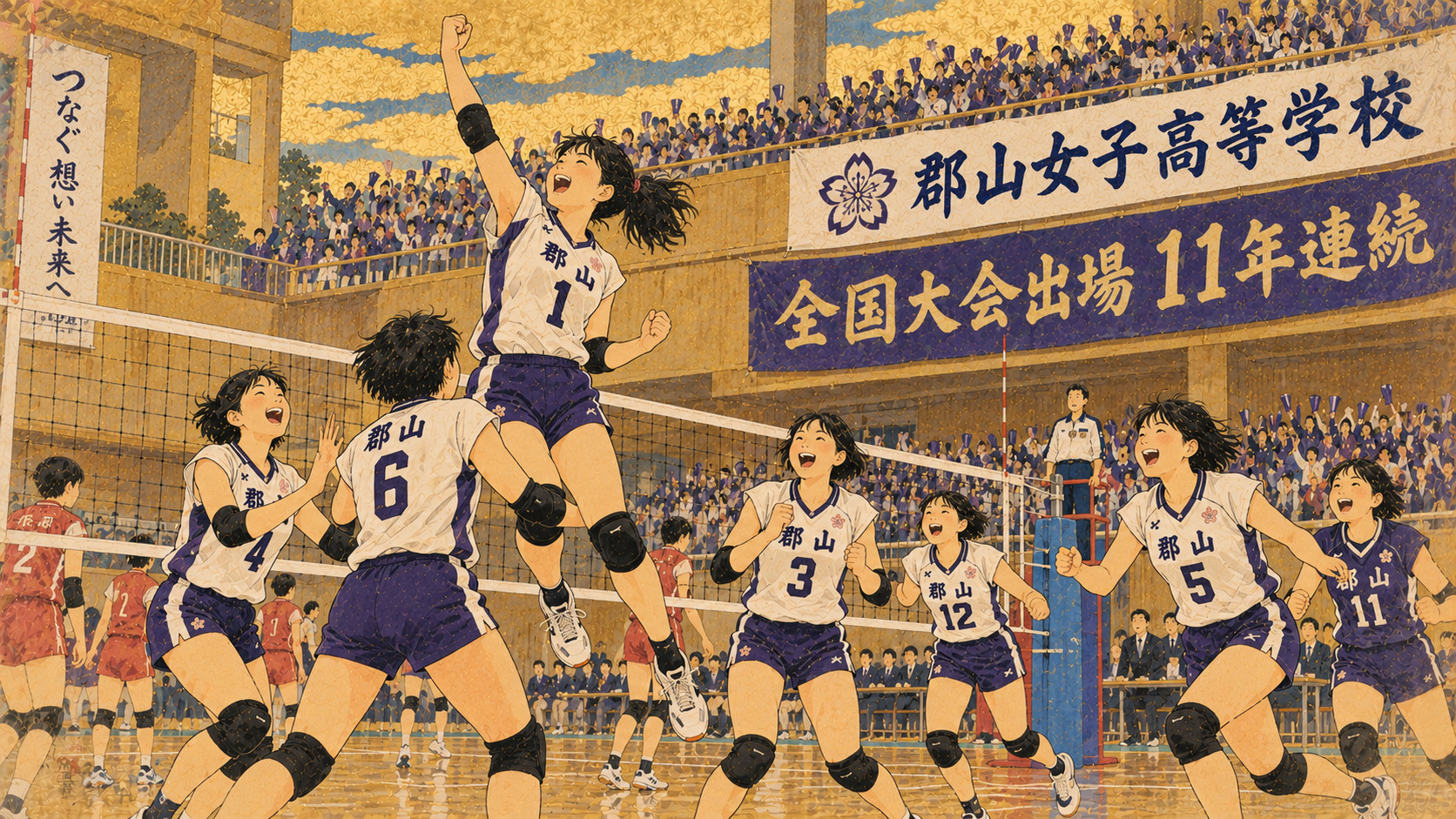
Eleven seasons, a new group of players
At a high-school tournament in Fukushima City on October 28, Koriyama Women’s University High School did what generations of its players have done before: win the prefecture’s coveted place in Japan’s national Spring High volleyball championship. The school defeated Seiko Gakuin High School in straight sets, securing an eleventh consecutive qualifying appearance and its twenty-eighth overall. The remarkable streak belongs to a program, not to any single group of teenagers. That is what makes the achievement worth examining.
The final, set by set
The scores were 25–18, 25–16 and 25–19. Fukushima Television reported that right-side attacker Karin Sato helped set the pace in the opener. Seiko Gakuin did not surrender quietly: it produced five straight points during the third set before Koriyama closed out the match. A three-set result should not erase the efforts of the runners-up, who had been pursuing their first national berth.
The difference between a prefectural dynasty and a national title
The 11-year streak represents consecutive appearances at the national tournament by winning Fukushima’s representative competition. The figure of 28 counts the school’s total appearances. Neither number means that the school has won 11 straight national championships. The school’s own October 29 victory notice and national tournament coverage support the distinction. It matters because regional sporting excellence deserves accurate measurement, not inflated claims.
What happened before the final
The prefectural competition gathered eight girls’ teams over October 27–28. Koriyama entered as the top seed and advanced past Fukushima Seikei in the semifinal. Published results record an especially tense second set, 34–32, in that encounter. Seiko Gakuin reached the final after defeating Wakamatsu Commercial, setting up a meeting between the established favorite and an ambitious challenger. Dominance in the final was earned through a difficult route, not awarded in advance.
The captain wants a different measure of success
After the final, third-year player and captain Hina Seino spoke to Fukushima Television about showing the team’s own enjoyable style of volleyball and reaching the national last 16. Earlier in October, she had reflected publicly on an Inter-High performance in which the team had been unable to display its full ability. Rather than claiming that a particular strategy guarantees progress, the story emerging from her remarks is more grounded: a perennial prefectural champion is still trying to become better on the larger stage.
The school grew from a postwar educational mission
Founded in 1957 as Koriyama’s first private girls’ high school, the institution was part of a broader effort to expand women’s educational opportunities in northeastern Japan. Its governing Koriyama Kaisei Gakuen organization traces its educational origins to the Koriyama Women’s Specialized Academy, established in 1947, shortly after the war. The school subsequently added music, design and food-related programs alongside general education. Its athletic success is one visible chapter in a much wider regional history of education for girls and young women.
What an enduring school program can—and cannot—tell us
A run spanning eleven tournaments requires a team to replace graduating players repeatedly. That makes continuity itself noteworthy. But it would be unjustified to attribute the results to a particular training method, recruitment practice or coaching philosophy without interviewing the people involved or obtaining reliable documentation. The school states that its founding educational values are respect, responsibility and freedom; that statement describes institutional philosophy, not scientific evidence of why the volleyball team wins.
Why a regional title matters internationally
Japanese school volleyball combines local affiliation, disciplined competition and a national spotlight. A team from Fukushima competing in Tokyo gives students a platform outside their prefecture and offers younger athletes an example to follow. The achievement also belongs to the wider ecosystem of opponents, clubs, teachers and families that make school sport possible. Seiko Gakuin’s emerging challenge is part of that story, not an afterthought.
Next stop: Tokyo, January 2027
The Japan Volleyball Association schedules the 79th All Japan High School Volleyball Championship for January 4–7 and 9–10, 2027 at Tokyo Metropolitan Gymnasium. The national draw is scheduled for November 29. As of this edition, Koriyama’s opening opponent and its eventual tournament results are unknown. The captain’s target of reaching the last 16 is an ambition, not a prediction.
A streak that must be renewed
There is a paradox in a long winning run: outsiders see eleven straight years, while each graduating class experiences its own uncertain season. A 3–0 victory over Seiko Gakuin allows the current students to enter the same national arena as their predecessors. What happens next will belong to them. That is a more compelling story than any suggestion that the past can win their future matches.
Sources and verification
Based on published school, organizer and contemporary reporting records. No independent player or coach interviews were conducted.