A bird need not perform to hold our attention
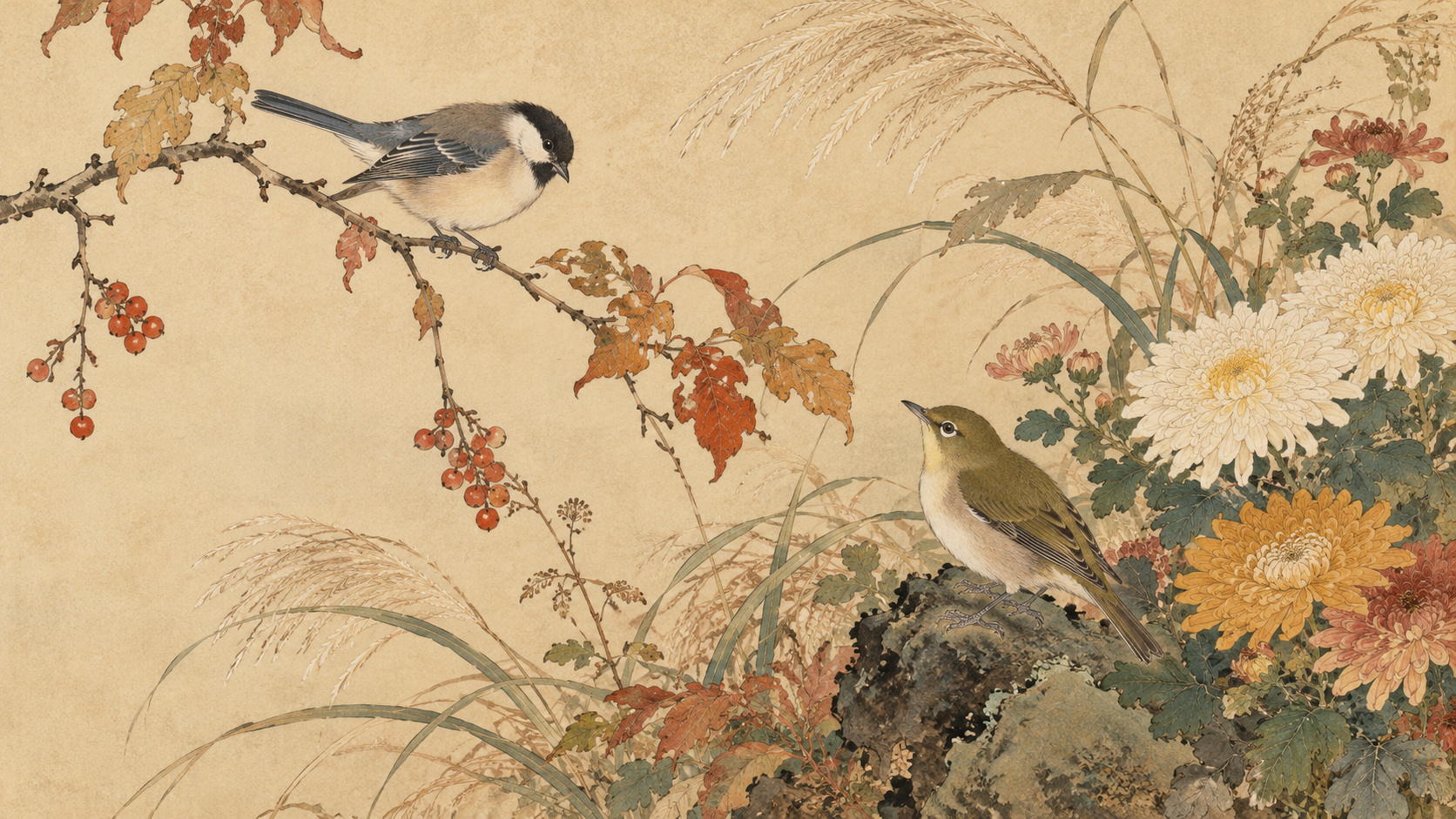
In a Bairei print, a bird can be doing almost nothing: settling its weight on a branch, turning toward the next sound, holding still as a flowering stem bends nearby. That modest scene is enough. Look longer and the composition begins to reveal what the artist cared about—balance, the direction of a gaze, the architecture of feathers, the space around living things.
Kōno Bairei (1844–1895), a Kyoto painter and influential teacher, belongs in the history of modern Japanese art for more than graceful birds. His work connects a long painting tradition to Meiji-period print culture and to the generation of artists who helped reinvent Japanese painting. His books also pose a question that has fresh relevance: what changes when careful observation becomes an artistic discipline?
A painter standing at a crossroads
The roots of Bairei’s approach lie in Kyoto’s Shijō school, founded by Goshun and carried forward through several generations of teachers. The Kyoto City KYOCERA Museum of Art traces a line through Matsumura Keibun, Okamoto Toyohiko and Shiokawa Bunrin to Bairei, Bunrin’s pupil. Across those generations, subjects drawn from nature could be closely studied while still being composed for expressive effect.
Bairei lived through the upheaval of the Meiji Restoration. Patronage, institutions and markets for pictures changed. At the same time, the new state promoted industrial production, exhibitions and arts education. In Kyoto, the relationship between painting, craft design and formal instruction became particularly significant. A bird album printed in this environment was not simply an echo of an older age. It was also a modern vehicle for transmitting ways of seeing.
The book that crossed oceans
His best-known publication is *Bairei hyakuchō gafu*, conventionally translated as *Bairei Picture Album of One Hundred Birds*. The National Diet Library lists publication by Kineidō in 1881–1884 and describes six books in all: three volumes of the original series, named Heaven, Earth and Human, and three supplementary volumes. The Metropolitan Museum of Art catalogues three-volume sets in its own collection. The difference reflects the scope of particular holdings, not contradictory dates for the entire project.
These are color woodblock-printed books, not paintings transferred mechanically onto paper. A printed image required skilled carving, registration and impressions. The format mattered as much as the subject: sheets could circulate far beyond the painter’s studio, opening his compositions to new viewers, students and collectors. The Met now makes images of its holdings freely accessible as public-domain resources, adding another chapter to that journey.
Observation is not the same as a field guide
A branch in Bairei’s work is not background filler. Its angle establishes the bird’s footing; leaves and flowers convey proportion and season. The blank paper around the form gives movement somewhere to happen. Detail and omission operate together. In an era of instant photography and searchable species databases, these prints reward a slower kind of identification: how precisely has the artist made a living presence believable?
It is tempting to call the pictures scientific illustrations. That would oversimplify them. Bairei was not publishing a modern ornithological field manual, and the album’s title should not be treated as a verified census of exactly one hundred biological species. Artistic selection governs the pose, color relationships and arrangement. Their remarkable achievement is not that art yielded to science, but that watching closely could make art richer.
The teacher behind future masters
Bairei’s influence did not end with his own prints. Museum histories name Kikuchi Hōbun, Taniguchi Kōkyō, Takeuchi Seihō and Tsuji Kakō among those who followed his instruction. Uemura Shōen, later celebrated for her distinctive portraits of women, studied under Bairei after earlier training with Suzuki Shōnen, then continued under Takeuchi following Bairei’s death.
Kyoto established the Kyoto Prefectural School of Painting in 1880, bringing different artistic traditions into an institutional setting. Its successors helped shape modern Japanese painting. The story of this period is not simply one genius replacing another. Skills were taught, questioned, adapted and carried forward. Bairei helped sustain that chain of transmission while younger painters pushed beyond the conventions they inherited.
More than the bird painter
Bairei also painted figures and larger-format works. Kyoto museum records include *Maiko and Birdcage* (1876) and *Woman* (1873) in exhibitions of Meiji art, while *Screen with Mounted Paintings of Birds, Flowers and Landscapes* has been used to illustrate the history of Kyoto art education. A focus on his bird books should not erase this breadth.
Nor is this article announcing a newly discovered Bairei masterpiece. Its purpose is renewed attention: to bring together Japanese scholarly and museum sources with the international collections through which readers can encounter his art. The objects were made more than a century ago; the invitation to look remains current.
Two images, two very different claims
For this edition, Japan.co.jp commissioned a contemporary illustration inspired by Bairei’s birds-and-flowers vocabulary. It is clearly labeled as an editorial interpretation, not a historic Bairei image. The original album can be explored through the Metropolitan Museum’s public-domain digital records, where the institution, accession number and publication period are documented. That distinction matters: an attractive modern image must never be passed off as a nineteenth-century artwork.
The lesson of Bairei is wonderfully undramatic. You can enlarge a world by attending to a small part of it. A bird on a stem is a lesson in movement, design, restraint and curiosity. In the late nineteenth century he helped teach Kyoto’s artists to see; his pages can still teach the rest of us to linger.
Sources and further reading
- Kyoto City KYOCERA Museum of Art: the Shijō school and Bairei
- Kyoto City KYOCERA Museum: training modern Kyoto painters
- Kyoto City KYOCERA Museum: Uemura Shōen and Bairei
- National Diet Library: bibliographic record
- CiNii Books: publication and volume records
- The Metropolitan Museum of Art: Bairei Picture Album
- Met Libraries: digitized public-domain folios
- National Museum of Modern Art, Kyoto: Meiji painting and crafts