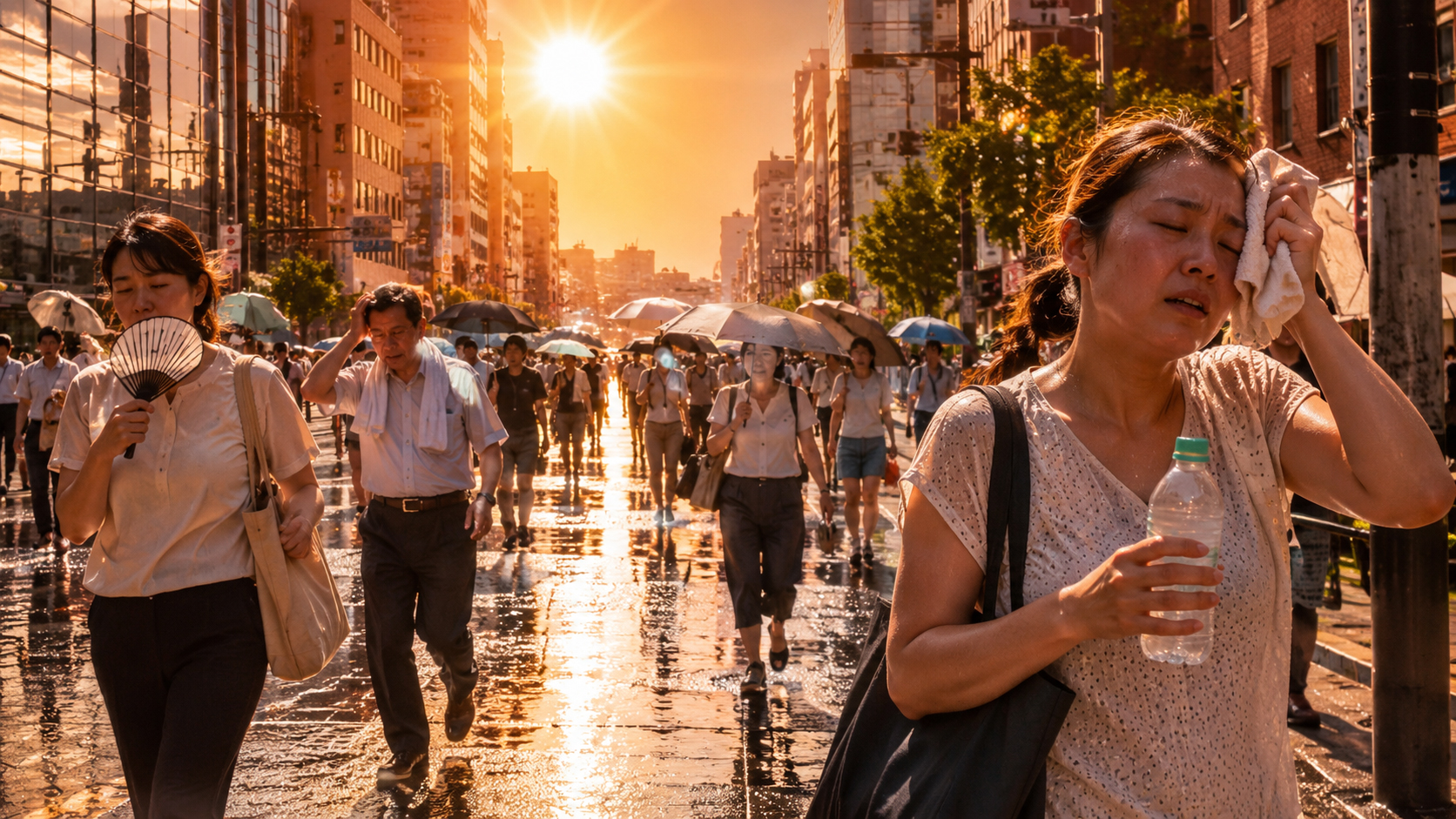
Japan’s summer has always had words. Natsubi, a summer day. Manatsubi, a midsummer day. Mōshobi, an extremely hot day. These terms moved from the weather forecast into everyday life, helping people decide what to wear, when to shop, whether to exercise, and how to plan a commute. In 2026, another word joined that ladder of heat: kokushobi. On April 17, the Japan Meteorological Agency announced that days with a maximum temperature of 40°C or higher would be called kokushobi—literally, a brutally or cruelly hot day. The term is short, severe, and intentionally hard to ignore.
This is not just a linguistic update. It is a signal that Japan’s summer has entered a different stage. Forty-degree heat is not merely an extension of ordinary discomfort. It affects elderly people living alone, outdoor workers, schoolchildren, tourists, emergency rooms, power demand, agriculture, housing, and city design. If a 35°C day is already dangerous, a 40°C day is a threshold at which normal routines must be questioned. Kokushobi gives the country a shared word for that threshold.
Why Japan needed a new word
The JMA chose kokushobi after a public survey and expert consultation. Japan already had established terms for days of 25°C, 30°C, and 35°C or higher, but no official forecast term for 40°C. For decades that omission made sense. Forty degrees was treated as exceptional. But as Japan has recorded 40°C days more regularly, the gap became harder to justify. A new condition needed a new warning word.
What makes 40°C dangerous is not just the number itself. Heat accumulates. Asphalt radiates. Concrete holds warmth long after sunset. Humidity weakens the body’s ability to cool itself through sweat. Urban canyons reduce airflow. At street level, children and wheelchair users can experience harsher heat from reflected ground radiation. By night, apartments may remain hot enough to prevent sleep. Extreme heat is therefore both an outdoor and an indoor hazard.
It is a social instruction: treat this day differently.
The danger inside the home
When people imagine heatstroke, they often picture construction sites, sports fields, or sun-baked sidewalks. But some of the most dangerous heat exposure happens indoors. Older residents in small apartments, people living alone, households worried about electricity costs, and residents of poorly insulated buildings can face rising temperatures even without leaving home. Air conditioning may be present but unused because of cost concerns, discomfort, old habits, or simple isolation.
That is why Japan’s heat problem is inseparable from aging. An extreme-heat warning is also a welfare warning. On a kokushobi, local governments, families, care workers, neighbors, and building managers cannot stop at saying, “Please be careful.” The more practical questions are sharper: Is the air conditioner on? Is there water nearby? Is the room cool enough at night? Does someone know to call if the resident becomes confused or weak?
Outdoor labor in a new climate
Construction, delivery, road work, farming, security, logistics, and event operations all depend on people who cannot simply retreat indoors whenever the temperature rises. But kokushobi-level heat is not a matter of toughness. It requires work redesign. Shade, cooling vests, breathable clothing, air-conditioned rest areas, water, salt, rescheduled shifts, and the authority to stop work all become part of safety management.
The key is the word “authority.” Equipment helps, but heat safety ultimately depends on whether supervisors can change plans. Heat illness often develops gradually: fatigue rises, attention slips, the body loses its ability to regulate temperature, and a routine task becomes dangerous. A forecasted kokushobi should tell a worksite that the day is not normal, and that normal expectations may be unsafe.

Schools, sports, and the end of “as scheduled”
Schools face one of the hardest transitions. Commuting, physical education, sports clubs, school festivals, field trips, and outdoor ceremonies have long followed calendars shaped by tradition. But children are especially vulnerable to heat. They are closer to hot ground surfaces, may not recognize early symptoms, and may hesitate to speak up during group activities. Gymnasiums without adequate cooling can also become dangerous indoor spaces.
In the kokushobi era, “as scheduled” can no longer be the default. Schools need protocols that make cancellation, postponement, shorter practice, indoor alternatives, cooling spaces, and active monitoring normal rather than exceptional. Extreme heat should not require teachers to improvise under pressure every time it arrives.
Tourism in a hotter Japan
Summer tourism in Japan remains powerful: festivals, fireworks, beaches, mountains, shaved ice, yukata, and long evenings. Yet extreme heat changes the visitor experience. Many foreign travelers are unfamiliar with Japan’s humid summers. They often pack ambitious itineraries, walk long distances, wait in lines, and climb sun-exposed shrine steps or castle approaches. Language barriers can weaken warnings. Crowding can make it harder to rest.
For tourist destinations, a kokushobi is a hospitality challenge. Visitors need shade, water, rest points, multilingual alerts, cooling spaces, and clear advice on when not to walk. As heat intensifies, the best tourism cities will not only be beautiful. They will be navigable, shaded, and survivable.
Cities that store heat
Urban Japan amplifies heat. Asphalt, glass, concrete, air-conditioner exhaust, narrow streets, limited shade, and reduced airflow all contribute to the heat-island effect. Daytime heat is only half the story; nighttime heat can be just as dangerous because it prevents recovery. When buildings and roads radiate stored heat into the night, sleep quality falls and health risk carries into the next day.
That means kokushobi is not only a personal-behavior issue. It is an urban-planning issue. Street trees, shaded sidewalks, reflective surfaces, insulation, water features, public cooling shelters, transit design, and emergency power planning all matter. A city built for yesterday’s summer may not protect residents in tomorrow’s one.
Can a word change behavior?
Weather terminology matters when it changes decisions. Japan has already learned this through disaster language: warnings, special warnings, and new terms for dangerous rain patterns influence whether people evacuate or stay put. Kokushobi should work the same way. It should prompt employers to adjust work, schools to change schedules, families to check on elderly relatives, tourists to shorten outdoor routes, and municipalities to open cooling spaces.
At first, the new term may sound like a news curiosity. Over time, it could become a practical trigger. “Tomorrow is a kokushobi, so shopping should be done in the morning.” “Practice is cancelled.” “Call your parents.” “Move the walking tour indoors.” If the word produces decisions like those, it will have done more than describe the weather. It will have helped save lives.
- How widely kokushobi appears in forecasts, media, schools, and local government alerts
- Whether workplaces adopt specific 40°C protocols rather than relying on general heat advice
- How municipalities support air-conditioning use and indoor heat safety for older residents
- Whether tourist areas redesign summer movement around shade, rest, water, and multilingual warnings
- How cities adapt streets, buildings, and public spaces to hotter nights as well as hotter days
Loving summer, fearing summer
Japan has not stopped loving summer. Fireworks, wind chimes, morning glories, festivals, beaches, and Bon dances remain part of the country’s cultural rhythm. But the kokushobi era requires a new balance: enjoy summer, but do not romanticize heat. A society that ignores extreme temperatures will not preserve its traditions; it will endanger the people who sustain them.
The naming of kokushobi tells us that 40°C is no longer a freak headline. It is a foreseeable condition. Once a condition is named, society becomes responsible for responding to it. Who works outside? Who lives alone? Which schools close? Which streets have shade? Which stations provide cooling? Japan’s summer is no longer only a matter of weather. It is becoming a test of social design.
Sources
This report was based on public materials from the Japan Meteorological Agency, health-policy sources, and climate-health reporting.
- Japan Meteorological Agency: naming days of 40°C or higher kokushobi
- Japan Meteorological Agency: daily counts of summer, extreme-heat, and severe-heat days
- Nippon.com: Severe Heat—Japan adopts official name for 40°C days
- Health and Global Policy Institute: warning from unprecedented heat in Japan
- Reuters: Japanese firms protect outdoor workers during severe heat
- Lancet Countdown: health and climate change in Japan