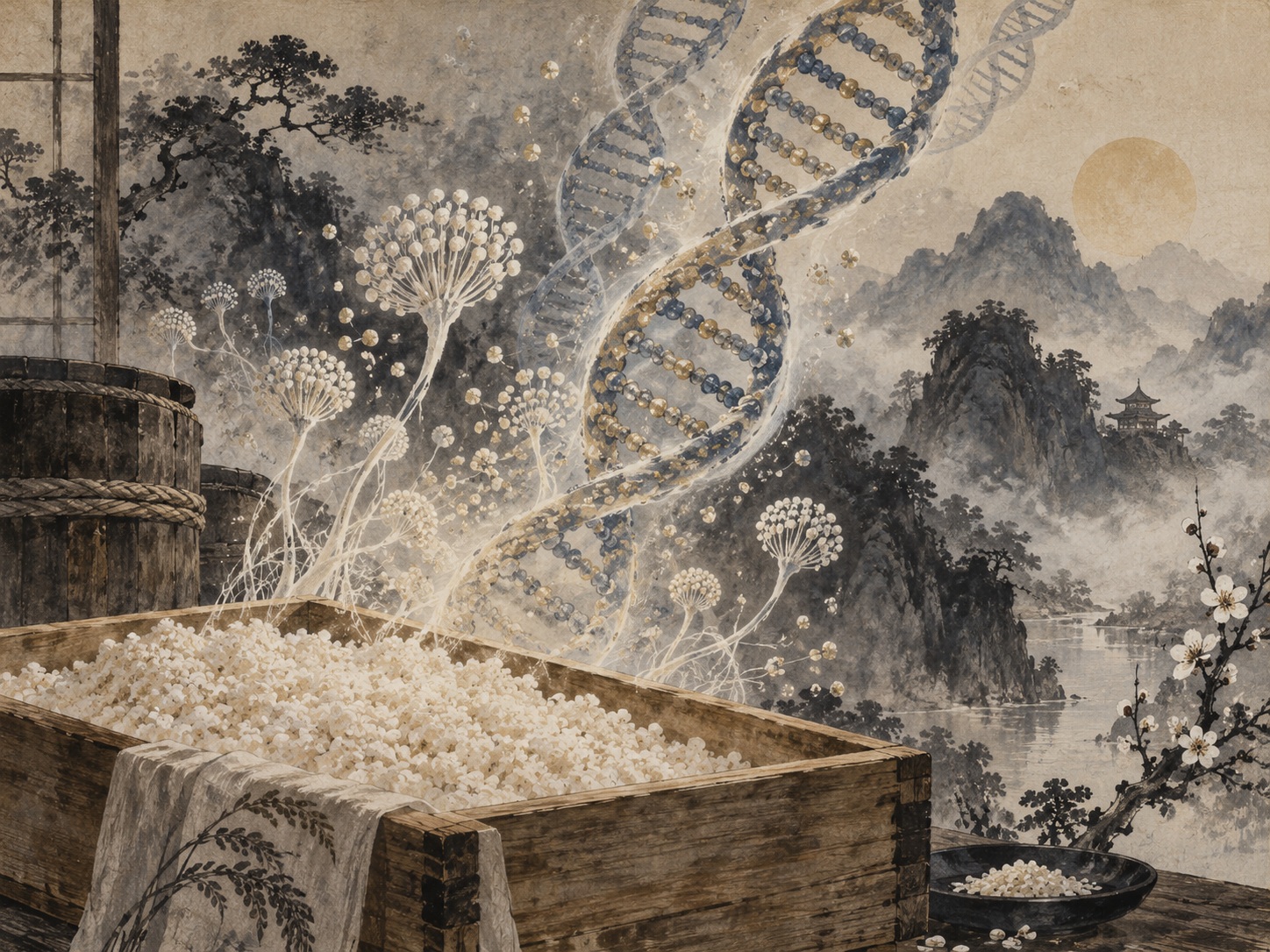
Sake, miso, soy sauce, mirin and amazake all depend on a fungus that has lived alongside Japanese food culture for centuries. Now researchers have found that the genome of that fungus contains enormous mobile DNA elements that behave almost like cargo vessels, carrying groups of genes from one genomic location — and perhaps one strain or species — to another.
A team led by Jun-ichi Maruyama at the University of Tokyo and Shuji Shigenobu at Japan’s National Institute for Basic Biology has identified multiple giant transposable elements known as “Starships” in Aspergillus oryzae, the domesticated koji mold used throughout Japanese fermentation. Their comparative genomic analysis suggests that Starships were gained, lost and possibly transferred horizontally as koji differentiated from its relatives and diversified into practical strains for sake, miso and soy-sauce production.[1]
What exactly is a Starship?
Transposons are mobile DNA sequences capable of changing position within genomes. Many familiar transposable elements are relatively small. The University of Tokyo describes fungal Starships as a much larger class, spanning roughly 15 to 700 kilobase pairs.[1]
That scale matters. A Starship can carry many complete genes rather than simply moving a small regulatory sequence. These “cargo genes” can potentially change a fungus’s metabolism, stress tolerance or interactions with its environment.
Starships characteristically contain a tyrosine recombinase gene near one end, thought to be involved in their mobility. Previous fungal studies have linked Starship cargo to traits including heavy-metal tolerance, formaldehyde tolerance and pathogenicity. The new work shows that this evolutionary machinery is also active in a fungus domesticated for food.
Koji is a domesticated organism
Aspergillus oryzae is thought to have differentiated from a lineage closely related to Aspergillus flavus. Some A. flavus strains produce aflatoxins, potent carcinogenic compounds, while koji has been selected and used safely for food fermentation over a very long period.
Domestication is not limited to dogs, cattle or crops. Microorganisms can also be domesticated. When humans repeatedly preserve, propagate and reuse strains with desirable traits, those populations accumulate genetic differences from their wild relatives.
Sake and miso strains carried extra amylase cargo
One of the most striking findings is the relationship between Starship cargo and industrial use.
Some strains used for sake and miso contained Starships carrying alpha-amylase genes. The researchers concluded that Starship activity appears to have contributed to increased copy number of these genes.[1]
That is important because starch breakdown is central to sake brewing. Yeast cannot efficiently ferment rice starch directly. Koji produces amylases that break starch into fermentable sugars, which yeast then converts to alcohol.
Soy-sauce strains carried plant-cell-wall enzymes
Starships in soy-sauce strains contained characteristic cellulase and xylanase genes — enzymes capable of breaking down major components of plant cell walls.[1]
Soy sauce is produced from soybeans and wheat, so the ability to break down complex plant material can influence fermentation performance and the release of nutrients and flavor precursors. The genomic pattern raises the possibility that Starships helped assemble useful combinations of genes in strains selected for specific fermentation jobs.
These elements may have crossed strain — and species — boundaries
The researchers found evidence suggesting that Starships did more than move around within individual genomes.
Comparisons with A. flavus identified some Starships consistent with inheritance from a common ancestor, but also patterns suggesting gains and losses during koji domestication. Sequence relationships among A. oryzae strains were consistent with horizontal transfer between strains.[1]
The team also found a similar Starship in the more distantly related red-koji fungus Monascus purpureus, raising the possibility that a giant element crossed a species boundary.
Horizontal transfer changes the normal family-tree model
Genes are usually imagined as moving vertically, from parent to offspring. Horizontal gene transfer means genetic material moves between organisms outside that parent-child pathway.
This is famously important in bacteria, where antibiotic-resistance genes can spread between lineages. Fungal genome studies are increasingly showing that mobile elements can also mediate horizontal exchange in eukaryotic microbes. A 2026 Nature Communications study found multiple lines of evidence for past horizontal movement of transposable elements associated with fungal Starships.[2]
Mobile DNA was once treated mainly as genomic clutter
Transposable elements were once commonly discussed as selfish or junk DNA — sequences that copied themselves without obvious benefit to the host. That view has changed. Mobile elements can reorganize genomes, change gene regulation and create new combinations of genes on which evolution can act.
Starships extend that idea to a much larger scale. By moving groups of complete genes together, they can potentially deliver a package of new metabolic capabilities rather than a single mutation at a time.
Japan first read the koji genome in the genomic era
The new study builds on two decades of Japanese koji genomics.
In 2005, researchers published the genome sequence of the reference A. oryzae strain RIB40 in Nature. Japan’s National Research Institute of Brewing summarized the genome at roughly 37 megabases with 12,074 predicted genes. Compared with other Aspergillus species, it contained expanded sets of secreted hydrolases, amino-acid metabolism genes and sugar and amino-acid transport genes — characteristics consistent with its industrial value in fermentation.[3]
That work helped answer why koji is such an effective biochemical factory. The Starship study asks a newer question: how did different industrial strains acquire different combinations of useful genes?
Japan calls koji its “national fungus”
In 2006, the Brewing Society of Japan designated koji molds as Japan’s “national fungi.” The National Research Institute of Brewing notes that yellow koji molds have long supported Japanese brewing and food culture.[4]
The designation is symbolic, but the industrial importance is concrete. A. oryzae is used in sake, miso, soy sauce, amazake and mirin and is also exploited as a producer of industrial enzymes and proteins.
From a toxin-producing relative to a food organism
The evolutionary relationship between koji and A. flavus is particularly striking because some A. flavus strains can produce aflatoxins.
Earlier work by Japan’s brewing researchers found large deletions in parts of the aflatoxin-biosynthesis homologous gene cluster in some A. oryzae strains. Long-term selection appears to have preserved lineages in which dangerous secondary-metabolite pathways are absent or inactive.[5]
The Starship research adds the other side of domestication. Koji evolution may not only have involved losing unwanted capabilities; it may also have involved acquiring, duplicating and rearranging useful genes.
Did humans select the genes, or did Starships create the strains?
The direction of causation remains important and unresolved.
Finding an amylase gene on a Starship in a sake strain does not prove that the Starship created the brewing phenotype. Humans may have selected a useful strain that happened to carry that Starship. Alternatively, Starship movement may have increased gene dosage or introduced a useful enzyme profile that made the strain more likely to be selected.
The most plausible history may involve both processes: mobile DNA generates variation, humans select desirable fermentation performance, and those selected genomes become the starting point for further variation.
The next question is which cargo genes actually change fermentation
The research team says a major next step is systematic analysis of Starship cargo to identify genes connected to useful brewing characteristics.[1]
That has direct implications for strain breeding. If particular cargo genes influence saccharification, flavor formation, substrate breakdown or stress tolerance, Starships could become a map of naturally assembled gene combinations useful for future food biotechnology.
Koji breeding has entered the genome-editing era
Maruyama’s University of Tokyo laboratory works on genome editing, fungal synthetic biology and large-scale genetic modification. The university describes koji research as having reached the point where even large portions of the genome can be redesigned for strain development.[6]
The Starship discovery adds an evolutionary irony. Long before humans had CRISPR, the koji genome appears to have possessed its own mechanisms for moving and rearranging large packages of genes.
Fermentation culture is also evolutionary history
Japanese fermentation is usually described through craftsmanship, brewery ecology, climate, ingredients and regional food traditions. The genomic story adds another layer.
For generations, people saved and propagated molds that saccharified rice well, produced desirable aromas or worked reliably in particular foods. Those choices became a form of artificial selection. Meanwhile, the fungal genome continued to change.
The result is a partnership measured not only in recipes but in DNA. Humans selected the molds; the molds evolved; humans selected again. Starships may be one of the mechanisms that made that long collaboration genetically creative.
Sources and references
- University of Tokyo, “Giant transposable elements drive genetic diversification in Aspergillus oryzae,” October 2026.
- Nature Communications, “Transposable elements hitchhike on Starships across fungal genomes,” 2026.
- National Research Institute of Brewing, Aspergillus oryzae genome research summary.
- National Research Institute of Brewing, koji mold classification and “national fungus” designation.
- National Research Institute of Brewing, aflatoxin-cluster deletions in Aspergillus oryzae.
- University of Tokyo, Jun-ichi Maruyama faculty profile and koji biotechnology research.
Reporting and verification cutoff: October 7, 2026. The study shows associations between Starship cargo and industrial strain use, but it does not prove that any one Starship directly created a particular flavor or fermentation trait. Horizontal transfer is described as supported or suggested by comparative genomic evidence, not as an observed transfer event in real time.