Blocking tumor growth in mice is not proof of a safe, effective medicine for patients.
The challenge was not finding a target, but breaking a handshake
Cancer often turns ordinary growth signals into instructions that never stop. One of the most consequential molecular handoffs occurs when an activated RAS protein recruits RAF, launching a cascade of events through MEK and ERK. If researchers could reliably interrupt that handoff, they might interfere with multiple forms of cancer without having to block every mutant RAS protein separately.
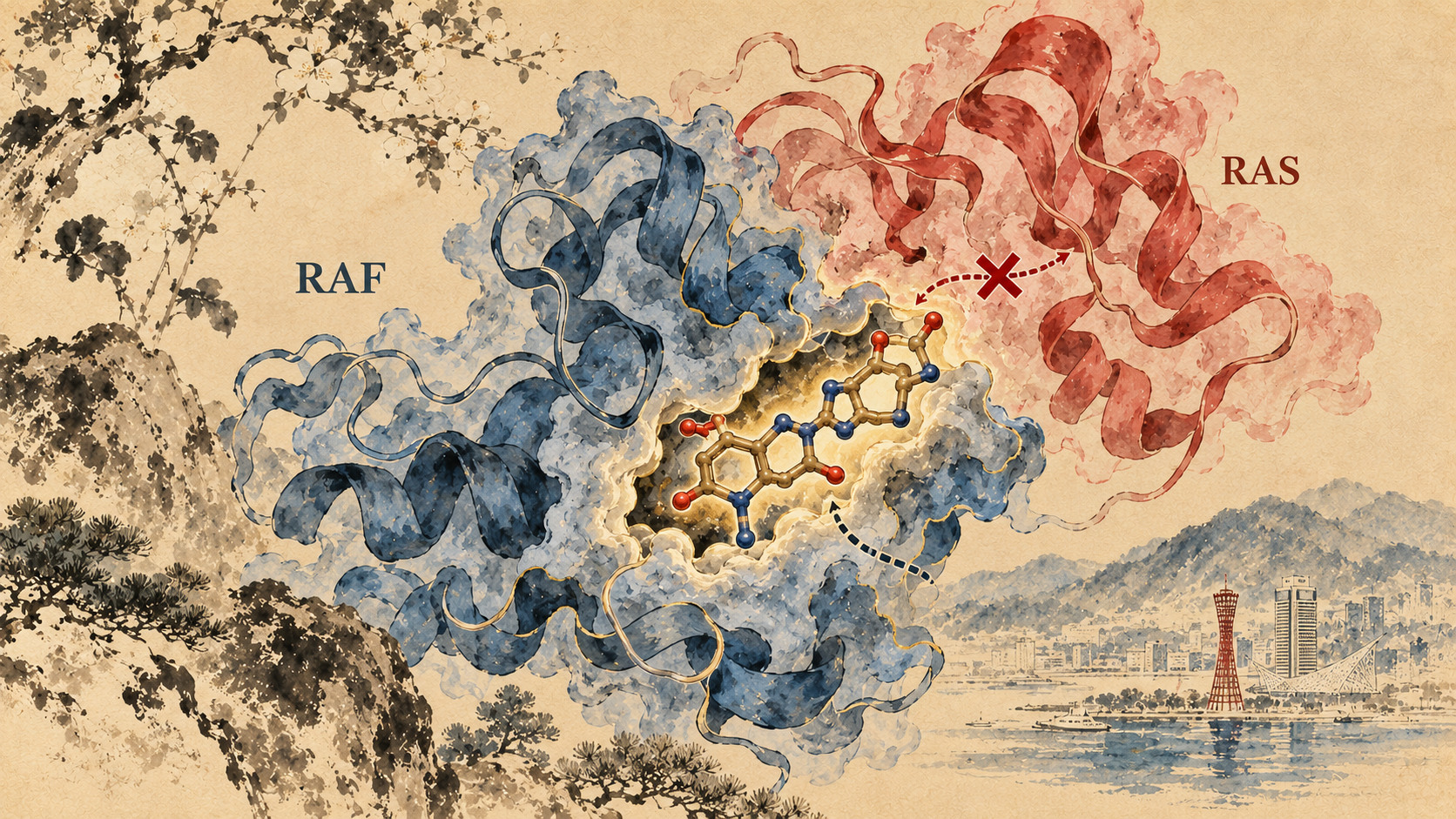
A multi-institution Japanese team led in part by Kobe University has reported a different way to approach that problem: chemically alter RAF at a location away from its direct contact with RAS. The resulting molecular distortion makes the interaction harder to sustain. It is a provocative drug-design principle, not a new approved cancer medicine.
The actual publication timeline
The results appeared in the peer-reviewed journal Nature Communications on August 27, 2026, and Kobe University issued its Japanese announcement that day. Science Japan revisited the research in October. Its appearance in the October 21 edition therefore represents explanatory follow-up journalism, not the discovery of a brand-new drug this week.
The original paper lists Yoko Yoshikawa and Hirokazu Kubota as joint first authors and Fumi Shima among the senior investigators, alongside an extensive collaboration spanning structural biology, molecular pharmacology and cancer research. Readers can inspect the open paper and accompanying data rather than rely only on the university announcement.
Why RAS remains formidable
RAS proteins behave like molecular switches. Their active, GTP-bound state helps recruit downstream effectors including RAF kinases. Variants of KRAS, NRAS and HRAS can leave proliferative signaling abnormally active, although the clinical significance depends on the mutation and cancer. Downstream, RAF helps activate MEK and ERK, proteins involved in decisions about growth and survival.
Drugs already target particular nodes in these pathways. KRAS G12C inhibitors have demonstrated that some once-formidable RAS mutations can be attacked pharmacologically. Other cancers may lack that particular alteration, however, and signaling networks can adapt to therapy. The rationale for a different molecular intervention is broad, but that breadth remains a hypothesis to test in patients.
What two and a half million candidates really means
Rather than expose millions of cancer cell cultures to millions of different drugs, the team combined computational screening, active learning and successive laboratory filters. A starting space of roughly 2.5 million compounds was narrowed to leads with activity against the RAS–RAF interaction. The initial distinctive hit was called Kobe3708.
Active learning uses experimental feedback to refine which candidates are worth testing next. It is an important efficiency gain, but not the discovery of a fully validated treatment by artificial intelligence. Experimental biology and structural measurements still had to determine whether the molecules bound the intended protein and how they affected downstream signaling.
Instead of occupying the interface, deform it
The RAS-binding domain of RAF presents a difficult drug-design surface. The obvious strategy is to fit a blocker directly between the two interacting proteins, yet protein–protein interfaces can be broad and comparatively featureless. The Japanese team pursued an allosteric mechanism: a compound attaches elsewhere on the RAF domain and produces a conformational change that impairs interaction with RAS.
Biochemical binding tests, nuclear magnetic resonance and crystallographic analyses supported interaction with RAF rather than RAS itself. The university identifies SPring-8 beamlines used for the structural work. Structural evidence makes this more than a screening result: it points to a specific pocket and a plausible mechanism that medicinal chemists may optimize.
From Kobe3708 to RK440 and RK447
The investigators synthesized more potent derivatives, RK440 and RK447. In one assay measuring disruption of RAS–RAF binding, the reported IC50 fell from 7.62 micromolar for Kobe3708 to 1.41 and 1.15 micromolar for RK440 and RK447, respectively. Lower values indicated stronger activity in that particular biochemical experiment.
Potency in a test system is not a clinical dosage, and all three compounds still operate in ranges requiring improvement. The investigators tested several RAS proteins and RAF family members and found effects across multiple variants. That pattern is intriguing precisely because there is no simple guarantee that it will translate into the same selectivity in human tissues.
The important evidence—and its small sample sizes
In cultured cancer cells carrying several forms of altered RAS, the team observed suppressed growth and diminished signaling through the RAF–MEK–ERK pathway. Patient-derived colorectal tumor organoids also provided evidence of sensitivity in selected mutant backgrounds. The experiments extended to mouse xenografts, where some dosing conditions reduced tumor volumes and weights.
Each treatment group in representative xenograft experiments included four mice. Several outcomes depended on compound and dose; some did not reach statistical significance. The paper also reports body-weight loss in certain RK440-treated groups, a reminder that an anticancer effect and an acceptable safety profile are very different findings. The data justify further research, not claims of treatment efficacy in people.
Could this approach matter for resistance?
Resistance is not always a simple matter of a cancer drug failing to engage its target. Cells can activate bypass pathways and restore growth signaling. The researchers studied laboratory melanoma models that had acquired resistance to the BRAF inhibitor PLX4032, also known as vemurafenib, after prolonged drug exposure.
Combinations of the experimental molecules with the existing inhibitor suppressed growth in those models, including mouse experiments. In some conditions the experimental compounds alone did not inhibit the resistant cells. The correct conclusion is that the work suggests a possible combination strategy for a particular laboratory mechanism of resistance—not that resistant melanoma has been overcome clinically.
A history of difficult targets
For decades after the identification of RAS oncogenes in the early 1980s, the proteins were widely regarded as exceptionally hard targets for small-molecule drugs. The approval of mutation-specific KRAS therapies changed what researchers considered feasible, but those successes also made the outstanding problem clearer: the RAS family contains many variants and downstream interactions.
The work from Japan fits a wider shift toward exploiting protein shape, conformational states and previously neglected binding sites. Its success depended on disciplines that rarely appear together in a short headline: synthetic chemistry, active-learning methods, cell biology, tumor models, NMR and synchrotron structural science.
What the authors themselves warn
The paper is unusually explicit about current constraints. Cellular selectivity is not yet adequate for clinical use. A growth-inhibition effect in some cells without RAS mutations raises concern that nonspecific cytotoxicity cannot be ruled out. Binding activity remains in the micromolar range, and improving the margin between anticancer effect and injury to normal tissues is essential.
Human pharmacokinetics, manufacturing, toxicity, dosing, benefit across specific tumors and interactions with established therapies all remain to be established. There is no human trial of these experimental compounds reported in this paper and no basis to describe them as available medicine. The National Cancer Center of Japan describes targeted therapies as treatments whose suitability and risks depend on the molecular and clinical setting.
The scientific opening, without the false promise
The memorable part of this story is not simply a search involving 2.5 million molecules. It is the idea that a protein can be prevented from making a dangerous connection by reshaping it from somewhere else. Such mechanisms can inspire an entirely different route through a drug-design problem.
Whether Kobe3708, RK440, RK447—or later compounds based on the same principle—will ever help patients is unknown. Their role today is to illuminate a vulnerability in the signaling machinery of cancer. That is news worth following, and it deserves a headline that leaves the distance to the clinic intact.
Sources and original research
Based on the university announcement and original peer-reviewed article. No original interviews or independent replication; no human clinical benefit has been established.