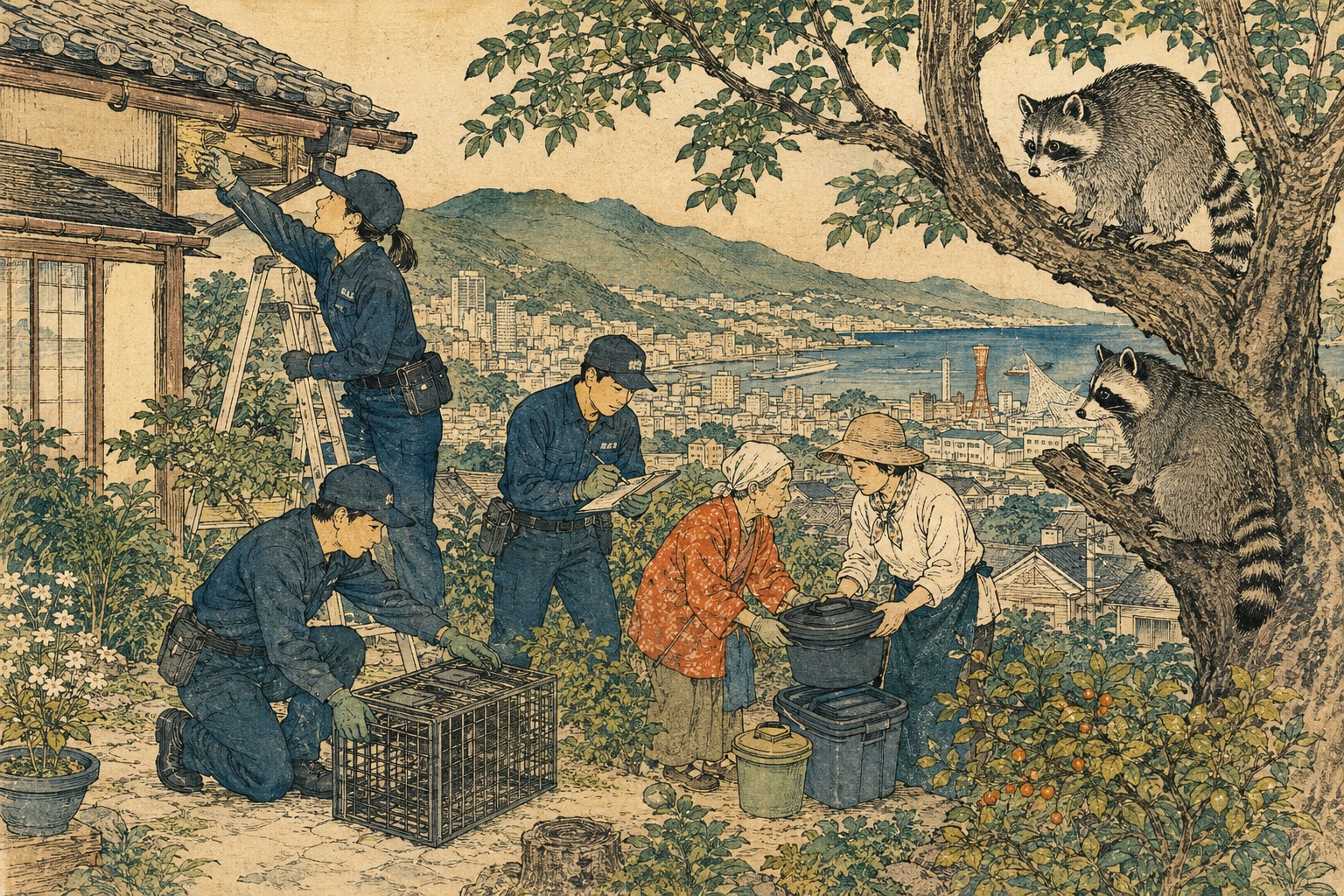
When the cage door drops at dawn, the first requirement is not celebration. Keep back. Keep bystanders away. Cover the trap with a blanket. Contact the city by smartphone and submit the required details and evidence photograph. For an ordinary registered group, the job then becomes waiting for a contractor. The live raccoon inside will not be released in another neighborhood.
The work behind Kobe’s “Raccoon Busters,” launched in July 2026, is heavier than its playful name. The city initially expected about five groups. At his July 9 press conference, Mayor Kizo Hisamoto said that 20 groups with 153 participants had applied. Alongside neighborhood organizations, the natural-science club at Kobe Prefectural High School registered, took roughly two hours of instruction and installed traps near its mountain-edge campus, regional broadcaster Sun Television reported.
Calling the students an extermination squad would be wrong. Under the standard division of labor, participants set and inspect cage traps, replace bait, report a capture and create the record. Specialists retrieve, euthanize and transport the animal. Yet nobody can responsibly join without understanding where a captured animal is going. Citizen science, neighborhood defense, supplementary public labor and an animal’s death all enter the same system.
After the door closes: the difference between ¥3,000 and ¥8,500
An eligible capture is a live raccoon in a cage trap within a team’s approved Kobe activity area. The city’s materials generally envision public or public-purpose sites. On private land, the owner must consent. The site is reported and discussed with the city in advance, and participating capture workers are formally notified. Each organization needs a Kobe base—an office, its representative’s home, a school or a workplace—at least five people, a nonprofit purpose and compliance with the program. It may not collect a second monetary reward for the same capture.
Kobe lends the cages, provides classroom and field training, and insures program activities. Daily inspection is the default. The public FAQ allows a camera-equipped trap to be checked at least weekly under its sensor-based operating rule. A capture triggers an immediate electronic form and photo. The money is not handed over at each cage: captures from April through September are paid by the end of November, and those from October through March by the following May.
If the animal is not a raccoon, the response changes. The rules say other wildlife should generally be released promptly or its release requested. Masked palm civets and nutria are reported for city pickup. A cage does not read the label on the species it catches. Inspection, identification and fast action on non-target animals are therefore central animal-welfare duties, not paperwork.
| Stage | Registered team’s normal role | Safety and verification |
|---|---|---|
| Before setting | Discuss the site with Kobe; inform and obtain consent from the landowner or manager | Registration, training, worker notification, group criteria and insurance |
| While active | Replace bait and normally inspect daily; follow the published camera rule when sensors are used | Trap marking, child and bystander safety, checks for non-target captures |
| On capture | Do not touch the animal; cover the cage, keep people back and file an immediate photo report | Verification of live animal, place and time; cancellation or repayment for fraud |
| Afterward | Normally transfer responsibility to a contractor or hunters’ association; only qualified teams may opt to dispose and transport | ¥3,000, or ¥8,500 including euthanasia and delivery, reconciled twice a year |
Do not hide killing inside the word “disposal”
In the administrative language, “disposal” normally means euthanasia. Kobe’s raccoon-control plan says a captured raccoon must not be privately taken home or abandoned outdoors. As a rule, it is to be killed by an appropriate method designed to cause as little suffering as possible, with carbon dioxide given as an example. An exceptional transfer is possible for research, exhibition, education or another recognized public purpose if the recipient holds a national permit. That is not the routine outcome.
Japan’s Invasive Alien Species Act generally prohibits keeping, storing, transporting, importing, selling or releasing a live raccoon. Moving a trapped animal to a distant mountain does not solve the problem. It exports damage and breeding to somebody else’s landscape and may violate the law. That is why Kobe manages a chain from capture through pickup, euthanasia and delivery to an animal-management or incineration facility.
But “as little suffering as possible” applies before death too. A metal cage in direct summer sun, dehydration, panic and delay can harm an animal before a contractor arrives. The interval from notification to pickup, shade and cover, camera-response performance and release time for non-target animals should be published alongside the capture total. A citizen-based system makes transparent welfare control more important, not less.
A 1962 escape and the 1977 Rascal paradox
Japan’s National Institute for Environmental Studies lists one early feral event in 1962, when 12 raccoons escaped from a zoo in Inuyama, Aichi Prefecture. The decisive social background to nationwide spread, however, was the 1970s pet trade. North American raccoons were imported in large numbers. Animals that became difficult to keep were abandoned or escaped, and breeding populations formed around the country.
From January through December 1977, the animated television series Rascal the Raccoon aired in 52 episodes. Nippon Animation’s official description places the story in Wisconsin and follows a boy named Sterling and Rascal through a year together. NIES says the program’s popularity helped produce a pet boom in the late 1970s, followed by escapes and abandonment.
The irony is that the underlying story did not ultimately present a raccoon as an easy stuffed toy. The mismatch between a maturing wild animal and a human household drives the story toward separation. Still, round eyes, a ringed tail and dexterous forepaws circulated more effectively as a character and commodity than as a warning. Blaming the cartoon alone would let import rules, sellers, impulse buyers and people who failed to keep their animals escape the frame.
1962 Early event recorded by NIES: 12 raccoons escape from an Inuyama zoo
1970s Large-scale import as pets; escaped and abandoned animals establish populations
1977 All 52 episodes of Rascal the Raccoon air; a pet boom follows
FY1998 Hyogo records its first harmful-wildlife capture in Kobe
June 2005 The Invasive Alien Species Act takes effect; raccoons are designated
FY2006 Capture under municipal control plans expands in Hyogo
2022 Kobe opens an invasive-species exhibition center
FY2024 The city doubles its cages from 700 to 1,400 and captures 2,948 raccoons
FY2025 Kobe assigns a wildlife specialist and records 2,173 captures
July 2026 Raccoon Busters launches with 20 groups and 153 people
From Kobe’s first raccoon to 2,948 captures
Hyogo Prefecture’s control guidelines say raccoons were being confirmed around Kobe by about 1998. That fiscal year, Kobe made the prefecture’s first harmful-wildlife capture. Captures accelerated from FY2003. After the national act took effect, municipal control-plan captures expanded from FY2006. The known range spread into Hanshin, Kita-Harima, Naka-Harima and Tamba.
Kobe’s current presentation marks 1,604 captures in FY2019, 2,948 in FY2024 and 2,173 in FY2025. The city calls the 2,948 a nationally high level. Yet Kobe had just doubled its cage inventory from 700 to 1,400 in 2024. A capture total combines abundance with number of traps, placement, active nights, bait, season and pickup capacity. It cannot reveal the outdoor population or a year-to-year population trend by itself.
Complaints need equal care. The mayor’s May briefing gave 1,077 inquiries for FY2024 and 701 for FY2025. Fewer calls might reflect less damage, but reporting channels, publicity, duplicate calls and public habituation also alter the number. A year with lower captures and fewer inquiries cannot be declared a success without measures of trapping effort and harm that do not depend on the hotline.
- Captures are not population: doubling cages can increase the catch even if abundance does not change.
- Calls are not total damage: access to reporting, publicity, duplicates and behavior affect the count.
- Reward is not total cost: cages, cameras, training, insurance, staff, pickup, euthanasia, transport and records sit outside the ¥3,000.
An animal built for the urban edge
Raccoons fit the physical form of Kobe. Native to North America, they are nocturnal and omnivorous. They climb, swim, and use sensitive forepaws to explore food and openings. Where forest, water, fields and housing meet within a short distance, a raccoon can den in a tree hollow or attic by day and move among orchards, crops, ponds, garbage and pet food at night. Litters commonly arriving from April into June, with roughly three to six young, can turn a local intrusion into a neighborhood issue quickly.
A Kobe forest study published on July 30, 2026 quantified part of this edge problem. Researchers placed 25 cage traps in Aina Satoyama Park. They detected no season with superior capture efficiency, but traps closer to water performed better. Camera frequency fell as cumulative captures rose, suggesting that imagery could track local density.
The paper also explains why removal only around homes and fields can fail: animals can move back in from surrounding forest. Much of Kobe’s municipal area is wooded. Water, forest, farms and houses need to be treated as one movement system rather than a set of isolated complaint addresses. The Busters’ lasting value may lie as much in mapping those paths with local eyes as in adding trapping labor.
Not only watermelons: adults and eggs disappearing at ponds
Crop loss is visible. Corn and watermelon are knocked down; grapes and strawberries are eaten. Damage inside a house announces itself through sound, odor, feces, urine and torn material. Ecological damage sends no invoice and may be discovered late.
Researchers from the Wildlife Management Research Center, Hyogo, and partner institutions placed automatic cameras at three Kobe wetland sites in February and March 2019. The images recorded raccoons eating what appeared to be adult Japanese brown frogs, frog egg masses and Setouchi salamanders. Native predators including herons, mustelids and owls also appeared, but invasive raccoons visited all three sites.
The observations did not establish how much raccoons reduced amphibian populations; the researchers called for that impact to be quantified. Still, repeated visits to breeding ponds, with both reproductive adults and the next generation’s eggs consumed, create a different timescale of harm from a lost crop. A farmer can plant again next year. Rebuilding a locally lost amphibian population may be far harder.
Attics and heritage: closing a hole can matter more than a catch
The May 28 press conference at which Kobe announced the Busters began with another story: the main Hakogi residence had just been recommended to become the first private home designated a National Treasure. In the same briefing that celebrated a medieval thatched house, the city explained how it would protect old buildings from raccoons. Heritage and invasive-species management were literally under one roof.
Kobe now subsidizes investigation, exclusion or capture, closure and repair of entry points, feces and urine removal, disinfection and restoration at qualifying historic buildings damaged by raccoons or masked palm civets. Eligible structures include those at least 50 years old, thatched buildings and designated cultural properties. The cap is the lower of actual expense or ¥100,000; extermination alone is capped at ¥50,000.
This “capture plus defense” approach is crucial. If the opening remains, another animal can occupy the attic. If waste remains, the health and sanitation problem remains. Put garbage out at the proper time, do not leave pet food outdoors, collect fallen fruit, prune branches reaching the roof, and close openings in foundations, vents, roofs and shutters with robust material. These unglamorous actions reduce the cycle in which animals are attracted and then killed. A competition based only on capture totals makes prevention disappear.
What does a per-head payment buy?
The ¥3,000 is not the “price” of an animal. It is a fixed acknowledgment of time spent selecting a site, changing bait, checking repeatedly and producing a digital record. Neighborhood associations, schools and environmental groups know places that city staff and contractors may not reach efficiently. Twenty applicants indicate both uncovered demand and a willingness to participate.
Per-head incentives also carry a structural risk. When visible success means a catch, a landscape that continues producing animals creates more rewards than one where prevention has ended the damage. Misidentification, double claims, trapping outside an area and burdens on non-target species need control. Kobe attempts that through live-capture photographs, immediate reports, approved zones, a ban on duplicate compensation, twice-yearly reconciliation, and cancellation or repayment for fraud.
Fraud control is not program evaluation, however. Kobe needs “trap nights”—where and how long each cage operated—captures per 100 trap nights, non-target captures, notification-to-pickup time, repeat entry at the same building, and changes in complaints and crop loss. A team that catches nothing because it sealed an opening and removed an attractant may have produced more public value than one that catches several animals.
| Measure for the FY2026 pilot | Why it matters | What raw captures miss |
|---|---|---|
| Captures per 100 trap nights | Normalizes differences in trap numbers and active time | Whether effort rose or local density changed |
| Damage, complaints, repeat entry | The goal is reducing harm, not maximizing a count | Whether the same field, house or pond relapsed |
| Pickup time, non-target capture | Audits welfare and field safety | How long live animals waited and what entered by mistake |
| Repairs and attractant removal | Measures durable prevention | Damage prevented without killing an animal |
| Total cost, participant retention | Captures public expense, burden and dropout | Whether the model can continue safely next year |
Hyogo’s guidelines name “human responsibility”
Hyogo’s raccoon-control guidelines are unusually direct for an administrative document. The problem began when people imported large numbers of animals, then abandoned them or allowed them to escape. The prefecture notes that many innocent raccoons consequently have to be killed and warns that irresponsible pet keeping must not reproduce the same outcome.
That recognition prevents the ethics from collapsing into “for” or “against” removal. The animal in the cage bears no responsibility for being taken from North America. The frog being eaten, farmer losing a crop and family with a contaminated attic bear no responsibility either. In a widely established population, ending all control shifts harm onto those other blameless parties.
The answer is not to turn the raccoon into a villain. It is to put human responsibility back into the system: lower-suffering capture and prompt euthanasia, protection of non-target species, scientific monitoring of damage and density, removal of food and entry points, cooperation beyond municipal borders, and education that prevents the next exotic-pet abandonment. A headline about money without those obligations makes the animal carry the burden again.
Cheap labor, or neighborhood intelligence?
Residents see details the administration does not: which field is raided at what hour, which drain forms a path, which vacant roof has an opening. A school science club can turn cameras, tracks, bait choice and seasonal records into education. If local observations enter a consistent dataset, they may outlast any single cage.
But a program that merely fills a professional labor shortage with nearly unpaid community work will not endure. Daily inspection includes weekends and rain. Encountering a live captured animal carries psychological weight. Summer heat, pathogens, bites and scratches, children and passersby, harassment and trap vandalism all require planning. Kobe’s insurance and training are a starting point. Accidents, near misses and reasons participants withdraw should feed directly into the next year’s design.
School participation especially needs ethical education that does not obscure death. The lesson cannot end at “caught one, earned ¥3,000.” Why is the species here? What happens after the report? What does protecting native species require? Which losses can be prevented without a kill? Asked seriously, those questions can make the Busters not merely removal workers, but a generation able to examine the pet culture that created the problem.
A program that can call fewer captures a success
Recruitment for FY2026 has closed. The work was only just beginning, and by the reporting cutoff of August 12 at 9:18 a.m. JST, Kobe had not published a Busters-only evaluation of captures, non-target animals, pickup time, cost or reduced harm. Recruiting 20 groups is a participation result, not evidence of ecological effectiveness.
Real success may not mean catching more next year. It could mean concentrating effort along water and movement routes, closing openings, removing food, seeing capture rates fall at equal effort, and reducing crop loss, attic entry and pressure on amphibians. A per-head payout will fall as animals become harder to find. That is the direction the policy should want.
When a cage door closes at dawn, one animal’s fate is almost settled. But beyond that door stand more than Kobe in 2026: a 1960s zoo, 1970s importers and living rooms, the first Kobe capture in 1998, the 2005 law, 700 cages becoming 1,400, frogs at a pond, an old roof and a student’s smartphone.
Raccoons did not choose to come to Japan. Kobe’s residents can choose not to ignore the consequences. Can the weight beneath a light name be measured in less damage, protected native wildlife, shorter suffering and sealed entry points—not simply bodies? That will decide whether “Raccoon Busters” remains a per-capture pilot or becomes a public policy capable of carrying 50 years of human responsibility.
- Kobe City, “KOBE Raccoon Busters” (registration criteria, work, inspection, payment, qualifications, insurance and FY2026 recruitment closure)
- Kobe City, Raccoon Busters Registration and Capture Payment Rules (effective May 28, 2026; eligible captures, reports, non-target species, payment and fraud)
- Kobe mayoral press conference, July 9, 2026 (20 groups, 153 people and training)
- Kobe mayoral press conference, May 28, 2026 (program launch, damage, doubled cage inventory, inquiries, capture and defense)
- Kobe City, “Further Strengthening Raccoon Damage Prevention” (captures, 2,948 in FY2024, 2,173 in FY2025, payments and division of work)
- Kobe City Raccoon Control Implementation Plan (safety, sanitation, euthanasia and exceptional transfer)
- Kobe City, raccoon countermeasures (home entry, food and den prevention, consultation and legal restrictions)
- Kobe City, historic-building wildlife damage subsidy (eligible structures and work, sanitation, ¥100,000 and ¥50,000 caps)
- Sun Television, “KOBE Raccoon Busters” (training and trapping by Kobe High School’s natural-science club)
- Hyogo Prefecture Raccoon Control Guidelines (import and abandonment history, Kobe’s FY1998 first capture, control, inspection and human responsibility)
- National Institute for Environmental Studies, Invasive Species of Japan: Raccoon (native range, ecology, reproduction, 1962 escape and 1970s pet boom)
- Nippon Animation, Rascal the Raccoon (January 2–December 25, 1977, 52 episodes and story setting)
- Ministry of the Environment, Invasive Alien Species Act overview and regulated acts (designation and restrictions on keeping, transport, import, sale and release)
- Kuriyama and Numata, record of raccoon predation on Japanese brown frogs in Kobe (2020; adults, egg masses and Setouchi salamanders)
- Park et al., efficient trapping environments and seasons in peri-urban Kobe forest (published July 30, 2026; distance to water, forest trapping and camera frequency)
- Suzuki et al., “Invasive raccoon management systems and challenges in regions with active control” (2020; early monitoring and collaboration among government, experts and residents)
Editor’s note: This article cross-checked Kobe City, Hyogo Prefecture and Ministry of the Environment materials, legal explanations, research papers and regional reporting available by August 12, 2026 at 9:18 a.m. JST. Japan.co.jp did not independently interview the city, registered groups, Kobe High School, hunters, contractors, animal-welfare specialists or ecologists. The 20 groups and 153 people come from the city’s July 9 announcement. The 2,948 figure is Kobe’s citywide FY2024 capture total, not a Busters-only result or a population estimate. FY2026 recruitment had closed; no program evaluation covering Busters captures, non-target animals, pickup time, damage reduction or budget performance had been published by the cutoff. We do not describe ¥3,000 as a public bounty, and we state that the extra ¥5,500 covers euthanasia and delivery by a qualified team, not transport alone. Disease is described as a potential carriage risk; this article does not claim that all wild Kobe raccoons carry any named disease.