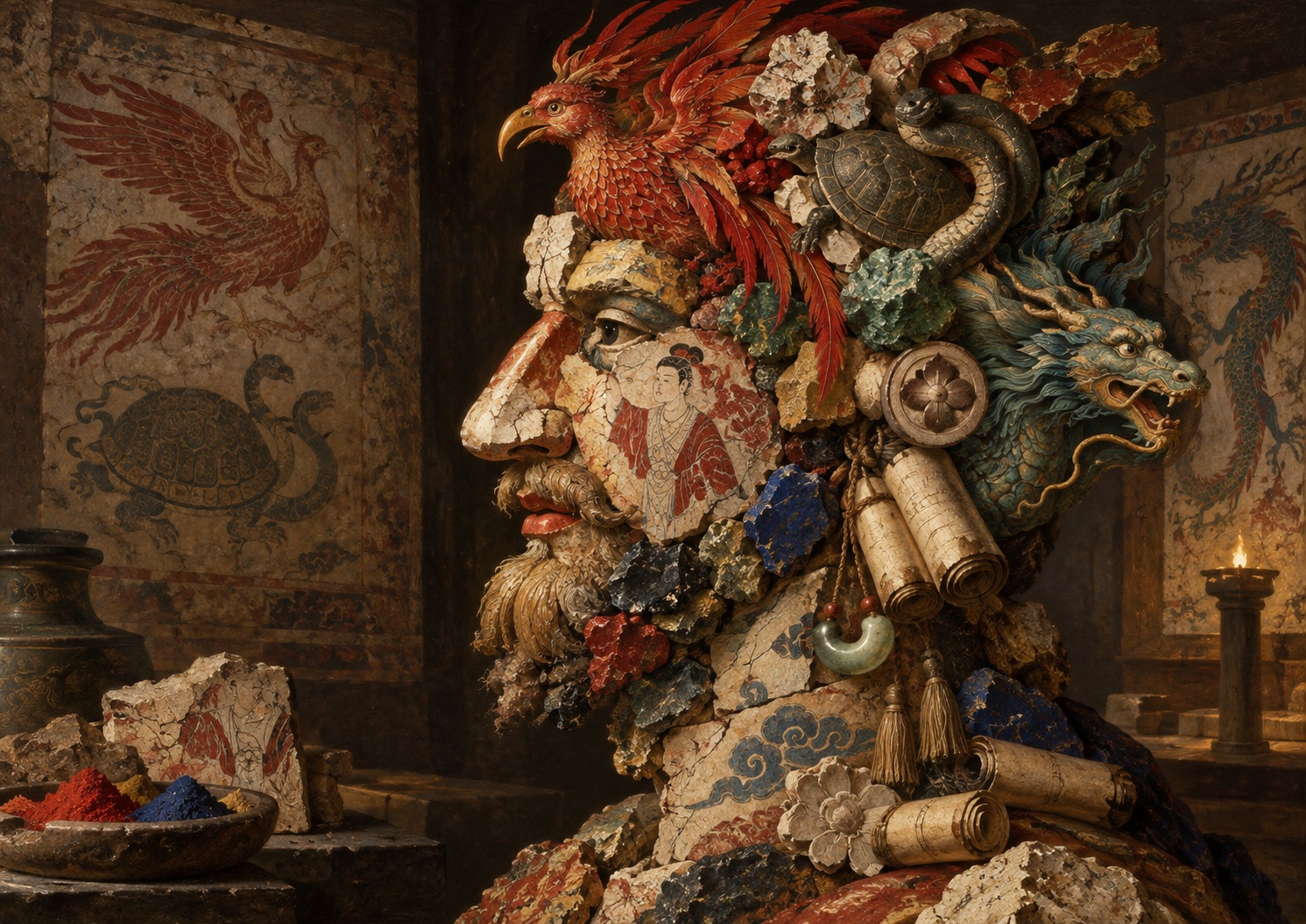
Suzaku in the south. Genbu in the north. Seiryū in the east. Roughly thirteen centuries ago, three guardian figures were painted around the dead inside a tiny stone chamber in Asuka. Beginning September 19, all three walls will be displayed together at the Kitora mural preservation center. [1] [2]
The 41st public viewing runs through October 18 at Shijin-no-Yakata, the Kitora Tumulus Mural Experiential Museum. Visitors will be able to see the south-wall Suzaku, north-wall Genbu and east-wall Seiryū in one viewing program. Admission is free. The Agency for Cultural Affairs and the Nara National Research Institute for Cultural Properties are the organizers. The first reservation round filled all available capacity, and the official site says there will be no general second round; telephone bookings may become possible only if cancellations create openings. [1] [2] [3]
A tomb chamber designed as a map of the cosmos
Kitora is a small two-tier round tumulus in Asuka, south of the ancient Fujiwara capital area. Archaeological work established a lower mound diameter of 13.8 meters and an upper diameter of 9.4 meters. At its center is a burial chamber assembled from 18 rectangular tuff blocks. The interior is only about 2.4 meters long, one meter wide and 1.2 meters high. [4] [5]
That compressed room was covered in white plaster and organized as a miniature universe.
Seiryū occupies the east wall, Suzaku the south, Byakko the west and Genbu the north. A celestial chart covers the ceiling. The sun was represented with gold leaf in the east and the moon with silver in the west. Human-bodied zodiac figures with animal heads were placed below the directional deities. [4]
The Four Directional Deities derive from ancient Chinese cosmology. Each guardian is linked to a direction, season, color and group of stars: the Azure Dragon to east and spring, the Vermilion Bird to south and summer, the White Tiger to west and autumn, and the Black Warrior to north and winter. In a tomb, that system did more than decorate the walls. It placed the dead within an ordered cosmos.
Suzaku: the instant before flight
The south-wall Suzaku is the most visually legible of the three guardians being shown this autumn.
Nara institute documentation describes the bird facing west from the viewer’s perspective, wings spread, feet pushing off as if about to launch into flight. Incised guide lines survive in the tail and legs, but the final painted tail diverges substantially from those preliminary marks, suggesting the painter valued the movement of the brush over strict adherence to the underdrawing. [3]
The south wall was the chamber’s closing stone, so researchers believe the Suzaku may have been painted while that stone was still outside the chamber. That could help explain the fine treatment of feathers and eyes.
The image is especially important because the south-wall Suzaku at the nearby Takamatsuzuka Tumulus was destroyed by tomb robbery. Kitora’s left wing was also damaged, but enough survives to reconstruct the figure. Kitora is the only Japanese painted tumulus in which all four directional-deity images survive as a set. [4]
Genbu: the image that revealed Kitora’s murals
Genbu, guardian of the north, is typically represented as a tortoise entwined with a snake. It also happens to be the figure through which Kitora’s painted world first entered modern scholarship.
In November 1983, investigators inserted a fiberscope into the stone chamber and confirmed Genbu on the back wall. That discovery established Kitora as Japan’s second known major polychrome painted tomb after Takamatsuzuka. [4] [6]
Seeing Genbu in the 2026 three-wall display therefore returns visitors to the first image that made the tomb’s significance visible.
Seiryū: damage is part of the history too
The east-wall Seiryū is much harder to read than Suzaku. Mud that entered the chamber in later centuries covers much of the composition. Nara researchers identify surviving details including the red tongue and portions of the front limbs; comparison with Byakko and with Takamatsuzuka imagery suggests a long-necked dragon with an open mouth. [4]
That obscurity is not simply a defect in the exhibit. Painted tombs survive through moisture, soil movement, biological growth, looting and the gradual detachment of plaster. What is hidden or damaged records the burial chamber’s post-construction history as surely as the surviving pigment records its original design.
Kitora was discovered in stages
The murals did not all become known in 1983.
The fiberscope revealed Genbu first. A miniature-camera investigation in 1998 and a digital-camera investigation in 2001 progressively identified the Four Directional Deities, celestial chart, sun and moon images and zodiac figures. Further excavation and the later mural-removal process revealed additional zodiac imagery. [6]
Kitora was therefore not one dramatic archaeological discovery but a sequence of technological encounters with an inaccessible chamber. Better cameras, excavation and conservation gradually turned fragments of evidence into a coherent interior.
Above the guardians is one of the world’s oldest surviving Chinese-style star maps
The Four Directional Deities are only one layer of the chamber.
The ceiling carries a celestial chart with circles representing features including the celestial equator and ecliptic. The Nara institute describes it as the world’s oldest surviving example of a full-scale Chinese-style star chart of this kind. [4]
The dead person was thus surrounded horizontally by directional guardians and vertically by the heavens. Gold-leaf sun and silver-leaf moon images added another axis of cosmic order.
For historians, those images are also evidence of the movement of astronomical and cosmological knowledge through East Asia and its adoption in Japan during the Asuka period.
Who was buried here remains unknown
For all the sophistication of the tomb, its occupant has never been securely identified.
Kitora lies within a burial zone associated with members of the imperial family and high-status elites south of Fujiwara-kyo, and its construction date, chamber and grave goods clearly point to elite status. But no surviving epitaph or equivalent evidence establishes a specific name.
Excavated material includes fragments of a lacquered coffin, gilt-bronze fittings, sword fittings, amber beads and tiny glass beads. Major objects were designated Important Cultural Properties in 2018. [4]
The temptation to turn a prestigious tomb into a named prince or court figure is understandable, but the evidence does not justify certainty. The occupant remains unresolved.
Saving the paintings meant removing them from the tomb
Visitors today are not entering the original stone chamber.
The plaster paintings had become unstable, and preservation specialists concluded that leaving them in place posed an unacceptable risk of loss. By 2010, all mural sections had been removed from the chamber. Conservation treatment continued in a temporary facility through 2016. [4]
The technical challenge was extreme: the goal was not simply to move stone blocks but to separate and stabilize the thin painted plaster layer attached to them. The Agency for Cultural Affairs says conservation methods developed during the Kitora project have since informed other cultural-property repair work. [2]
Archaeological preservation usually evokes the ideal of keeping an object where it was found. Kitora became a case where removing the image from its architectural context was the means of preventing the image from disappearing.
From Important Cultural Property to National Treasure
The five mural surfaces — east, west, south, north and ceiling — were designated Important Cultural Properties in October 2018 and National Treasure in July 2019. The national database classifies them as Asuka-period paintings on plaster inside a stone chamber. [7] [8]
When the murals were elevated to National Treasure, the Nara institute emphasized the rarity of surviving Asuka-period painting, the survival of Kitora’s Suzaku when Takamatsuzuka’s had been lost, and the importance of the celestial chart. [8]
2026 is also the 10th anniversary of Shijin-no-Yakata
The Kitora district of Asuka Historical National Government Park opened on September 24, 2016. The preserved tumulus, museum and surrounding landscape were developed as one cultural-historical environment. In 2026 the park is marking the district’s 10th anniversary. [9]
The three-wall display is therefore also a milestone in the history of preservation and public access: ten years of presenting paintings that had to be removed from their original chamber in order to survive.
And this year Kitora entered a World Heritage property
On July 26, 2026, the World Heritage Committee approved the inscription of Asuka-Fujiwara: Ancient Capitals of Japan. Kitora Tumulus is one of the component assets included in the new World Cultural Heritage property. [10]
The timing gives the September viewing an unusual context: World Heritage inscription in July, the 10th anniversary of the Kitora park district, and then a three-wall simultaneous display in September.
That combination encourages a wider reading of Kitora. The tomb is not only an isolated masterpiece of ancient painting; it belongs to a landscape in which court politics, religion, astronomy, technology and international cultural exchange were being reorganized at the formation of the early Japanese state.
- Dates: Sept. 19–Oct. 18, 2026
- Closed: Sept. 30 and Oct. 14
- Murals: Suzaku (south), Genbu (north), Seiryū (east)
- Venue: Center for Preservation of Kitora Tumulus Mural Paintings, Shijin-no-Yakata, Asuka
- Admission: Free
- Reservations: First-round capacity filled; cancellation openings may occasionally become available by telephone
- Access: About 15 minutes on foot from Kintetsu Tsubosakayama Station; temporary weekend/holiday buses connect Asuka, Kitora and Takamatsuzuka
Why seeing three walls together matters
Each guardian can be appreciated as an individual painting. Kitora, however, was designed through relationships in space.
Suzaku alone is a red bird caught in motion. Genbu alone is the northern guardian. Seiryū alone is a damaged dragon emerging from layers of mud. Seen within one viewing program, they are easier to understand as elements of the same chamber, surrounding the same burial and oriented beneath the same painted sky.
The ancient painters were not simply decorating four walls with mythic animals. They were translating a system of directions, seasons, colors and constellations into architecture.
The chamber was a small room containing a very large universe.
On September 19, three sides of that universe will be visible together again.
- Agency for Cultural Affairs, 41st public viewing of Kitora Tumulus murals
- Agency for Cultural Affairs, three-wall simultaneous display and 10th anniversary of Shijin-no-Yakata
- Nara National Research Institute for Cultural Properties, 41st Kitora mural viewing, Aug. 18, 2026
- Nara National Research Institute for Cultural Properties, Kitora Tumulus overview
- Nara National Research Institute for Cultural Properties, Kitora-Atlas
- Nara National Research Institute for Cultural Properties, Kitora murals become a National Treasure
- Agency for Cultural Affairs, National Cultural Properties database: Kitora Tumulus mural paintings
- Nara National Research Institute for Cultural Properties, Kitora murals designated National Treasure
- Asuka Historical National Government Park, 10th anniversary of the Kitora area
- Asuka Historical National Government Park, Asuka-Fujiwara inscribed as World Cultural Heritage, July 27, 2026
- Agency for Cultural Affairs, access and temporary bus service during the viewing
