With less than three months before teams from Japan, the United States, Puerto Rico, South Korea and Taiwan are due in Kitakyushu, the tournament's public fundraising drive is far from its target. At noon JST on August 23, the campaign had collected ¥3,851,501 from 351 supporters—38 percent of a ¥10 million goal, leaving a gap of ¥6,148,499.
The gap concerns the quality of welcome, not simply whether games occur
The Sixth World Baseball Tournament for Persons with Physical Disabilities—branded WORLD DREAM BASEBALL 2026—will be held November 21 and 22 at Kitakyushu Municipal Baseball Stadium, with November 23 reserved for weather. The organizer is the Japanese nonprofit formally registered as 特定非営利活動法人日本身体障害者野球連盟. It is the tournament's first edition in Kyushu, and admission will be free.
The federation says the ¥10 million campaign will help pay tournament operations, international teams' travel and lodging, interpreting, competition arrangements and outreach. Rising prices and operating costs, it says, have made existing sponsorship insufficient. The campaign does not publish a complete tournament budget or a line-by-line funding requirement. Japan.co.jp therefore describes ¥6.15 million as the distance to the campaign target—not a verified deficit without which the event cannot proceed.
Why an international tournament helps pay for international travel
These are not national teams supported by the commercial machinery surrounding major professional baseball. The Japanese federation says its 25-player squad was chosen from roughly 1,000 registered players. Visiting athletes and staff may need to move sports wheelchairs, prostheses and specialized equipment, arrange accessible lodging and local transport, and navigate languages. Needs differ from person to person; disability is not one standardized travel category.
Helping with travel and accommodation can reduce the chance that national wealth or individual income determines who reaches the field. But the campaign does not disclose roster sizes by team, how costs are divided, or which bookings remain unsecured. Claims about the funding pressure must therefore remain attributed to the organizer.
Changing baseball to fit bodies—not bodies to fit baseball
The sport begins with rubber-ball baseball but adapts rules so athletes with different physical disabilities can compete safely and fairly. Federation rules provide for a runner beginning from a designated line for some batters and restrict bunting and stolen bases. The aim is not to make every athlete move in the same way. It is to preserve meaningful competition while allowing different bodies and equipment to perform baseball's essential acts.
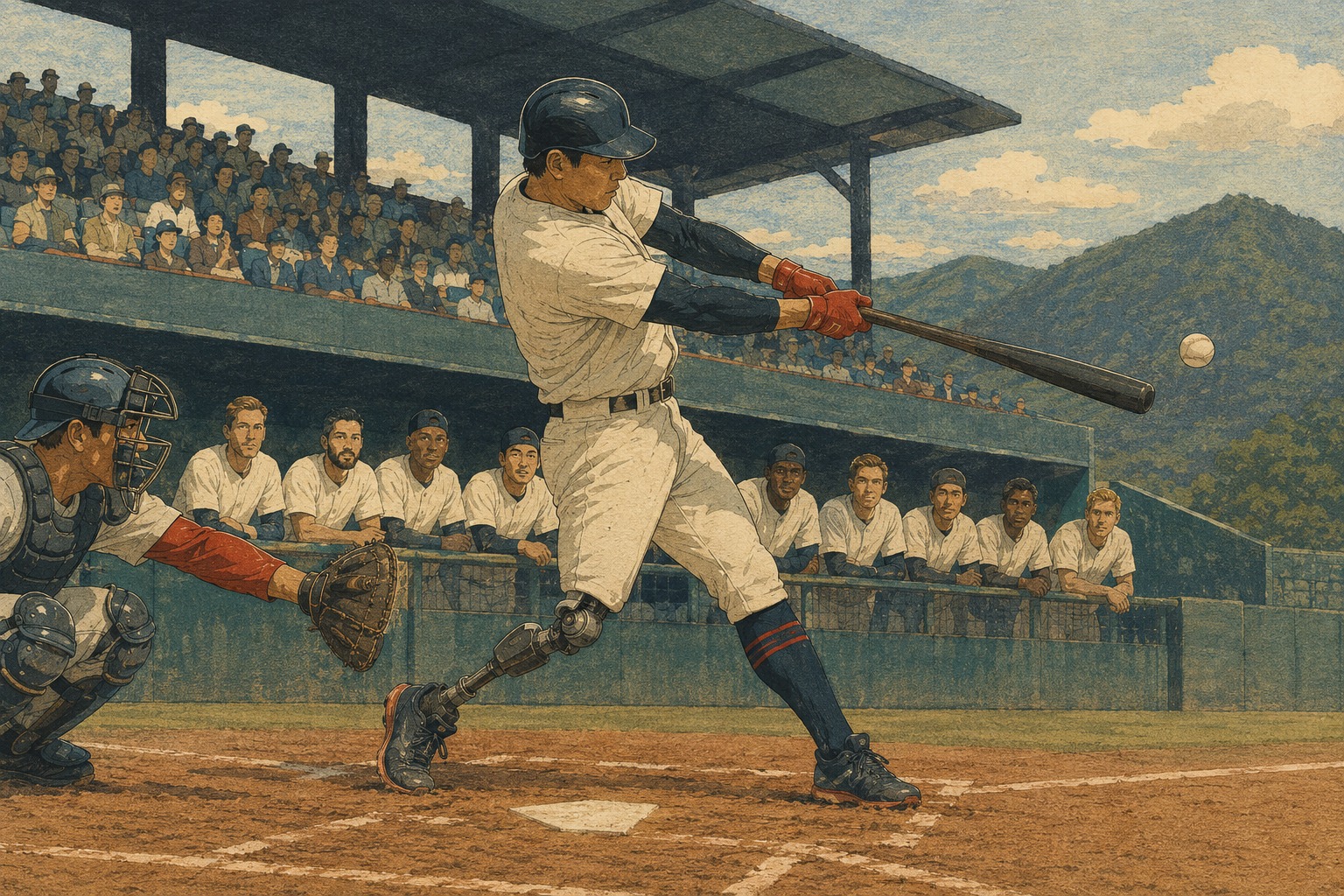
A one-handed fielder may catch, remove the glove, transfer the ball to the same hand and throw in one rapid sequence. A wheelchair pitcher creates velocity and movement through trunk rotation rather than a conventional leg drive. Other players use prosthetic legs, work with paralysis, or fasten a customized glove to a hand. These are not simplified versions of ordinary technique. They are highly rehearsed technical solutions.
Regional reporting identifies four Kitakyushu Futures members on Japan's squad: player-coach Masayuki Miyachi, Shodai Miyachi, Hayato Kataoka and Eishu Kajiwara. Shodai Miyachi pitches from a wheelchair and has become a visible local figure in the buildup. Japan.co.jp did not interview the four players and does not independently assess their roster roles or performance.
From one Kobe team to a national structure
The federation traces Japanese disabled baseball to the Kobe Cosmos, formed in 1981. Its history says a visit by Hankyu Braves base-stealing star Yutaka Fukumoto to a medical facility, where he played catch with children, helped spark the first team. The national federation was established in 1993 and developed national selection and championship structures.
There is a source conflict worth making visible. The current crowdfunding page says the federation was established in 1983. The federation's own history page and corporate supporter ENEOS say 1993. Japan.co.jp uses 1993; the campaign's date may be a typographical error, but the federation has not confirmed that to us.
The campaign says the organization now includes 36 teams and about 1,000 players. A national invitational tournament is held in spring; regional winners advance to an autumn national championship. Those participation figures are organizer counts, not government statistics.
How the “other WBC” began
1981: Kobe Cosmos formed, regarded by the federation as the starting point in Japan.
1993: The national federation was established.
2006: Japan proposed and hosted the first world tournament in Kobe.
2023: After a one-year pandemic postponement, the fifth tournament was held in Nagoya; Japan won unbeaten.
2026: Sixth edition moves to Kitakyushu, the tournament's first Kyushu host.
The first tournament followed Japan's victory in the inaugural World Baseball Classic in 2006. Japanese organizers proposed their own international competition and brought five countries and territories to Kobe that November. The event has generally returned every four years.
The federation calls it the “other WBC.” That is organizer branding, not evidence of an institutional relationship with the World Baseball Classic operated by Major League Baseball and its partners. At the 2023 tournament in Nagoya, Japan finished first, South Korea second, the United States third, Puerto Rico fourth and Taiwan fifth. The same five are scheduled for Kitakyushu.
Why Kitakyushu matters
Kitakyushu has a local club, the Kitakyushu Futures, and players selected for the national squad. The city has received tournament representatives, while the Fukuoka SoftBank Hawks have pledged funding and travel support, helped run introductory clinics, worked on official goods and promotion, and committed staff to event operations.
The Hawks say this is the first direct support by a Nippon Professional Baseball club for the world tournament and the federation. That “first” is a company claim, not an independently audited record. ENEOS Holdings is also supporting the event and has published the same five-team roster.
Corporate support raises an obvious question: why crowdfunding too? The federation cites global inflation and rising operating costs. Public documents do not reveal total sponsorship, municipal contributions, corporate amounts or the full event budget, making it impossible to independently calculate the actual remaining need.
A campaign total cannot measure a sport's worth
Thirty-eight percent with eight days remaining looks like a difficult fundraising position. But a crowdfunding result is not a referendum on the quality of the sport or the organizer. Awareness, campaign design, media reach, donor habits and the relationship between corporate and public funding all shape the number.
There is also a representational risk. Disability sport is often marketed primarily through courage, hope and overcoming adversity. The campaign uses some of that language. Athletes can inspire viewers, but they are not obligated to exist as lessons for nondisabled audiences. They are competitors whose tactics, records, development and execution deserve the same attention given to other baseball players.
Eight days—and a longer funding question
Supporters can choose a ¥1,000 message tier or a ¥10,000 official-shirt tier, with bank transfer available. Because the campaign is all-in, money pledged will be used for the tournament even if the total remains below target.
The immediate question is how much of the ¥6,148,499 gap can be closed. The longer question is whether a quadrennial world tournament should repeatedly rely on late public appeals, or whether federations, cities, professional clubs, corporate sponsors, broadcasters, streaming partners and spectators can build a durable cost-sharing model.
When the tournament begins in November, the most important story will not be an abstract tale of overcoming disability. It will be the speed of a one-handed catch-and-transfer, the movement a wheelchair pitcher creates, and the strategic decisions made by five teams. The campaign is trying to finance the conditions in which that competition can be seen.
- CAMPFIRE: tournament crowdfunding campaign
- Japanese federation: 2026 tournament page
- Japanese federation: history and organization
- Japanese federation: competition rules
- Fukuoka SoftBank Hawks: tournament support
- ENEOS Holdings: sponsorship and event outline
Editorial note: Funding, supporter, percentage and time-remaining figures are current to noon JST on August 23 and require a pre-publication update. The total budget, sponsor and public contributions, country-level travel obligations and line-item shortfall were not publicly verified. The campaign says the federation was founded in 1983; the federation's official history and ENEOS say 1993, which this article uses. Japan.co.jp did not directly interview organizers, players, teams, Kitakyushu officials or sponsors.