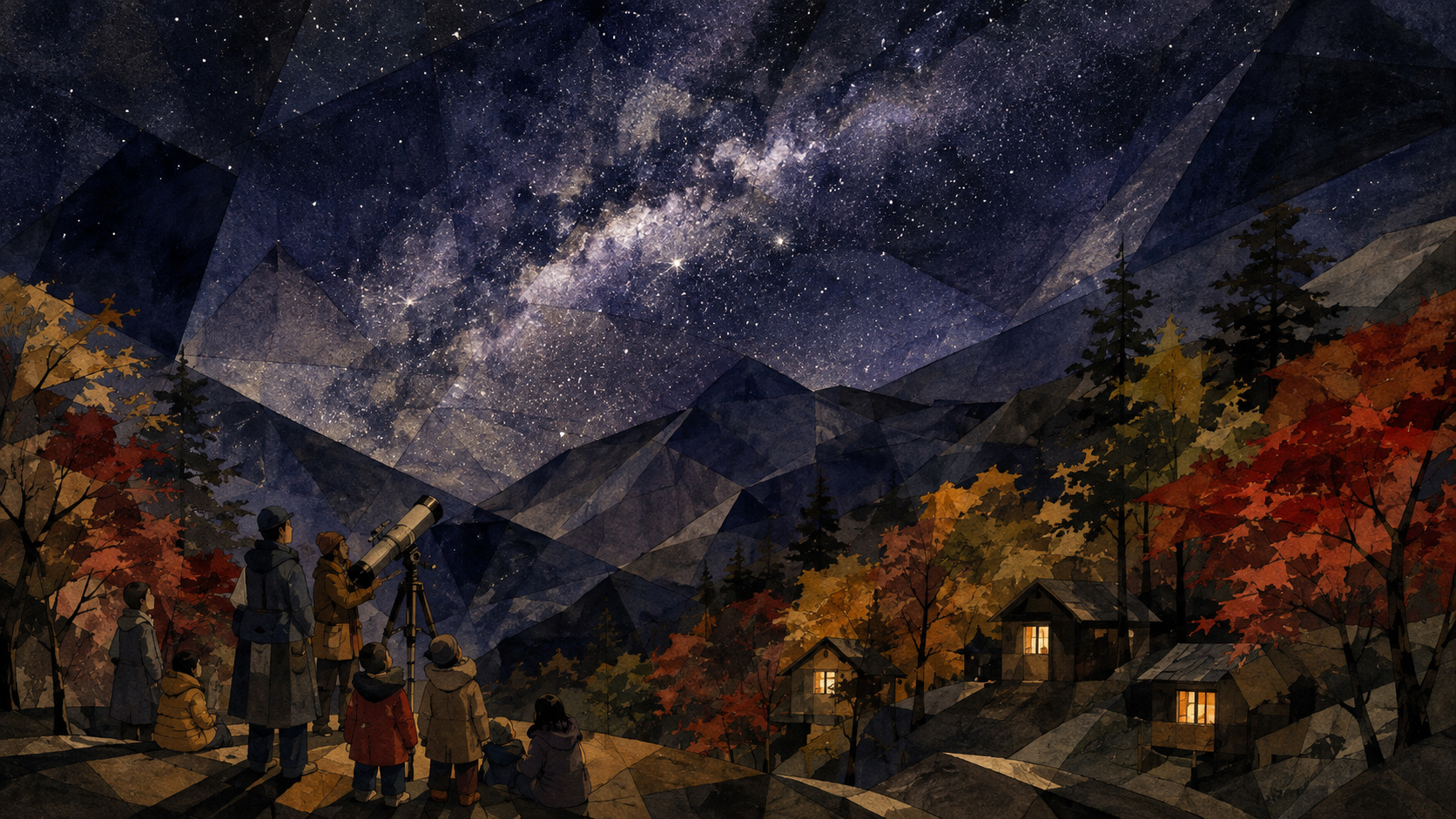
At eight in the evening, a campground normally advertises itself with light. A reception lamp shows the way. Cabin windows promise warmth. Headlights sweep across gravel as late arrivals look for a turn. A phone illuminates a map. At Choja no Mori this autumn, the most valuable thing overhead will become visible only when much of that reassurance is reduced.
The resort in Kitaaiki, eastern Nagano Prefecture, has scheduled seven 30-minute “Choja Star Night” sessions across September and October. A guide will introduce the autumn sky on the athletic field; each paying adult receives a planisphere. Children can attend free—up to two for each adult—and day visitors are welcome. The group is capped at 20 people. For the duration, the facility asks participants to observe its silent time and adults to keep small children close in the dark.
It sounds modest because it is. There is no announced observatory, all-night retreat or guaranteed telescope. The direct product is half an hour of interpretation, quiet and attention. Yet the experiment touches a large problem for rural recreation: summer fills beds and campsites, while buildings, water systems, grounds and staff do not disappear when the season thins. A night program can make an October journey imaginable where a family previously saw only an August escape.
Seven appointments with seven different skies
The September sessions are set for the 19th, 20th, 21st and 22nd; the October sessions for the 3rd, 17th and 31st. Each runs from 8:00 to 8:30 PM. Advance admission is ¥2,000 per adult. Same-day participation costs ¥500 more and is restricted by the organizer’s conditions: it is offered for the September dates and for October slots that have already reached the minimum. Adults receive a planisphere, and the program is open to both resort guests and people arriving only for the event.
| Date | The Moon at that point in its cycle | What that changes |
|---|---|---|
| September 19–22 | First quarter occurs at 5:44 AM JST on September 19; the Moon then waxes toward the September 27 full moon. | A bright evening Moon will be part of the scene. It can reward lunar observation and help orientation, but it reduces contrast for faint stars and the Milky Way. |
| October 3 | Last quarter occurs at 10:25 PM JST. | The Moon belongs mainly to the later night, making the scheduled early-evening half-hour comparatively less moonlit—if cloud, haze and local light cooperate. |
| October 17 | Two days before first quarter on October 19. | A waxing Moon will be visible in the evening, though less illuminated than on the September dates. |
| October 31 | Five days after the October 26 full moon and two days before last quarter. | The waning Moon rises later than a full Moon. Its exact interference during the short program depends on horizon, timing and atmospheric conditions. |
The lunar calendar matters because “stargazing” is not one interchangeable product. A Moonless night reveals fainter structure; a half Moon offers mountains, craters and a bright object children can find. A cloud deck removes both. Autumn can bring clearer, less humid air and longer darkness than midsummer, but altitude does not sign a service guarantee with the weather.
The National Astronomical Observatory of Japan’s 2026 ephemeris makes another correction to the promotional picture. The four September sessions begin on first quarter and move toward full. They are not the darkest dates of the month. That does not make them bad nights; it makes them moonlit nights. A responsible guide can turn the distinction into the lesson: darkness has degrees, the sky changes, and a successful observation is learning what conditions make visible.
The organizer describes a professional stargazing guide and a planisphere. It does not list telescopes, binoculars, a rain program or a clear-sky guarantee in the public event outline examined for this article. Visitors should ask what equipment, accessibility arrangements and cancellation rules apply rather than infer them from generic astronomy imagery.
A summer resort searches for a shoulder
Choja no Mori is not a blank meadow assembled for a single event. It is a village facility with campgrounds, cottages, a lodge, baths, barbecue space and outdoor recreation in a larch forest. It also serves as a trailhead for Mount Ogura, one of Japan’s 200 famous mountains. Public listings place its operating season from late April into autumn, although the stated closing point varies from late October to mid-November; the resort advises checking current availability.
Advance Co. took over as designated manager in April 2025. The phrase matters. Under Japan’s designated-manager system, a local government can appoint a company or other organization to run a public facility under an ordinance and council approval. Private operating skill enters the site, but the place does not become only a private product. The owner’s public purpose—resident welfare, access, education, community value and stewardship—remains part of the test.
The new operator added hot-water washing areas, dog-friendly accommodation, river and lake sites, family activities and group offerings. Its August publicity says more than 150 dog-accompanied reservations had been received and interest from forest schools, organizations and corporate groups was increasing. The same program of reinvention includes autumn leaves, illumination and these guided nights.
The attendance headline needs exact boundaries. According to the operator, visitor numbers by the end of July 2025 exceeded 200 percent of the comparable point in 2023. That means more than double, but it is not a 2026 annual result. The publicity does not disclose absolute visitors, occupied site-nights, lodging revenue, operating surplus or the 2023 baseline. It says 2026 demand remains strong, especially among families from the Tokyo metropolitan area, without publishing a comparable count.
- It tells us: the operator reports substantially more entries by July 2025 than at the same stage in 2023.
- It does not tell us: whether the baseline was unusually weak, how long visitors stayed, what they spent or whether revenue covered labor and maintenance.
- It cannot yet tell us: whether growth will endure, whether autumn occupancy rises or whether the night program creates an extra trip rather than serving people already booked.
- It should be measured next: occupied nights by month, repeat visits, local procurement, off-season employment, conservation spending and resident experience.
There is a useful honesty in the resort’s environmental fee. Overnight adults and school-age children are listed at ¥500; day visitors at ¥300. The fee is assigned to waste disposal, maintaining nature, paving and repairs. It reminds the visitor that a forest destination is not free because the trees grew without invoices. Roads, sanitation, erosion, rubbish, water and buildings create costs before a star tour sells one ticket.
The arithmetic of a half-hour
At the maximum group size, a session containing 20 advance-paying adults would generate ¥40,000 in gross ticket sales. Across seven full, all-adult sessions, the theoretical ceiling would be ¥280,000 before guide fees, staffing, administration, insurance, payment costs and tax. Family groups with free children would yield less, and the event can operate with only four participants.
This is not an estimate of actual revenue. It is a scale test. The direct admission income alone is unlikely to carry a resort with cottages, baths, roads and grounds. The strategic value lies around the half-hour: one more cottage night, an October campsite, meals and supplies, a repeat visit, a group booking, or a family that learns the village has a season after summer.
That makes day visitors both welcome and economically ambiguous. They widen access and can spend locally, but headlights arriving just before eight and departing just after can impair dark adaptation, disturb campers and illuminate the very field being sold as dark. Timed parking, downward-facing path lights, a gathering point away from vehicles and clear arrival instructions are not minor logistics. They are product design.
Season extension can also improve work. A longer calendar may provide staff with steadier hours, make guide training worthwhile and spread maintenance over more paying months. But it can do the reverse if thin events require call-outs and heating without additional stays. The useful measure is contribution after incremental costs, not attendance alone.
For the village, the return can include more than facility profit. A public resort can support outdoor education, provide a place for local and group use, introduce guests to trails and archaeology, and bring demand to nearby fuel, food and services. Those benefits should be named and measured. If “economic impact” means everything good and nothing countable, it becomes impossible to distinguish a beloved institution from an unaffordable one.
A village almost entirely under trees
Kitaaiki’s scale changes the stakes. The village website listed 648 residents in 341 households as of October 1, 2025. Agriculture ministry data puts its total area at 5,632 hectares and forest land at 5,117 hectares—about 91 percent. A busy weekend arriving from the metropolis can be small by city standards and large relative to the host community.
The forest is not a scenic border around village life. It shapes roads, watersheds, work, fire risk, wildlife and the cost of reaching and maintaining public facilities. Choja no Mori sits within that physical system. Its official menu ranges from tent sites and cottages to lodge rooms and group spaces; the Aiki River and white birch and larch woodland make the facility an encounter with landscape rather than a self-contained hotel.
High elevation is part of the appeal. Being around 1,300 meters can lift observers above some low haze, and separation from major city centers can reduce nearby skyglow. Neither condition is sufficient. Thin cloud can reflect artificial light. Humidity and aerosols scatter it. The Moon brightens the background. A single unshielded lamp, cabin curtain or vehicle beam can erase faint contrast in the immediate field. “Mountain” is geography; “dark” is a condition that must be maintained.
The global context shows why that condition is marketable. A 2016 atlas in Science Advances, modeled from satellite data and tens of thousands of ground measurements, estimated that more than 80 percent of humanity lived under light-polluted skies and that the Milky Way was hidden from more than one-third. A later citizen-science study in Science found that changes in reported star visibility from 2011 to 2022 were consistent with average sky brightness increasing 9.6 percent a year in the observed data.
Those are global findings, not measurements of Kitaaiki. The citizen observations were geographically uneven, and neither number establishes a local trend at Choja no Mori. Their relevance is cultural and economic: an ordinary dark night has become unfamiliar enough to sell as an experience. The village’s product is partly the metropolitan visitor’s loss.
Before tourism, a shelter under rock
Kitaaiki has a much longer history of people finding shelter within the landscape. The Tochibara Rock Shelter lies beneath an overhang carved along the Aiki River. Discovered in 1965 and designated a national historic site in 1987, it preserves remains from the earliest Jomon period: human burials, hearths, pottery, stone tools, animal and bird bones, finely worked bone fishhooks and ornaments made with marine shells.
The survival of ancient human remains is exceptional in Japan’s acidic soils. Nagano Prefecture’s account explains that thick wood ash helped protect them. The shelter itself formed in volcanic deposits associated with an ancient Yatsugatake mudflow; erosion created a dry, bright recess where people lived roughly 10,000 years ago. The village archaeology museum now presents the excavated material, including touchable three-dimensional reproductions and a virtual visit to the site.
It is tempting to draw a straight romantic line from people beside a Jomon hearth to families beneath an autumn Milky Way. Archaeology cited here does not establish what the shelter’s residents believed about the stars or whether they practiced astronomy. The responsible connection is smaller and more human. Long before a cottage could be booked, people in this valley already depended on the exact qualities of natural shelter, river, animal life, fire and season.
Today’s visitor uses a different infrastructure but remains embedded in those limits. Fire brings comfort and smoke. A roof protects but can shine light outward. A road grants access and fragments habitat. The forest offers seclusion and requires maintenance. Tourism is not an escape from the landscape’s material conditions. It is a new arrangement inside them.
Thirty minutes, and the biology of seeing
The event length creates an astronomical challenge. NASA’s Night Sky Network teaching material says full dark adaptation can take up to 30 minutes; sensitivity can improve markedly after 20 to 30 minutes without bright light. In other words, the eye may spend the entire scheduled session becoming capable of seeing what the ticket promised.
A white flashlight, bright phone, cabin lamp or headlight can reverse part of that adaptation. This makes preparation unusually valuable: arrive before the start, find the toilet and path in daylight, lower screen brightness, cover unnecessary displays and follow the guide’s lighting instructions. A planisphere becomes more useful if the reader can illuminate it with a dim red light rather than a white screen.
Dark adaptation is also an accessibility issue. The solution is not to remove every safety light and tell everyone to manage. Older visitors, people with low vision, children and anyone navigating uneven ground need routes that can be understood. Responsible lighting directs a small amount of warm light downward, shields the source from the eye and activates it only where and when needed. High contrast at steps, tactile or reflective low-level markers, escorted routes and advance descriptions can protect both safety and sky.
| Factor | Why it changes the view | What the resort or visitor can control |
|---|---|---|
| Cloud, haze, smoke | Scatter and absorb light; can erase stars even far from a city. | Not the weather, but honest go/no-go communication and alternative interpretation. |
| Moon phase | Natural light raises sky brightness and reduces contrast for faint objects. | Describe each night accurately; use moonlit dates to teach lunar features and shadow. |
| Local fixtures | Glare impairs vision; upward spill adds skyglow. | Shield, aim down, dim, warm the color and switch off when not needed. |
| Phones and vehicles | Close bright sources interrupt dark adaptation. | Set arrival windows, parking orientation, screen rules and red-light guidance. |
| Observer time | Eyes need many minutes to become more sensitive. | Begin dark adaptation before 8:00 PM and continue observing after the guided segment where rules allow. |
Darkness has to be designed
DarkSky International and the Illuminating Engineering Society summarize responsible outdoor lighting in five principles: useful, targeted, low level, controlled and warm-colored. For a mountain resort, that means asking a purpose of every fixture, shielding light below the horizontal, avoiding more brightness than the task requires, using timers or motion controls and limiting blue-rich light.
The principles do not demand a theatrical blackout. Poorly aimed bright lamps can produce glare and deep shadows that make a path harder to see. Better lighting can improve visual comfort while reducing upward spill. The choice is not safety or stars; it is thoughtful information versus indiscriminate brightness.
At Choja no Mori, the event can become a lighting audit in public. Which cabin curtains leak? Where do cars turn? Does the bathhouse exit face the field? Can toilets be reached without a phone flashlight? Are staff vehicles and emergency procedures compatible with the observation window? Answers would improve the experience on all nights, not only seven advertised dates.
Ecology belongs in the design too. Artificial light at night changes darkness that nocturnal insects, birds, bats and other animals use for orientation, feeding and reproduction. An autumn tourism strategy should not measure its environmental care only through litter. Light, sound and traffic are part of the footprint. The event’s silent-time rule is therefore more than atmosphere, though quiet human voices do not eliminate vehicle or equipment noise.
The operator’s promotional material does not claim formal dark-sky designation. That leaves an opportunity for evidence before branding grows: repeat measurements with a sky-quality meter under documented weather and lunar conditions; a map of fixtures and color temperatures; guest protocols; wildlife consultation; and public targets for reducing spill. Certification may or may not be a future goal. Measurement should come first.
The paradox of successful astrotourism
Dark-sky tourism can create a conservation constituency. A visitor who has seen the Milky Way may understand why a warmer bulb, shielded fixture or darker parking lot matters. Guide fees can support skilled interpretation. Overnight spending can make intact landscape economically visible. Children can learn that the sky is not a wallpaper but a changing clock of motion, season and light.
Success can also consume its foundation. More cars bring headlights. More cabins bring windows. More paths bring safety lighting. More social-media attention can produce late arrivals, drones, loud equipment and unplanned parking. A photograph advertising darkness can require an exposure the naked eye never sees, leaving guests disappointed by a truthful sky.
The answer is not to prevent growth. It is to define capacity by the experience and ecosystem, not only by how many bodies fit on a field. The 20-person ceiling is a sensible beginning. Future decisions should incorporate parking light, guide-to-guest ratio, trail and toilet capacity, noise, resident tolerance, habitat and the number of usable dark minutes—not merely demand.
- Sky: repeatable brightness readings, fixture inventory and change over time.
- Season: incremental September–November occupied nights, not annual entries alone.
- Economy: local wages, guide work, procurement and spending retained in the village.
- Public value: village use, school access, affordability and participation by people with disabilities.
- Ecology: changes to lighting, traffic, waste, noise and wildlife disturbance.
- Trust: weather cancellations, lunar conditions and visual expectations communicated before purchase.
The environmental fee offers a mechanism but not yet a full public account. Publishing what the money repairs, what natural maintenance it buys and how lighting changes would make stewardship visible. The attendance claim could likewise grow into a useful dashboard if absolute counts, overnight stays and seasonal distribution were disclosed.
The night as a commons
On the athletic field, the guide may begin with a planisphere. A family rotates paper until date and hour align. The printed window removes most of the universe and reveals the part that can be seen from this place at this time. It is a simple instrument with a serious lesson: the sky is not generic.
Neither is rural revitalization. A program that works for a large observatory beside a highway may fail at a small public resort in a village of 648. Kitaaiki’s advantage is intimacy: 20 people, a half-hour, a guide, a forest edge. Its constraint is the same. Limited population and infrastructure mean that expansion has to remain legible to those who live with it.
Choja no Mori’s autumn wager is not that stars suddenly appeared above Nagano. It is that the absence surrounding them can be organized into an experience worth a journey. That requires commercial imagination—packages, schedules, guides, lodging—and unusual restraint. The operator must sometimes decline to illuminate, enlarge or promise.
At 8:30, the formal session ends. The most important outcome may be that a child keeps looking. The planisphere returns home. A family notices the missing stars over its city. A village sees that one of its assets was not built, mined or imported. It was protected by distance, forest, topography and generations of limited light.
Darkness belongs to no single ticket-holder. It crosses the campground, the river, the houses and the habitat beyond. If Kitaaiki can treat it as a commons—measured, shared and defended—the seven nights will do more than extend a season. They will show how a rural place can earn from what it chooses not to erase.
Reporting note and principal sources
Event and operating details were checked through August 13 at 9:52 AM JST. The 2026 sessions had not occurred at publication. Attendance, demand and facility-improvement statements attributed to the operator are promotional claims; no audited attendance or financial statement was available in the cited releases.
- Advance Co. event release: dates, time, prices, capacity, guide, planisphere and attendance claim
- Advance Co.: management changes, 2025 attendance comparison and 2026 initiatives
- X-Project Group: designated management from April 2025 and Mount Ogura trailhead
- Choja no Mori official price page: accommodation, environmental fee and designated manager
- Mont-bell Club listing: facility setting and operating season
- Kitaaiki Village: population and households as of October 1, 2025
- Ministry of Agriculture, Forestry and Fisheries: village area and forest area
- Kitaaiki Village guide: Choja no Mori, Mount Ogura and archaeology museum
- Nagano Prefecture: Tochibara Rock Shelter discovery, designation, geology and finds
- Hachijuni Cultural Foundation: national historic-site record for Tochibara
- National Astronomical Observatory of Japan: 2026 lunar phases in JST
- Science Advances: New World Atlas of Artificial Night Sky Brightness
- Science: citizen observations of changing star visibility, 2011–2022
- DarkSky International and IES: Five Principles for Responsible Outdoor Lighting
- NASA Night Sky Network: dark adaptation and observing practice
- Osaka Prefecture summary of Japan’s designated-manager system and Local Autonomy Act framework