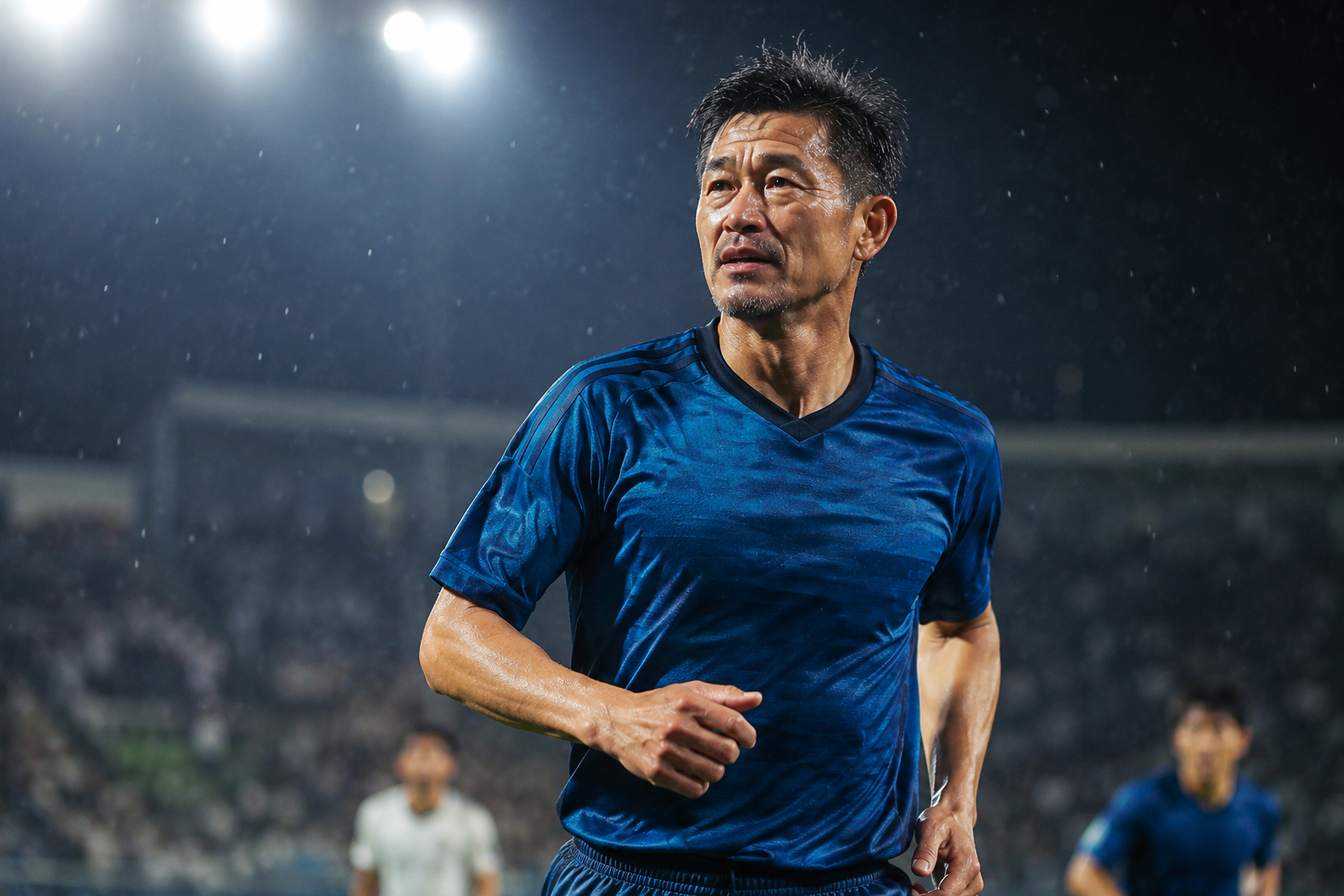
Kazuyoshi Miura is not finished. At 59, “King Kazu” has extended his loan with Fukushima United until June 2027 and is preparing for a 42nd season as a professional footballer. At an age when most players are long retired, coaching, commentating or appearing in anniversary ceremonies, Miura is still putting on boots, training, and waiting for another chance to play.
Reuters reported that Miura has extended his loan with J3 side Fukushima United until June 2027, meaning he can enter his 60s with his boots still on. He joined Fukushima from Yokohama FC at the end of December, made six appearances early in 2026, and said he wants to train hard and help the club fight for promotion to J2. The Japan Times also reported the extension, making it a perfect small-but-large Japan story: sport, age, memory and stubborn joy.
The boy who went to Brazil
Miura’s story began before Japan had a professional football league. Born in Shizuoka in 1967, he left Japan for Brazil as a teenager. Today, Japanese players moving abroad is normal. In the early 1980s, it was almost unthinkable. Japan was not yet a World Cup nation. J.League did not exist. A teenage boy going to Brazil to become a footballer was not a career plan. It was a leap of faith.
Brazil gave him more than technique. It gave him a football identity. The rhythm, showmanship, improvisation and seriousness of football life became part of him. In 1986, he began his professional career with Santos. That fact alone makes his longevity almost surreal: his career began before Japan’s professional league existed and continues deep into the era of globalized Japanese football.
From Hidetoshi Nakata to Keisuke Honda, Shinji Kagawa, Yuto Nagatomo, Kaoru Mitoma and Takefusa Kubo, Japanese players now move into the world. Miura walked that road before it was a road.
The face of the J.League
When the J.League launched in 1993, Japan needed stars. Professional football had to become more than sport; it had to become entertainment, fashion, aspiration and television culture. Miura was ready. With Verdy Kawasaki, he became one of the faces of the league’s opening era.
There was the white suit. The raised collar. The Kazu dance. The goals. The Brazilian style filtered through Japanese discipline. He was not only a striker. He was a translator between the global romance of football and a Japanese public still learning what professional football could feel like.
Glory, heartbreak and 1998
Miura scored 55 goals in 89 appearances for Japan. He was central to the national team through the 1990s, including the 1992 Asian Cup triumph and the long struggle to qualify for the World Cup. He helped make Japan believe it belonged on the world stage.
But his international career also carries one of Japanese football’s most painful memories. In 1998, when Japan reached its first World Cup, Miura was left out of the final squad shortly before the tournament. He was 31 — hardly old by modern standards — but already treated as a veteran. The decision remains one of the great emotional ruptures in Japan’s football history.
Many players would have become defined by that wound. Miura did not. He kept playing. Japan, Croatia, Australia, Portugal, lower divisions, loans, substitute appearances, record milestones. His career kept changing shape, but he kept its central identity: player.
Why keep playing?
It is hard to explain a 59-year-old professional footballer purely through competitive logic. He is not the explosive young forward of the 1990s. His minutes are limited. Fukushima is not signing him only for goals.
But football clubs are not built only from tactics. They are built from memory, standards, morale, identity and supporters. For young players, Miura is a daily training example. For fans, he is a reason to come to the stadium. For a local club, he brings national attention. For himself, football appears to be less a job than a way of living.
Reuters reported that Miura wants to keep training well and contribute to Fukushima’s promotion push. That matters. He is not speaking like a museum piece. He is still speaking as a teammate.
Why Fukushima matters
The setting matters. Fukushima is not just another club name. Since 2011, Fukushima has carried special national weight: earthquake, nuclear disaster, evacuation, reputation damage, recovery, depopulation, resilience and local pride. A football club can become a regional flag.
Miura playing for Fukushima is not only a celebrity story in J3. It brings attention to a local team, gives children a reason to watch, and connects national football memory to a region still writing its post-disaster story. King Kazu’s presence gives Fukushima United a narrative larger than the standings table.
King Kazu and aging Japan
Japan is one of the world’s oldest societies. Retirement, re-employment, healthy life expectancy, pensions, lifelong work and lifelong learning are national questions. Miura’s story resonates because it turns age from an ending into a storyline.
Of course, almost nobody can play professional football at 59. It takes extraordinary genetics, discipline, luck, institutional support and obsession. But his example still carries a simple power: age does not have to close the story. It can become part of the story.
A King Kazu timeline
| Year | Moment |
|---|---|
| 1967 | Born in Shizuoka Prefecture. |
| Early 1980s | Moved to Brazil as a teenager to pursue football. |
| 1986 | Began his professional career with Santos. |
| 1993 | Became one of the defining stars of the new J.League era. |
| 1998 | Left out of Japan’s first World Cup squad shortly before the tournament. |
| 2017 | Scored at 50, drawing global attention as football’s oldest professional goalscorer. |
| 2026 | Played for Fukushima United and extended the loan. |
| 2027 | Could still be playing professionally after turning 60. |
Japan.co.jp view
King Kazu’s extension is not the biggest news of the day. It is better than that. It is the kind of story that makes a newspaper breathe at the end of an edition: effort, humor, memory, region, age, stubbornness and grace.
Young players see him and learn what longevity looks like. Middle-aged fans see him and feel that the story is not over. Aging Japan sees him and asks how time can become meaning rather than decline.
Miura is no longer young. That is why the story is beautiful. He refuses to exist only as a former star. He remains present tense. A 59-year-old forward on a Fukushima pitch is Japanese football history still moving.
King Kazu plays on. Japan’s football story has not closed his page.
Sources and references
- Reuters: Kazuyoshi Miura extended his loan with Fukushima United until June 2027 and will enter his 42nd professional season.
- The Japan Times: Miura extends Fukushima United loan at 59.
- Associated Press: Miura’s long career, early move to Brazil, international record and oldest-goalscorer context.
- Guinness World Records: Miura became the world’s oldest professional football goalscorer and had 55 goals in 89 Japan appearances.
- ESPN: Miura’s 2025 move toward Fukushima United and status as the world’s oldest professional footballer.