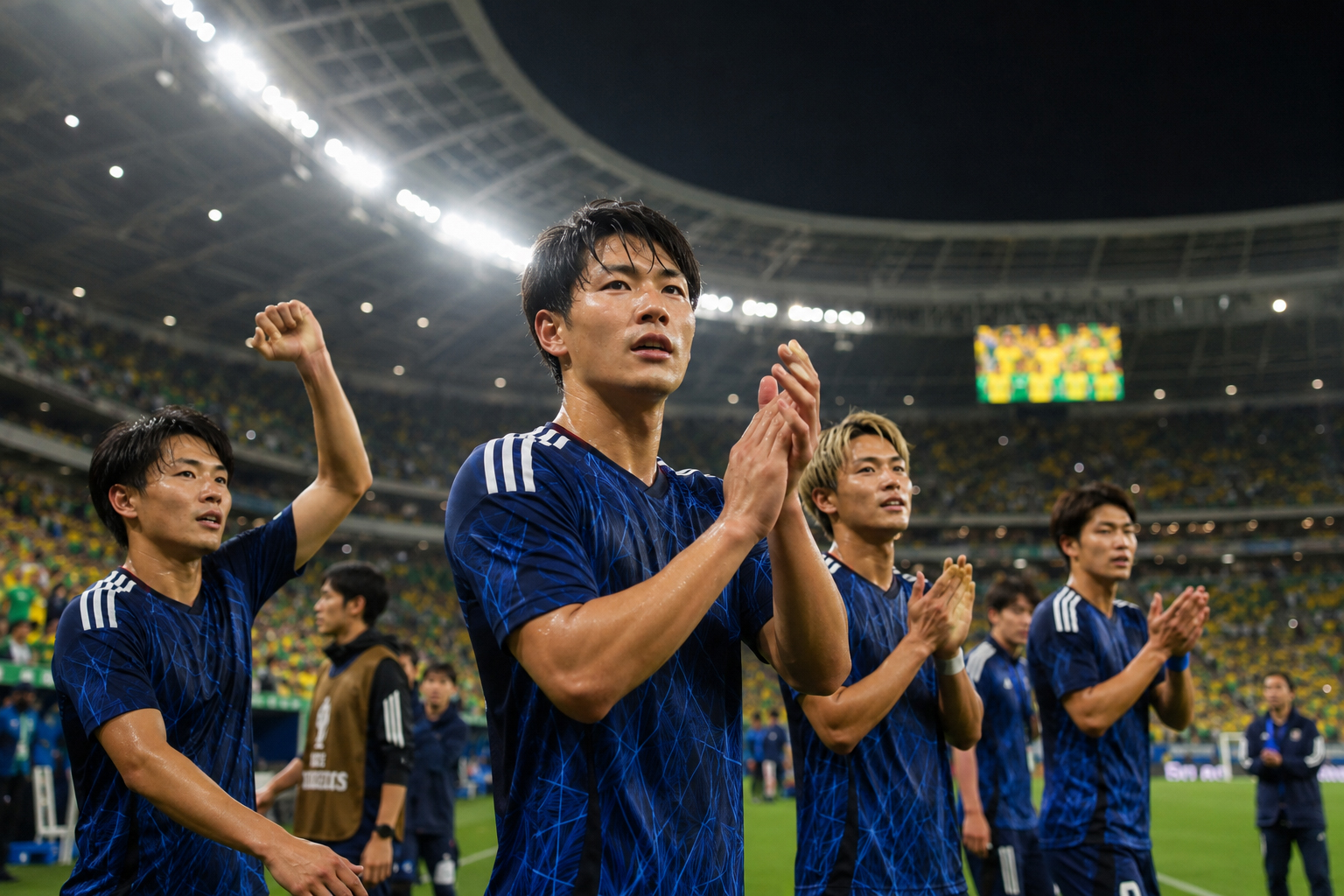
When the final whistle sounded in Arlington, Japan had not produced the clean, cinematic victory it wanted. It had produced something more practical and, perhaps, more mature: the result it needed. Japan drew 1-1 with Sweden, finished second in Group F, and moved into the World Cup knockout round. Sweden moved on too. But for the Samurai Blue, the night carried a heavier meaning. Japan did not simply survive the group. It earned the right to walk straight into one of football’s oldest mirrors: Brazil.
Not a win, but a grown-up result
Japan took the lead in the 56th minute through Daizen Maeda, finishing a move that looked like a small statement about the country’s football identity: quick passing, collective movement, a runner arriving in the right place, and no wasted touch. Six minutes later, Anthony Elanga equalized for Sweden. From that point, the match became less about romance and more about management.
That can feel unsatisfying in the moment. But World Cup final group games are not played in a museum. They are played inside tables, tie-breakers, fatigue, risk, and fear. Japan gave up the chance to finish first, but it protected the essential prize. It did not lose. It did not collapse. It advanced. The Netherlands finished top of Group F, Japan second, and the bracket handed Japan a Round of 32 meeting with Brazil.
The 2006 memory: the wall in Germany
Japan and Brazil carry a painful World Cup memory together. In 2006, Japan met Brazil in Germany and lost 4-1. Keiji Tamada’s opening goal remains one of those bright flashes Japanese fans still remember, but Brazil’s response was devastating. Ronaldo, Ronaldinho, Kaká, Roberto Carlos: the names alone still sound like a football mythology.
That match showed Japan the size of the wall. Japan was trying to become a serious football nation. Brazil was the summit. The gap was visible in the speed of thought, the rhythm of the ball, the calm near goal, and the cruelty with which elite teams turn small spaces into finished chances.
Twenty years later, Japan faces the same name from a very different position. This Japan is not a visitor asking whether it belongs. Its players operate across Europe’s top leagues, understand pressure, press intelligently, and can hurt opponents in transition. The world still treats Brazil as a special football country. It should. But Japan is no longer merely the team that might spring a surprise. It is a team opponents must prepare for.
The unfinished story since 1998
Japan’s World Cup story began in France in 1998. The debut ended with three defeats, but it changed the country’s football psychology. Japan had reached the stage. Once reached, it became a standard. In 2002, as co-host, Japan reached the knockout round for the first time. It returned to the last 16 in 2010, 2018, and 2022. FIFA’s own Japan profile lists the country’s first World Cup as France 1998 and its best World Cup finish as the Round of 16.
There remains one door Japan has never opened: the quarterfinals. Turkey in 2002. Paraguay in 2010. Belgium in 2018. Croatia in 2022. Each loss had a different shape, but each left the same aftertaste. Japan had come close enough to see the next room, but not close enough to enter it.
That is why Brazil matters. This is not just another heavyweight opponent. This is a chance to change the grammar of Japanese football history. Beat Brazil, and Japan no longer has to be described as a respected Round-of-16 regular. It becomes a nation capable of removing one of the giants from the tournament.
Moriyasu’s message: respect is not fear
After the Sweden draw, coach Hajime Moriyasu projected confidence. Reuters reported that Moriyasu said Japan would not be pushovers against Brazil and emphasized that his team had a real chance to win. That was not empty bravado. It was the correct posture for a knockout game. Respect Brazil. Study Brazil. But do not spend the week worshipping Brazil.
Brazil is Brazil: five-time world champion, creator of football icons, a country where the sport is both art and expectation. But knockout football does not award goals for history. It rewards timing, structure, nerve, and punishment of mistakes. A bad first touch, one transition, one set piece, one moment of panic: that is often enough.
What Brazil brings
Brazil topped Group C. The Houston Chronicle reported that Brazil finished on seven points after drawing Morocco and beating Haiti and Scotland, with Vinícius Júnior scoring in all three group matches and Matheus Cunha adding multiple goals. This is not Brazil in name only. This is a Brazil team that has already found goals in the tournament.
Under Carlo Ancelotti, Brazil can be both controlled and explosive. Vinícius can turn a left-sided duel into a sprint race no defender wants. Cunha can connect the middle. Neymar’s presence, if used, changes the emotional geometry of the match. Japan cannot defend the legend. It must defend the angles, distances, second balls, and passing lanes.
Japan’s realistic path to an upset
The path exists. It is narrow. First, Japan must survive the opening 15 minutes without conceding. Brazil can turn early pressure into emotional control. Once a favorite scores first, the underdog must chase, and chasing Brazil can become a trap.
Second, Japan must control the first five seconds after losing the ball. Brazil’s most dangerous moments often begin before the defending team has even admitted it has lost possession. If Japan’s midfield and back line stretch apart, Brazil’s individual quality will create chain reactions. If Japan compresses quickly, stops the first pass, and forces Brazil sideways, the match becomes more manageable.
Third, Japan must treat set pieces as opportunity, not interruption. In knockout football, the perfect open-play goal is a luxury. Corners, free kicks, second balls, blocked clearances, and rebounds are often where upsets begin. Japan’s best chance may come from a sequence that looks ordinary until it is suddenly historic.
Why Maeda’s goal matters
Daizen Maeda’s goal against Sweden is a clue. Maeda runs when defenders look away. He lives in the half-second when a back line’s attention shifts from the runner to the ball. Against Brazil, Japan may not enjoy long periods of settled possession. That makes the timing of runs even more important.
Japan cannot simply defend and hope. It must make Brazil uncomfortable. Maeda’s pressing, Kaoru Mitoma’s dribbling, Takefusa Kubo’s left foot, Ritsu Doan’s shot, Wataru Endo’s ball-winning, and Japan’s collective discipline all have to become one argument: Brazil can be hurt.
The warning from Sweden
There is also a warning. Japan led Sweden and was caught six minutes later. Against Brazil, that kind of lapse is even more dangerous. If Japan scores first, it cannot sink too deep too quickly. If it becomes a match of repeated waves, Brazil will eventually find the crack.
The question is not whether Japan will have to suffer. It will. The question is whether the suffering is controlled or panicked. Controlled suffering is part of knockout football. Panic is elimination.
Why this match moves Japan
Brazil is not just another opponent in Japanese football culture. Brazil helped shape Japanese football’s imagination. Zico came to Kashima and helped give the J.League credibility. Kazuyoshi Miura went to Brazil as a teenager and returned as proof that a Japanese player could chase football at its source. Brazilian players have filled Japanese clubs for decades, teaching, entertaining, and raising standards. Japan did not grow in isolation. Brazil has always been somewhere in the background.
That makes this Round of 32 match more than a contest. It is a reply. A generation that learned from Brazil now gets a chance to face Brazil with its own football language.
Houston waits
The stage is Houston. The Houston Chronicle called Brazil-Japan one of the city’s major Round of 32 fixtures. For Japanese fans, it will feel both far away and very close: across an ocean physically, but close enough to stop offices, homes, phones, and trainside conversations.
Japan did not beat Sweden. It did not need to. It got through. Now comes Brazil, the heaviest name in football and perhaps the cleanest test Japan could have asked for. If Japan loses, the old story continues: close, brave, respected. If Japan wins, the story changes.
The Samurai Blue are standing in front of the question that has followed them for a generation: can Japan do more than surprise the world?
Houston will answer.
Sources and references
This article draws on public reporting and reference material from Reuters, ESPN, The Guardian, Houston Chronicle, FIFA, and historical World Cup records. Match details, lineups, and knockout schedules may update as the tournament progresses.
- Reuters: Japan draw 1-1 with Sweden to finish second in Group F.
- Reuters: Moriyasu says Japan will not be pushovers against Brazil.
- ESPN: Japan book Brazil World Cup clash as Sweden also advance.
- The Guardian: Japan and Sweden both reach World Cup last 32.
- Houston Chronicle: Brazil and Japan will play in Houston in the Round of 32.
- FIFA: Japan team profile and World Cup history.