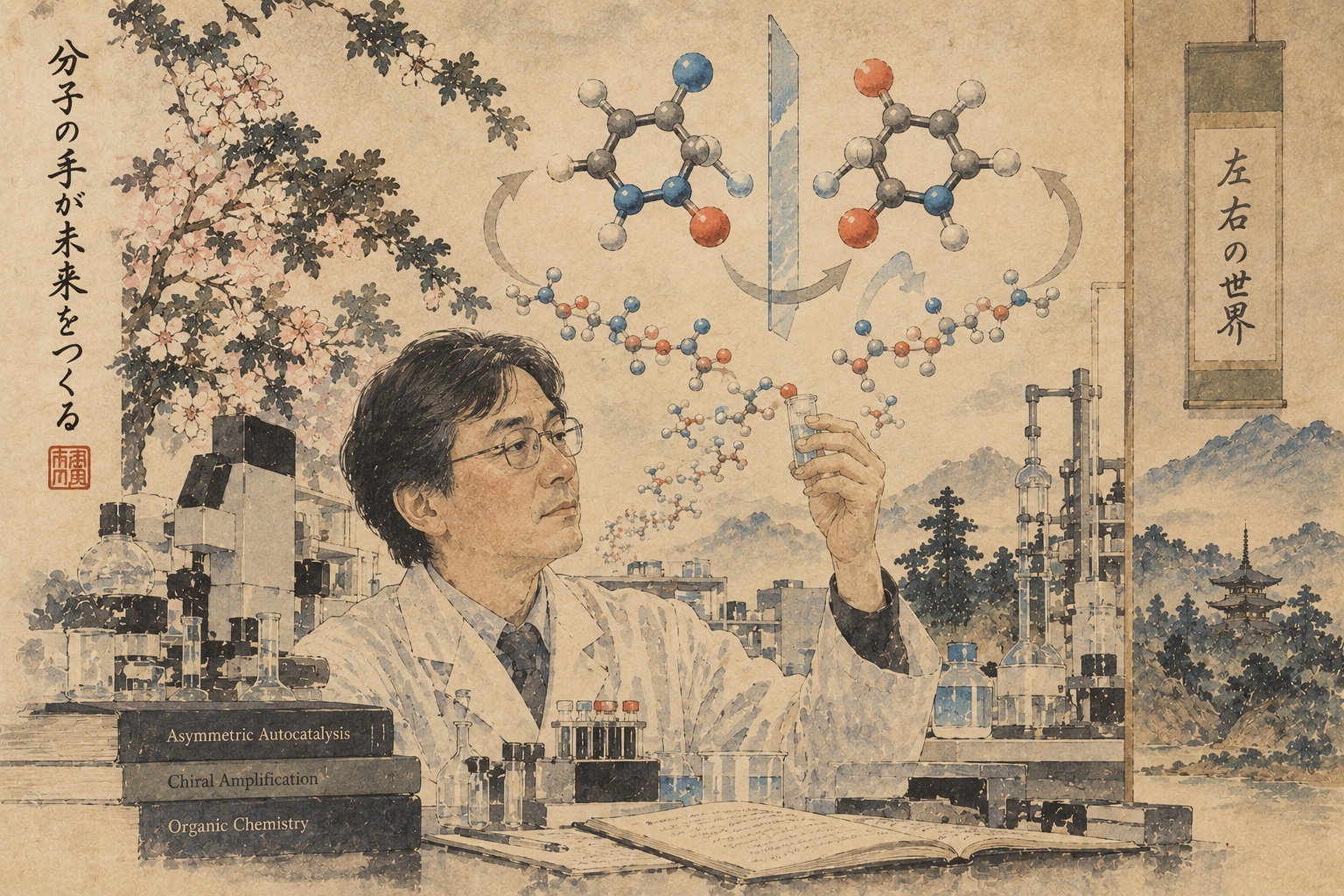
A left hand and a right hand look like the same object reflected in a mirror. Yet they cannot be perfectly superimposed. Chemistry has its own version of that puzzle: molecules with the same atoms and the same connectivity, but three-dimensional arrangements that are non-superimposable mirror images.
On October 7, the Royal Swedish Academy of Sciences awarded the 2026 Nobel Prize in Chemistry to Henri B. Kagan and Kenso Soai, professor emeritus at Tokyo University of Science, “for the discovery of non-linear effects and autocatalysis in asymmetric organic synthesis.” Soai’s contribution is embodied in the reaction that now bears his name: an artificial chemical system in which a tiny preference for one molecular handedness can reinforce itself as the reaction proceeds.[1]
Why life uses only one molecular “hand”
Chirality takes its name from the Greek word for hand. Many biologically important molecules exist as two mirror-image versions, or enantiomers. Yet life is overwhelmingly homochiral: proteins are constructed from one handedness of amino acids, while the sugars used in DNA and RNA overwhelmingly have the opposite handedness.[1]
That raises a foundational question. Ordinary chemical reactions often create both mirror images in roughly equal amounts. How, then, did chemistry on the early Earth become so strongly biased toward one?
Pasteur opened the door
The story begins with Louis Pasteur in the nineteenth century. Studying tartaric acid crystals, he recognized that the crystals came in two forms that were mirror images. He physically separated them with tweezers and found that solutions of the two types rotated polarized light in opposite directions. When mixed, the effects canceled.[1]
Pasteur later observed that microorganisms selectively consumed one mirror form of tartaric acid but ignored the other. Chemistry and biology, it seemed, were connected through molecular handedness.
In 1953, theory described the route before chemistry could achieve it
The next major step came from theoretical physicist Charles Frank. In 1953 he proposed a model showing how homochirality might emerge if three conditions were met: an asymmetric reaction with a chiral catalyst; a mechanism that favors one mirror form while suppressing the other; and autocatalysis, in which the reaction makes more of its own catalyst.[1]
In such a system, a tiny initial imbalance need not remain tiny. It can feed back into itself and grow.
Kagan revealed the power of non-linearity
Henri Kagan’s work in the 1980s challenged a common assumption in asymmetric synthesis: that the handedness of the product would simply track the handedness of the catalyst in a linear way. Kagan showed that this relationship could be strongly non-linear. A modest imbalance in a chiral catalyst could generate a much larger imbalance in the product.[1]
The result gave chemists a new mechanistic tool. Non-linearity suggested that catalyst molecules were interacting or aggregating, allowing one chiral pathway to be favored more strongly than expected.
Soai asked whether the product could catalyze its own formation
Soai’s leap was to combine chirality with autocatalysis. Tokyo University of Science describes the key system as the addition of diisopropylzinc to pyrimidine-5-carbaldehyde, producing a 5-pyrimidyl alkanol that itself acts as a highly effective asymmetric autocatalyst.[4]
As product forms, there is more catalyst. As there is more catalyst, more product forms. Crucially, the initially favored enantiomer becomes an increasingly dominant catalyst for its own reproduction.
In 1995, 2% became 87%
The landmark result appeared in Nature on December 28, 1995. Soai, Takanori Shibata, Hiroshi Morioka and Kaori Choji began with 5-pyrimidyl alkanol containing only a 2% enantiomeric excess. After asymmetric autocatalysis, the product reached an 87% enantiomeric excess.[5]
For the first time, an artificial organic reaction had demonstrated that a very small initial chiral imbalance could amplify itself dramatically through autocatalysis. The Royal Swedish Academy of Sciences describes the Soai reaction as the first chemical realization of the key self-reinforcing step outside living systems.[1]
Why that mattered to the origin-of-life problem
The Soai reaction is not evidence that this exact chemistry took place on the early Earth. Diisopropylzinc and the specific pyrimidyl alcohol are not being presented as a literal reconstruction of prebiotic chemistry.
Its importance is more fundamental. It proved experimentally that the mechanism long imagined by theorists is chemically possible: a very small asymmetry can be amplified toward near-homochirality by a self-reinforcing reaction.
When the Japan Academy awarded Soai its 2025 prize, it emphasized that his catalyst combines three functions — asymmetric recognition, autocatalysis and asymmetric amplification — and described the work as an important step toward understanding how homochirality could arise.[3]
A chemical amplifier for almost invisible asymmetry
Later work pushed the reaction far beyond the original 1995 experiment. Researchers showed that the Soai system can respond to extremely weak chiral influences, including isotopic chirality, chiral crystals and other subtle asymmetric inputs.
By 2003, experiments had demonstrated amplification from extremely small enantiomeric excesses to greater than 99.5% ee.[6] That turned the system into something resembling a chemical amplifier: a minute bias that might otherwise be impossible to observe can determine the handedness of a much larger product population.
What “enantiomeric excess” actually measures
Enantiomeric excess, usually abbreviated ee, quantifies the imbalance between two mirror-image forms. A 50:50 mixture has 0% ee. A 75:25 mixture has 50% ee. A pure single enantiomer is 100% ee.
That number matters because biology itself is chiral. Enzymes, receptors and other biomolecules can distinguish between mirror-image molecules, which means two enantiomers may behave very differently in a living organism.
Why pharmaceutical chemistry cares so much about handedness
The Nobel Committee highlighted pharmaceuticals as one of the clearest applications of asymmetric chemistry. One mirror image of a drug can bind usefully to a biological target while the other can have a different, unnecessary or harmful effect.[1]
The historical discussion often turns to thalidomide. The example is important but can be oversimplified: thalidomide enantiomers interconvert in the body, so the tragedy cannot be reduced to the idea that administering only one purified enantiomer would have solved the problem. The broader lesson is that molecular handedness can fundamentally alter biological activity.
Japan already had a deep tradition in asymmetric synthesis
Japan’s chemistry community has played an outsized role in the field. Ryoji Noyori shared the 2001 Nobel Prize in Chemistry with William Knowles and K. Barry Sharpless for work on chirally catalyzed reactions. In 2021, Benjamin List and David MacMillan were honored for asymmetric organocatalysis.
The 2026 prize addresses a related but distinct level of the problem. It is not only about making one desired enantiomer efficiently. It is about understanding how asymmetry itself can become amplified.
From Hiroshima to Tokyo University of Science
Tokyo University of Science says Soai was born in Hiroshima in 1950, graduated from the University of Tokyo’s Faculty of Science and received a doctorate in science. He worked as a Japan Society for the Promotion of Science research fellow and later as a postdoctoral researcher at the University of North Carolina before becoming a professor in the Faculty of Science at Tokyo University of Science.[2]
He received the Medal with Purple Ribbon in 2012. In 2025 he received the Japan Academy Prize for “the discovery of asymmetric autocatalysis and studies on the origin of homochirality.” His laboratory and collaborators continued to pursue the same basic problem for decades.[3]
“The most exciting day in my life”
Speaking by telephone to the Nobel press conference after the announcement, Soai said he was thrilled by the news and described it as the most exciting day of his life. Reuters reported that he had been out shopping when the call came.[7]
There is an appealing simplicity to the origin of the work itself. The Royal Swedish Academy says Soai noticed structural similarities between catalyst and product and began asking whether a product could be designed to catalyze its own formation. Years of trial and error turned that question into a reaction now known throughout chemistry.[1]
The mystery is not over
The Nobel Prize does not mean science now knows why terrestrial life chose L-amino acids and D-sugars. The original trigger for biological homochirality remains unresolved. Researchers continue to investigate possibilities ranging from circularly polarized light and mineral surfaces to isotopic effects and fundamental symmetry breaking.
What Soai changed was the scale of the required first cause. The initial imbalance does not have to be large. If a system contains the right kind of autocatalytic feedback, chemistry can magnify a faint preference into near-total dominance.
That is why the 2026 Nobel Prize reaches beyond synthetic chemistry. It honors a reaction that made a philosophical question experimentally tangible: how can a world that begins almost perfectly balanced end up choosing one hand?
Sources and references
- Royal Swedish Academy of Sciences, “They solved chemistry’s asymmetric mystery,” October 7, 2026.
- Tokyo University of Science, Nobel Prize announcement and biography, October 7, 2026.
- Japan Academy, 2025 Japan Academy Prize citation for Kenso Soai.
- Tokyo University of Science, research description of asymmetric autocatalysis.
- Kenso Soai et al., “Asymmetric autocatalysis and amplification of enantiomeric excess of a chiral molecule,” Nature 378, 767–768 (1995).
- Nature Chemistry review and references on the mechanism and amplification of the Soai reaction.
- Reuters, “Nobel chemistry prize goes to pair who solved mystery of 'mirror image' molecules,” October 7, 2026.
Reporting and verification cutoff: October 7, 2026. This article does not claim that the Soai reaction itself occurred on the prebiotic Earth, nor that the origin of biological homochirality is solved. It describes the reaction as an experimental demonstration of a chemically plausible amplification mechanism.