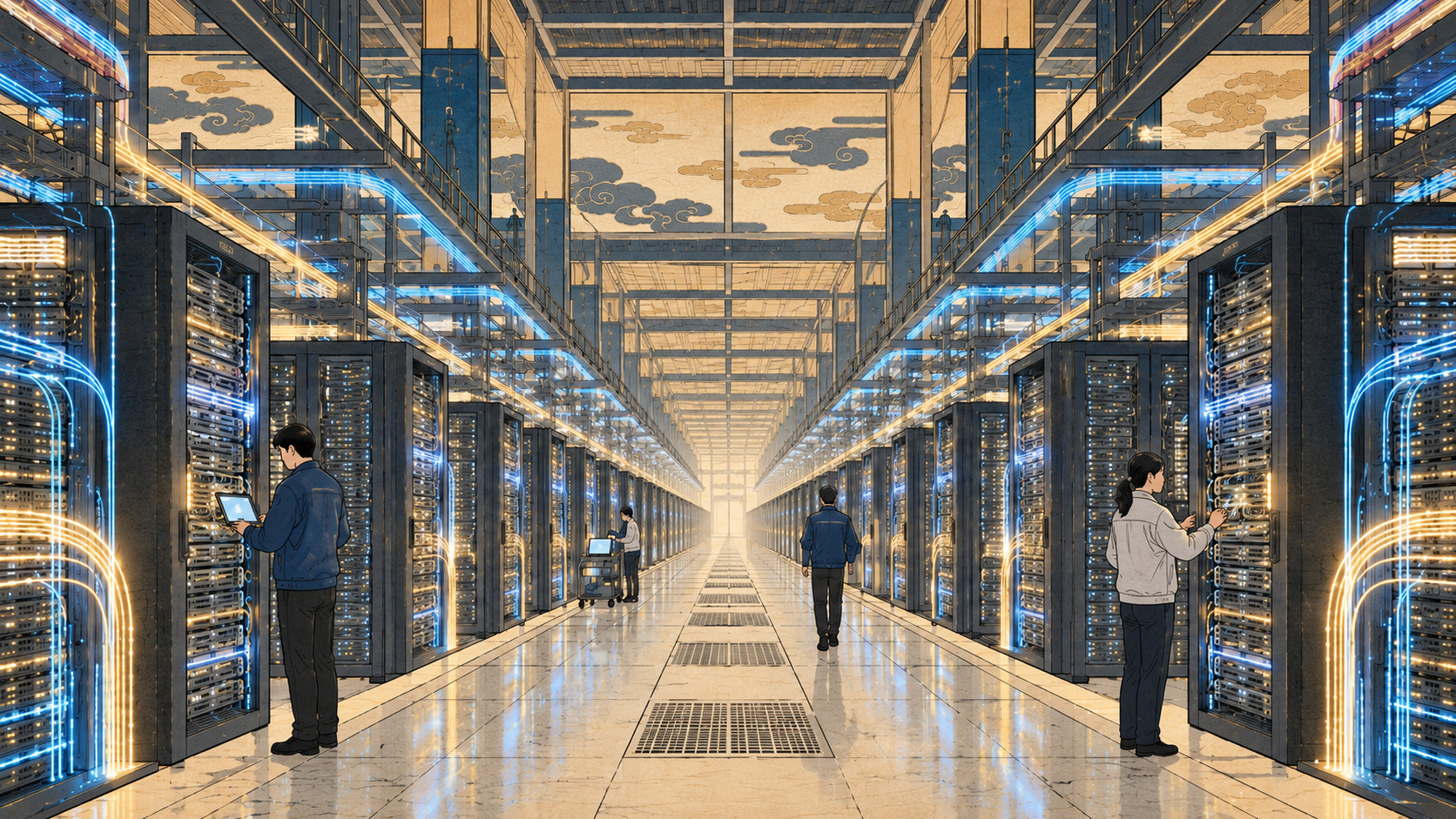
AI infrastructure is not only a contest of computing power. The energy cost of moving data is becoming part of the race.
The next AI bottleneck is the journey between chips
In a large AI cluster, buying faster processors is only half the problem. The processors must exchange data rapidly enough to stay busy. A network that drops packets, suffers congestion or consumes excessive energy can undermine expensive computing capacity. That makes the less glamorous machinery between GPUs a strategic question for the AI economy.
On October 22, Japanese telecom operator KDDI announced a technical partnership with California-based Broadcom to test co-packaged optics, or CPO, in an AI data-center network. The aim is to reduce the energy used to move information among GPUs. The announcement begins a verification program; it does not announce a demonstrated saving at KDDI or a completed commercial rollout.
Bringing light closer to the switch
Modern high-speed networks already rely heavily on optical fiber. The difficult part is the short electrical path between the switching silicon and the module that converts electronic signals to light. As signaling rates increase, those paths create losses that can demand more power-hungry compensation.
CPO places compact optical engines alongside a switch chip within a tightly integrated package. Moving the conversion closer to silicon shortens the electrical journey. It does not make every component optical, eliminate electricity use, or solve cooling by itself. Lasers, packaging, thermal management and serviceability remain engineering considerations.
What KDDI intends to test
KDDI says its test environment will use a CPO switch incorporating Broadcom’s Tomahawk 6 Ethernet switching ASIC and Davisson optical engines. Tomahawk 6 offers a stated 102.4 terabits per second of single-chip switching capacity. That specification is not the measured application throughput of KDDI’s future test, nor a promise of a 102.4-Tbps connection to one AI server.
The verification will examine power consumption and network behavior during workloads designed to resemble distributed AI training and inference. KDDI identifies packet loss, congestion control and effective throughput as measurements. These are important because raw hardware bandwidth tells only part of the story: useful training time depends on whether data arrives when the processors need it.
The technology predates the partnership
Broadcom announced its Tomahawk 6–Davisson CPO platform in October 2025 as a third-generation product, building on earlier integrated-optics work. Its product material promotes improvements in link stability, bandwidth density and energy efficiency. Those are vendor claims about its technology, not independently reported results from the KDDI verification.
The chronology matters. October 2026 does not mark the invention of optical switching, the launch of Tomahawk 6 or the first use of fiber in data centers. The news is that a major Japanese network operator is putting the technology into a site-specific evaluation tied to its larger AI infrastructure plans.
The power-saving percentage is still unknown
A serious comparison must define the boundary of the measurement. Is it the switch chip, optical interfaces, external lasers, full networking equipment, or the cooling and redundant systems supporting them? Does the baseline use conventional pluggable optical transceivers at comparable bandwidth, utilization and reliability? Without those answers, impressive component-efficiency claims cannot be treated as facility-wide electricity savings.
Neither company’s October 22 partnership announcement supplied a KDDI-verified percentage reduction, a budget for the project, or a date for fleet-wide deployment. That uncertainty is central rather than incidental: the real prize is a network design whose energy and operating costs hold up under production conditions.
Why home broadband appears in a data-center announcement
The partnership also reaches beyond the AI facility. KDDI plans to explore next-generation fiber-to-the-home using Broadcom’s optoelectronic expertise. That is an investigation into future broadband infrastructure, not a newly priced or launched residential product.
KDDI connects the idea to its “Digital Belt” vision, combining data centers, submarine cables, all-photonics networking and future 6G technologies to build low-latency communication and AI computing infrastructure across Japan. Connecting cloud capacity to homes and businesses is a commercial strategy as much as an engineering one.
Japan has a longer optical-networking story
Optical communications transformed long-haul telecommunications decades before generative AI made GPU clusters a household term. The next frontier is shrinking electrical signaling distances close to the computing hardware. Silicon photonics, advanced chip packaging and network architecture all contribute to that effort.
The field is competitive, not a discovery belonging to one partnership. In Japan, NTT began commercial All-Photonics Network IOWN 1.0 services in March 2023. Its broader IOWN ambitions show that optical networking has been a strategic industry theme for years. NTT’s platform and KDDI’s proposed CPO evaluation should not be confused as identical technologies or commercial stages.
A growing electricity problem makes the experiment consequential
In an updated assessment, the International Energy Agency projects global data-center electricity demand rising from around 485 terawatt-hours in 2025 to roughly 950 TWh by 2030. AI-focused facilities are expected to grow much faster than the broader sector. These are worldwide projections, not estimates for KDDI’s infrastructure.
Reducing energy consumed per bit can help manage the economics of new installations, but efficiency alone does not guarantee falling total electricity use. More demand, larger models, cooling loads and grid constraints can offset unit improvements. Operators will increasingly need to explain both the performance of individual systems and the overall energy profile of their sites.
Five questions that will decide whether this matters
Investors, engineers and customers should watch for five details: the measured network-power reduction versus a clearly specified baseline; throughput and stability under real workloads; fault and repair behavior; total cost including optical engines and laser systems; and the timetable for wider operation. A trial can succeed technically without immediately becoming economical to deploy.
KDDI plans an exhibit about the partnership at KDDI SUMMIT 2026 on October 27–28. An exhibit is not proof of a successful production trial. The more durable significance of the collaboration is that AI infrastructure competition is shifting from processor counts alone to the quality, reliability and energy cost of the connections between them.
Sources and verification
This report distinguishes company announcements from editorial analysis. KDDI-specific measured energy savings, full deployment timing and project costs have not been released. No direct interviews were conducted.